EQL’s pitch deck is a masterclass in niche positioning. By defining 'Hype Commerce' as a distinct market segment worth billions, the company moves beyond being a simple raffle tool to becoming essential infrastructure for global retailers. The deck highlights significant traction, noting over 1,000 high-heat launches across 10 markets and a user base of 720,000. While the deck is light on specific financial modeling and competitive analysis, it leans heavily on social proof with logos like Foot Locker and Crocs. The narrative focuses on solving the technical 'chaos' of launches—site crashes a…
Key takeaways
- EQL defines 'Hype Commerce' as the buying and selling of scarce, highly talked about goods on Slide 1.
- The company raised 25M (AUD) from Insight Partners and Airtree Ventures as stated on Slide 2.
- Traction is demonstrated by +1000 high heat launches across 10 markets and 6 languages on Slide 2.
- The global streetwear market alone is valued at $185 billion, providing a massive TAM for hype-driven products on Slide 4.
- The core problem addressed is that standard e-commerce platforms crash under high traffic and are vulnerable to bots and scammers on Slide 5.
- EQL provides a 'Run Fair' certification, a trademarked seal of fairness for retailers and customers shown on Slide 11.
- The 'EQLIZER' feature increases a user's chances of winning based on consecutive losses and loyalty status on Slide 13.
- The platform uses a 'Headless Commerce' approach, allowing integration in days without replacing the merchant's existing stack on Slide 17.
The Narrative: Defining a New Category
EQL does not describe itself as a raffle app or a queue management tool. Instead, it opens by defining a new category: Hype Commerce . This is a strategic move that allows the company to own the terminology of its niche. By framing the problem as a 'Megatrend' on Slide 4, they elevate the conversation from a technical fix to a global economic shift. The deck is visually dark, utilizing high-contrast neon accents that mirror the aesthetic of the streetwear and sneaker communities they serve.
Slides 1-3: The Hook and The Mission
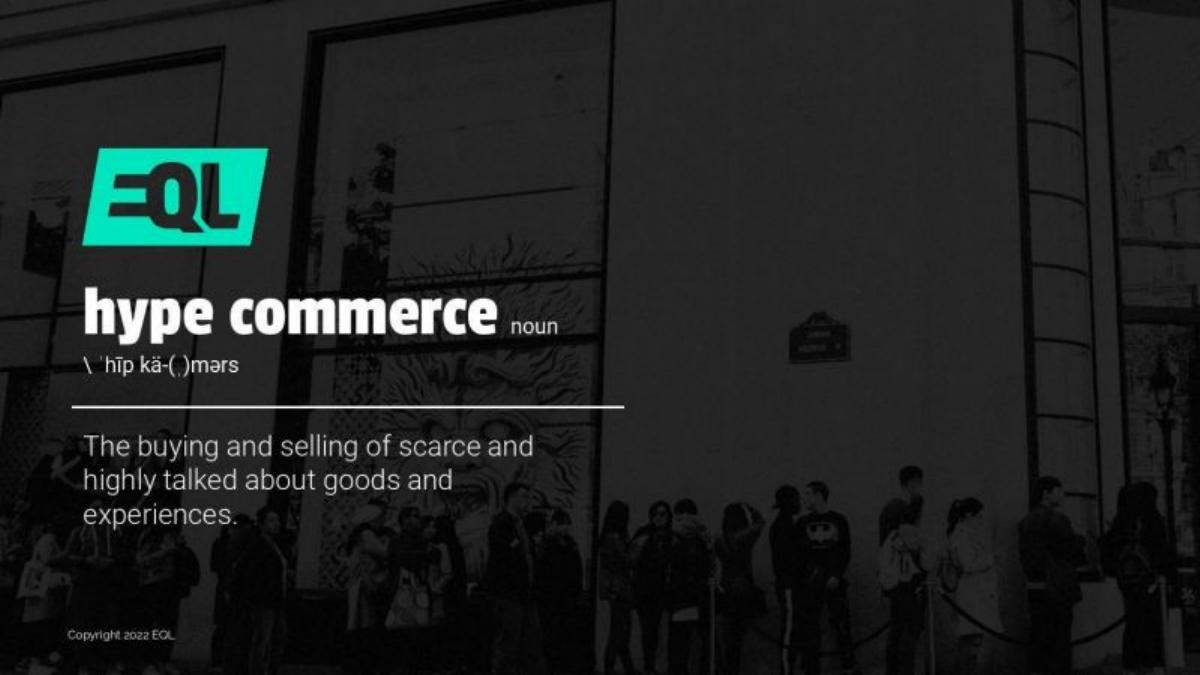
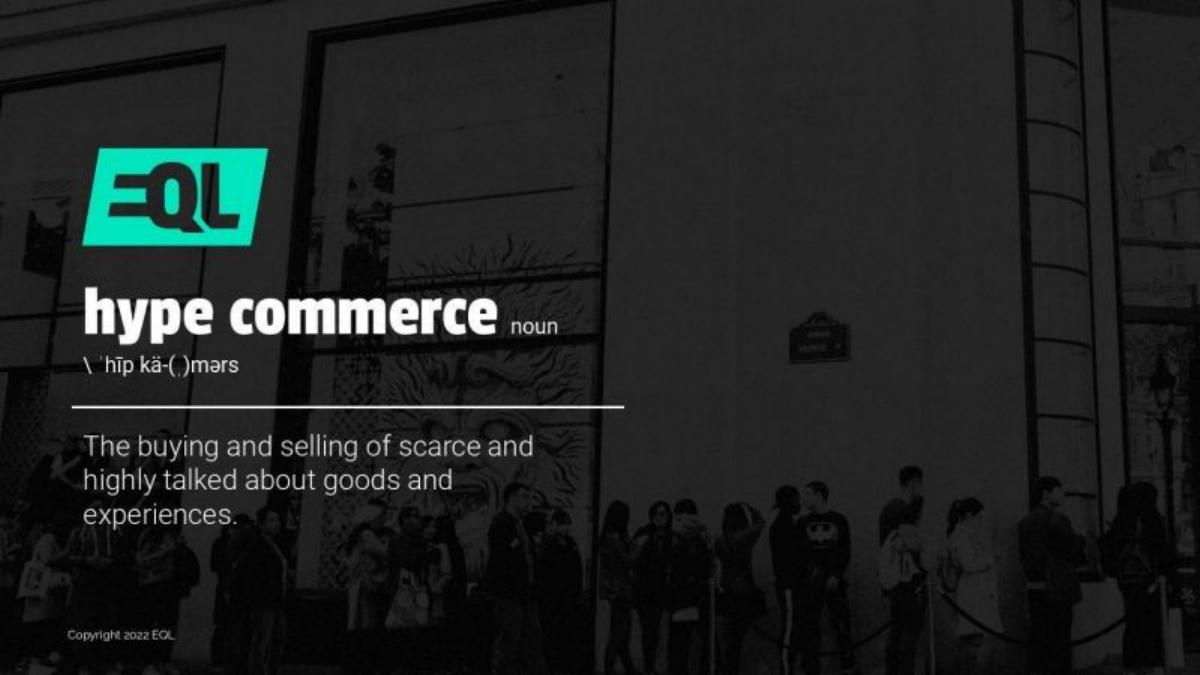
Slide 1 functions as a dictionary entry for 'Hype Commerce,' defining it as the buying and selling of scarce and highly talked about goods. This immediately tells the investor that EQL is not for every retailer, but for those with the 'good' kind of problem: too much demand.
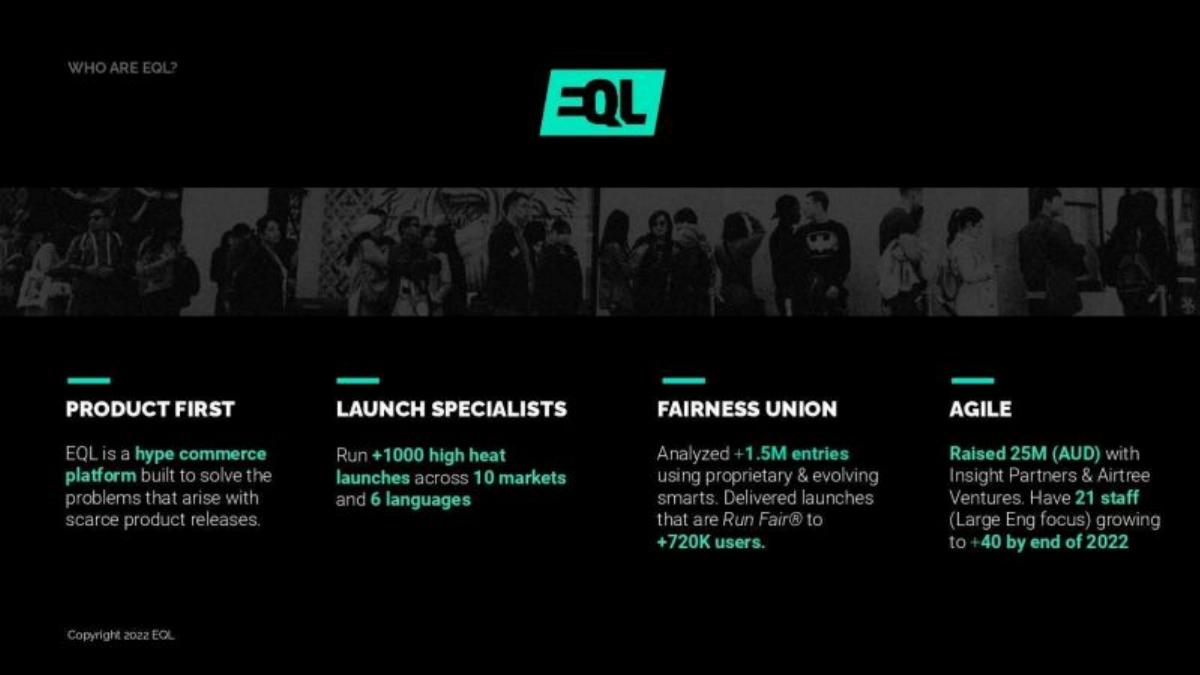
Slide 2 provides a 'Who Are EQL?' summary that serves as a mini-executive summary. It lists impressive traction: +1000 high heat launches , 10 markets, and +720K users . It also confirms their funding status, noting 25M (AUD) raised from top-tier firms like Insight Partners and Airtree Ventures. This slide effectively de-risks the investment by showing that the product is already validated and scaled.
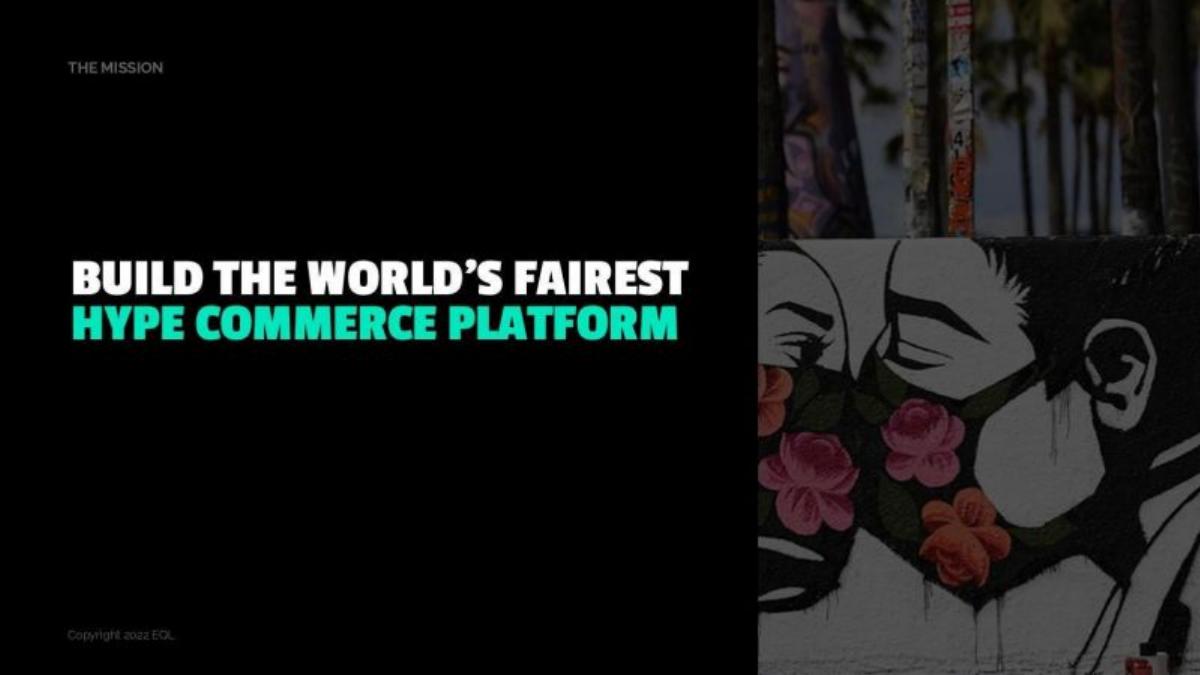
Slide 3 delivers a simple, punchy mission statement: 'Build the world’s fairest hype commerce platform.' The focus on 'fairness' is a recurring theme that differentiates them from standard bot-protection software.
Slides 4-6: Market and Problem
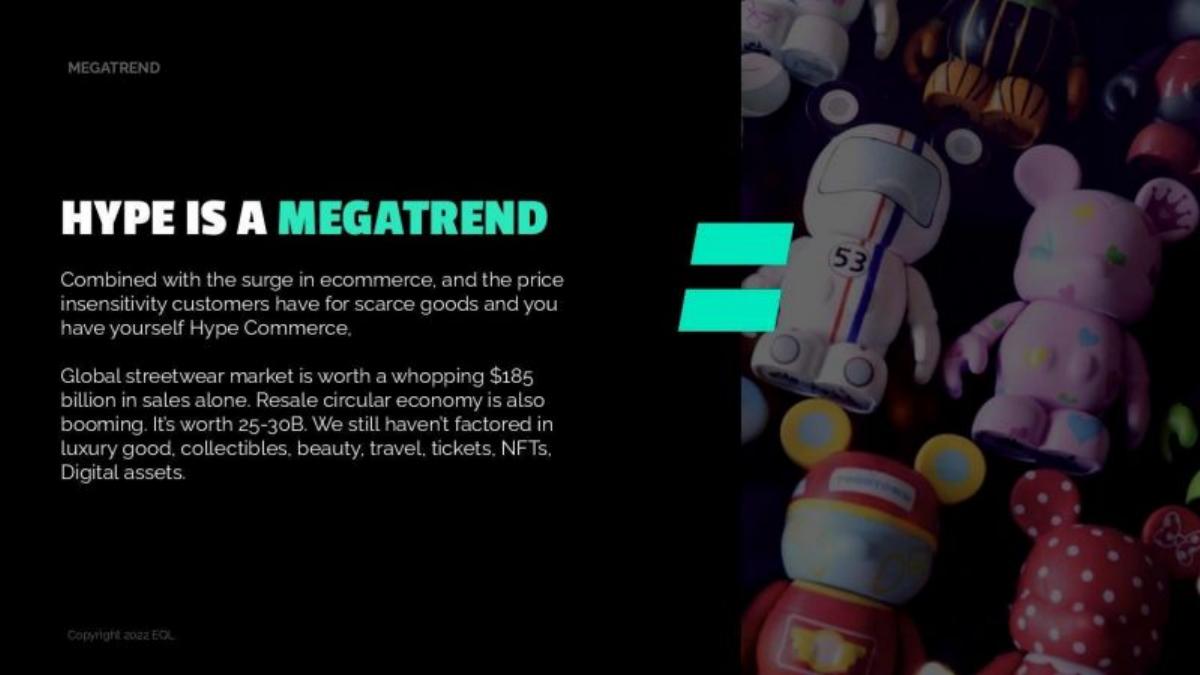
Slide 4 quantifies the 'Megatrend.' It cites a $185 billion global streetwear market and a $25-30B resale economy. Crucially, it lists other verticals like luxury, beauty, and tickets, suggesting that while they started with sneakers, their TAM is much larger. This is a classic 'wedge' strategy—start in a passionate niche and expand to all scarce goods.
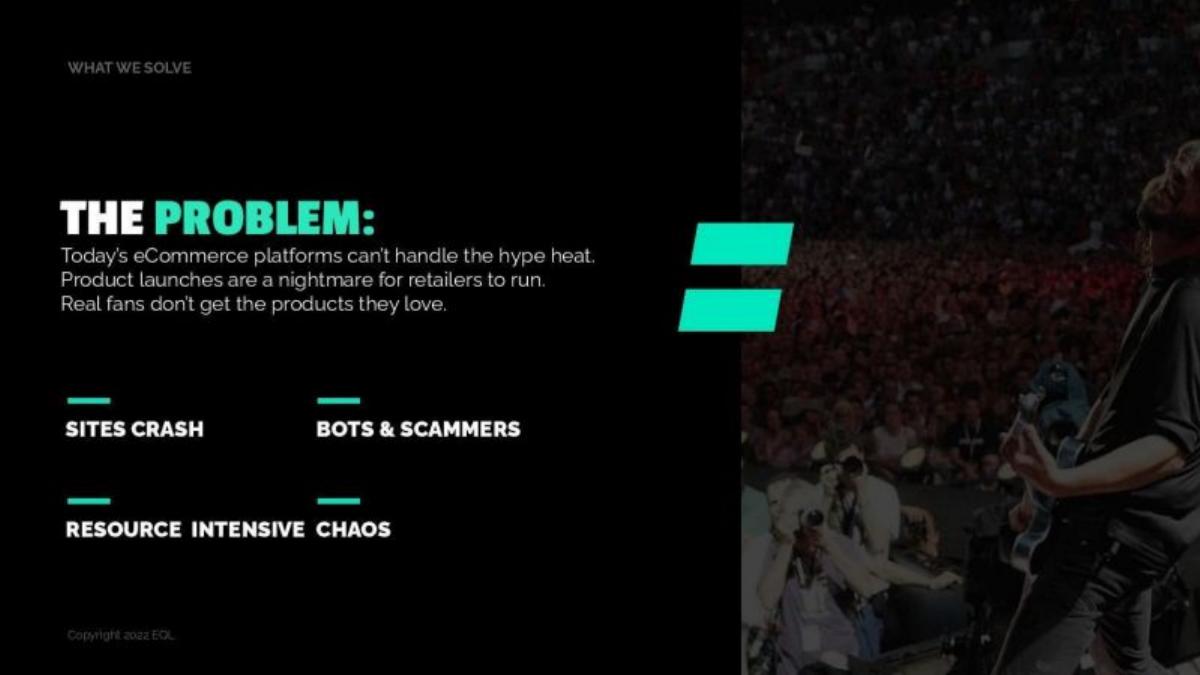
Slide 5 outlines 'The Problem.' It identifies four pain points for retailers: Sites Crash , Bots & Scammers , Resource Intensive , and Chaos . The slide notes that 'Real fans don't get the products they love,' which frames the technical failure as a brand reputation failure for the retailer.
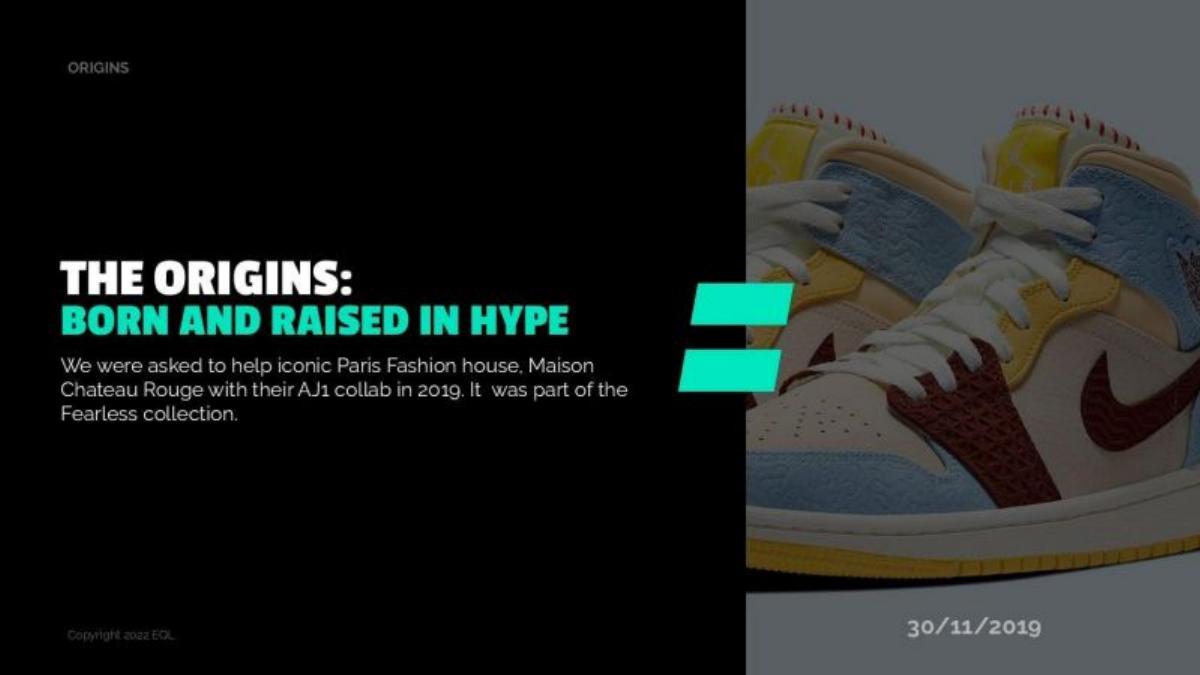
Slide 6, 'The Origins,' provides a brief founder-product fit story. They were asked to help Maison Chateau Rouge with an AJ1 collab in 2019. This gives the company 'street cred,' showing they were born out of a real-world crisis in the heart of the hype community.
Slides 7-10: Social Proof and Product Interface
Slide 8 is a powerful logo cloud. Seeing Foot Locker and Crocs validates that EQL can handle enterprise-level scale. For a B2B infrastructure play, this slide is often the most important one in the deck.
Slide 9 introduces the 'Delivering the Mission' wheel. It breaks the platform into seven components: Certified Fair, Hype Infrastructure, Fairness Algorithm, EQLIZER, Smart Checkout, Launch Automation, and Hype Analytics. This shows the breadth of the solution—it's not just a front-end form; it's a full backend suite.
Slide 10 provides a product mockup on a MacBook. It shows a Foot Locker branded draw for an Air Jordan 1. The interface is clean and emphasizes the 'Run Fair' branding. This slide helps investors visualize the end-user experience, which is indistinguishable from the retailer's own site, maintaining brand consistency.
Slides 11-14: The Proprietary 'Secret Sauce'
Slide 11 explains the 'Run Fair' certification . This is a brilliant marketing move. By creating a trademarked seal of fairness, EQL turns a technical service into a brand asset that retailers can show to their customers to build trust.
Slide 12 addresses the 'Hype Infrastructure.' It claims the tech stack is 'purpose built for hype' and uses custom domains to protect the retailer's core website from going down. This is the 'insurance' aspect of their value proposition.
Slide 13 introduces the EQLIZER . This is the most technical part of the deck, explaining how they use data to 'upweight' certain customers. The mention of rewarding 'consecutive losses' is a direct solution to the 'L' (loss) culture in the sneaker world, where fans get frustrated by never winning draws. This gamification element is key to user retention.
Slide 14 covers 'Accurate, Smart Payments.' It highlights that hype frenzies often cause carts to crash and payments to go out of sync. EQL manages 'linear payments' to ensure no over or under-selling occurs, which is a major operational headache for retailers.
Slides 15-18: Analytics and Integration
Slide 15 promises 'Real-Time Hype Analytics.' It claims to help retailers 'understand the true demand' for their products. In the world of scarcity, knowing that 100,000 people wanted a shoe when you only had 1,000 pairs is vital data for future production and marketing.
Slide 16, 'Launch Automation,' emphasizes the 'End-to-End' (E2E) nature of the service. They handle product page creation, entry capture, and payments. This positions EQL as a 'set it and forget it' solution for busy retail marketing teams.
Slide 17 is the technical 'How it Works' slide. It describes a 'Headless Commerce' approach. This is a critical selling point: EQL is a 'layer of commerce that sits on top of your stack.' It doesn't require a total overhaul of the retailer's existing systems and can be 'up and running in days.' This significantly lowers the barrier to entry for new enterprise clients.
Slide 18 is a simple 'Any Questions?' closing slide with a logo. It lacks a specific 'Ask' or a detailed 'Team' slide, which are notable omissions for a standard fundraising deck.
What EQL Does Well
Category Creation: By naming and defining 'Hype Commerce,' they move from being a utility to a strategic partner. · Social Proof: The use of global brand logos (Foot Locker, Crocs) does the heavy lifting for their credibility. · Clarity of Value: They clearly articulate the 'Chaos' of the status quo versus the 'Fairness' of their solution. · Visual Identity: The deck looks and feels like the culture it serves—modern, dark, and premium.
What is Missing from the Deck
Team Slide: There is no mention of the founders' backgrounds or the leadership team. For a $25M round, investors usually want to see the 'who' behind the 'what.' · The Ask: While the deck mentions they raised 25M (AUD), it doesn't specify what they are looking for next or how they plan to use the funds (e.g., hiring, geographic expansion). · Unit Economics: There is no mention of CAC, LTV, or even a general revenue model. It is unclear how much EQL makes per launch or per user. · Competition: The deck ignores competitors like Shopify’s own launch tools or other queue management software like Queue-it.
What Other Founders Should Copy
The 'Problem' Framing: Instead of just saying 'sites crash,' EQL frames it as a 'nightmare for retailers' where 'real fans' are hurt. Connect technical failures to brand damage. · The 'Wedge' Strategy: Show how you dominate a specific, high-intensity niche (sneakers) before explaining how that applies to a broader market (luxury, tickets, NFTs). · Branded Features: Don't just call it an algorithm; give it a name like the 'EQLIZER.' Don't just call it a service; call it a 'Run Fair Certification.' This makes your IP feel more tangible and marketable. · Headless Integration: If your software is B2B, emphasize how easy it is to plug in without replacing the customer's existing 'stack.' 'Up and running in days' is a powerful phrase for any enterprise buyer.
Frequently asked questions
- What is the primary problem EQL solves?
- EQL addresses the technical and social failures of high-demand product launches. Standard e-commerce sites often crash under the 'hype heat' of thousands of simultaneous users. Furthermore, these launches are frequently targeted by bots and scammers, preventing real fans from purchasing products. EQL provides the infrastructure to handle this traffic surge while using algorithms to ensure products go to legitimate customers.
- How does EQL make money?
- The deck does not explicitly detail its fee structure or revenue model. However, Slide 17 mentions that EQL plugs into existing payment gateways and that the retailer remains the 'merchant on record.' This suggests a SaaS or transaction-based fee model where EQL charges for the use of its specialized launch infrastructure and fairness algorithms.
- Who are EQL's main customers?
- EQL targets global retail brands that deal with high-demand, limited-edition inventory. Slide 8 showcases several high-profile customers, including Foot Locker, Crocs, Courir, Culture Kings, Fast Times, and Sullivans Cove. Their solution is applicable across streetwear, luxury goods, collectibles, beauty, and even tickets or NFTs.
- What is the 'EQLIZER' and how does it work?
- The EQLIZER is a proprietary algorithm described on Slide 13 that manages 'boosts and upweighting' for entrants. It is designed to reward engagement and loyalty. For example, it can increase a customer's chances of winning a draw if they have had multiple consecutive losses in previous launches, or it can reward proximity to a physical store and other ingested data points.
- What was the outcome of this pitch?
- According to Slide 2 and the catalogue facts, EQL successfully raised $25M AUD (approximately $16M-$17M USD at the time) in a round led by Insight Partners and Airtree Ventures. The catalogue listing also notes a total raised amount of $186M, indicating significant subsequent funding rounds following this 2022 deck.