Olsam’s 12-slide Series A deck focuses heavily on the 'Amazon Aggregator' thesis, a popular model in 2021. The deck prioritizes team pedigree and market timing over complex financial modeling, leaning on the fact that the founders are former Amazon Marketplace managers. With a clear value proposition of 'valuation arbitrage'—buying small brands at 2.0-4.5x profits and scaling them to trade at 10-20x—the deck successfully communicates a high-velocity growth strategy. While it lacks a detailed roadmap or specific 'ask' slide, the inclusion of a concrete case study (Peak Coffee) provides the nec…
Key takeaways
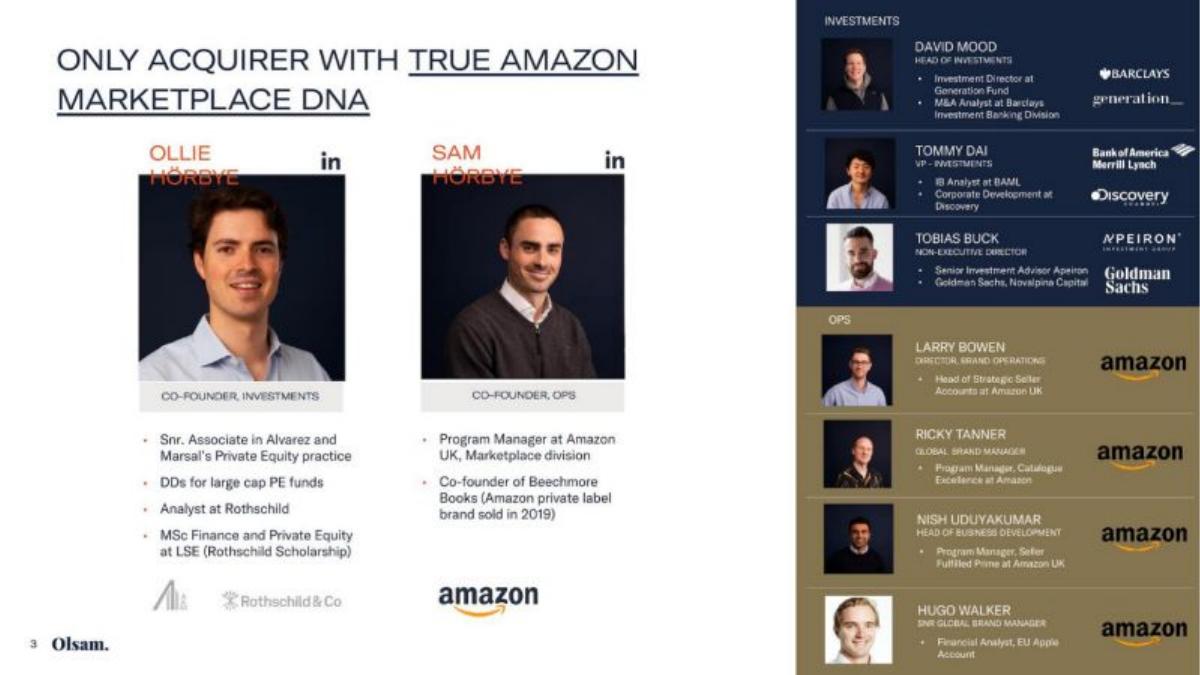
- The company positions itself as the only acquirer with 'true Amazon DNA' due to the founders' backgrounds as Amazon Marketplace managers (Slide 3).
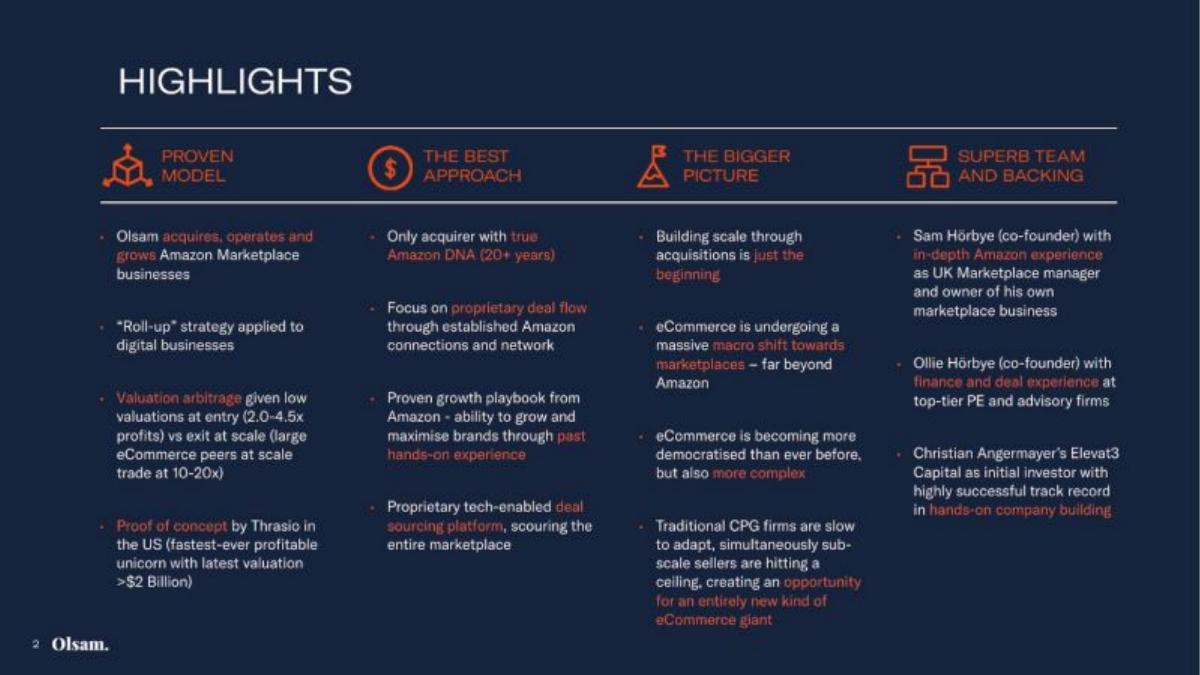
- Olsam identifies a specific valuation arbitrage opportunity: acquiring brands at 2.0-4.5x SDE while large ecommerce peers trade at 10-20x (Slide 2).
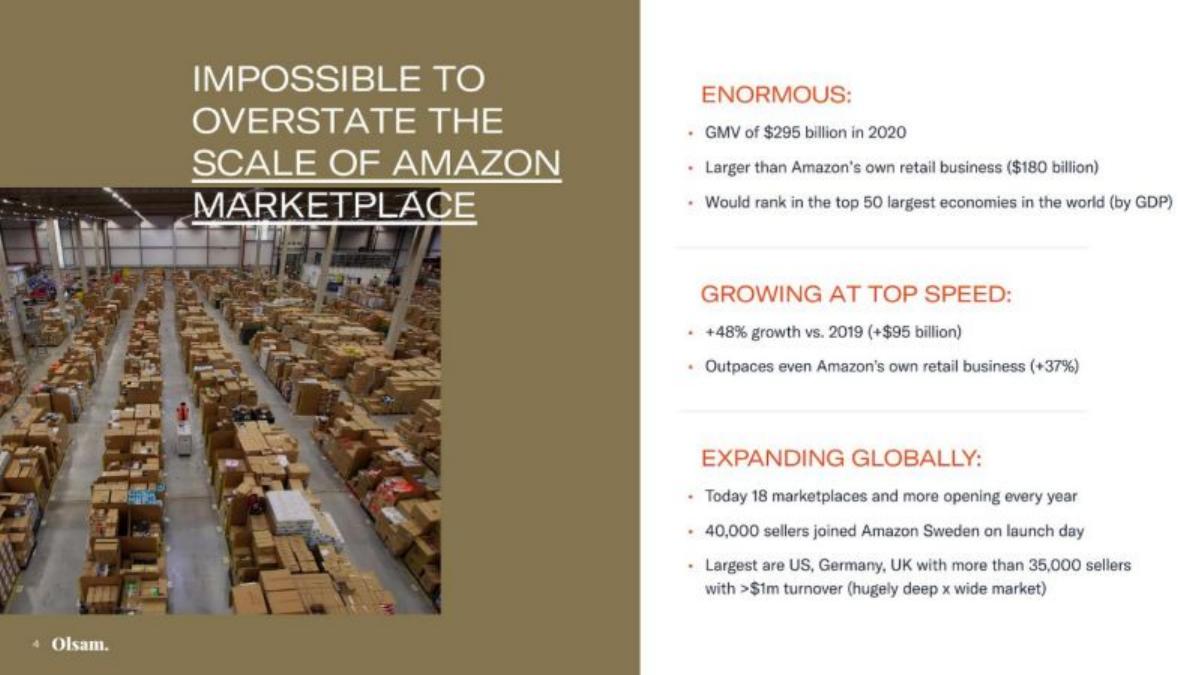
- The market opportunity is defined by Amazon Marketplace's $295 billion GMV in 2020, which is larger than Amazon's own retail business (Slide 4).
- A detailed case study of 'Peak Coffee' shows a 60% revenue increase from £592k to £954k post-acquisition (Slide 7).
- The business model relies on four pillars: Multiple Arbitrage, Economies of Scale, Top-line Growth, and Automation through Technology (Slide 8).
- Olsam compares the disruption of CPG firms to the disruption of traditional banks by challenger banks like Revolut and N26 (Slide 9).
- The deck highlights strong institutional backing from Elevat3 Capital and Christian Angermayer (Slide 10).
- The deck omits a specific use-of-funds slide or a formal 'ask' for the $165M round mentioned in catalogue facts.
The Olsam Pitch Deck: A Deep Dive into the Amazon Roll-up Strategy
In 2021, the Amazon aggregator space was one of the most competitive sectors in venture capital. Olsam’s pitch deck, used to secure a $165M Series A, focuses on a singular competitive advantage: operational pedigree. While many aggregators were led by finance professionals, Olsam led with the fact that they were former Amazon insiders. This teardown examines how they structured their 12-slide presentation to win over investors in a high-stakes environment.
Slide 1: Title and Visual Identity
The cover slide establishes a clear brand identity. The tagline, "BUILDING A NEW KIND OF ECOMMERCE GIANT," is paired with a grid of diverse consumer products—everything from coffee pods and dumbbells to garden hoses and frying pans. This visually communicates the breadth of their acquisition strategy without needing a single word of explanation. It is dated August 2021 and marked as confidential.
Slide 2: The Executive Summary (Highlights)
Slide 2 serves as a high-level summary of the entire investment thesis. It is divided into four pillars: Proven Model , The Best Approach , The Bigger Picture , and Superb Team and Backing . Key data points include the mention of valuation arbitrage, noting that they enter at 2.0-4.5x profits while scale peers trade at 10-20x . It also cites Thrasio as a proof of concept, calling it the "fastest-ever profitable unicorn" with a valuation >$2 Billion .
Slide 3: The 'Amazon DNA' Team Slide
This is arguably the most important slide in the deck. Olsam claims to be the "ONLY ACQUIRER WITH TRUE AMAZON DNA." It lists co-founders Ollie Hörbye (Investments) and Sam Hörbye (Ops). Sam’s credentials include being a Program Manager at Amazon UK and a co-founder of an Amazon brand sold in 2019. The right side of the slide lists six additional team members, four of whom are former Amazon employees with titles like "Head of Strategic Seller Accounts" and "Global Brand Manager." This heavy emphasis on former Amazon staff is designed to de-risk the operational execution for investors.
Slide 4: Market Scale
Slide 4 focuses on the sheer volume of the Amazon Marketplace. It states that the marketplace had a GMV of $295 billion in 2020 , which is larger than Amazon’s own retail business ($180 billion). The slide notes that the marketplace grew +48% vs 2019 . To provide a sense of depth, it mentions that the US, Germany, and UK have more than 35,000 sellers with >$1m turnover , creating a "hugely deep x wide market."
Slide 5: Defining the Asset Class
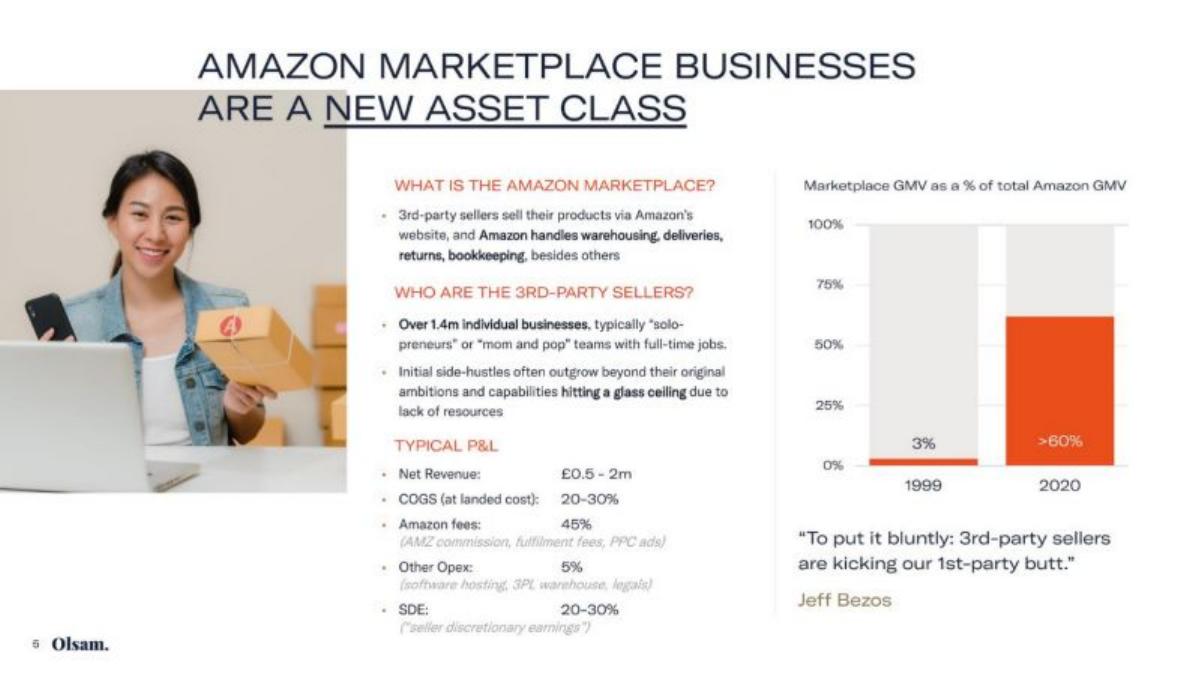
This slide educates the investor on the mechanics of a third-party seller business. It includes a chart showing that marketplace GMV grew from 3% in 1999 to >60% in 2020 . Crucially, it provides a Typical P&L for these sellers: Net Revenue of £0.5 - 2m , COGS at 20-30% , and SDE (Seller Discretionary Earnings) of 20-30% . A quote from Jeff Bezos—"3rd-party sellers are kicking our 1st-party butt"—is used to validate the trend.
Slide 6: The Consolidation Thesis
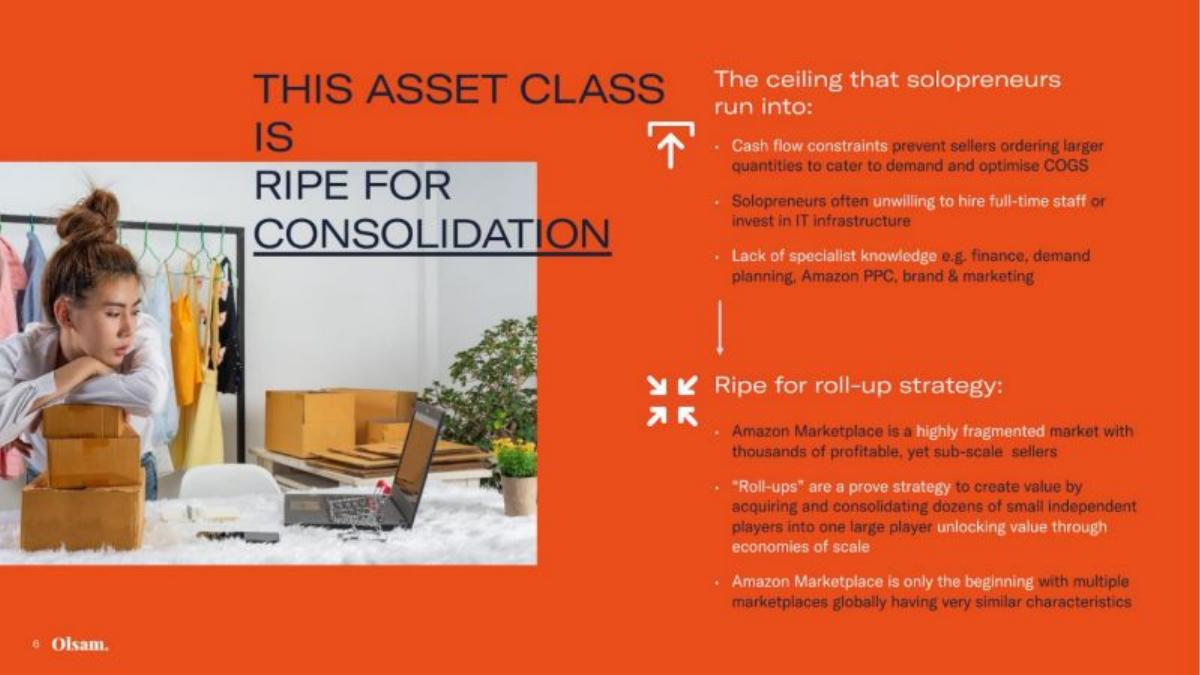
Slide 6 explains why these businesses are "RIPE FOR CONSOLIDATION." It identifies the "ceiling" that solopreneurs hit, including cash flow constraints, lack of specialist knowledge (demand planning, PPC), and unwillingness to hire staff. Olsam positions the roll-up strategy as a way to unlock value through economies of scale and professional management.
Slide 7: Case Study - Peak Coffee
To prove the model works, Olsam presents a "CLOSED DEAL" case study. Peak Coffee, a UK-based coffee capsule holder brand, was acquired for 3.2x SDE + earn-out . The financial summary shows revenue growing from £592k in 2019 to £954k in 2020 (a 60% increase), with SDE rising from £78k to £211k . This slide provides concrete evidence that Olsam can identify, acquire, and grow a brand profitably.
Slide 8: The Value Creation Playbook
Slide 8 breaks down the four ways Olsam creates value: 1. Multiple Arbitrage (buying low, selling high), 2. Economies of Scale (shared back-office and marketing centers of excellence), 3. Top-line Growth (geographic and product expansion), and 4. Automation through Technology (proprietary tech stack for sourcing and marketing).
Slide 9: The Disruption Narrative
This slide uses a comparison to the fintech sector to frame Olsam’s potential. It shows how Challenger banks (N26, Revolut, Robinhood) disrupted traditional banks (HSBC, Barclays) in the 2010s. It then posits that Olsam will disrupt traditional retail CPGs (P&G, Unilever, Reckitt Benckiser) in the 2020s. This is a classic venture capital framing technique: comparing a new business model to a previously successful disruption.
Slide 10: Institutional Backing
The final content slide focuses on Elevat3 Capital and Christian Angermayer . It notes that Elevat3 led the Seed and Series A rounds and that Angermayer manages approximately USD 2.5 billion . It lists other "platform companies" in the Apeiron universe, such as ATAI Life Sciences and Cryptology Asset Group , to show that Olsam is part of a larger, successful ecosystem of companies.
Slide 11 & 12: Contact and Closing
The deck ends with a simple "THANK YOU" slide providing contact emails for Sam and Ollie Hörbye, as well as a press contact. Slide 12 is a promotional slide for the platform where the deck was hosted and is not part of the company's original presentation.
What Works in the Olsam Deck
Pedigree as Moat: By dedicating a full slide (Slide 3) to their Amazon-specific backgrounds, the founders preemptively answer the question of why they are better than a well-funded hedge fund attempting the same strategy. · Financial Transparency: Providing a typical P&L (Slide 5) and a specific case study with real numbers (Slide 7) gives investors a clear understanding of the unit economics and the potential ROI. · Clear Arbitrage Logic: The deck doesn't hide the fact that this is a financial play. By explicitly stating the entry and exit multiples (Slide 2 and 8), they make the path to a 5x-10x return very obvious. · Macro Context: Using the Jeff Bezos quote and the comparison to challenger banks helps frame a relatively new business model within a larger, proven historical context of industry disruption.
What is Missing from the Olsam Deck
The Ask: The deck does not specify how much money they are raising or how they intend to allocate it. While catalogue facts state they raised $165M, the deck itself lacks a "Use of Funds" or "The Round" slide. · Portfolio Performance: While the Peak Coffee case study is strong, there is no data on the performance of the rest of the portfolio. Investors would typically want to see if the growth seen in one brand is being replicated across others. · Technology Deep-Dive: Slide 8 mentions a "proprietary tech stack," but there are no screenshots or detailed descriptions of what this software actually does. In a "tech-enabled" roll-up, the tech is often the differentiator, but here it is treated as a bullet point. · Competitive Landscape: The deck mentions Thrasio as a proof of concept but does not address the dozens of other aggregators that were active in 2021. A slide showing their positioning relative to other aggregators is a notable omission.
What Founders Should Copy
The 'Highlights' Slide: Starting with a four-pillar summary (Slide 2) is an excellent way to prime the reader for the detailed information that follows. It ensures the key takeaways are absorbed even if the investor only skims the deck. · The Disruption Comparison: Comparing your startup to a successful disruption in a different industry (Slide 9) is a powerful way to communicate the potential scale of your business. It helps investors visualize the 'end state' of the market. · Specific Case Studies: Don't just talk about what you can do; show what you have done. The Peak Coffee slide (Slide 7) is the most persuasive part of the deck because it moves from theory to reality. · Focus on 'DNA': If your team has a specific background that makes you uniquely qualified (e.g., former employees of the platform you are building on), make that the centerpiece of your pitch.
Frequently asked questions
- What is the core business model of Olsam?
- Olsam operates as an Amazon aggregator. According to Slide 2, they acquire, operate, and grow Amazon Marketplace businesses. They use a 'roll-up' strategy to buy small, profitable brands at low multiples (2.0-4.5x) and apply a professional growth playbook to increase their value, aiming for the higher multiples (10-20x) seen by large-scale ecommerce entities.
- How does Olsam differentiate itself from other aggregators like Thrasio?
- Olsam differentiates primarily through 'Amazon DNA.' Slide 3 highlights that co-founder Sam Hörbye was a Program Manager at Amazon UK's Marketplace division and previously sold his own Amazon private label brand. The deck emphasizes that their team includes several former Amazon employees from the Marketplace, Catalogue Excellence, and Seller Fulfilled Prime divisions, suggesting superior operational knowledge.
- What specific growth levers does Olsam use for acquired brands?
- Slide 7 and Slide 8 outline their growth levers: US and European geographic expansion, redesigning brand identity and listings, supply chain optimization to prevent stock-outs, and professionalizing marketing through SEO and PPC 'centres of excellence.' They also mention using a proprietary tech stack to automate deal sourcing and marketplace algorithm tracking.
- What is the 'glass ceiling' mentioned in the deck?
- Slide 6 explains that 'solopreneurs' often hit a ceiling due to cash flow constraints that prevent large inventory orders, an unwillingness to hire full-time staff, and a lack of specialist knowledge in areas like demand planning or finance. Olsam positions itself as the solution that unlocks value by providing the capital and expertise these small sellers lack.
- Who are the key investors mentioned in the Olsam deck?
- Slide 10 explicitly identifies Elevat3 Capital as the lead for the Seed and Series A rounds. Elevat3 is described as a European-centric venture fund founded by Christian Angermayer. The slide also notes a connection to the 'Apeiron universe,' alongside companies like ATAI Life Sciences and Cryptology Asset Group.