Omnitron Sensors raised $4,000,000 in 2019 using a concise 9-slide deck that prioritizes team pedigree and market size over granular technical specifications. The deck addresses a specific stagnation in Micro-Electro-Mechanical Systems (MEMS) processes, which the founders claim has been flat for over 10 years. By positioning their silicon photonics solution as a way to reduce sensor costs from tens of thousands to hundreds of dollars, they present a compelling economic argument for the autonomous vehicle and drone sectors. While the deck is light on financial projections and specific product…
Key takeaways
- The deck identifies a decade-long stagnation in MEMS silicon processes as the core market pain point on slide 4.
- Founder pedigree is a central pillar, highlighting 15-20+ years of experience and 20+ patents between the CEO and CTO on slide 3.
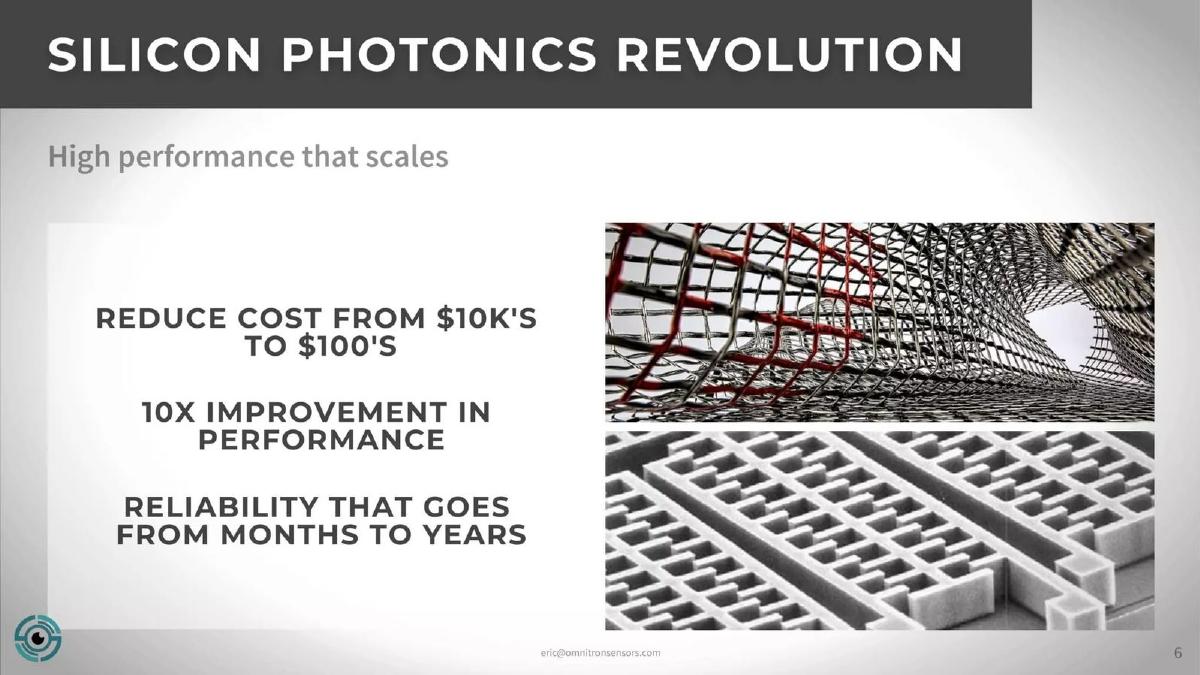
- The value proposition promises a radical cost reduction from $10,000s to $100s for high-performance sensors on slide 6.
- Market sizing focuses on a $30 billion automotive opportunity within a broader MEMS sensor landscape on slide 7.
- The technology claims to improve sensor reliability from a lifespan of months to years on slide 6.
- Current traction is signaled by 50% of the round being committed and existing partnerships in LiDAR and robotics on slide 8.
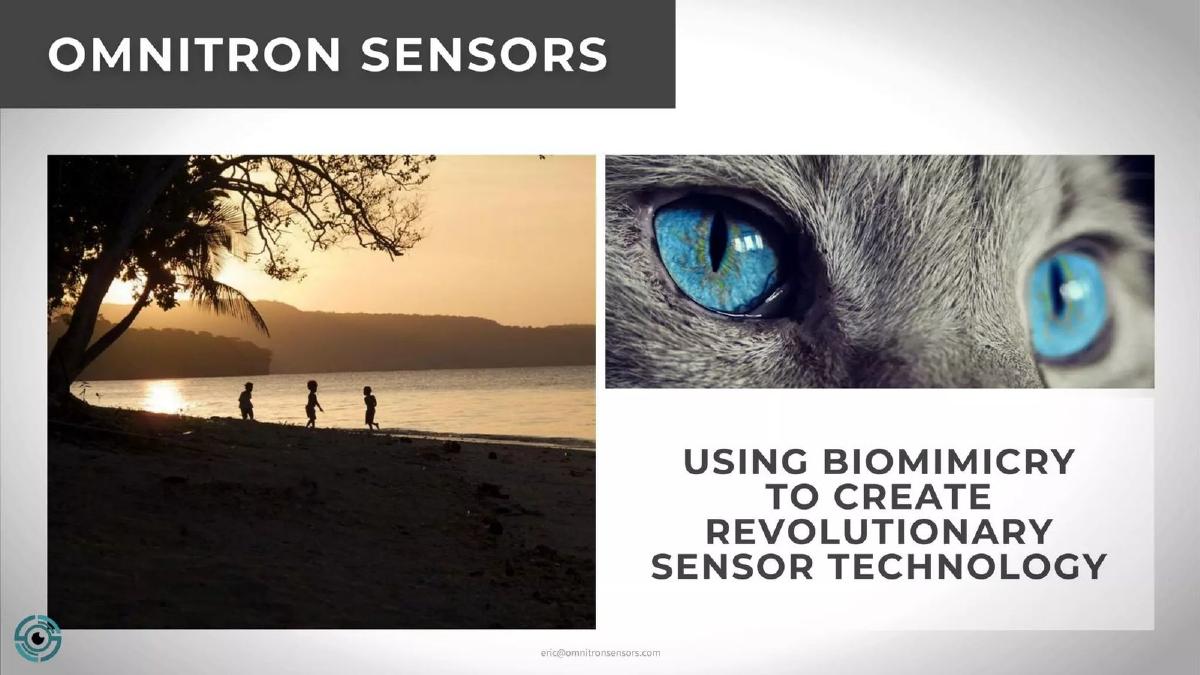
- The deck uses biomimicry as a conceptual bridge to explain their revolutionary sensor technology on slide 5.
- Specific technical failures of current sensors are listed as lasting less than 6 months and costing tens of thousands of dollars on slide 4.
The 9-Slide Deep Tech Narrative
Omnitron Sensors provides a masterclass in how to pitch a complex, deep-tech hardware play without drowning the investor in white papers. At just 9 slides, the deck moves rapidly from team credibility to market pain, then straight into a massive total addressable market (TAM). For a company raising $4 million in a seed round, the brevity suggests a high level of confidence in the underlying technology and the team's ability to execute.
Slides 1-3: Identity and Authority
Slide 1: Title Slide The deck opens with a clean logo and the CEO's contact information. There is no tagline here, which is a missed opportunity to set the stage, but the visual branding is professional and minimalist.
Slide 2: The Context Titled "Sensors are Everywhere," this slide uses a collage of images—smartphones, highway interchanges, and a stadium crowd. It establishes the ubiquity of the technology without using a single bullet point. It serves as a visual reminder that while the company is high-tech, its applications are grounded in everyday infrastructure.
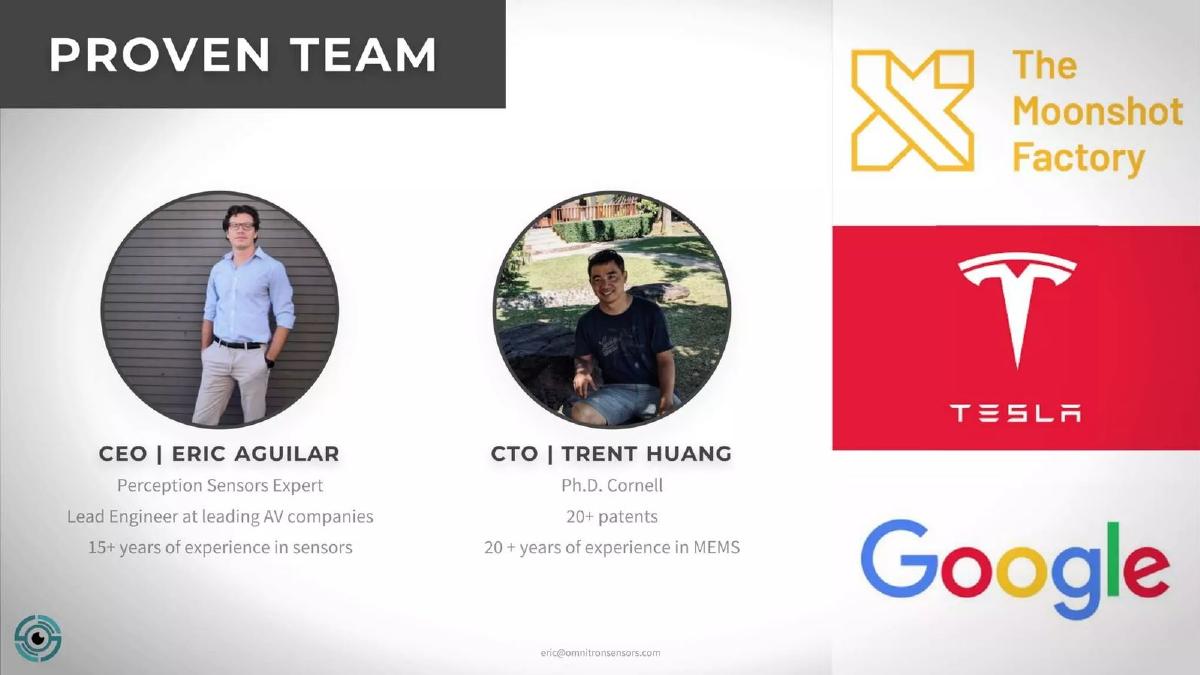
Slide 3: Proven Team This is arguably the most important slide in the deck. For a seed-stage company, the team is the product. Omnitron highlights CEO Eric Aguilar and CTO Trent Huang. The slide lists heavy-hitting credentials: 15-20+ years of experience each, a Ph.D. from Cornell, and 20+ patents. The right side of the slide features logos for X (The Moonshot Factory), Tesla, and Google. This immediately validates the founders as top-tier talent in the autonomous vehicle (AV) and MEMS space. By placing this slide third, they ensure the investor views the subsequent problem/solution slides through a lens of technical authority.
Slides 4-6: The Problem and The Pivot
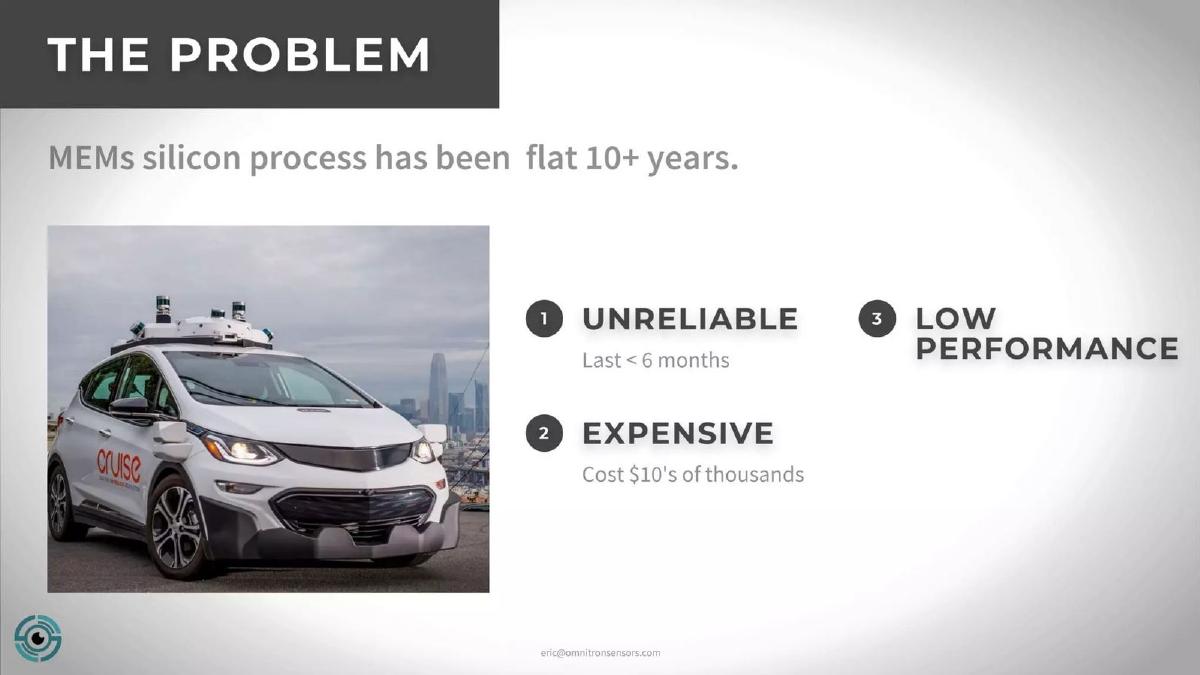
Slide 4: The Problem The deck identifies a specific industry bottleneck: "MEMs silicon process has been flat 10+ years." It uses a Cruise autonomous vehicle as a visual reference for the current state of the art. The slide lists three critical failures of existing sensors: they are unreliable (lasting less than 6 months), expensive (costing tens of thousands), and suffer from low performance. This slide is effective because it quantifies the pain—giving investors specific numbers ($10k+ cost, <6 month lifespan) to anchor against.
Slide 5: Omnitron Sensors This slide introduces the solution concept: "Using biomimicry to create revolutionary sensor technology." The imagery of a cat's eye and a sunset is abstract, which is a common trope in deep tech decks to avoid revealing proprietary IP too early. However, it bridges the gap between the "flat" silicon process mentioned previously and a new way of thinking about perception.
Slide 6: Silicon Photonics Revolution Here, the company gets specific about the "what." They are moving toward silicon photonics to achieve "high performance that scales." The slide lists three bold promises: reducing costs from $10k's to $100's, a 10x improvement in performance, and reliability that extends from months to years. The 99% cost reduction is the "hook" that makes this a venture-scale opportunity rather than just an incremental hardware improvement.
Slides 7-9: Market and Momentum
Slide 7: MEMS Sensor Market The market slide uses a simple pie chart to show a $37 billion total market. The breakdown is $30B for Automotive, $3B for Industrial, $2B for Drones, and $2B for Agriculture. By focusing on these four verticals, Omnitron shows they aren't just a "car company," but their primary target is clearly the $30B automotive sector. The figures are cited "in Billions," providing a clear sense of the scale.
Slide 8: The Ask and Traction This slide is unusually sparse. It mentions "Partnerships in LiDAR and robotics space" and notes that "50% committed in current round." It also features a large "500" logo, presumably referring to 500 Startups, though the slide doesn't explicitly explain the relationship. The mention of 50% commitment is a classic fundraising tactic to signal that the deal is moving fast and that other sophisticated investors have already done the due diligence.
Slide 9: Contact The deck ends with Eric Aguilar's direct contact information and a San Francisco address. The use of a neon handshake sign as the background image reinforces the idea of partnership and deal-making.
What Works
Pedigree as a Shield: In deep tech, investors are often terrified of "science projects" that never commercialize. By leading with 20+ years of experience and logos like Tesla and Google, Omnitron effectively neutralizes the risk of technical incompetence before they even explain the product.
Quantified Pain Points: Many decks stay too high-level. Omnitron gives specific numbers for the current failure state: $10,000 cost and a 6-month lifespan. This makes the "10x improvement" and "$100s cost" claims on the following slide feel like a direct, measurable solution rather than vague marketing speak.
Extreme Focus: With only 9 slides, the deck is designed to be read in under two minutes. It respects the investor's time and focuses only on the most critical drivers of a seed-stage investment: Who are you? What is broken? How big is the market if you fix it?
What is Missing
Unit Economics and Business Model: The deck explains that the sensors will be cheaper to make, but it doesn't explain the business model. Is this a licensing play for the silicon process, or are they manufacturing and selling the physical sensors? The lack of a margin profile or a go-to-market strategy is a significant omission, even for a seed round.
The "How": While they mention "silicon photonics" and "biomimicry," there is zero explanation of how they actually achieve a 99% cost reduction. While protecting IP is important, a high-level architectural diagram or a mention of a specific manufacturing innovation would help ground the claims.
Competition: The deck acts as if Omnitron is the only company working on the next generation of LiDAR or MEMS sensors. In 2019, the AV sensor space was incredibly crowded. Failing to acknowledge competitors or explain why their silicon photonics approach is superior to other solid-state LiDAR startups is a gap in the narrative.
Financial Projections: There is no slide showing how the $4 million will be spent or what milestones (e.g., a working prototype, a pilot with an OEM) will be reached with this capital. Investors generally want to see a 18-24 month roadmap of how their money gets the company to a Series A.
What a Founder Should Copy
The "Proven Team" Layout: Slide 3 is a perfect template for founders with strong backgrounds. It uses high-contrast logos, clear bullet points for years of experience, and professional headshots. It sells the "who" effectively.
The Cost-Reduction Hook: If your technology enables a 10x or 100x change in a key industry metric (like cost or reliability), make that the centerpiece of your solution slide. Omnitron's Slide 6 is the "money slide" because it translates technical jargon into economic impact.
Market Segmentation: Instead of just saying "The sensor market is $37B," Slide 7 breaks it down into logical buckets. This shows that the founders understand which industries will be the early adopters (Automotive) versus secondary markets (Agriculture).
Final Verdict
The Omnitron Sensors deck is a high-conviction, low-detail presentation. It relies almost entirely on the founders' resumes and the massive, obvious need for cheaper, better sensors in the autonomous vehicle race. While it lacks the financial and competitive rigor of a later-stage deck, its clarity on the "Problem/Solution" axis is likely what allowed them to secure a $4 million seed round. It proves that in the early stages, a clear value proposition and a world-class team can outweigh the need for a 50-page business plan.
Frequently asked questions
- How much did Omnitron Sensors raise with this deck?
- According to the catalogue listing, Omnitron Sensors raised $4,000,000 in a Seed round in 2019. The deck itself notes on slide 8 that 50% of the round was already committed at the time of the presentation, which is a common tactic to build FOMO among remaining prospective investors.
- What is the primary technical problem the company is solving?
- The company targets the stagnation of MEMS (Micro-Electro-Mechanical Systems) silicon processes. Slide 4 explicitly states that this process has been 'flat' for over 10 years, resulting in sensors that are unreliable (lasting less than 6 months), expensive (costing tens of thousands), and low performance.
- Who are the founders and what is their background?
- The team consists of CEO Eric Aguilar and CTO Trent Huang. Aguilar is described as a perception sensors expert with 15+ years of experience and lead engineering roles at 'leading AV companies.' Huang holds a Ph.D. from Cornell, has 20+ years of MEMS experience, and holds over 20 patents. Their previous employers include Tesla, Google, and X (The Moonshot Factory).
- What specific markets is Omnitron Sensors targeting?
- Slide 7 breaks down the MEMS sensor market in billions: Automotive ($30B), Industrial ($3B), Drones ($2B), and Agriculture ($2B). The primary focus is clearly the automotive sector, which represents the vast majority of their addressable market opportunity.
- What are the key performance metrics promised by their new technology?
- On slide 6, the company promises three major shifts: reducing costs from $10,000s to $100s, a 10x improvement in performance, and increasing reliability from a lifespan measured in months to one measured in years. This represents a 90-99% cost reduction, which is a significant claim for a seed-stage hardware company.