The Dirk Da Dhobi pitch deck, dated January 2017, targets the highly unorganized Indian laundry sector, which it values at over 2.2 Lakh Crore. The company differentiates itself through a 'Society Model'—establishing captive customer bases within residential complexes—and a commitment to owning the backend processing rather than outsourcing. With a reported 5,000+ customers and partnerships with aggregators like UrbanClap, the startup seeks $250,000 to scale its processing capacity and expand from Bangalore into Hyderabad and Pune. While the deck provides clear market sizing and a specific us…
Key takeaways
- The Indian laundry market is characterized as a 2.2+ Lakh Crore unorganized sector with a 20% CAGR (Slide 2).
- The startup utilizes a 'Society Model' to secure a captive customer base within residential areas (Slide 5).
- Dirk Da Dhobi rejects the pure aggregator model, opting for 'no outsourcing of jobwork' to maintain quality control (Slide 5).
- Traction includes 500+ regular customers and 5,000+ total customers at the time of the deck (Slide 6).
- The company serves as a 'Priority Partner' for major service aggregators UrbanClap and TimeServz (Slide 6).
- The $250,000 Pre-Series A ask is heavily weighted toward physical infrastructure, with 45% allocated to machine investment (Slide 7).
- Expansion plans target a phased rollout across eight major Indian cities, including Mumbai, Chennai, and Delhi (Slide 7).
- The deck claims the business model is designed to generate profits within two months of implementation (Slide 6).
Executive Summary: Professionalizing the Dhobi
OnDemand Home Care, operating under the brand Dirk Da Dhobi, addresses the fragmentation of the Indian laundry market. The deck, dated early 2017, positions the company as a technology-enabled service provider that eschews the common 'aggregator-only' model in favor of owning the backend processing. By focusing on 'Trust' and 'Affordable Quality,' the startup aims to transition consumers from unorganized local dhobis to a standardized, reliable service. The pitch is centered on a $250,000 Pre-Series A round intended to fund physical infrastructure and multi-city expansion.
Slide 1: Title and Branding
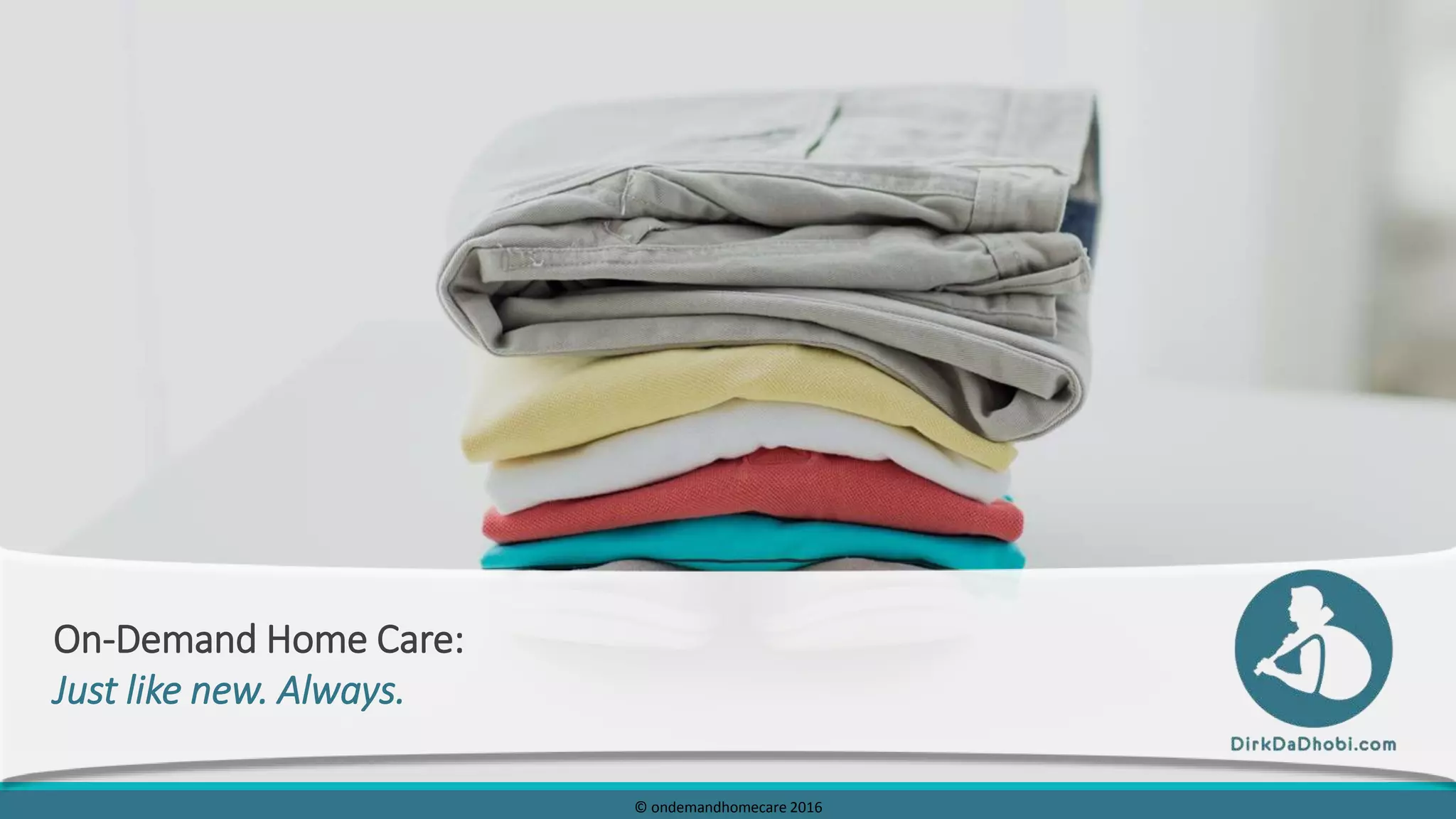
The cover slide introduces the brand 'Dirk Da Dhobi' with the tagline 'Just like new. Always.' The imagery of neatly folded laundry reinforces the core service. The company name is listed as On-Demand Home Care, suggesting a broader potential vision for home services, though the deck focuses exclusively on laundry. The copyright footer indicates the content was developed in 2016.
Slide 2: The Marketplace Opportunity
This slide provides the macro-economic justification for the business. It cites a '3X growth' trajectory in laundry services from 174 Bn in 2016 to 490 Bn in 2018. Crucially, it identifies a '2.2+ Lakh Crore Unorganized Sector,' which represents the primary target for disruption. The slide also uses an 'Income Pyramid' to show the growth of households earning between 18L and 60L, identifying this as the target demographic. It notes that there are 12M+ online consumers, providing a digital acquisition path for a traditionally offline service.
Slide 3: The Problem Statement
The deck uses a bubble chart to explain why consumers would switch to on-demand laundry. The reasons cited include a 'Lack of time' due to lifestyle changes, 'Cumbersome chore' (lack of convenience), and 'Zero wash techniques' (lack of specialized knowledge). It also critiques the current market by mentioning 'Unreliable aggregator services' and 'Faster wear of clothes' from home washing. This slide effectively sets up the need for a professionalized, reliable alternative.
Slide 4: The Solution - 'Dhobi Dust'
Slide 4 introduces the solution, centering it on the concept of 'Trust.' It lists four pillars: Trustworthy, Affordable Quality, Incentivized, and Guaranteed by Technology. The right side of the slide introduces the term 'Dhobi Dust,' a marketing phrase used to describe their commitment to delivering a 'just like new' result through consistent processing ('Wash after wash'). It explicitly states that the business is not just about logistics, but about the 'promise' of quality.
Slide 5: Business Model and Enablers
This is a critical slide that explains the operational strategy. It highlights three overlapping models: Society Model (captive customer base), Ownership & Aggregation Model (owning backend integration), and Integrated Model (online + offline). A quote from Co-Founder Dirk Lewis emphasizes that the business requires a 'sound understanding of the backend.' The slide lists three key differentiators: 'No outsourcing of jobwork,' 'Scalable model,' and 'Premium service provider.' This signals to investors that the company is building an asset-heavy, quality-controlled moat rather than a light logistics layer.
Slide 6: Traction and Roadmap
The 'What’s trending' section provides hard numbers: 500+ regular customers and 5,000+ total customers. It mentions being a 'Priority Partner' for UrbanClap and TimeServz, which serves as significant third-party validation. The timeline shows they have already established 6+ in-society laundries. The 'What’s next' section outlines the launch of iOS and Android apps, building processing capacity, and consolidating in Bangalore before moving to the 'next 6' cities. A notable claim on this slide is that the model 'will generate profits in 2 months,' though no data is provided to support this specific timeframe.
Slide 7: The Ask and Use of Funds
The final slide in the provided set details a $250,000 Pre-Series A investment request. The use of funds is highly specific: 45% for 'Machine Investment & Building Processing Capacity,' 35% for 'Talent Acquisition' (including delivery and ironing staff), 15% for 'Technology & Logistics,' and 5% for 'New Society Acquisition.' The slide also lists expansion targets for 2017-18, including Hyderabad, Pune, Mumbai, Chennai, Delhi, Gurgaon, and Kolkata, as well as a plan to enable B2B services for hotels and corporates.
What Dirk Da Dhobi Does Well
The deck excels at identifying a specific, massive market inefficiency in India. By quantifying the 'unorganized sector' at 2.2 Lakh Crore, the founders immediately establish the scale of the opportunity. The 'Society Model' is a clever tactical approach to the 'last mile' problem, effectively turning apartment complexes into micro-hubs with captive audiences. Furthermore, the decision to own the backend processing (no outsourcing) addresses the primary pain point of existing laundry aggregators: inconsistent quality. The partnership with UrbanClap is a strong signal of product-market fit and operational capability.
What is Missing from the Deck
The most glaring omission in the provided slides is a dedicated Team Slide . While Co-Founder Dirk Lewis is quoted, the background, expertise, and size of the founding team remain unknown. There is also a lack of Unit Economics ; while the deck claims profitability within two months, it does not show the Average Order Value (AOV), Customer Acquisition Cost (CAC), or the margins per wash. The Competitive Landscape is also ignored; while they mention being a partner to aggregators, they do not address other direct laundry competitors who were active in the Indian market during the 2016-2017 period. Finally, the 'Technology' aspect is mentioned as a 'guarantee' and an 'enabler,' but there are no screenshots or descriptions of the actual software interface or logistics routing tech.
Founder's Guide: What to Copy
Founders in the service industry should emulate the Use of Funds breakdown on Slide 7. It is granular and links the capital directly to physical capacity and headcount, which is essential for an operationally heavy business. The Roadmap visualization on Slide 6, using the falling stones/dominoes metaphor, effectively communicates momentum and the logical sequence of scaling. Additionally, the Market Sizing on Slide 2 is a great example of using reputable third-party data (Euromonitor, KPMG) to validate a 'gut feeling' about a fragmented market. Finally, the clear differentiation on Slide 5—explicitly stating what they are not (a pure logistics play) and what they do not do (outsource jobwork)—is a strong way to define a company's unique value proposition in a crowded sector.
Conclusion
The Dirk Da Dhobi deck is a pragmatic, operationally focused pitch. It recognizes that in the Indian context, technology is a tool for management, but the real value lies in infrastructure and trust. While the $250,000 ask is modest for a multi-city expansion, the heavy weighting toward machinery suggests a founder who understands that quality control is the only way to win in the laundry business. To be truly compelling to a Pre-Series A investor, the missing unit economics and team pedigree would need to be addressed in the full 14-slide version or the subsequent due diligence process.
Frequently asked questions
- What is the 'Society Model' mentioned in the deck?
- The Society Model is a hyper-local strategy where the company sets up operations or marketing efforts specifically within large residential societies. According to slide 5 and 6, this creates a 'captive customer base.' By the time of the pitch, they had established 6+ in-society laundries, allowing them to reduce logistics friction and secure recurring revenue from a concentrated geographic area.
- How does Dirk Da Dhobi plan to use the $250,000 investment?
- The investment is split into four categories as shown on slide 7: 45% for machine investment and building processing capacity, 35% for talent acquisition (including managerial, delivery, and ironing staff), 15% for technology and logistics improvements, and 5% for new society acquisition. This indicates a capital-intensive strategy focused on vertical integration rather than a lean software-only approach.
- Who are the primary partners for this startup?
- Slide 6 identifies Dirk Da Dhobi as a 'Priority Partner' for UrbanClap and TimeServz. This suggests a B2B2C strategy where they act as the fulfillment engine for larger home-service aggregators who lack their own laundry processing infrastructure. This partnership is labeled as a '1st of its kind' in the deck.
- What is the stated market opportunity in India?
- Slide 2 cites Euromonitor and KPMG estimates, valuing the laundry services market at 174 Billion in 2016 and projecting growth to 490 Billion by 2018. It highlights that the 'unorganized sector' is worth over 2.2 Lakh Crore, suggesting that professionalizing this fragmented market is the primary value proposition.
- What geographic areas are targeted for expansion?
- The company initially focused on consolidating its presence in Bangalore. Slide 7 outlines a roadmap to expand into Hyderabad and Pune by Q3 of FY 2017-18, followed by a phased rollout into Mumbai, Chennai, Delhi, Gurgaon, and Kolkata. This represents a plan to capture all major Tier-1 Indian metropolitan hubs.