Here, a real estate fintech platform, successfully raised $5M in Seed funding in 2022 by pitching a fractional ownership model for short-term vacation rentals. The deck focuses heavily on the yield disparity between vacation rentals and traditional residential real estate, claiming a 129% higher average return for the former. By handling the operational 'hassle'—including property management and guest relations—Here positions itself as a fully passive investment vehicle. The deck is notable for its clean aesthetic and strong team pedigree, featuring alumni from Divvy Homes, Evolve, and AngelL…
Key takeaways
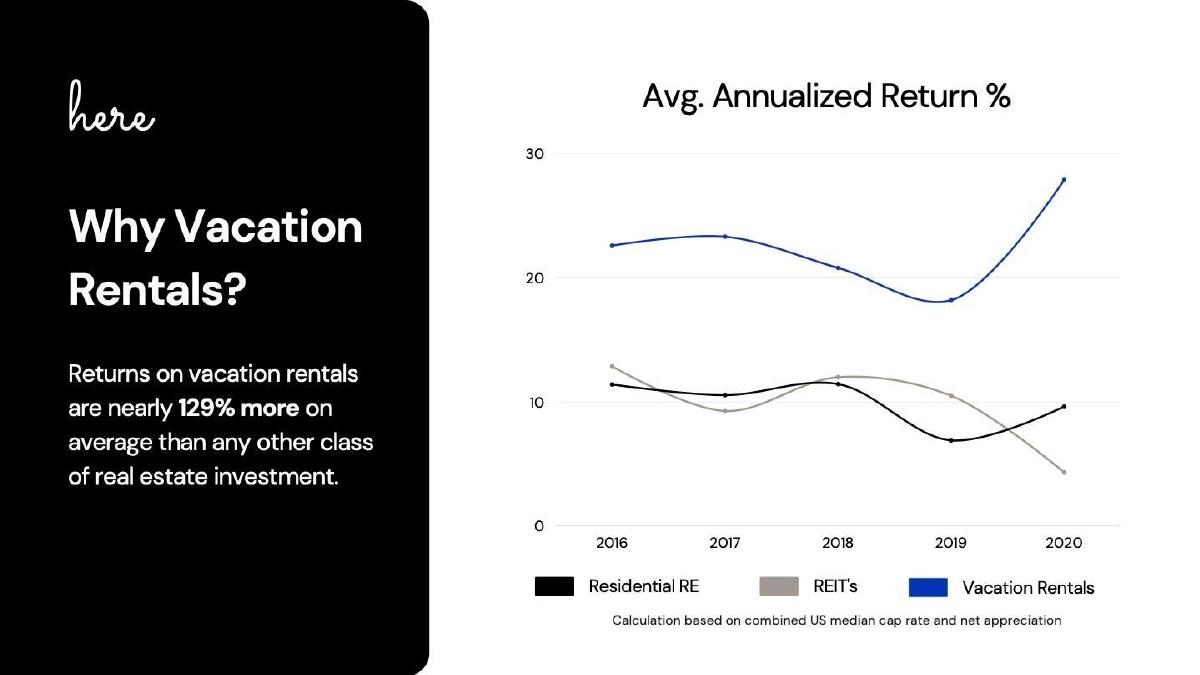
- The deck claims vacation rental returns are nearly 129% higher on average than any other real estate class (Slide 3).
- The platform allows users to purchase shares in properties for as little as $1 per share (Slide 5).
- Here handles four core operational pillars: Property Management, Demand Optimization, Cleaning & Maintenance, and Guest Relations (Slide 4).
- Early traction is demonstrated by a waitlist of over 25,000 members (Slide 6).
- As of May 24, 2022, the company reported a Gross Investment Volume of $389,000 (Slide 6).
- The average investment per user on the platform is stated as $584 (Slide 6).
- The market opportunity is valued at $1.8 trillion, citing Airbnb's 2020 S-1 filing (Slide 7).
- The founding team includes a 2x Proptech founder and a Head of Acquisition who previously acquired 600+ homes for Divvy Homes (Slide 8).
The Here Pitch Deck: Democratizing the Short-Term Rental Asset Class
In 2022, Here raised $5 million in a Seed round to expand its platform that allows everyday investors to buy into the vacation rental market. The deck is a masterclass in visual simplicity and focused messaging. It targets a specific pain point: the high barrier to entry and operational complexity of owning short-term rentals (STRs), while highlighting the superior yields these assets offer compared to traditional long-term residential real estate.
Slide 1-2: The Hook and Visual Identity
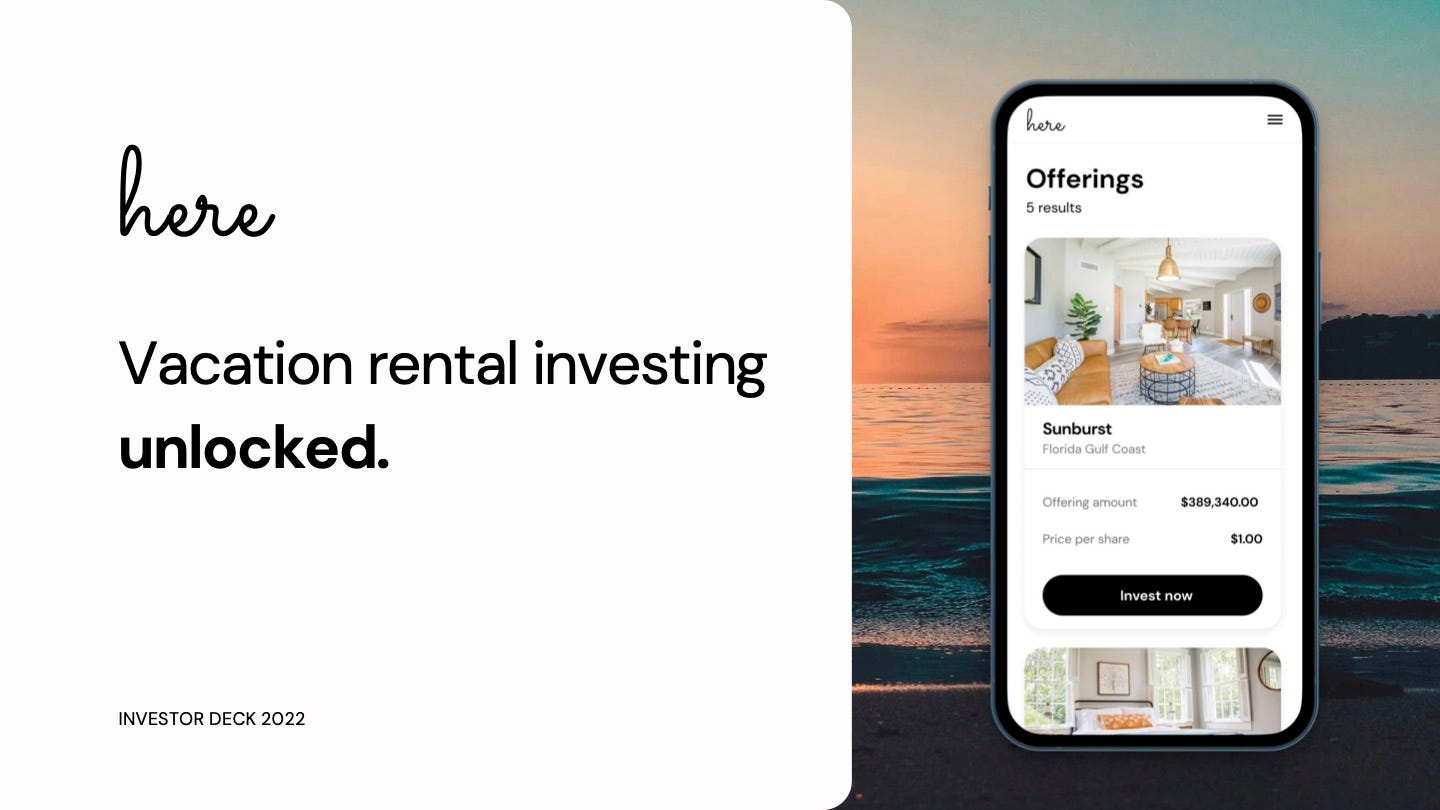
The opening slides establish the brand identity. The tagline 'Vacation rental investing unlocked' is clear and value-oriented. Slide 1 features a mobile mockup showing an 'Offerings' page with a property named 'Sunburst' on the Florida Gulf Coast. This immediately communicates that the product is a digital marketplace. The price per share is listed at $1.00, reinforcing the 'unlocked' or democratized nature of the investment.
Slide 3: The 'Why Now'—Yield Disparity
Slide 3 is perhaps the most critical slide in the deck. Titled 'Why Vacation Rentals?', it features a line graph comparing the Average Annualized Return % of Residential Real Estate, REITs, and Vacation Rentals from 2016 to 2020. The blue line representing Vacation Rentals ends significantly higher than the others. The slide claims that returns on vacation rentals are nearly 129% more on average than any other class of real estate investment. By citing that this calculation is based on combined US median cap rates and net appreciation, the founders provide a data-driven justification for why an investor should care about this specific niche.
Slide 4: The Solution—Removing the Friction
Real estate investing is notoriously 'un-passive.' Slide 4 addresses this by stating, 'You invest, we handle the rest.' It breaks down the operational burden into four quadrants: Property Management, Demand Optimization, Cleaning & Maintenance, and Guest Relations. For an investor, this slide represents the removal of the 'hassle' mentioned in the sub-headline. It positions Here not just as a financial platform, but as a full-stack hospitality operator.
Slide 5: The Value Proposition and Risk Mitigation
Slide 5, 'Why we win,' uses a six-grid layout to detail the benefits to the user. It reiterates the 'Fully Passive' nature and 'Fractional Ownership' (shares for as little as $1). Crucially, it mentions 'Economic Rights' (tax benefits and appreciation) and 'Liability.' The note that 'Each property is held in its own LLC' is a vital piece of information for sophisticated investors who want to know how the assets are ring-fenced. The 'Alignment' point—stating they partner with members on every property—suggests the company has skin in the game, which is a common requirement for real estate syndications.
Slide 6: Traction and Social Proof
Slide 6 shifts from theory to reality. It displays three large figures: 25k+ members on the waitlist, a $584 average investment, and $389k in Gross Investment Volume (GIV) as of May 24, 2022. While $389k GIV is relatively small for a $5M round, the 25k+ waitlist demonstrates significant top-of-funnel interest and market fit. The average investment of $584 is a healthy number for a 'democratized' platform, suggesting users are willing to commit more than the bare minimum.
Slide 7: Market Size
Slide 7 cites the Airbnb S-1 to value the market at $1.8 trillion. While 'Total Addressable Market' slides are often dismissed as 'up and to the right' fluff, linking the opportunity to a successful incumbent like Airbnb helps investors contextualize the scale. The imagery of a plane flying over palm trees reinforces the 'vacation' theme of the asset class.
Slide 8: The Founding Team
The final slide in the provided sequence showcases a high-pedigree team. Corey Ashton Walters (CEO) is noted as a 2x Proptech founder who scaled to 900+ cities. Caleb Olthoff (Head of Product) brings 10+ years of experience from Evolve.com, a major player in the STR space. Eugene Davidzon (Head of Acquisition) previously acquired 600+ homes for Divvy Homes, a well-known proptech unicorn. Tucker McKay (Investor Relations) comes from AngelList. This team composition covers all the necessary bases: proptech scaling, STR operations, high-volume real estate acquisition, and fintech fundraising.
What Works in the Here Pitch Deck
1. Data-Driven Urgency: By leading with the 129% yield advantage, Here makes a compelling case for the asset class itself before even discussing their specific product. They aren't just selling a platform; they are selling access to superior returns.
2. Operational Clarity: Many fractional platforms gloss over who actually cleans the toilets and manages the guests. Slide 4 explicitly lists these tasks, which builds trust that the founders understand the operational intensity of short-term rentals.
3. Team-Market Fit: The team slide is exceptionally strong. Having a Head of Acquisition from Divvy Homes and a Head of Product from Evolve directly addresses the two biggest risks: finding the right properties and managing the technology for short-term stays.
What is Missing from the Here Pitch Deck
1. The 'Ask' and Use of Funds: The provided slides do not include a specific 'Ask' slide detailing how much they are raising or how the $5M will be allocated (e.g., hiring, marketing, property down payments). While we know the outcome from publisher reports, its absence in the deck is a notable omission for a fundraising teardown.
2. Unit Economics: While the deck mentions 'High-Yield' for the investors, it does not explain how Here makes money. Is there an acquisition fee? A monthly management fee? A spread on the appreciation? Investors need to see the company's path to profitability, not just the users' returns.
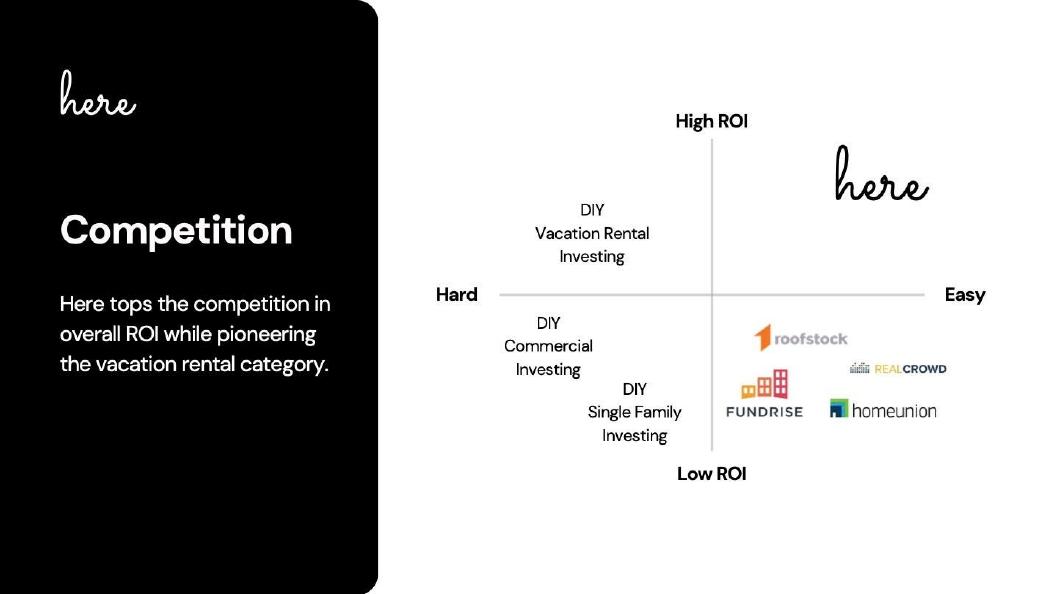
3. Competitive Landscape: The deck does not mention competitors like Pacaso (which focuses on second homes rather than pure investments) or Arrived Homes. A slide showing why Here's model is superior to other fractional real estate platforms would have strengthened the 'Why we win' argument.
Founder Takeaways: How to Copy the Here Approach
Focus on the 'Yield Gap': If you are building in fintech or proptech, find a chart that shows your asset class outperforming the status quo. Here's Slide 3 is the 'North Star' of the entire pitch. · Use 'Pedigree Logos': The team slide (Slide 8) uses the logos of the founders' previous companies (Divvy, Evolve, AngelList). This is a powerful visual shorthand that transfers the credibility of established companies to the new startup. · Simplify the Legal: Fractional ownership can be legally confusing. Here uses a single bullet point—'Each property is held in its own LLC'—to answer a complex structural question. Don't over-explain the legalities; just state the structure clearly. · Waitlist as Traction: If your transaction volume is still low, lead with your waitlist. 25,000 people wanting a product is a strong signal of demand, even if you haven't processed all their capital yet.
Frequently asked questions
- What is the minimum investment amount on the Here platform?
- According to slide 5, Here allows for fractional ownership where users can purchase shares for as little as $1 per share. However, publisher-reported facts suggest the entry point for users to start investing in a property is generally around $100.
- How does Here differentiate itself from traditional REITs?
- Slide 3 provides a chart showing that vacation rentals significantly outperform REITs in average annualized returns. Slide 5 further notes that Here offers 'Economic Rights' including direct rental income, tax benefits, and property appreciation, which are often more abstracted in traditional REIT structures.
- Who is responsible for managing the vacation properties?
- Slide 4 explicitly states 'You invest, we handle the rest.' The company manages property maintenance, cleaning, demand optimization, and guest relations, making the investment 'fully passive' for the member.
- What legal structure does Here use for its property investments?
- Slide 5 indicates that 'Each property is held in its own LLC.' This structure is designed to isolate liability to the specific asset and provide clear economic rights to the fractional owners of that specific property.
- What was the reported traction at the time of the Seed round?
- Slide 6 reports three key metrics: a waitlist of over 25,000 members, an average investment of $584, and a Gross Investment Volume of $389,000 as of May 24, 2022.