HelloSky’s Seed deck is a masterclass in brevity, relying on the strength of its founding team and a specific technical architecture to justify a $5.5M raise. The company targets the executive search market, arguing that current manual processes—relying on fragmented data from sources like LinkedIn and PitchBook—are inefficient. By positioning themselves at the intersection of talent acquisition, company intelligence, and relationship intelligence, HelloSky claims a unique competitive advantage. While the deck is notably missing financial projections, unit economics, and a specific 'Ask' slid…
Key takeaways
- The deck consists of only 8 slides, omitting traditional sections like financials, go-to-market strategy, and a specific funding ask.
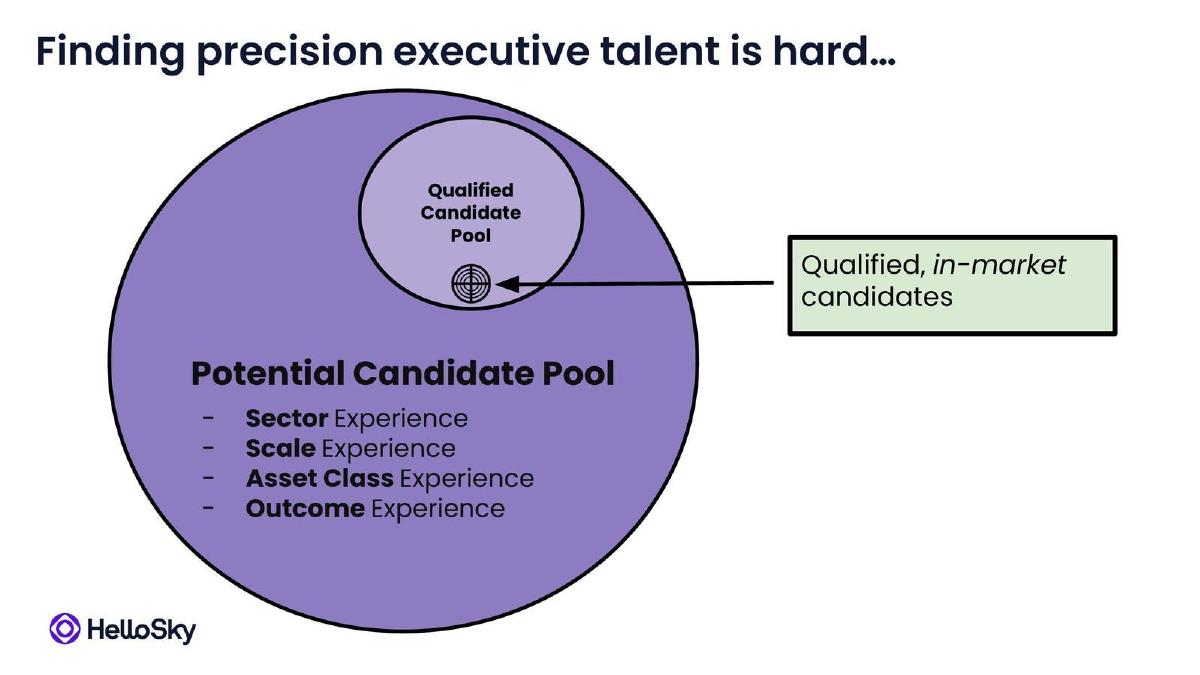
- HelloSky identifies a 'Qualified, in-market' candidate pool as a tiny fraction of the total potential pool on Slide 2.
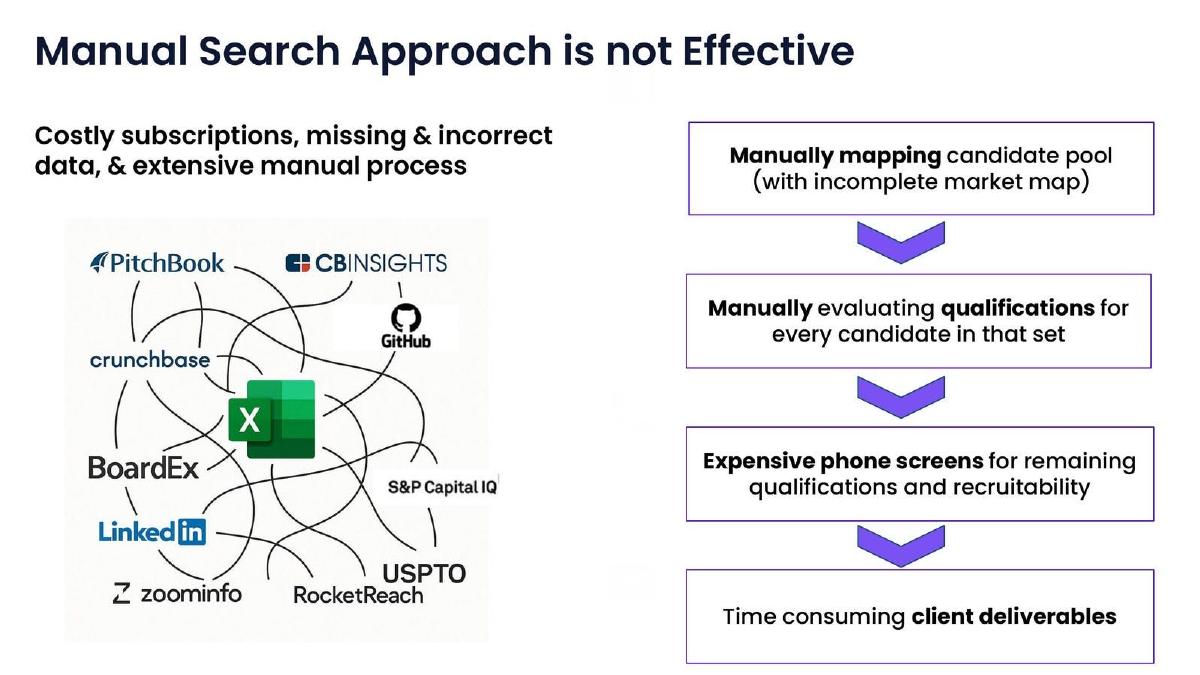
- Slide 3 lists 11 different data sources, including GitHub, USPTO, and Crunchbase, to illustrate the inefficiency of manual search.
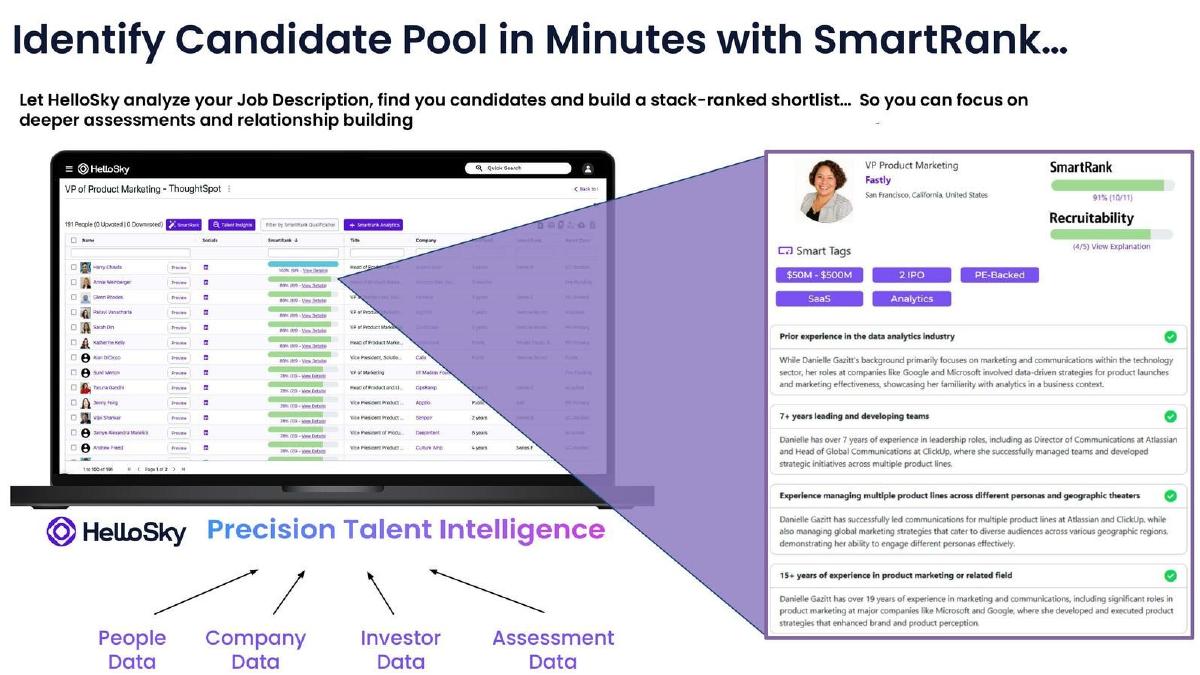
- The 'SmartRank' feature claims to analyze job descriptions and build stack-ranked shortlists in minutes, as shown on Slide 4.
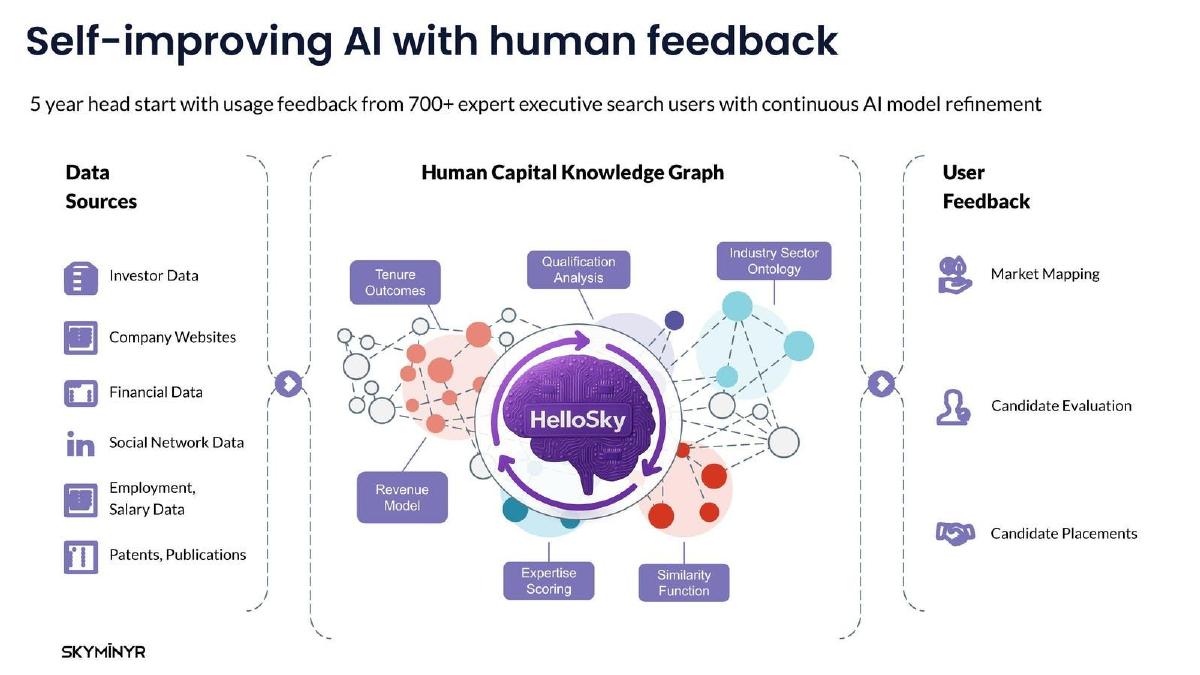
- A technical moat is claimed on Slide 5 through a 'Human Capital Knowledge Graph' fueled by 5 years of feedback from 700+ expert users.
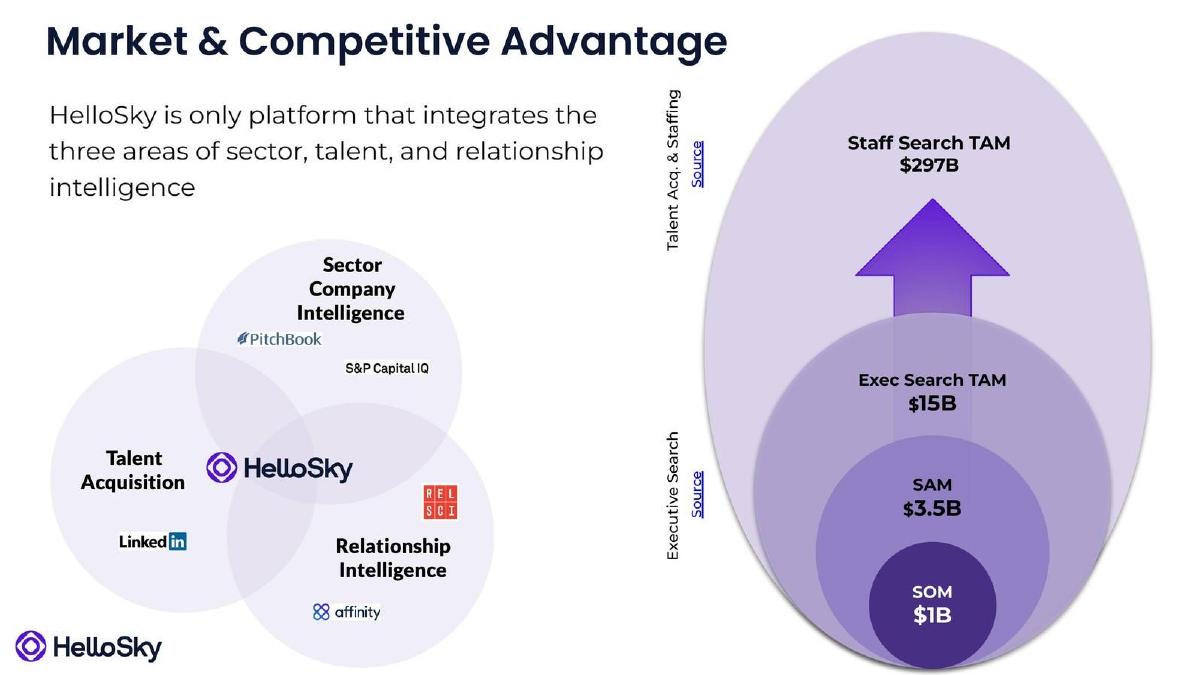
- The market sizing on Slide 6 identifies a $1B Serviceable Obtainable Market (SOM) within a broader $15B Executive Search TAM.
- The leadership team includes a founder whose previous company, Mtell, was acquired by a NASDAQ-listed firm (Slide 7).
- Slide 7 also highlights a Board Member/Investor, John Mutch, associated with a $4.2B AI exit.
Slide 1: Title Slide
The deck opens with the HelloSky logo and the tagline: "Precision Talent Intelligence for Executive Search." It includes the company URL, hellosky.ai. The visual theme is dark blue with purple and blue geometric accents, establishing a professional, tech-forward aesthetic immediately.
Slide 2: The Problem - The Needle in the Haystack
Slide 2 uses a Venn diagram to illustrate the difficulty of executive recruitment. It defines a large "Potential Candidate Pool" based on Sector, Scale, Asset Class, and Outcome experience. Inside this is a smaller "Qualified Candidate Pool," and finally, a bullseye representing "Qualified, in-market candidates." The slide title, "Finding precision executive talent is hard...", sets up the necessity for a tool that can filter down to that specific bullseye.
Slide 3: The Inefficiency of Manual Search
This slide critiques the status quo. It features a chaotic web of logos including PitchBook, Crunchbase, LinkedIn, ZoomInfo, GitHub, and USPTO, all funneling into a central Excel icon. The text notes "Costly subscriptions, missing & incorrect data, & extensive manual process." On the right, a four-step flowchart describes the current manual approach: mapping the pool, evaluating qualifications, expensive phone screens, and time-consuming deliverables. The slide effectively argues that the current recruiter workflow is fragmented and low-leverage.
Slide 4: The Solution - SmartRank
Slide 4 introduces the product solution: "Identify Candidate Pool in Minutes with SmartRank..." The slide shows a laptop screen displaying the HelloSky interface, which includes a list of candidates for a "VP of Product Marketing" role. A call-out box highlights a specific candidate profile, showing a "SmartRank" score of 91% and a "Recruitability" meter. The interface uses "Smart Tags" (e.g., $50M - $500M, 2 IPO, PE-Backed) and provides AI-generated explanations for why a candidate fits specific criteria, such as "7+ years leading and developing teams." The bottom of the slide lists the data inputs: People Data, Company Data, Investor Data, and Assessment Data.
Slide 5: The Technical Moat
Titled "Self-improving AI with human feedback," this slide explains the underlying technology. It claims a "5 year head start" based on feedback from "700+ expert executive search users." The central graphic is the "Human Capital Knowledge Graph," which processes data sources (Patents, Financial Data, Social Networks) through a cycle of Tenure Outcomes, Qualification Analysis, and Expertise Scoring. The right side of the slide shows how user feedback on Market Mapping and Candidate Evaluation feeds back into the model. This slide is designed to convince investors that the AI is not just a wrapper on a LLM, but a proprietary system with a data advantage.
Slide 6: Market and Competitive Advantage
HelloSky uses a three-circle Venn diagram to show its market positioning. It places itself at the intersection of "Talent Acquisition" (LinkedIn), "Sector Company Intelligence" (PitchBook, S&P), and "Relationship Intelligence" (Affinity, RelSci). The claim is that HelloSky is the "only platform that integrates the three areas." On the right, a market sizing graphic shows a total Staff Search TAM of $297B, an Executive Search TAM of $15B, a SAM of $3.5B, and a SOM of $1B. The focus on the $15B executive search niche suggests a premium, high-margin target market rather than a general recruitment play.
Slide 7: Leadership and Advisors
This is arguably the strongest slide in the deck. It features six leadership members and six advisors. CEO Alex Bates is noted as the founder of Mtell, which was acquired by a NASDAQ-listed company. Chief of AI Alex Wissner-Gross is highlighted for his Harvard PhD and MIT fellowship. Board Member John Mutch is credited with a $4.2B AI exit (HNC Software). The advisors include former heads of recruiting from Google and Cisco, and partners from major search firms like Russell Reynolds and Caldwell Partners. The presence of a former Intel Officer from the CIA (Betsy Wouldenberg) adds a layer of "intelligence craft" credibility.
Slide 8: The Conclusion
The final slide is a summary statement. It claims HelloSky is "poised to corner the emerging market" and that after years of data science, the "GenAI platform is ready." It describes the company as being at a "major inflection point." There is no specific financial ask, no use of funds, and no roadmap on this slide, just a closing invitation to "join us on this journey."
What HelloSky Does Well
HelloSky excels at problem-solution alignment . By showing the mess of logos in Slide 3 (Excel, LinkedIn, PitchBook), they tap into a visceral pain point for executive recruiters who spend thousands on disconnected tools. They don't just say they are better; they show how they consolidate a fragmented tech stack.
The technical architecture slide (Slide 5) is a strong defense against the "AI wrapper" skepticism prevalent in 2024. By citing a five-year head start and a specific "Human Capital Knowledge Graph," they signal to investors that there is significant R&D behind the product that would be difficult for a new entrant to replicate quickly.
Finally, the team slide is a masterclass in social proof. For a Seed round, investors are primarily betting on the people. Having a founder with a successful exit, a Harvard/MIT AI lead, and advisors from the very firms they are trying to sell to (Russell Reynolds) provides immense credibility.
What is Missing from the HelloSky Pitch Deck
The most glaring omission is traction and revenue metrics . While the deck mentions 700+ expert users, it does not specify if these are paying customers, pilot users, or historical users from a previous iteration. There are no mentions of ARR, MRR, or growth rates.
There is also a complete lack of Go-to-Market (GTM) strategy . The deck explains what the product is and who the market is, but it doesn't explain how HelloSky intends to capture that $1B SOM. Will they use a direct sales force, partnerships with search firms, or a bottom-up SaaS model?
The financial ask is missing entirely. A standard pitch deck usually concludes with the amount being raised, the valuation cap (if applicable), and a breakdown of how the funds will be spent (e.g., 50% engineering, 30% sales). HelloSky relies entirely on the strength of the narrative and the team to prompt a follow-up conversation where these details would presumably be shared.
Founder Takeaways: What to Copy
Use a 'Messy' Slide to Show Fragmentation: Slide 3’s visual representation of the current workflow (the tangled lines connecting data sources to Excel) is a highly effective way to demonstrate why a new solution is needed. Founders should look for ways to visually represent the "chaos" of the current manual process they are replacing.
Focus on the 'Why Now': Slide 8 mentions that the platform is "ready" after "years of data science." This creates a sense of timing. Founders should emphasize why their product is hitting the market at this specific inflection point—in this case, the maturation of GenAI meeting a decade of proprietary data collection.
Segment Your TAM: Rather than just claiming a $300B recruitment market, HelloSky narrowed it down to a $1B SOM specifically for executive search intelligence. This makes the business plan feel more realistic and targeted. Founders should always show the path from the massive TAM to the specific, winnable SOM.
Leverage Advisor Pedigree: If you have high-profile advisors, don't just list their names. Include the logos of the prestigious companies they worked for, as HelloSky did on Slide 7. This allows an investor to scan the slide and immediately see "Google," "Cisco," and "MIT," which builds instant trust.
Frequently asked questions
- How much did HelloSky raise with this deck?
- According to publisher-reported facts from Business Insider, HelloSky raised $5.5M in a Seed round in 2024. The deck itself does not state the amount being raised or the valuation, which is common for decks intended for wide distribution or those used as a visual aid during a verbal pitch.
- What is the core problem HelloSky is solving?
- HelloSky targets the inefficiency of executive search. Slide 3 highlights that recruiters currently juggle 'costly subscriptions' and 'incorrect data' across platforms like LinkedIn, PitchBook, and ZoomInfo. They argue that manually mapping and evaluating candidates leads to expensive phone screens and time-consuming deliverables that AI could automate.
- What is the 'Human Capital Knowledge Graph' mentioned in the deck?
- Detailed on Slide 5, this is HelloSky's proprietary data engine. It integrates data from investor records, company websites, social networks, and patent filings. It uses a feedback loop from 700+ expert users to refine its 'Expertise Scoring' and 'Similarity Function,' creating what they call a 'self-improving AI.'
- Does the deck mention any specific competitors?
- Slide 6 identifies competitors by category rather than direct AI search rivals. It lists LinkedIn in Talent Acquisition, PitchBook and S&P Capital IQ in Company Intelligence, and Affinity and RelSci in Relationship Intelligence. HelloSky claims to be the only platform that integrates all three areas.
- Who are the key people behind HelloSky?
- The team is high-pedigree. CEO Alex Bates previously founded Mtell (acquired by AspenTech). The Chief of AI, Alex Wissner-Gross, holds a Harvard PhD and was an MIT Institute Fellow. The advisory board includes former executives from Google, Cisco, and Russell Reynolds Associates, as shown on Slide 7.