The Terebellum Investment Group pitch book, dated March 2015, is a 49-slide presentation (10 slides analyzed) designed for accredited investors. Led by Managing Partner Jeff Williams, the fund positions itself as a hedge against global volatility, specifically citing the 'oil bust' and 'Russian instability' as catalysts. The deck emphasizes the negative correlation between managed futures and the S&P 500, highlighting that an index of managed futures outperformed the S&P 500 during the seven most volatile periods of the last 25 years. Performance data for the Terebellum Fund itself shows a 5.…
Key takeaways
- The fund was active and raising as of March 2015, led by Managing Partner Jeff Williams (Slide 1).
- The investment thesis is built on geopolitical shifts, specifically linking the oil market downturn and Ukraine-related sanctions to Russian instability (Slide 11).
- Managed futures are marketed as a hedge, showing a 39.41% performance difference over the S&P 500 during the 1987 Black Monday crash (Slide 21).
- The Terebellum Fund reported a Sharpe Ratio of 1.07 and a Sortino Ratio of 2.77 for its first year of operations (Slide 26).
- The fund experienced a maximum drawdown of 14.27% between November 2014 and December 2014 (Slide 26).
- Terebellum utilizes a 'Multi-strategy' approach, which it metaphorically describes as the 'best of the best' (Slide 31).
- Institutional credibility is established through third-party service providers like Opus Fund Services (Administrator) and Kaplan & Company (Auditor) (Slide 41).
- The deck includes detailed technical disclosures for risk metrics, citing Investopedia as a source for definitions like Calmar Ratio and Standard Deviation (Slide 46).
Terebellum Investment Group: The 2015 Macro Thesis
The Terebellum Investment Group pitch book is a classic example of a mid-2010s hedge fund deck. It leans heavily on the 'Global Macro' narrative, using geopolitical friction and commodity volatility as the primary justification for an alternative investment strategy. Dated March 2015, the deck captures a specific moment in financial history: the aftermath of the 2014 oil price collapse and the escalating tensions between the West and Russia.
Slide 1: Title and Contact Information
The cover slide establishes the firm's identity and the primary point of contact, Managing Partner Jeff Williams. It includes a specific date (March 2015) and a clear regulatory warning: 'FOR ACCREDITED INVESTORS ONLY.' The tagline, 'Helping Others Reach for the Stars,' is paired with a logo featuring four-pointed stars, creating a consistent, if somewhat generic, brand identity.
Slide 6 and 11: The Macroeconomic Environment
Slide 6 serves as a transition header titled 'Changes in the United States.' This leads into the core thesis presented on Slide 11. This slide features a prominent photograph of President Barack Obama and President Vladimir Putin. The text overlay provides a simple equation for the fund's current focus: 'Oil bust + sanctions over Ukraine = Russian instability.' This indicates that the fund is positioning itself to trade around the volatility caused by these specific geopolitical events.
Slide 16 and 21: The Value Proposition and Historical Context
Slide 16 asks the fundamental question, 'Why us?' The answer is partially provided by the data on Slide 21, titled 'Performance History: NEGATIVE CORRELATION.' This slide is a data-heavy table comparing the S&P 500 Index against the Barclay BTOP 50 (an index of managed futures). It highlights seven specific periods of market distress from 1987 to 2008. The 'Difference' column emphasizes how managed futures provided a cushion during these crashes, with the most significant gap being 39.41% during the 1987 Black Monday crash. This slide is intended to prove that the fund's asset class is a necessary diversifier for equity-heavy portfolios.
Slide 26: Fund Performance and Risk Analysis
This is the most critical slide for potential investors. It provides a 'Benchmark Comparison - Since Fund Inception' (March 2014 to March 2015). The Terebellum Fund is compared against the S&P 500 and the EAFE. Key figures include:
Ending VAMI: $1,792.92 for Terebellum vs. $1,089.87 for the S&P 500. · Sharpe Ratio: 1.07 for Terebellum vs. 0.92 for the S&P 500. · Sortino Ratio: 2.77 for Terebellum vs. 0.09 for the S&P 500. · Maximum Drawdown: 14.27% for Terebellum, which is significantly higher than the S&P 500's 3.45% during that specific window.
The slide also notes that the fund had 7 positive periods (53.85%) and 6 negative periods (46.15%) during its first year.
Slide 31 and 36: Strategy and Expectations
Slide 31 uses a visual metaphor—a grocery store display of various apple varieties—to explain its 'Multi-strategy' approach, labeled as 'best of the best.' This suggests the fund does not rely on a single trading algorithm or asset class but rather a diversified mix of strategies. Slide 36, titled 'Positive Expectations,' features a high-quality photograph of marbles, which serves as a thematic transition but lacks specific financial data.
Slide 41: The Operational Team
Hedge funds live and die by their service providers. Slide 41 lists the 'Experienced Team' of third-party vendors:
Administrator: Opus Fund Services (San Francisco, CA) · Auditor: Kaplan & Company (Northbrook, IL) · Compliance Administrator: National Regulatory Services (Chicago, IL) · Prime Broker: Wells Fargo Prime (San Francisco, CA)
Listing these reputable firms is a standard industry practice to assure investors that the fund's assets are being handled and audited by professional third parties, reducing the risk of fraud.
Slide 46: Technical Disclosures
The final slide in this selection is a 'Disclosure' page specifically for the performance data on Slide 18 (though the performance table appears on Slide 26 in this set). It provides textbook definitions for complex financial metrics like the Calmar Ratio, Standard Deviation, and Downside Deviation. The source for these definitions is cited as 'Investopeida' (sic). This level of detail is required for regulatory compliance and helps educate the 'accredited investor' on how the fund's risk is being measured.
What Works in This Deck
Strong Comparative Data: Slide 21 is highly effective. By showing exactly how managed futures performed during well-known historical crises (like 9/11 and the 2008 banking crisis), the founders make a compelling case for why an investor needs this specific asset class in their portfolio. It moves the conversation from 'we are good traders' to 'this asset class is a mathematical necessity.'
Institutional Credibility: The 'Service Providers' slide (Slide 41) is excellent. For a smaller or newer fund, showing that you have a prime brokerage relationship with Wells Fargo and an established administrator like Opus is vital for passing the due diligence phase of institutional or high-net-worth investors.
Clear Thesis: The 'Oil bust + sanctions' slide (Slide 11) is a very clear, shorthand way of explaining the fund's current focus. It shows that the management team is paying attention to global events and has a plan to capitalize on them.
What Is Missing from This Deck
Specific Strategy Details: While the deck mentions 'Multi-strategy' and 'Managed Futures,' it does not explain how the fund makes decisions. Is it trend-following? Mean-reversion? Discretionary or systematic? The 'apples' metaphor on Slide 31 is too vague for a sophisticated investor to understand the actual trading edge.
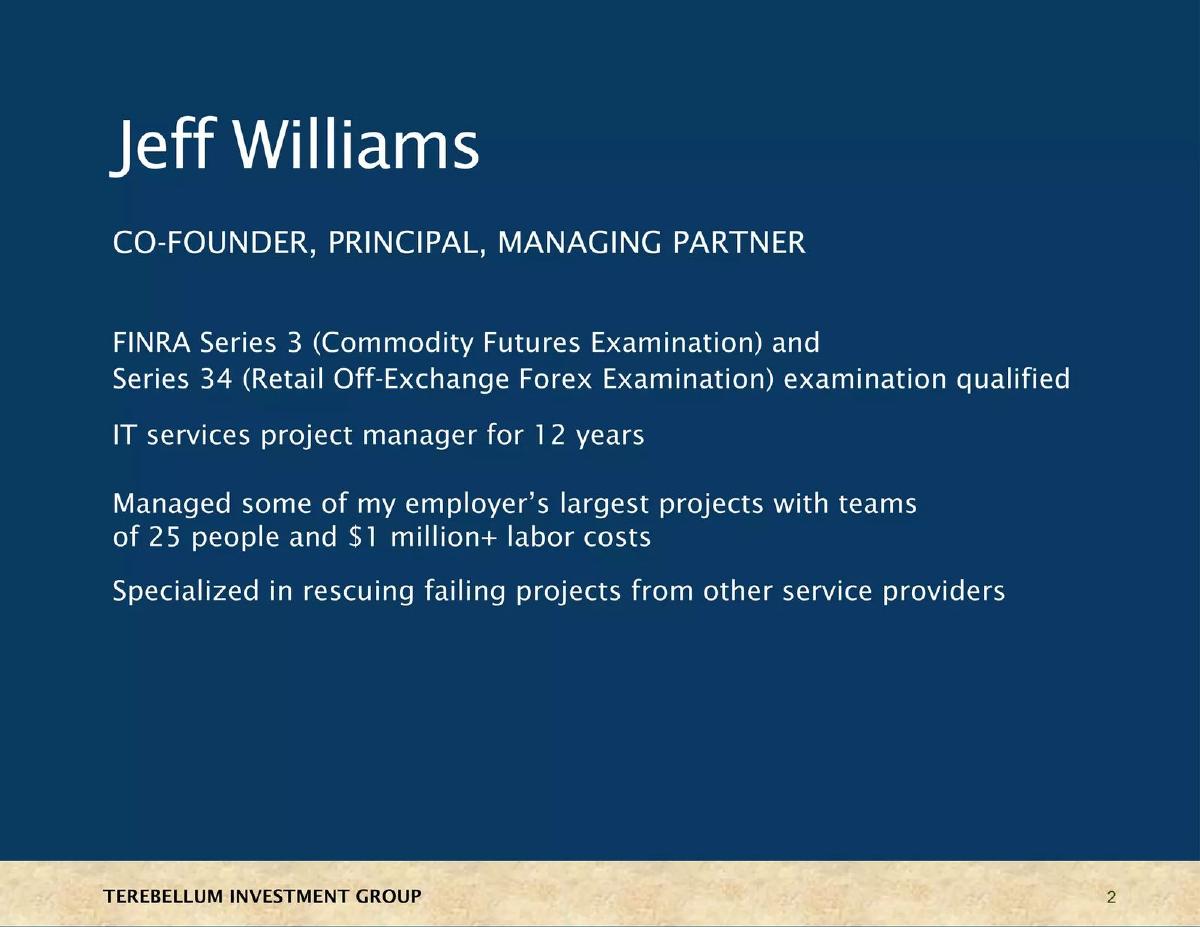
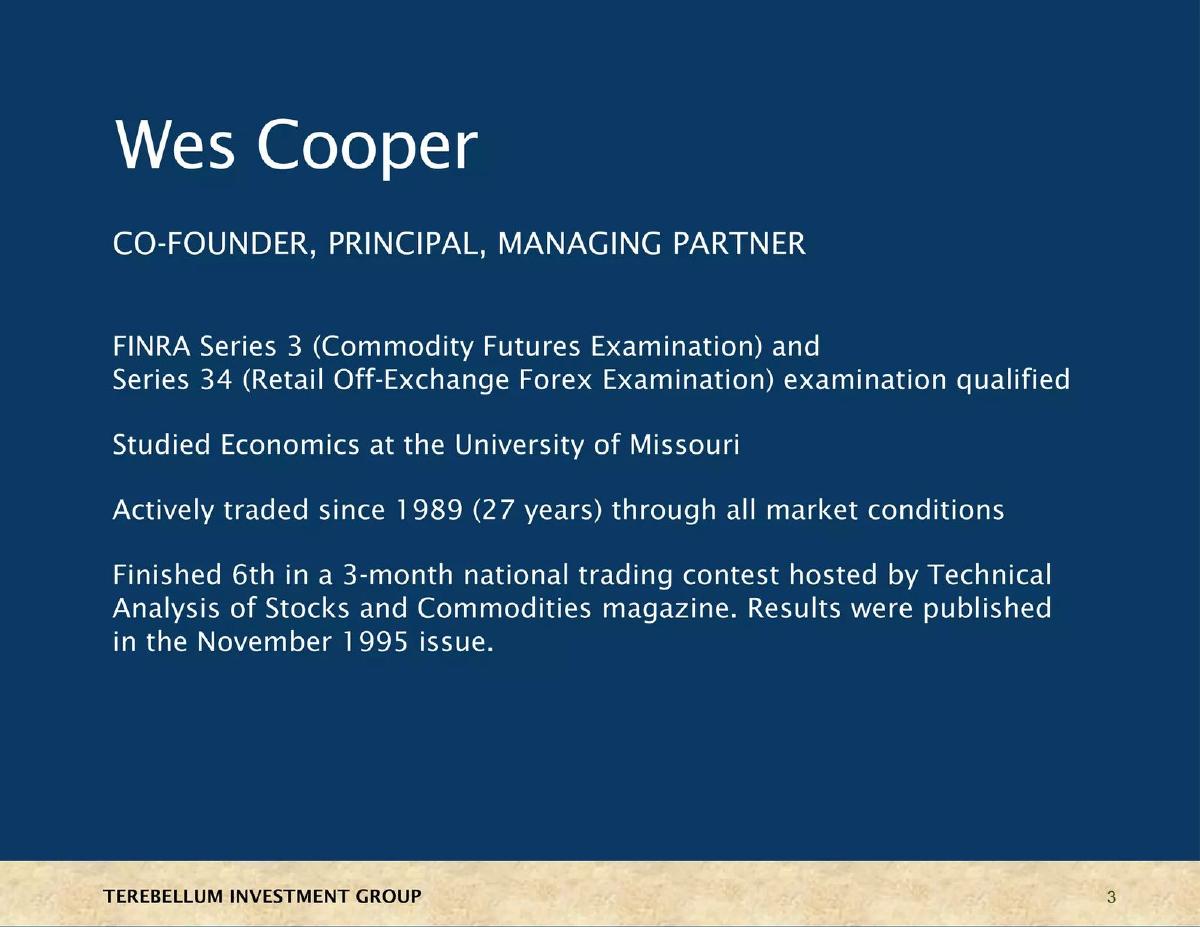
Team Biographies: Although Jeff Williams is mentioned on the cover, this selection of slides lacks a 'Team' slide with professional backgrounds, past performance at other firms, or educational credentials. In the hedge fund world, the 'pedigree' of the traders is often as important as the strategy itself.
Fee Structure and Terms: There is no mention of the management fee, performance fee (the 'carry'), lock-up periods, or minimum investment requirements. These are standard 'Ask' components for a fund pitch.
What a Founder Should Copy
The 'Negative Correlation' Table: If you are building a product or fund that serves as a hedge, you must include a table similar to Slide 21. Don't just say you are a hedge; show how your category performed during the worst days of the market over a 25-year span.
Detailed Risk Metrics: Don't just show returns. Terebellum's inclusion of Sharpe, Sortino, and Calmar ratios (Slide 26) shows a level of professional maturity. Investors want to know how much risk you took to get those returns. Copy the format of providing both the raw return (VAMI) and the risk-adjusted metrics.
The Disclosure Page: Including a slide that defines your terms (Slide 46) is a great way to ensure there is no ambiguity. It shows you are transparent and helps prevent future disputes with investors over how 'success' or 'risk' was defined during the pitch.
Frequently asked questions
- What is the primary investment strategy of Terebellum Investment Group?
- Based on the slides, Terebellum employs a multi-strategy approach focused on managed futures and commodities. The deck emphasizes 'negative correlation' to traditional equities, suggesting the fund seeks to profit from market volatility and macroeconomic shifts, such as geopolitical instability in Russia and fluctuations in oil prices.
- How did the fund perform relative to major benchmarks in its first year?
- According to Slide 26, from inception in March 2014 to March 2015, the Terebellum Fund achieved an 'Ending VAMI' of $1,792.92 (based on a hypothetical $1,000 investment). This outperformed the S&P 500 Index ($1,089.87) and the EAFE ($993.12) during the same period, despite a higher maximum drawdown of 14.27%.
- Who are the key people and partners involved with the fund?
- Jeff Williams is identified as the Managing Partner on the title slide. The fund's operational infrastructure includes Opus Fund Services as the Administrator, Kaplan & Company as the Auditor, National Regulatory Services for compliance, and Wells Fargo Prime as the Prime Broker, as detailed on Slide 41.
- What specific market events does the deck use to justify its strategy?
- Slide 21 lists seven major market shocks where managed futures outperformed the S&P 500. These include Black Monday (1987), the 2008 Banking Crisis, the WorldCom Scandal (2002), the 9/11 attacks (2001), the Iraq invasion of Kuwait (1990), the technology bubble aftermath (2002), and the 2001 U.S. tech bear market.
- What are the risk metrics disclosed by Terebellum?
- The fund discloses a Standard Deviation of 19.44% and a Downside Deviation of 6.69% (Slide 26). It also provides a comprehensive disclosure page (Slide 46) defining these terms, including the Calmar Ratio (reported as 5.01) and the Sortino Ratio (reported as 2.77), to ensure investors understand the volatility associated with the fund's returns.