HearHere’s 2022 pitch deck is a masterclass in leveraging 'unfair advantages'—specifically the involvement of Academy Award winner Kevin Costner as a co-founder. The deck successfully identifies a niche in the booming audio market by focusing on the 'great American road trip.' With a content library of over 8,500 stories at the time of the pitch, the company demonstrated significant operational progress rather than just a concept. The business model is straightforward, utilizing a tiered subscription and one-time payment structure. While the deck is light on granular unit economics and churn…
Key takeaways
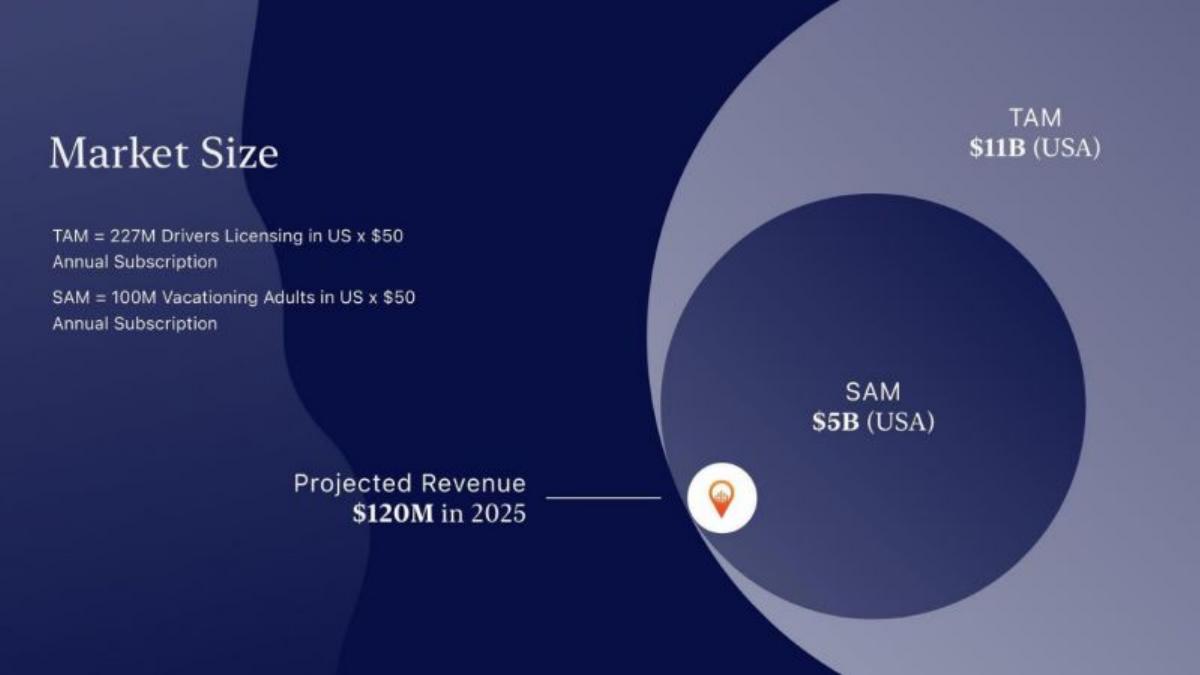
- The company identifies a TAM of $11B based on 227M licensed drivers in the US paying a $50 annual subscription (Slide 5).
- Kevin Costner is listed as a Co-Founder, providing immediate brand equity and high-quality narration (Slide 7).
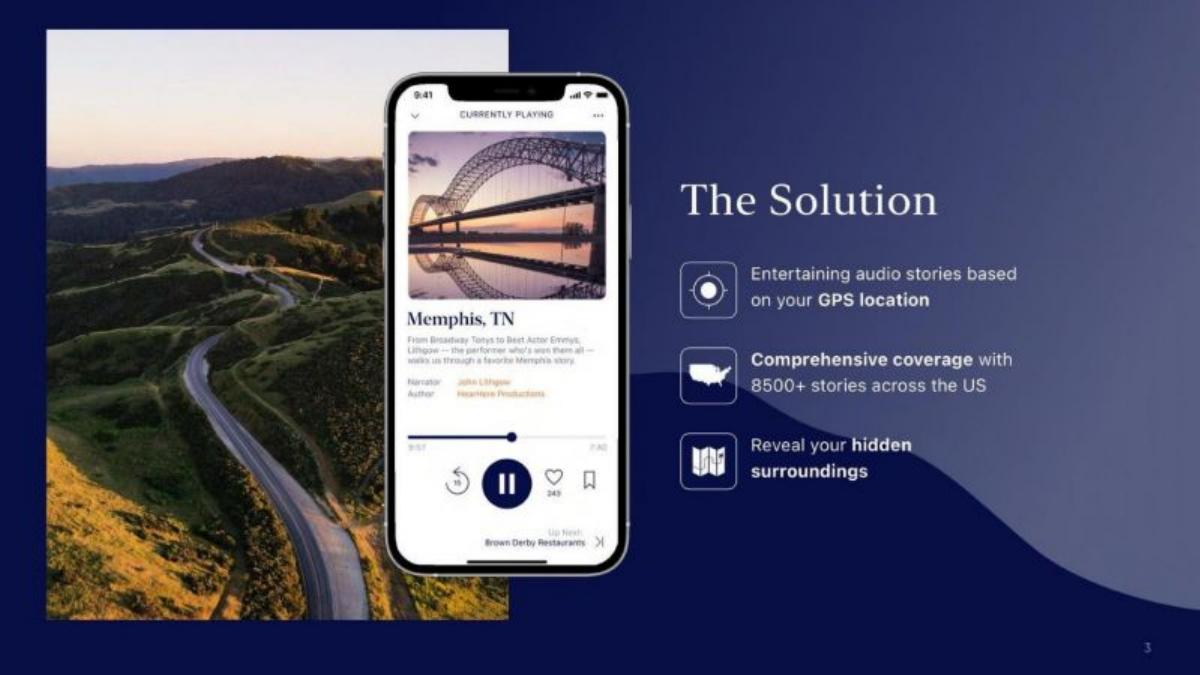
- The platform launched with a significant content moat of 8,500+ stories across the US (Slide 3).
- Monetization is split between a $35.99 annual subscription and one-time payments of $29.99 for 30 days or $69.99 for 3 years (Slide 8).
- The team includes deep industry expertise, such as a Co-Founder who was the former President of The North Face (Slide 7).
- Strategic institutional investors include AAA, Camping World, and the Yellow Accelerator by Snap Inc. (Slide 14).
- HearHere projects reaching $120M in revenue by 2025 (Slide 5).
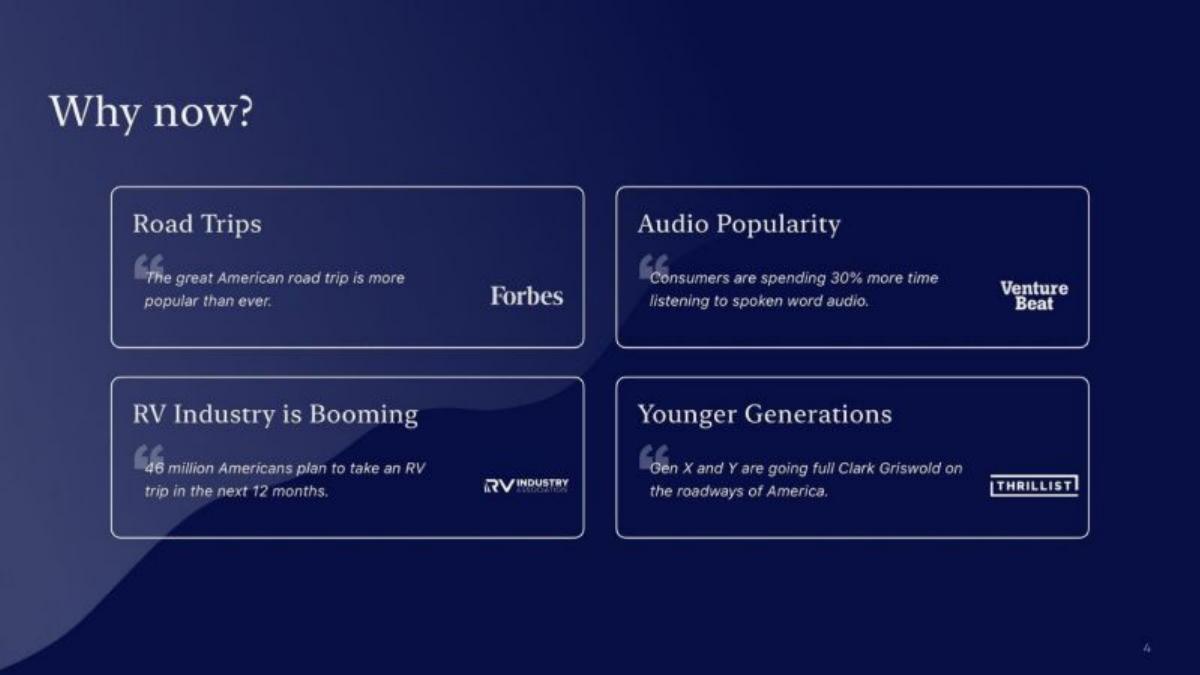
- The 'Why Now' slide cites a 30% increase in time spent listening to spoken word audio (Slide 4).
The Hook: Location-Based Storytelling
HearHere enters the market with a clear, evocative value proposition: 'You’ve never taken a trip like this.' Slide 1 sets the tone with high-quality lifestyle imagery, immediately positioning the product as a travel companion rather than just another utility app. The sub-headline, 'Location-based audio stories for road trips,' provides the necessary functional context.
The Opportunity and Problem (Slides 2-4)
Slide 2 frames the 'Opportunity' around the curiosity of travelers. It asks, 'How many times have you driven past a small town and wanted to know more?' This is a relatable emotional hook. The slide also includes a key statistic: 60% of Americans plan to travel more in 2021 than 2019, grounding the emotional appeal in post-pandemic travel trends.
The 'Solution' (Slide 3) introduces the product interface. It emphasizes three pillars: GPS-based stories, comprehensive coverage (8,500+ stories), and the ability to 'reveal your hidden surroundings.' By showing the app UI, HearHere proves the product is more than just an idea; it is a functional platform with significant content depth.
Slide 4, 'Why now?', uses third-party validation from Forbes, Venture Beat, and the RV Industry Association. The most compelling figure here is that 46 million Americans plan to take an RV trip in the next 12 months. This specific segment (RV travelers) represents a high-intent, captive audience for long-form audio content.
Market Size and Projections (Slide 5)
HearHere presents a TAM (Total Addressable Market) of $11B. They calculate this by multiplying 227M licensed drivers in the US by a $50 annual subscription. The SAM (Serviceable Addressable Market) is narrowed to 100M 'Vacationing Adults,' resulting in a $5B market. While the $50 price point used for calculation is slightly higher than their actual $35.99 annual sub listed later, it establishes the scale of the ambition. Most notably, they project $120M in revenue by 2025, a bold target that suggests they expect rapid adoption or additional revenue streams not fully detailed in the primary slides.
The Product Experience (Slide 6)
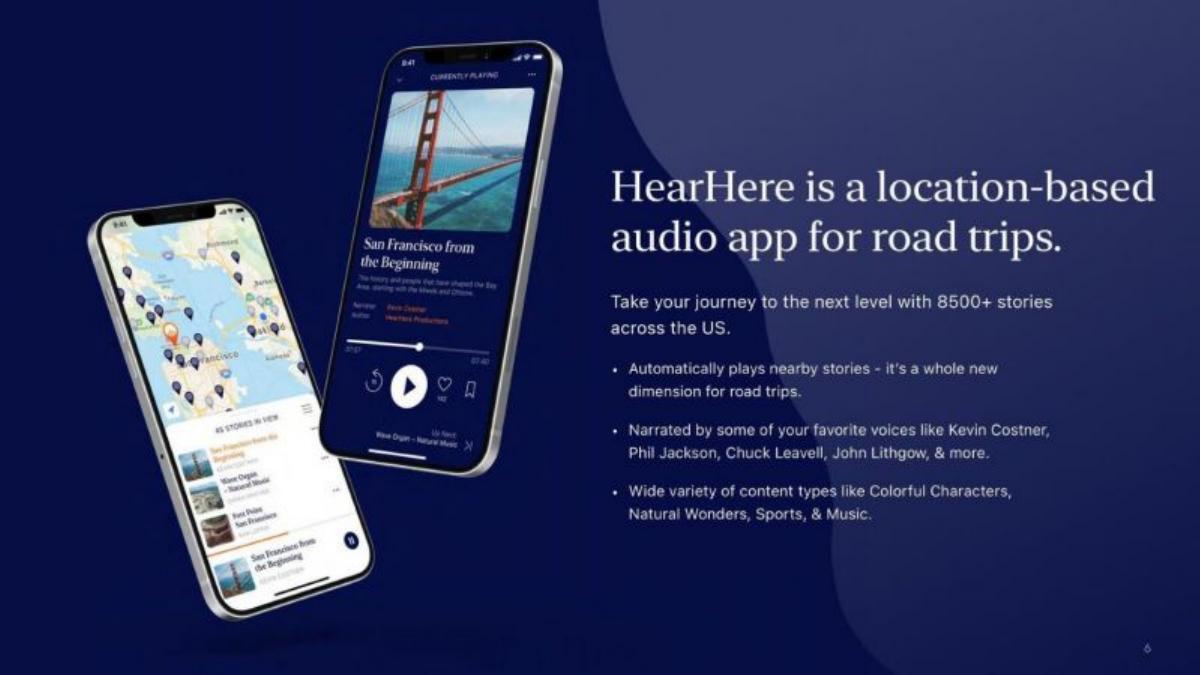
This slide reiterates the core features but adds a crucial detail: the narrators. By name-dropping Kevin Costner, Phil Jackson, and John Lithgow, HearHere moves from a 'tech' pitch to a 'media' pitch. This isn't just an algorithm; it's a curated, premium content experience. The mention of 'Colorful Characters, Natural Wonders, Sports, & Music' suggests a broad content strategy designed to appeal to diverse demographics.
The Power of the Team (Slide 7)
The 'Team' slide is perhaps the strongest in the deck. It features:
Woody Sears (CEO): Founder of iStoryTime (acquired) with 18 years in mobile software. · Bill Werlin (Content): Former President of The North Face and GM at Patagonia Japan. · Kevin Costner (Co-Founder): Academy Award winner. · Sean O'Brien (CMO/CTO): Inc. 5000 CMO with Stanford/Wharton credentials.
This team covers all the bases: technical execution, brand building in the outdoor space, and world-class storytelling. The inclusion of logos like Disney, Tesla, and Patagonia adds significant weight to their professional backgrounds.
Business Model and Monetization (Slide 8)
HearHere’s business model is refreshingly simple. They break it down into four stages: Create, Experience, Amplify, and Monetize. The 'Create' stage mentions a content team of 22 researchers, writers, and narrators, which explains how they reached the 8,500-story milestone. The 'Monetize' section lists three clear price points:
$29.99 for 30 days (One-time) · $35.99 for 1 year (Annual Subscription) · $69.99 for 3 years (One-time)
This structure is well-suited for travel. The 30-day pass captures the 'one big summer trip' user, while the annual sub targets the enthusiast.
Social Proof and Competitive Advantage (Slides 11-12)
Slide 11 ('Press') displays a 'who's who' of media logos, including TechCrunch, Forbes, and Business Insider. This level of coverage is rare for a Seed-stage startup and likely a direct result of the celebrity co-founder's involvement.
Slide 12 ('Competitive Advantage') uses a map of the US covered in pins to visualize their '8500+ Stories & Growing.' They claim to be the 'First Nationwide Platform,' positioning themselves as the incumbent in a new category. A quote from Kevin Costner—'HearHere could be the biggest thing I’ve ever been a part of'—serves as the ultimate endorsement.
Investment and Advisors (Slides 14-15)
The 'Investment' slide (Slide 14) shows a mix of institutional and angel support. Notable names include AAA and Camping World, which are strategic partners that can provide direct access to their target customer base (drivers and RVers). The 'Angels' list includes executives from Bloomberg, Masterclass, and PIMCO, indicating a high level of confidence from sophisticated individual investors.
Slide 15 lists 'Strategic Advisors,' including the former Division CFO at Bloomberg and the former Sonos Global PR Director. This reinforces the idea that the company is surrounded by experts in finance, audio hardware, and public relations.
What Works in This Deck
1. Unfair Advantage: The involvement of Kevin Costner is not just a gimmick; it is integrated into the product (narration) and the brand. This provides a massive advantage in customer acquisition and press coverage.
2. Content Moat: Launching with 8,500 stories is a significant barrier to entry. A competitor would need substantial capital and time to replicate this library of 'Original IP.'
3. Strategic Alignment: The investors (AAA, Camping World) are perfectly aligned with the product's use case. This suggests a clear path to distribution that doesn't rely solely on expensive Facebook or Google ads.
What Is Missing
1. Unit Economics: There is no mention of Customer Acquisition Cost (CAC) or Lifetime Value (LTV). While this is a Seed round, investors would want to know if the $35.99 annual fee can support the cost of acquiring a user through traditional digital channels.
2. Engagement Metrics: The deck lacks data on how long users spend in the app, how many stories they listen to per trip, or any early retention data from a beta or soft launch.
3. Tech Stack: For a 'location-based' app, there is very little detail on the underlying technology. How do they handle offline mode in areas with poor cell service (common on road trips)? This is a critical functional question for this specific product category.
What a Founder Should Copy
1. The 'Why Now' Slide: HearHere does an excellent job of stacking multiple trends (audio growth, RV sales, post-pandemic travel) to create a sense of urgency.
2. Visualizing the Moat: Using a map covered in pins (Slide 12) is a much more effective way to show '8,500 stories' than just writing the number. It makes the scale of the work feel tangible.
3. Tiered Pricing: Offering a 30-day, 1-year, and 3-year option is a smart way to handle the 'seasonal' nature of travel. Founders in the travel space should look at this as a way to reduce friction for users who don't want a recurring subscription for a one-time event.
Frequently asked questions
- How does HearHere monetize its user base?
- HearHere employs a multi-tiered pricing strategy shown on slide 8. They offer a 30-day access pass for a one-time payment of $29.99, an annual subscription for $35.99, and a three-year 'long-haul' pass for a one-time payment of $69.99. This allows them to capture revenue from both one-off vacationers and frequent travelers.
- What is HearHere's primary competitive advantage?
- According to slide 12, their advantage lies in being the 'First Nationwide Platform' with over 8,500 stories and original IP. This is bolstered by their 'Strategic Partnerships' and the star power of co-founder Kevin Costner, whose involvement provides a level of marketing reach and content quality that is difficult for competitors to replicate.
- Who are the key members of the HearHere team?
- The team is led by CEO Woody Sears, who previously founded iStoryTime. Other key figures include Bill Werlin (former President of The North Face), Kevin Costner (Academy Award winner), and Sean O'Brien (CMO/CTO). This mix of tech, retail, and entertainment experience is a core pillar of their pitch (Slide 7).
- What market trends is HearHere capitalizing on?
- Slide 4 highlights four key trends: the increasing popularity of road trips, a 30% growth in spoken word audio consumption, a 'booming' RV industry with 46 million Americans planning trips, and the high travel intent of Gen X and Y generations.
- Is there any mention of user growth or retention in the deck?
- The deck is notably silent on historical user growth, active users (MAU/DAU), or retention rates. It focuses heavily on the 'Opportunity' and 'Market Size' rather than past performance metrics, which is common for Seed-stage companies focusing on the scale of the vision and the strength of the initial content library.