Trash Warrior's 2019 pre-seed deck is a textbook example of a marketplace pitch. By identifying a specific macro-economic catalyst—China's refusal to accept U.S. waste—the founders framed a 'once in a lifetime' opportunity to rebuild a $56B annual commercial collection market. The deck successfully contrasts the high-cost, low-tech incumbents like 1-800-Got-Junk against their own $70 on-demand service. While the deck lacks a formal 'Ask' slide detailing the specific use of funds, its strong traction metrics (60% MoM GMV growth) and high-pedigree team (ex-Niantic, McKinsey, and Visa) provided…
Key takeaways
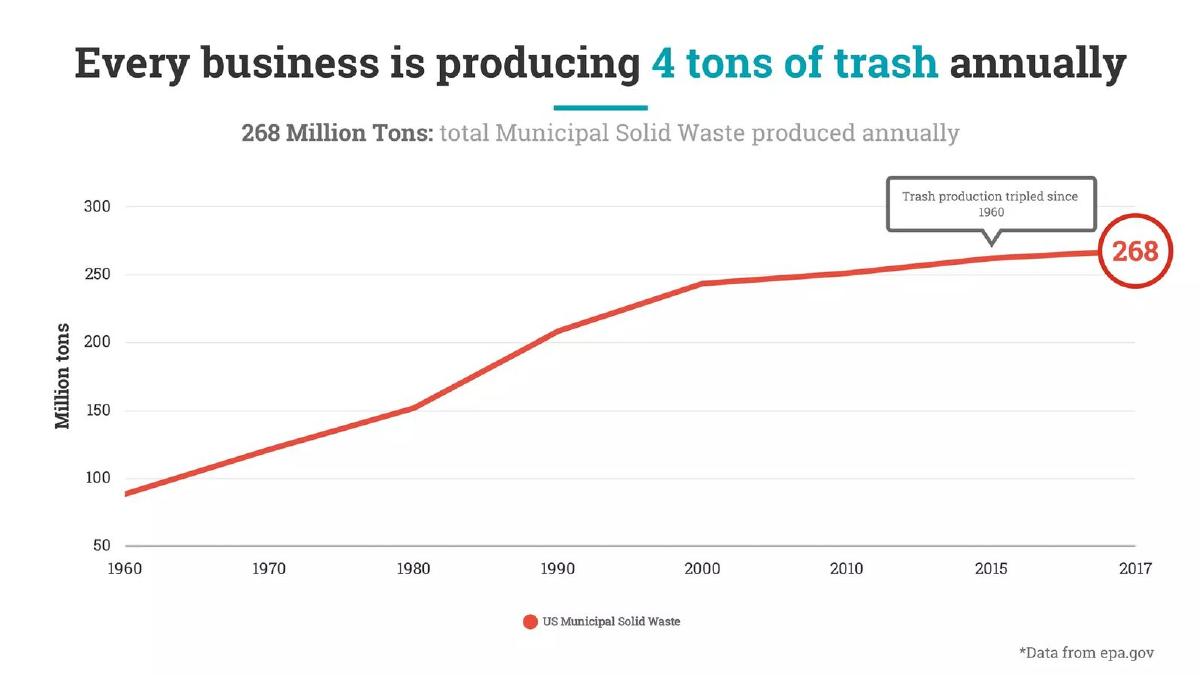
- The deck identifies a massive market opportunity, citing $268 million tons of municipal solid waste produced annually on slide 2.
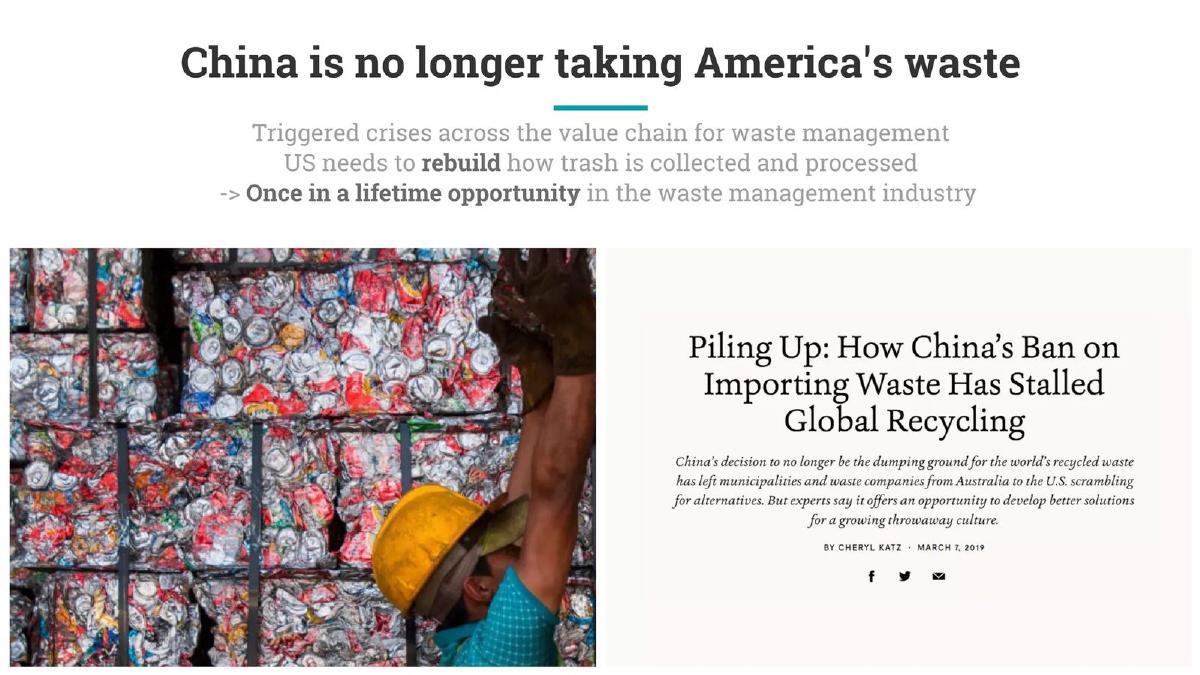
- Macro-economic timing is used as a lever, specifically referencing China's ban on importing waste as a crisis for the value chain on slide 3.
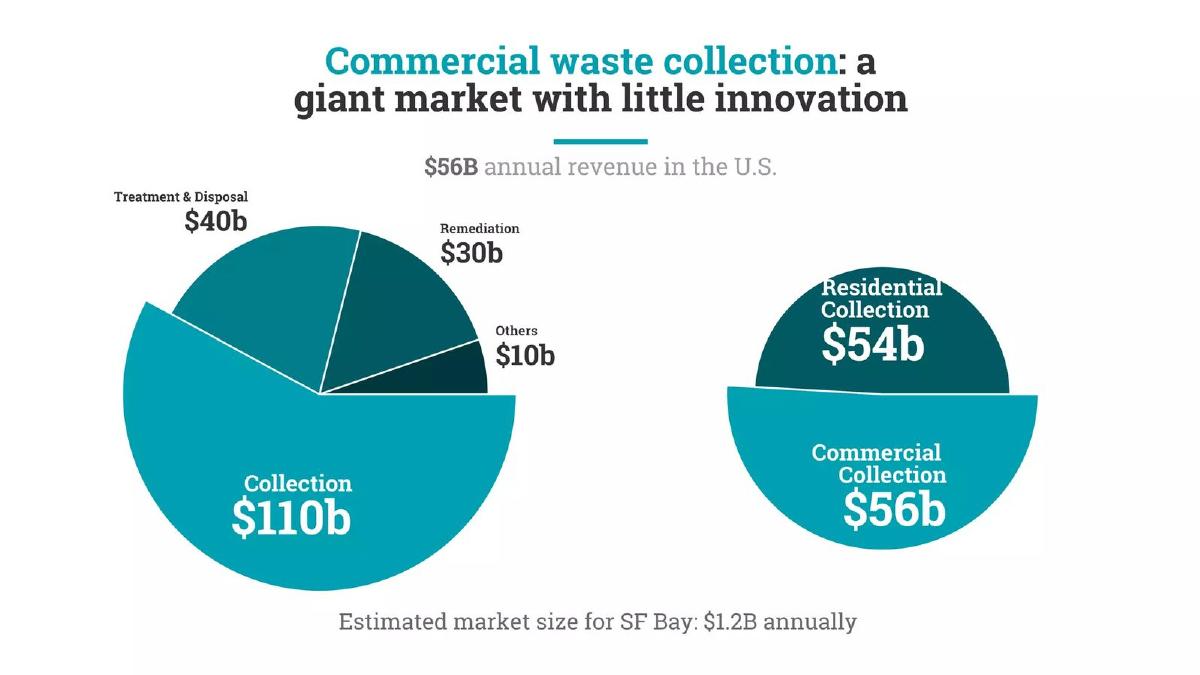
- Market sizing is granular, breaking down the $110B collection market into a $56B commercial opportunity on slide 4.
- Direct price comparison is a core strategy, showing Trash Warrior at $70 versus a competitor's $430 for the same service on slides 9 and 10.
- Traction is demonstrated through a 60% average month-over-month GMV growth rate since launch on slide 11.
- The product is shown in a functional state, with a five-step 'How it works' flow featuring screenshots of the beta app on slide 7.
- The team slide emphasizes marketplace and growth experience, including roles at Niantic, McKinsey, and Visa on slide 14.
- The deck omits a specific financial 'Ask' slide, failing to state the exact amount being raised or the intended allocation of capital.
Trash Warrior: The On-Demand Waste Management Teardown
In 2019, Trash Warrior set out to modernize one of the least glamorous but most essential industries: waste management. This 17-slide pre-seed deck was the vehicle for a $150,000 raise, positioning the company as a tech-forward marketplace in a sector dominated by 'rent-seeking incumbents' and fragmented 'guys with trucks.' The deck relies heavily on a clear problem-solution narrative and strong early growth numbers.
Slide 1: Title and Mission
The cover slide is minimalist, featuring the company name and the tagline: "On-Demand Waste Management at Your Fingertips." It immediately establishes the 'Uber for X' framework, which was a highly recognizable pitch pattern in 2019. The inclusion of the website URL suggests a product that is already live and accessible.
Slides 2-3: The Macro Problem
Slide 2 uses EPA data to show that U.S. municipal solid waste production has tripled since 1960, reaching 268 million tons . This establishes the scale of the sector. Slide 3 introduces the 'Why Now?' factor: China's ban on importing American waste. The deck calls this a "once in a lifetime opportunity" to rebuild the waste value chain, moving the problem from a general environmental concern to a specific, urgent market disruption.
Slide 4: Market Sizing
Trash Warrior narrows its focus to commercial waste collection. The slide breaks down the $110B collection market , identifying a $56B annual revenue opportunity in the U.S. commercial sector specifically. They also provide a local validation point: an estimated $1.2B annual market size for the SF Bay Area , which serves as their initial launchpad.
Slide 5: The Competitive Landscape
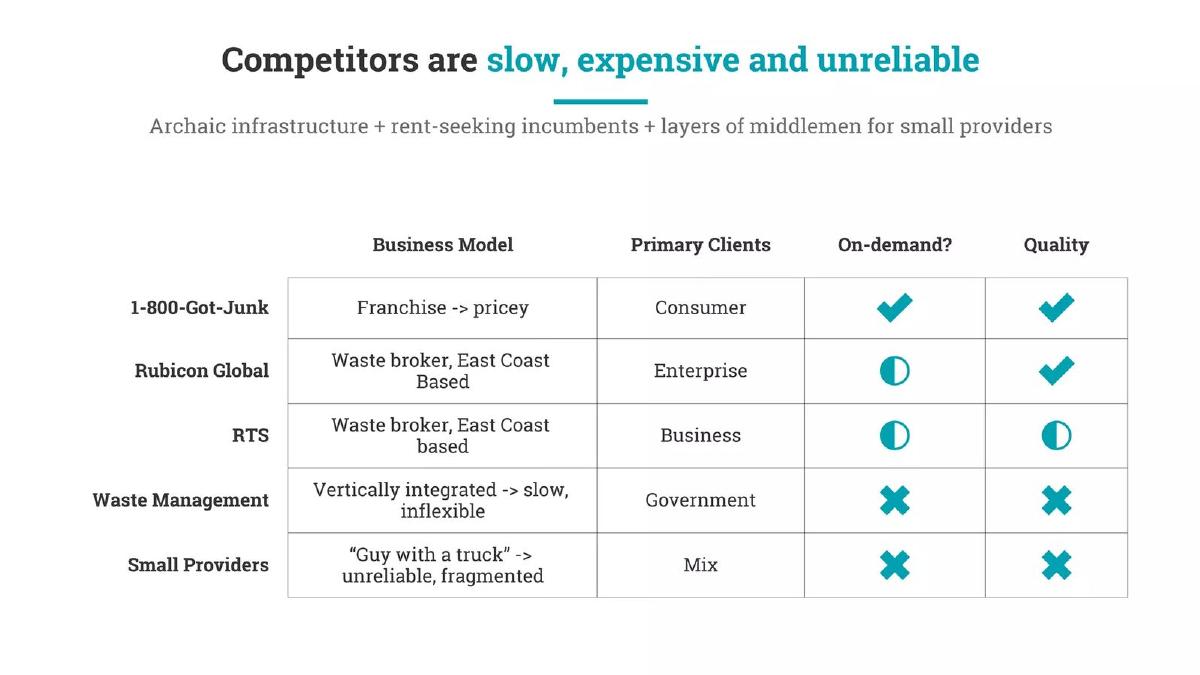
This slide uses a standard comparison grid to attack incumbents. 1-800-Got-Junk is labeled as "pricey," while Waste Management is described as "slow" and "inflexible." The 'Small Providers' (the 'guy with a truck') are dismissed as "unreliable" and "fragmented." By checking the 'On-demand' and 'Quality' boxes for themselves, Trash Warrior positions itself as the only modern alternative.
Slide 6: The Marketplace Value Proposition
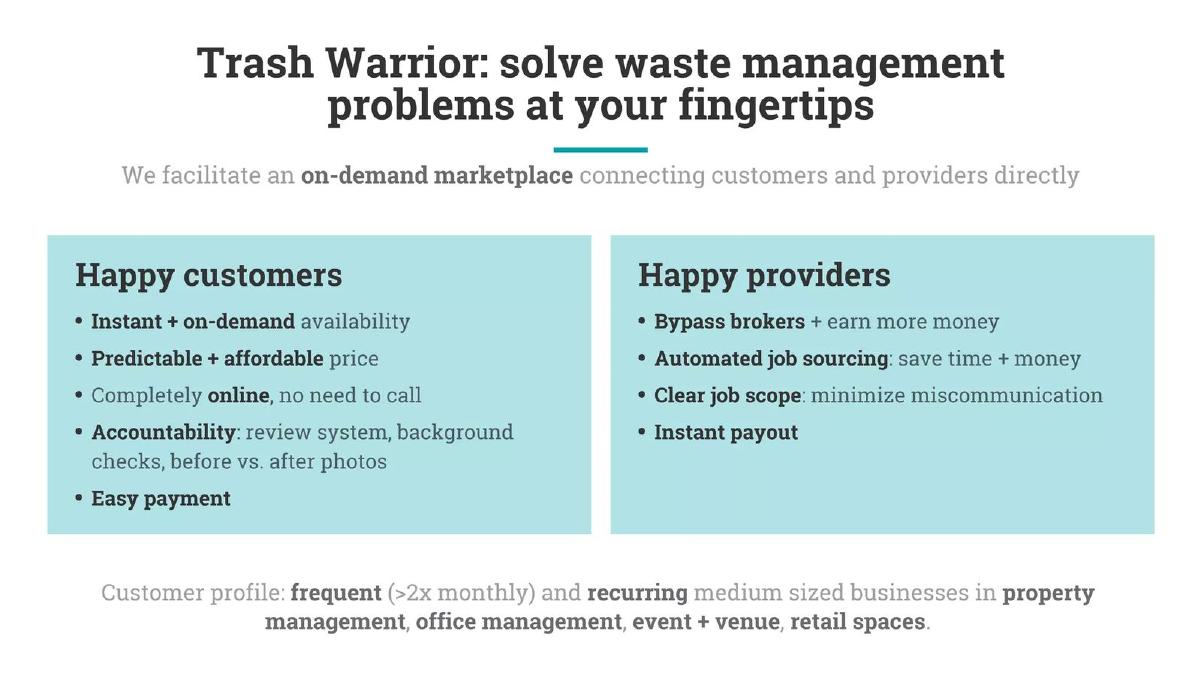
Marketplaces live or die by their two-sided utility. For customers, the promise is "instant + on-demand availability" and "predictable + affordable price." For providers, the hook is the ability to "bypass brokers" and receive "instant payout." The slide also defines their target customer profile: medium-sized businesses in property management, retail, and events who require service more than twice monthly.
Slide 7: Product Walkthrough
The 'How it works' slide is crucial for early-stage decks. It shows five screenshots of the mobile app, from booking to rating the service. This proves that the "MVP in beta" is a functional reality, not just a concept. The mention of the beta launching in 09/2019 provides a timeline for the traction data that follows.
Slides 8-10: The Case Study (Price Disruption)
These three slides tell a specific story. Slide 8 shows a photo of a pile of boxes with the quote, "My business needs to remove these boxes." Slide 9 shows that 1-800-Got-Junk would charge $430 for this, while Craigslist is a gamble between $20 and $400. Slide 10 delivers the punchline: "Trash Warrior provided the same service at $70." This 80%+ price reduction is a powerful argument for a marketplace's ability to squeeze out inefficiency.
Slide 11: Traction and Growth
This is the 'money slide.' It shows a bar chart of GMV from September 2019 to March 2020. The headline claims an "avg. 60% MoM growth." They report a "$560K annualized GMV" by month seven. For a pre-seed round, these growth rates are the primary signal investors look for to validate product-market fit.
Slides 12-13: Social Proof
Slide 12 displays logos of early customers, including Blick Art Materials, Grove Collaborative, and Vanguard Properties . They claim that "52% of customers would be very disappointed without Trash Warrior," a nod to the Sean Ellis test for product-market fit. Slide 13 provides 'Provider Personas' (David and Gilberto), humanizing the supply side of the marketplace and explaining how the app helps them automate sourcing.
Slide 14: The Team
The team slide is high-pedigree. CEO Lily Shen is noted as a founding data scientist at Niantic (the makers of Pokemon Go) and a former consultant at McKinsey and Deloitte . Lumin Chen (Growth) is a former founder with experience at Visa and Cornerstone Consulting . This combination of data science, consulting, and growth hacking is tailored to appeal to Silicon Valley investors.
Slide 15: Backers and Advisors
The deck lists impressive early support, including 500 Startups (current batch), Lightspeed Ventures (scout fund), and Alumni Ventures Group . Individual advisors include the CPO of Lyft and a co-founder of Caviar , reinforcing the 'on-demand marketplace' expertise surrounding the founders.
Slide 16: The Vision and Roadmap
The roadmap is ambitious. It moves from immediate pain points (2019-21) to "Smart sorting to improve recycling" (2021-24). The ultimate goal is to improve the U.S. recycle rate from 35% to 79% . This adds a 'mission-driven' layer to the pitch, suggesting that the company isn't just a trash hauler, but a data-driven sustainability platform.
Slide 17: Contact and Call to Action
The final slide provides contact information and repeats the goal: "Help us solve the 268 million tons of trash in the US!" It includes links to the landing page and the MVP, maintaining the focus on the live product.
What Trash Warrior Did Well
Direct Price Comparison: The three-slide sequence comparing their $70 price point to the $430 incumbent price is the most effective part of the deck. It makes the value proposition undeniable. · Macro-Timing: Connecting the business to the China waste ban gives the pitch a sense of urgency that a generic 'trash app' would lack. · Traction Clarity: Showing MoM GMV growth in a simple bar chart provides the 'up and to the right' visual that investors crave. · Team-Market Fit: The founders' backgrounds in data science and growth are perfectly aligned with the needs of a marketplace startup.
What Was Missing
The Ask: The deck never states how much money they are raising. While the catalogue facts say $150K, a founder should typically include a slide detailing the round size and the milestones that capital will unlock. · Unit Economics: While they show the price to the customer, they don't show the margin. How much of that $70 goes to the provider? What is the cost to acquire that customer? · Retention Data: For a service that claims to be 'recurring,' showing repeat purchase rates or cohort retention would have strengthened the traction slide significantly.
Founder's Playbook: Lessons to Copy
Use 'Why Now' Slides: Don't just explain the problem; explain why the problem is solvable right now due to external shifts (like the China waste ban). · Show, Don't Just Tell: The screenshots of the app on Slide 7 and the photo of the actual trash pile on Slide 8 make the business feel tangible. · Leverage Advisor Logos: If you have high-profile advisors from relevant companies (Lyft, Caviar, Groupon), feature them prominently to borrow their credibility in your specific niche. · Granular Market Sizing: Instead of just saying 'Waste is a $100B market,' Trash Warrior broke it down into collection vs. disposal, and commercial vs. residential. This shows a deep understanding of where the actual revenue lies.
Frequently asked questions
- How much did Trash Warrior raise with this deck?
- According to the catalogue facts, Trash Warrior raised $150,000 in a pre-seed round in 2019. The deck itself does not explicitly state the amount raised or the valuation sought, which is common in early-stage decks that are used as conversational aids rather than standalone financial documents.
- Who are the primary competitors identified in the pitch?
- Slide 5 identifies several competitors across different tiers: 1-800-Got-Junk (franchise model), Rubicon Global and RTS (waste brokers), Waste Management (vertically integrated incumbent), and 'Small Providers' (fragmented independent operators). The deck characterizes these incumbents as slow, expensive, and unreliable.
- What is the core value proposition for the service providers?
- On slide 6, Trash Warrior highlights that providers can 'bypass brokers' to earn more money. The platform offers automated job sourcing to save time and 'instant payout' features. This addresses the pain points of small hauling businesses who typically struggle with finding new clients and waiting for payment cycles.
- What traction metrics did the company show?
- The company demonstrated significant early momentum on slide 11, reporting an average of 60% month-over-month growth in Gross Merchandise Value (GMV). By March 2020, just seven months into operations, they reached an annualized GMV of $560,000 within the San Francisco Bay Area.
- What is missing from the Trash Warrior pitch deck?
- The most notable omissions are a clear 'Ask' slide (detailing how much money is needed and what it will be spent on) and a detailed 'Unit Economics' slide. While they show a price comparison, they do not break down their take rate, margins, or customer acquisition costs (CAC) vs. lifetime value (LTV).