Marketplace Competition Slide: Real Pitch Deck Examples
How marketplace startups show competition in a pitch deck: commission rates, the offline and informal alternatives, and why users would switch.
Marketplace Competition Slide: Real Pitch Deck Examples
Seven competition slides from marketplace startups, shown in full, compare how each positions itself against other platforms, and against the offline way people trade today.
TL;DR
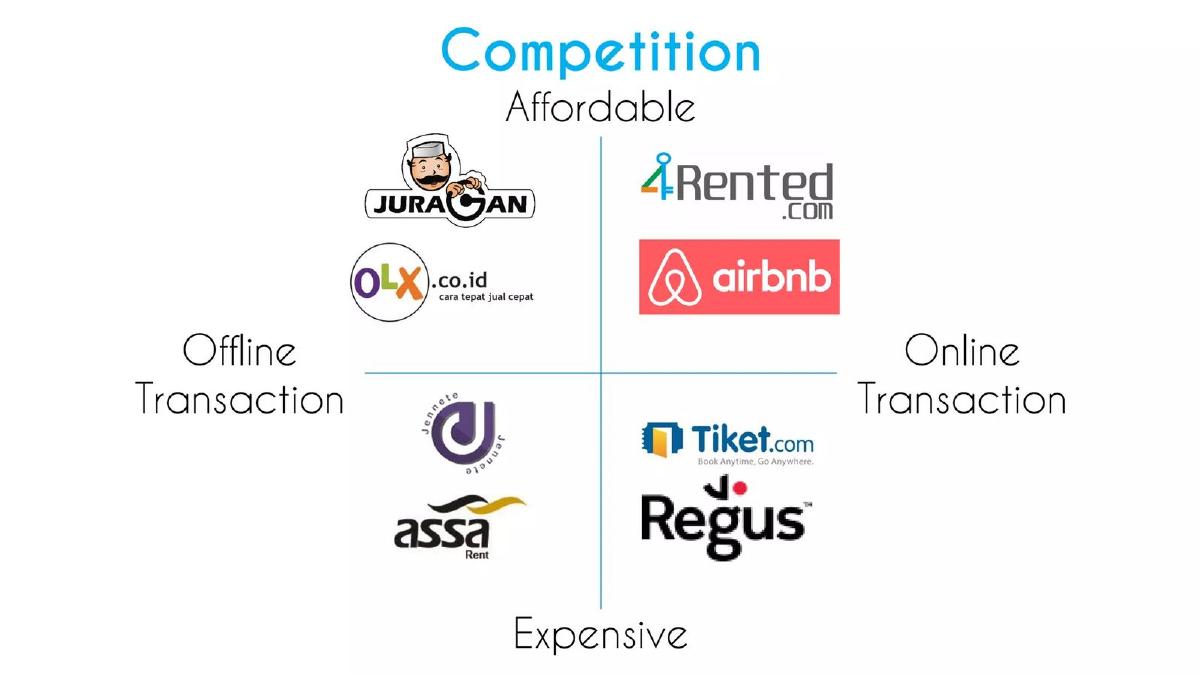
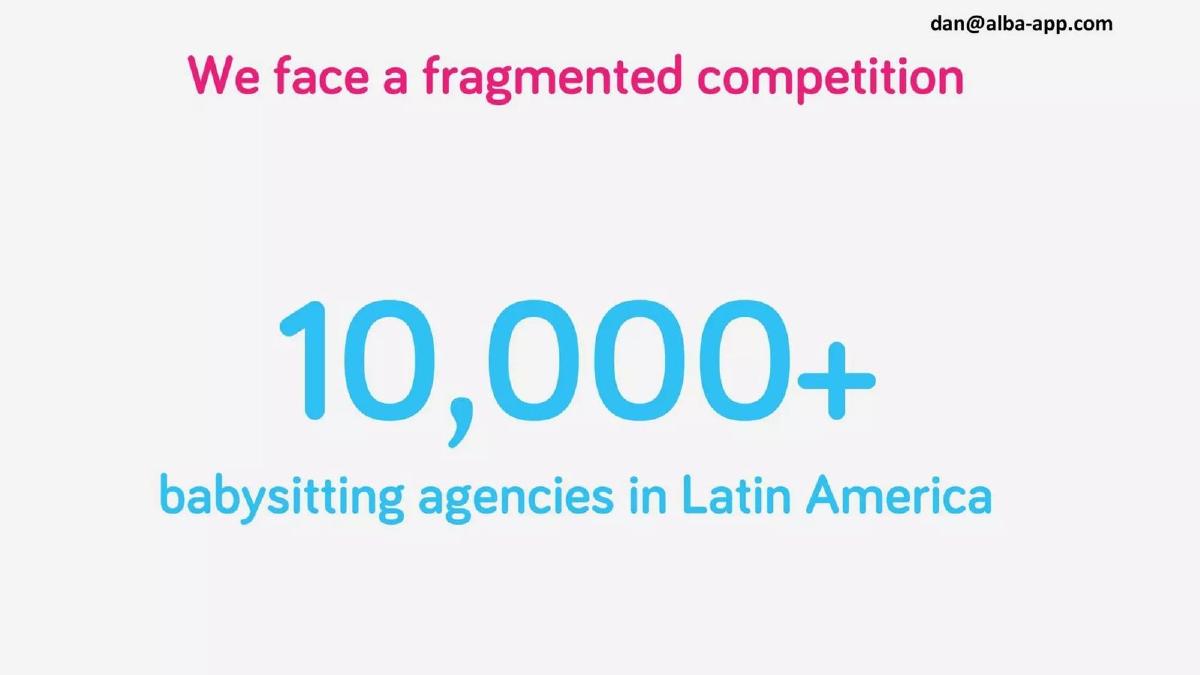
A marketplace competes on two things investors can compare: what it charges each side and whether it beats the way people already deal with each other, often offline. The strongest slides put the commission next to rivals' commissions: Kangarooo shows 25% against Viator's 30% and two local sites at 35%; Reality Loops lists 10% against 12% to 30%. They also name the informal option as a competitor: Smatbeba has an "Informal Sector" quadrant ("unpredictable pricing", "lack of safety"), Trash Warrior lists "Small Providers" ("guy with a truck"), and 4Rented splits rivals into offline and online transactions. A slide that only names other apps (Instaparty) or only counts rivals (Alba's "10,000+ babysitting agencies") doesn't show why either side would switch.
Marketplace competition slides from real pitch decks
Each example shows the exact stored slide above its analysis and links to the full teardown. Figures are as shown on the slides; we have not verified them.
Kangarooo competition slide — slide 6
Australian tours marketplace. Commission and cancellation terms compared.
Kangarooo deck, slide 6. Exact stored slide matched to this analysis.
Our analysis: Commission speaks to tour operators; free cancellation speaks to travellers. Each side gets a reason.
Evidence and limitation: Commission and cancellation terms for four platforms.
What a founder can adapt: Put your take rate and one buyer-facing term in the first two rows.
Supporting analysis
What the deck claims: "COMPETITION — Australian market focus, hustle free cancellation, and lower commissions are our keys to dominate the market." Table: Platform Commission — Kangarooo 25%, Viator 30%, Discover Australia 35%, ToursToGo 35%. Cancellation fee: free, free, 100%, 20%. Also Market Focus, Mobile Optimized, Corporate Retreats.
Presentation choice: Every row is a checkable fact rather than a tick-box opinion.
When it does not fit: Explain how 25% stays profitable when Viator can match it.
On-demand transport in Kenya. The informal sector as a named competitor.
Smatbeba deck, slide 5. Exact stored slide matched to this analysis.
Our analysis: It places the informal sector (affordable but inconvenient) on the same map as funded rivals.
Evidence and limitation: No figures.
What a founder can adapt: Put the informal or offline option on your map with its specific weaknesses.
Supporting analysis
What the deck claims: "Competition" map with axes Convenient–Inconvenient and Expensive–Affordable. Sendy: "Mainly focuses on B2B and urban clients (Expensive)". Kobo 360: "Mainly focuses on B2B and the retail sector". Informal Sector: "Inconsistency in quality of service", "Unpredictable pricing", "Lack of safety", "Lack of transparency". Smatbeba: "efficient transport at low prices to the mass market (urban and rural markets)".
Presentation choice: In many markets the informal option is what customers use now; ignoring it misreads the competition.
When it does not fit: Add a price comparison to support "affordable".
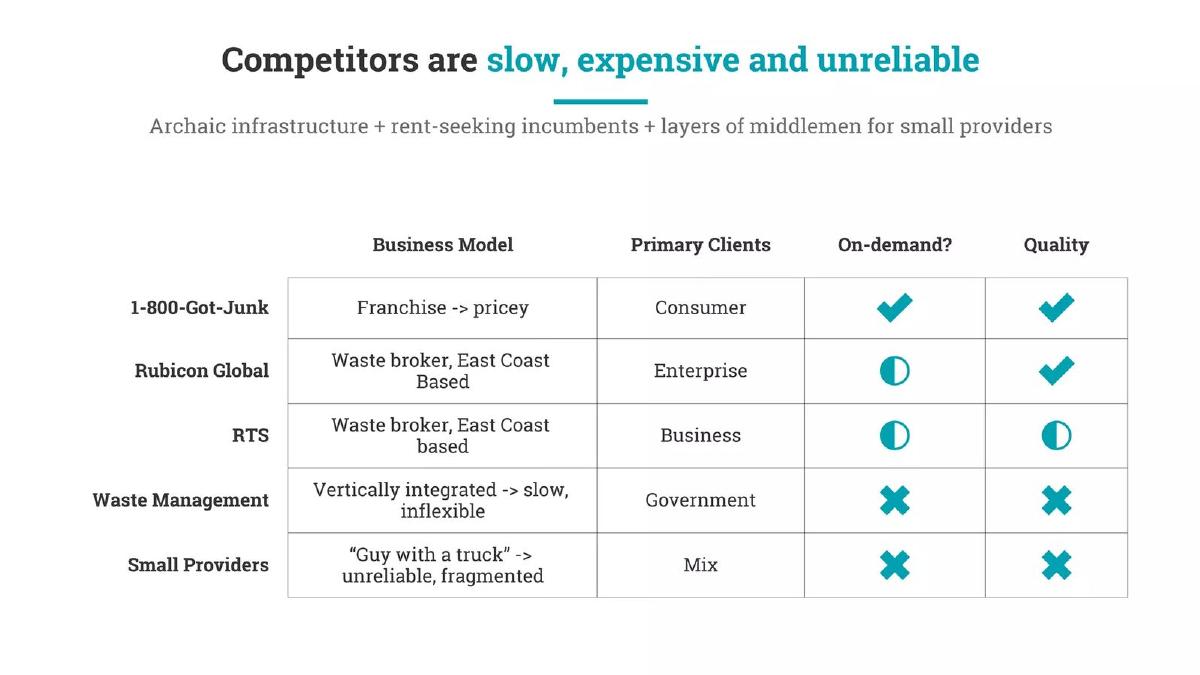
On-demand waste hauling marketplace. Incumbents, brokers and small providers.
Trash Warrior deck, slide 5. Exact stored slide matched to this analysis.
Our analysis: It covers every competitor type: franchise, broker, integrated incumbent and the informal supply it wants to organise.
Evidence and limitation: No figures.
What a founder can adapt: If your supply is fragmented, show it as today's option and as your future sellers.
Supporting analysis
What the deck claims: "Competitors are slow, expensive and unreliable. Archaic infrastructure + rent-seeking incumbents + layers of middlemen for small providers." Table: 1-800-Got-Junk (franchise, pricey), Rubicon Global and RTS (waste brokers), Waste Management (vertically integrated, slow), Small Providers ("'Guy with a truck' → unreliable, fragmented"), with columns for primary clients, on-demand and quality.
Presentation choice: The small providers row is both a competitor and the supply Trash Warrior plans to recruit.
When it does not fit: Half-filled circles aren't explained. Replace with a price or response time.
Nightlife booking app. Included as a weaker pattern.
Instaparty deck, slide 6. Exact stored slide matched to this analysis.
Our analysis: It names rivals but compares nothing: no fees, no features, no reason each side would switch.
Evidence and limitation: None.
What a founder can adapt: Turn "more focused value to bar owners" into a fee or a booking number.
Supporting analysis
What the deck claims: "Competition — This space is heating up right now and Instaparty's take on it is far superior." "TableList, YPlan, Gaggyl, barHappy and Guest of a Guest have shown that the tech savvy market segment is demanding this type of product. We represent a more focused value to bar owners and a more valuable approach to users."
Presentation choice: Included as a contrast: a claim of superiority with no evidence.
When it does not fit: Calling your product "far superior" without a comparison.
Whether the take rate and the offline option appear.
Example
Commission shown
Offline or informal option
Format
Kangarooo
Yes (25% vs 30–35%)
No
Table
Reality Loops
Yes (10% vs 10–30%)
No
Table
Smatbeba
No
Yes (informal sector)
2×2 map
Trash Warrior
No
Yes (small providers)
Table
4Rented
No
Yes (offline axis)
2×2 map
Alba
No
Implied (agencies)
Single number
Instaparty
No
No
Paragraph
Key Takeaways
Show your commission next to competitors'. It's the number both sides compare.
Include the offline or informal alternative. For many marketplaces it's the biggest competitor.
Compare from each side's view: what buyers get and what sellers keep.
A lower commission needs a reason it's sustainable, or investors will see a price war.
Fragmentation is an opportunity only if you say how you'll win the scattered supply.
Build your marketplace competition slide
Fill each row from both sides' point of view.
Platforms. Which platforms do your buyers or sellers use today, and what does each charge?
Offline option. How do people trade without a platform, and what goes wrong?
Seller's reason. What does a seller keep or gain by moving to you?
Buyer's reason. What does a buyer get that they don't today?
Copyable framework: We charge [X]% vs [rival] [Y]%. Today most [buyers] use [offline option], which means [problem]. Sellers keep [more / gain]; buyers get [benefit].
Illustrative example 1 — written by us
Before: Our platform is far superior to existing apps.
After: We take 12% vs 20–30% on the two largest apps. Most tutors still find students by word of mouth, so parents can't compare prices or reviews.
What improved: Our illustrative rewrite; figures are invented for the example. It compares commission and names the offline alternative.
What this guide adds
The general competition slide guide covers competitor tables and positioning maps for any startup. Marketplaces face two extra questions: how the take rate compares, and whether users will leave the informal way they already trade. This guide compares how marketplace decks answer both.
The marketplace problem slide guide covers each side's pain; this guide covers who else is already trying to solve it.
Three kinds of marketplace competitor
Other platforms: direct rivals with a commission you can compare (Kangarooo, Reality Loops).
Offline and informal options: agencies, brokers, word of mouth, "a guy with a truck" (Smatbeba, Trash Warrior, 4Rented, Alba).
Vertically integrated incumbents: companies that own the supply themselves, like Waste Management in Trash Warrior's table.
A strong slide covers the first two and says why both sides would move.
Common mistakes
Apps only. Leaving out the offline way people trade today.
No commission. Take rate is the easiest comparison; show it.
All ticks for you. A grid where you win every row isn't believed.
Count, not comparison. "10,000 competitors" needs a reason you'll win.
Unexplained lower fee. Say why a lower commission is sustainable.
Diagnostic checklist
Your commission appears next to competitors'.
The offline or informal alternative is on the slide.
Each side has a reason to switch.
At least one row shows where a rival is stronger.
Every comparison is a fact, not an adjective.
Frequently asked questions
How we chose these examples
Corpus: published pitch deck teardowns on StartupFundraising.com. Founder-uploaded private decks are excluded.
Selection (2026-09-24): we searched extracted text for competition slides in decks that describe a marketplace, and for competition slides mentioning commissions, brokers or offline options, then inspected about twenty candidates. We excluded Nepsify (already in the general competition slide guide), CoinMall (used in the marketplace problem guide), decks whose competition slide image isn't stored (Koala, M&A Nexus, Nanno, Holiday Online) and non-marketplace matches.
Overlap check: the general competition slide guide covers competitor tables and maps for any startup. This guide covers take-rate comparison and offline alternatives specific to marketplaces.
Instaparty is included to show a weaker pattern.
Review: all seven stored slide images were inspected on 2026-09-24 and matched to company, deck and slide number (editorial model review). No person has yet completed an editorial review of this page.
Figures are as shown on the slides; we have not verified them. We make no claim that any slide caused a fundraising outcome.