Marketplace Problem Slide: Showing Pain on Both Sides
How marketplace and platform startups frame the problem in a pitch deck: a separate pain for each side and the reason they can't find each other today.
Marketplace Problem Slide: Showing Pain on Both Sides
Eight problem slides from marketplace and platform startups, shown in full, compare how each explains what goes wrong for each side of the market, and why the two sides aren't already connected.
TL;DR
A marketplace only works if both sides join, so its problem slide has to give each side its own reason. The clearest slides split the page: SafeMotos has "Problem for Customers" (unsafe rides, haggling over price) and "Problem for Drivers" ("under utilisation of motorcycle", "low unit economics per trip"). CGHero labels its halves Supply and Demand. The best also say why the sides aren't connected today: Narrative says "Buyers and Sellers don't know each other" and brokers take "outsized margins". A slide that describes one side only, like Flexpay's freelancer pain, leaves an investor asking why the other side will show up.
Marketplace problem slides from real pitch decks
Each example shows the exact stored slide above its analysis and links to the full teardown. Figures are as shown on the slides; we have not verified them.
SafeMotos problem slide — slide 4
Motorcycle taxi app in Rwanda. One heading per side.
SafeMotos deck, slide 4. Exact stored slide matched to this analysis.
Our analysis: Each side gets a distinct problem: riders want safety and a fair price, drivers want more trips and better earnings.
Evidence and limitation: One unsourced claim about traffic fatalities; the rest is description.
What a founder can adapt: Use two labelled blocks, one per side, each naming a loss that side feels.
Supporting analysis
What the deck claims: "Problem for Customers: Traffic fatalities are Africa's second biggest killer after HIV/AIDS, negotiation of price is a pain and drivers have low levels of customer service." "Problem for Drivers: Under utilisation of motorcycle, no capacity for product differentiation, low unit economics per trip."
Presentation choice: The two headings answer the investor's first marketplace question immediately.
When it does not fit: Source the fatality claim and add a number for driver utilisation.
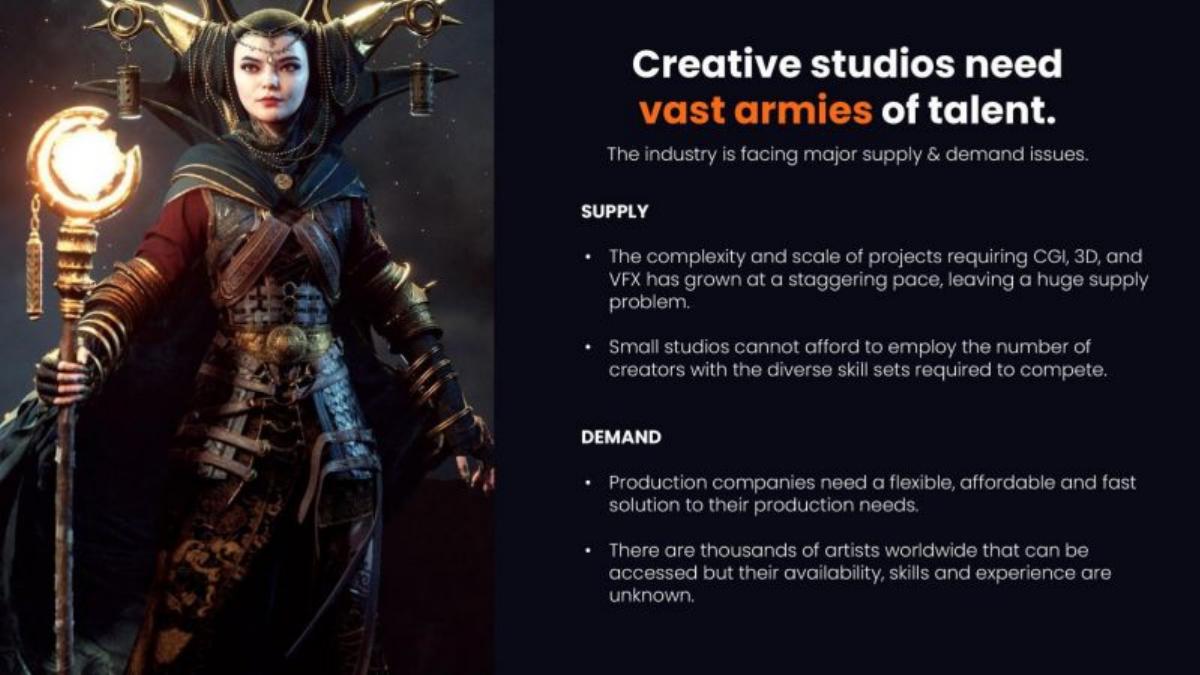
Marketplace for CGI, 3D and VFX artists. Supply and demand labelled.
CGHero deck, slide 3. Exact stored slide matched to this analysis.
Our analysis: The last line names the gap: artists exist, but studios can't see who is available or qualified.
Evidence and limitation: No figures.
What a founder can adapt: End with the information or trust gap that keeps the sides apart.
Supporting analysis
What the deck claims: "Creative studios need vast armies of talent. The industry is facing major supply & demand issues." Supply: projects have grown "leaving a huge supply problem"; "Small studios cannot afford to employ the number of creators". Demand: "Production companies need a flexible, affordable and fast solution"; "thousands of artists worldwide... but their availability, skills and experience are unknown."
Presentation choice: It explains why the market isn't already working, not just that both sides want something.
When it does not fit: The Supply and Demand labels are swapped in places (the studio's hiring cost sits under Supply). Keep each side's points under its own heading.
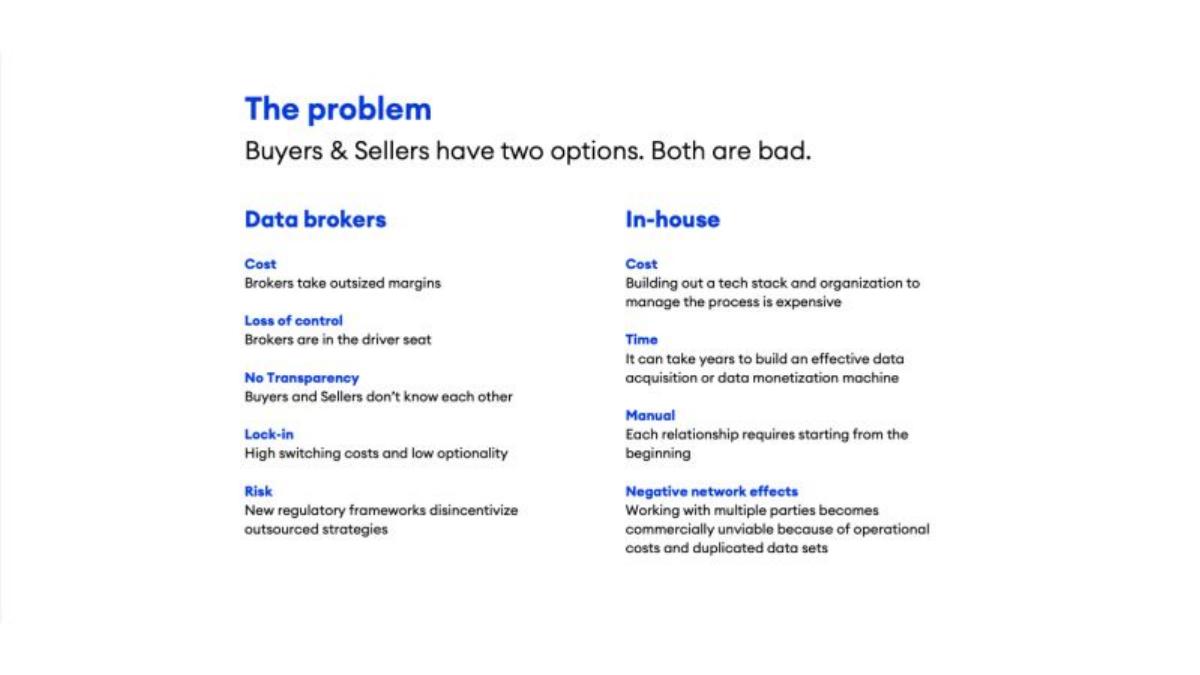
Data marketplace. Both sides' current options compared.
Narrative deck, slide 2. Exact stored slide matched to this analysis.
Our analysis: Instead of splitting by side, it compares the two ways both sides trade today, and why each fails.
Evidence and limitation: No figures.
What a founder can adapt: If both sides share the same problem, compare today's alternatives instead of the sides.
Supporting analysis
What the deck claims: "The problem — Buyers & Sellers have two options. Both are bad." Data brokers: "Brokers take outsized margins", "Brokers are in the driver seat", "Buyers and Sellers don't know each other", "High switching costs". In-house: "Building out a tech stack... is expensive", "It can take years", "Each relationship requires starting from the beginning".
Presentation choice: Naming the middleman and its margin shows exactly where a marketplace creates value.
When it does not fit: Quantify the broker margin; "outsized" invites the question "how much?"
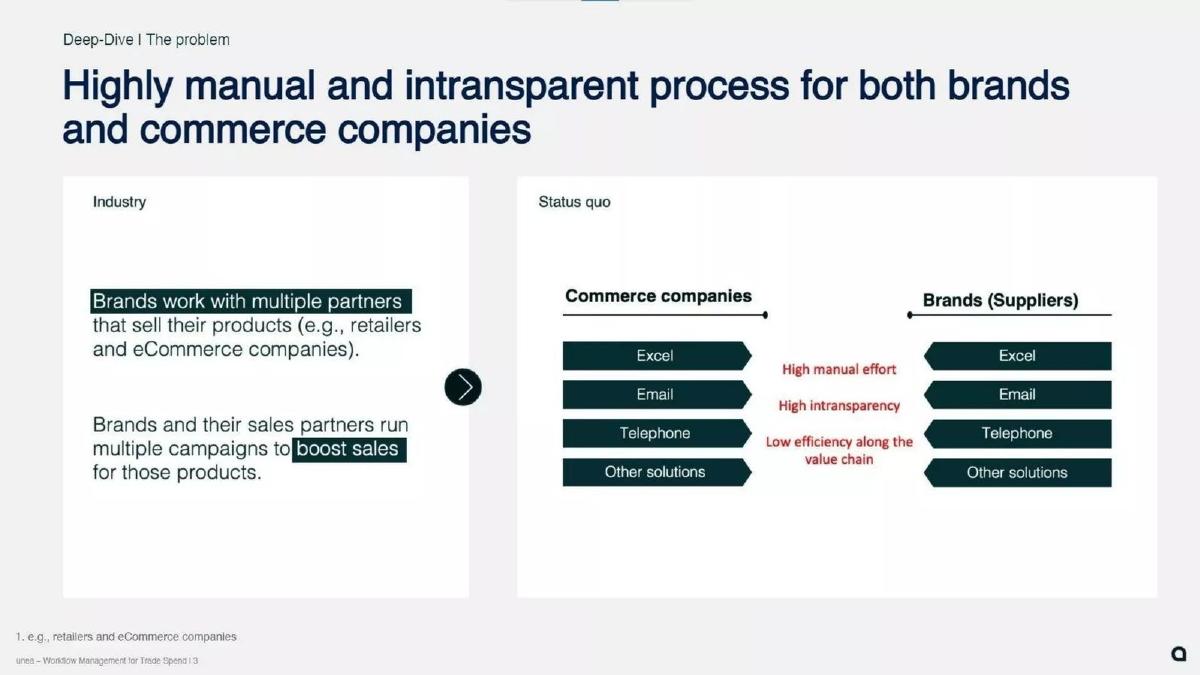
B2B platform between brands and retailers. The shared process shown as a diagram.
Unea deck, slide 3. Exact stored slide matched to this analysis.
Our analysis: The mirrored columns show both sides stuck with the same tools, and the problem sits in the middle.
Evidence and limitation: No figures.
What a founder can adapt: Draw the two sides facing each other with today's process between them.
Supporting analysis
What the deck claims: "Highly manual and intransparent process for both brands and commerce companies." Commerce companies and Brands (Suppliers) each use "Excel, Email, Telephone, Other solutions", with "High manual effort", "High intransparency" and "Low efficiency along the value chain" between them.
Presentation choice: The layout makes it obvious that fixing one side alone won't help.
When it does not fit: Add the time or cost of one campaign run this way.
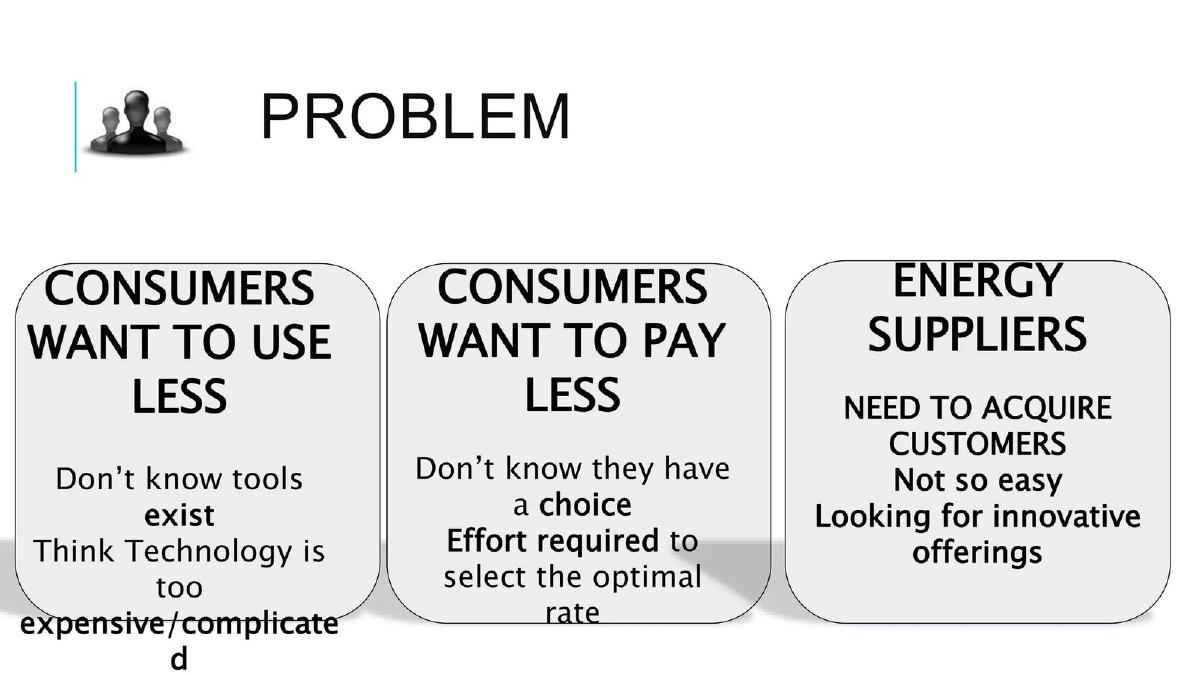
Energy switching platform. Two consumer pains and one supplier pain.
BetterNRG deck, slide 2. Exact stored slide matched to this analysis.
Our analysis: Suppliers get a box of their own, so the platform has a reason to be paid by them.
Evidence and limitation: No figures.
What a founder can adapt: Give the paying side its own clearly stated problem.
Supporting analysis
What the deck claims: "PROBLEM": "Consumers want to use less: Don't know tools exist; Think technology is too expensive/complicated." "Consumers want to pay less: Don't know they have a choice; Effort required to select the optimal rate." "Energy suppliers need to acquire customers: Not so easy; Looking for innovative offerings."
Presentation choice: The supplier box hints at the business model: suppliers pay to reach consumers.
When it does not fit: "Not so easy" is vague. Give a customer acquisition cost.
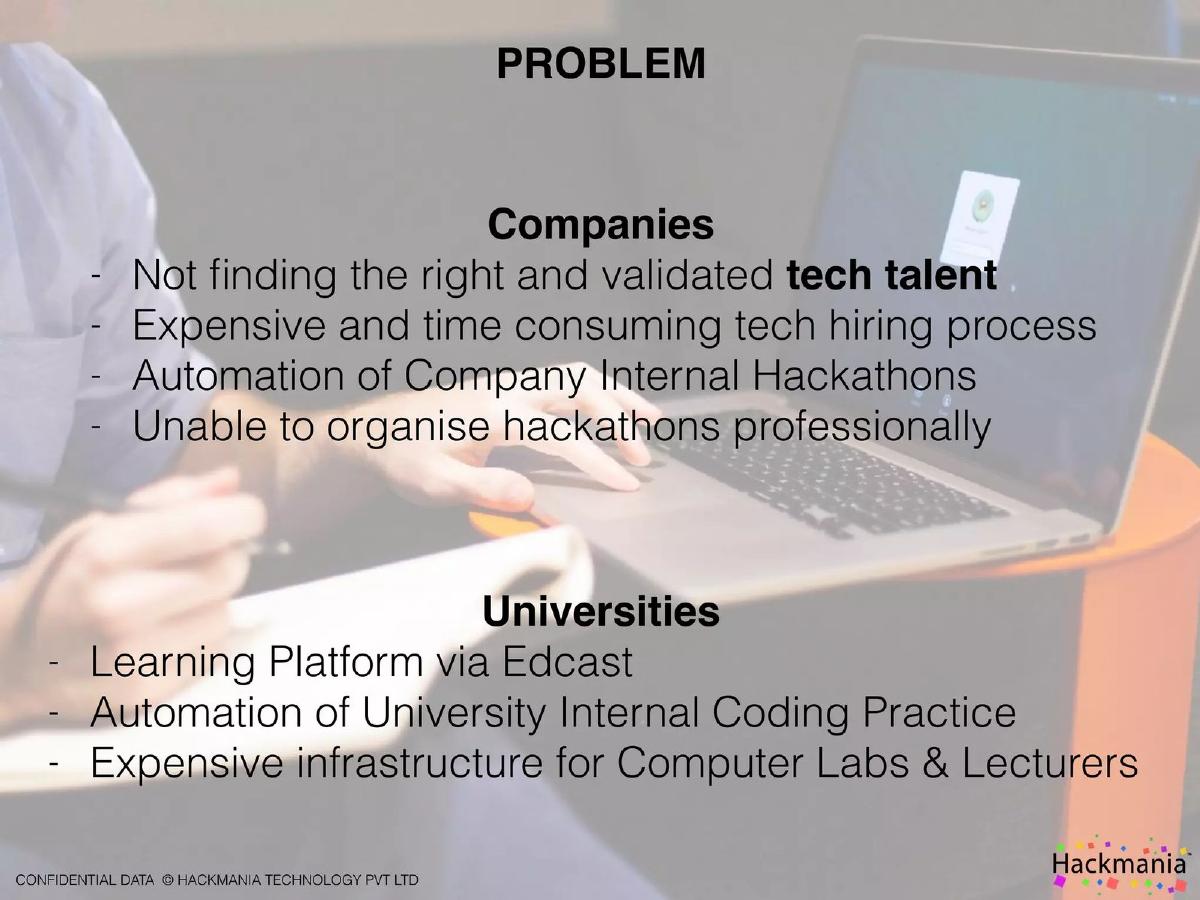
Hackathon and tech-hiring platform. Companies and universities.
Hackmania deck, slide 2. Exact stored slide matched to this analysis.
Our analysis: The company side is a clear hiring problem; the university side mixes problems with product features.
Evidence and limitation: No figures.
What a founder can adapt: Write every line as a pain, not as something you plan to build.
Supporting analysis
What the deck claims: "PROBLEM" Companies: "Not finding the right and validated tech talent", "Expensive and time consuming tech hiring process", "Unable to organise hackathons professionally". Universities: "Learning Platform via Edcast", "Automation of University Internal Coding Practice", "Expensive infrastructure for Computer Labs & Lecturers".
Presentation choice: It shows the risk of the split layout: the second side can become a feature list.
When it does not fit: "Learning Platform via Edcast" is a solution, not a problem.
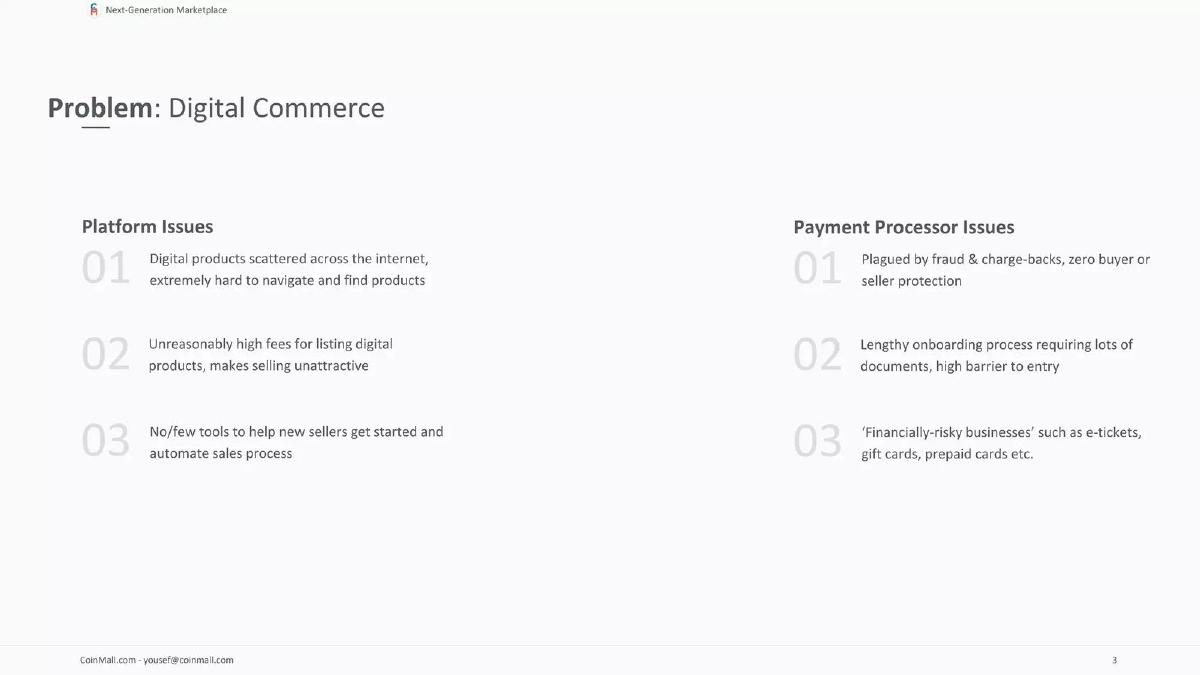
Digital goods marketplace. Split by type of failure, not by side.
CoinMall deck, slide 3. Exact stored slide matched to this analysis.
Our analysis: Buyer and seller problems appear, but mixed across both columns, so the reader has to sort them.
Evidence and limitation: No figures.
What a founder can adapt: If you split by cause, tag each point with the side it hurts.
Supporting analysis
What the deck claims: "Problem: Digital Commerce." Platform issues: "Digital products scattered across the internet, extremely hard to navigate and find products"; "Unreasonably high fees for listing"; "No/few tools to help new sellers". Payment processor issues: "Plagued by fraud & charge-backs, zero buyer or seller protection"; "Lengthy onboarding"; "'Financially-risky businesses' such as e-tickets, gift cards".
Presentation choice: Shows that a split by failure type is harder to read than a split by side.
When it does not fit: Quantify "unreasonably high fees" against a named alternative.
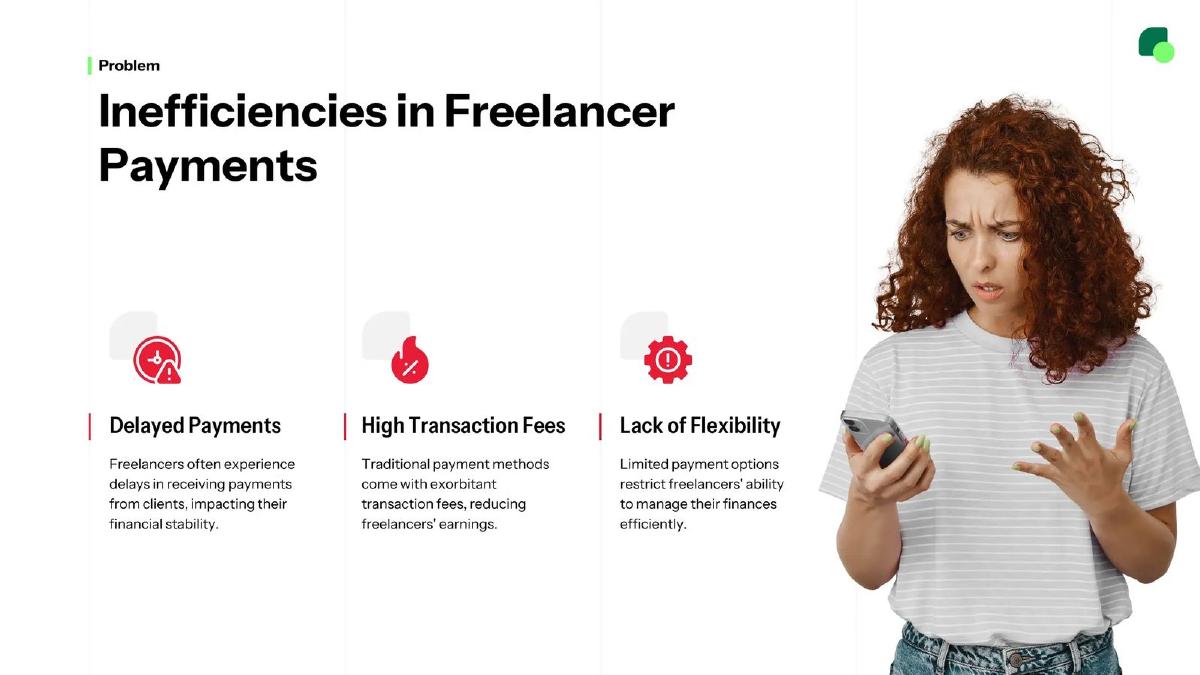
Freelancer payments. Included as a weaker pattern.
Flexpay deck, slide 2. Exact stored slide matched to this analysis.
Our analysis: Every point is the freelancer's; the clients who pay them have no problem stated.
Evidence and limitation: No figures.
What a founder can adapt: Add what the paying side loses today, or say why it will adopt your product anyway.
Supporting analysis
What the deck claims: "Problem — Inefficiencies in Freelancer Payments." "Delayed Payments: Freelancers often experience delays in receiving payments from clients"; "High Transaction Fees"; "Lack of Flexibility".
Presentation choice: Included as a contrast: a two-sided payment flow shown from one side only.
When it does not fit: Describing only one side when the product needs both.
Whether each side has its own problem, and whether the gap between them is named.
Example
Demand side
Supply side
Gap between sides named
SafeMotos
Safety, haggling
Low utilisation, earnings
No
CGHero
Studios need flexible talent
Small studios can't hire enough
Yes (artists invisible)
Narrative
Shared
Shared
Yes (brokers, no visibility)
Unea
Manual process
Manual process
Yes (intransparency)
BetterNRG
Don't know they can save
Hard to acquire customers
No
Hackmania
Can't find tech talent
Mixed with features
No
CoinMall
Hard to find products, fraud
High fees, no tools
Partly (scattered)
Flexpay
—
Late payments, fees
No
Key Takeaways
Give each side its own labelled problem. Two headings are clearer than one mixed list.
Say why the sides can't find each other today: a middleman, scattered information, or manual work.
Make each side's pain specific to that side. Drivers' low earnings and riders' safety are different problems.
Add one number per side if you can. None of the eight slides here does both.
If only one side has a problem, explain on the slide why the other side will still join.
Build your marketplace problem slide
One line per part, each with a number if you have one.
Demand side. What can buyers not get today, and what does it cost them?
Supply side. What do sellers lose today: unused capacity, low earnings, costly sales?
The gap. Why don't they already meet: a middleman, scattered listings, no trust?
Evidence. One figure for each side, with a source.
Copyable framework: [Buyers] can't [get X] and pay [cost]. [Sellers] [lose Y]. They don't meet today because [middleman / no visibility / manual process].
Illustrative example 1 — written by us
Before: Freelancers get paid late and pay high fees.
After: Agencies spend 6 hours a month chasing invoices from 20 contractors. Contractors wait 45 days to be paid and lose 5% in fees. Today they settle by bank transfer and spreadsheet.
What improved: Our illustrative rewrite; figures are invented for the example. It gives both sides a problem and names the current process.
What this guide adds
The general problem slide guide covers customer pain in any business. A marketplace has two sets of customers, and investors check whether both have a reason to join. This guide compares how platform startups show that on one slide.
The marketplace business model and traction guides cover how the platform earns money and proves liquidity; this guide covers the problem that comes first.
Three parts of a marketplace problem
Demand side: what buyers, riders or studios can't get today (SafeMotos, CGHero, Hackmania).
Supply side: what sellers, drivers or artists lose today, often unused capacity or low earnings (SafeMotos, CGHero, BetterNRG).
The gap between them: why they don't already meet, such as brokers, manual processes or scattered listings (Narrative, Unea, CoinMall).
Strong slides cover all three. Most real slides cover two.
Common mistakes
One side only. Investors will ask why the other side joins.
Mixed-up lists. Keep each side's points under its own heading.
Features as problems. "Needs a platform" is your solution, not their pain.
No gap named. Say why the sides don't already find each other.
No numbers. One figure per side makes both pains testable.
Diagnostic checklist
Each side has its own labelled problem.
Each problem is something that side loses today.
The slide says why the sides aren't already connected.
There is at least one number, with a source.
No line describes your product.
Frequently asked questions
How we chose these examples
Corpus: published pitch deck teardowns on StartupFundraising.com. Founder-uploaded private decks are excluded.
Selection (2026-09-24): we searched extracted text of slides 2–5 for problem slides that mention both sides of a market (buyer and seller, supplier and customer, driver and customer, talent and employer), and inspected about fifteen candidates. We excluded Airbnb (already in the general problem slide guide), its duplicate deck versions, and matches that weren't problem slides or weren't two-sided.
Overlap check: the general problem slide guide covers customer pain in any business; the marketplace business model and traction guides cover revenue and liquidity. This guide covers how a platform shows a problem on each side.
Flexpay is included to show a weaker pattern.
Review: all eight stored slide images were inspected on 2026-09-24 and matched to company, deck and slide number (editorial model review). No person has yet completed an editorial review of this page.
Figures are as shown on the slides; we have not verified them. We make no claim that any slide caused a fundraising outcome.