CGHero is a collaborative talent platform designed to solve the 'vast armies of talent' problem in the CGI, 3D, and VFX industries. Their 15-slide deck highlights a significant market opportunity within a $270 billion global studio market, specifically targeting an $8 billion niche in non-core outsource production. With a network of 5,500 artists across 100 countries and a client list including Disney, Netflix, and Epic Games, CGHero demonstrates strong early traction. The deck effectively utilizes high-quality industry visuals to underscore their value proposition. However, it lacks specific…
Key takeaways
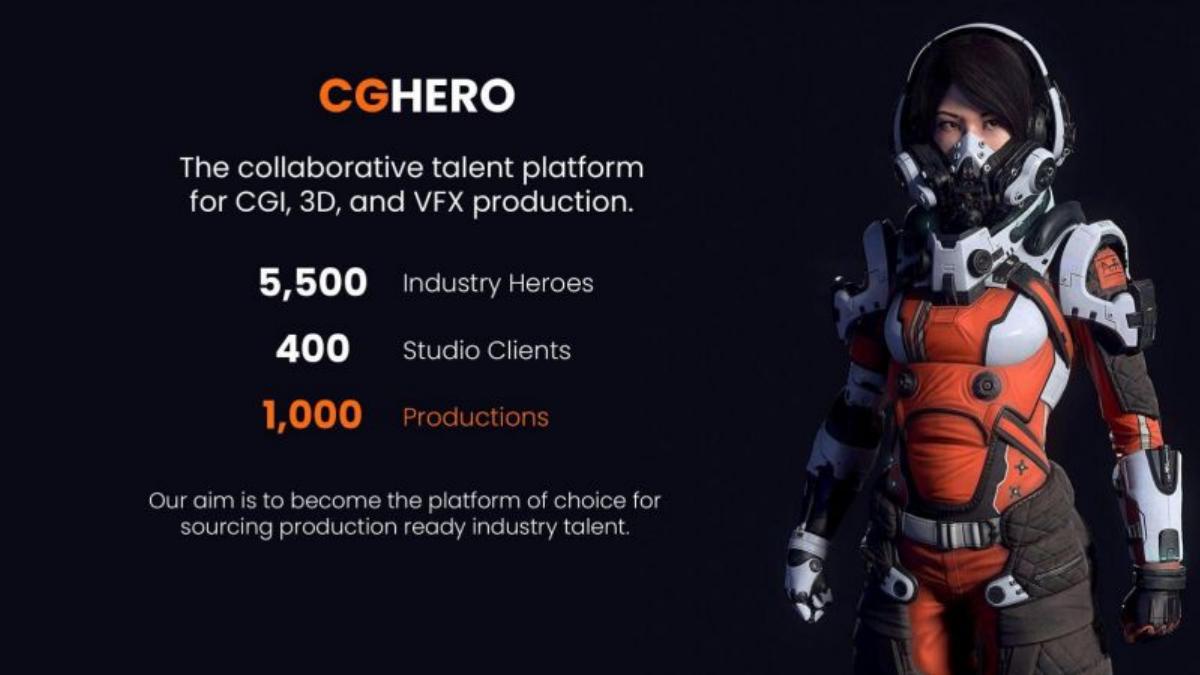
- The platform has successfully onboarded 5,500 'Industry Heroes' and 400 studio clients (Slide 5).
- CGHero has completed over 1,000 productions to date (Slide 5).
- The company identifies a specific $8 billion opportunity in non-core outsource production within the larger $270bn studio market (Slide 10).
- The client roster includes major global brands such as Disney, Sega, Netflix, and the BBC (Slide 8).
- Founder Jonathan Lloyd has a proven track record, having previously founded Falling Pixel and sold it to TurboSquid (Slide 12).
- The deck introduces the concept of 'Liquid Super Teams' as the ultimate evolution of their production scale (Slide 7).
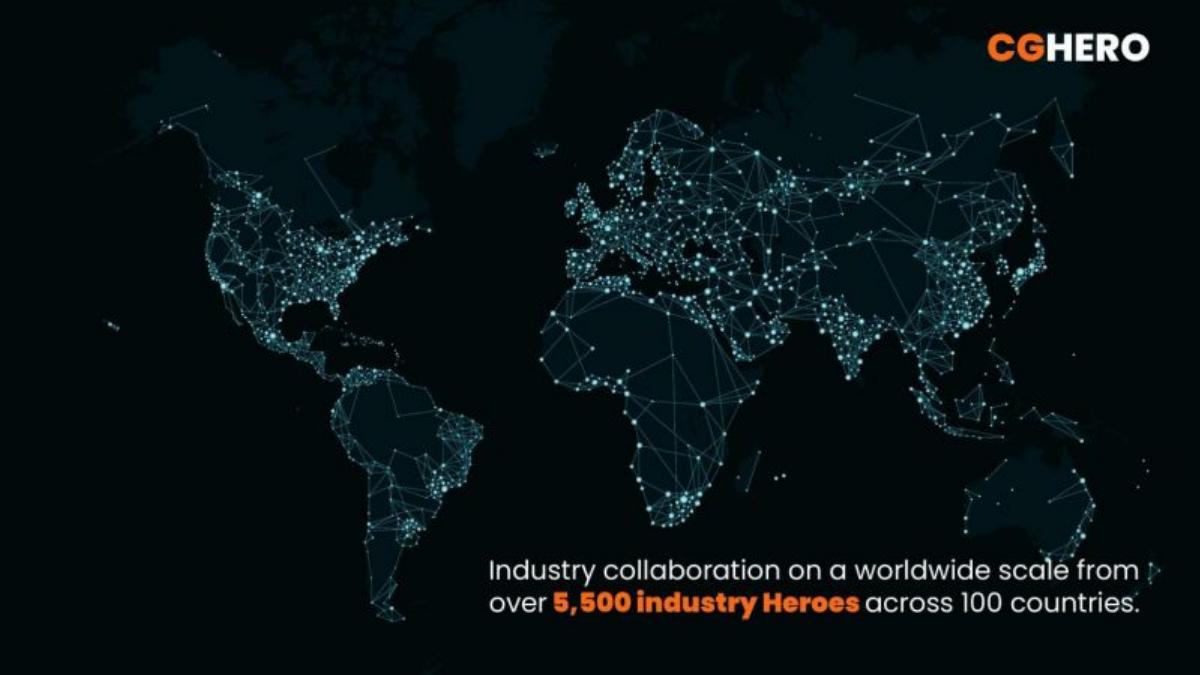
- The network is globally distributed across more than 100 countries (Slide 6).
- The deck is supported by notable investors including Beringea, Fuel Ventures, and an Epic MegaGrant (Slide 13).
Executive Summary
CGHero’s pitch deck is a visually driven presentation that leans heavily on the company's industry credibility and the founder's previous exit. By positioning themselves as the solution to the talent shortage in the CGI and VFX space, they appeal to the massive growth in digital content consumption. The deck successfully establishes the 'Why Now' by citing the staggering pace of CGI complexity, but it leaves significant questions regarding the company's financial health and specific fundraising goals.
Slide 1: Title Slide
The deck opens with a high-impact visual grid of various CGI assets and character portraits. The CGHero logo is centered. This immediately establishes the company's aesthetic and industry focus without requiring a single word of explanation.
Slide 2 & 3: The Problem
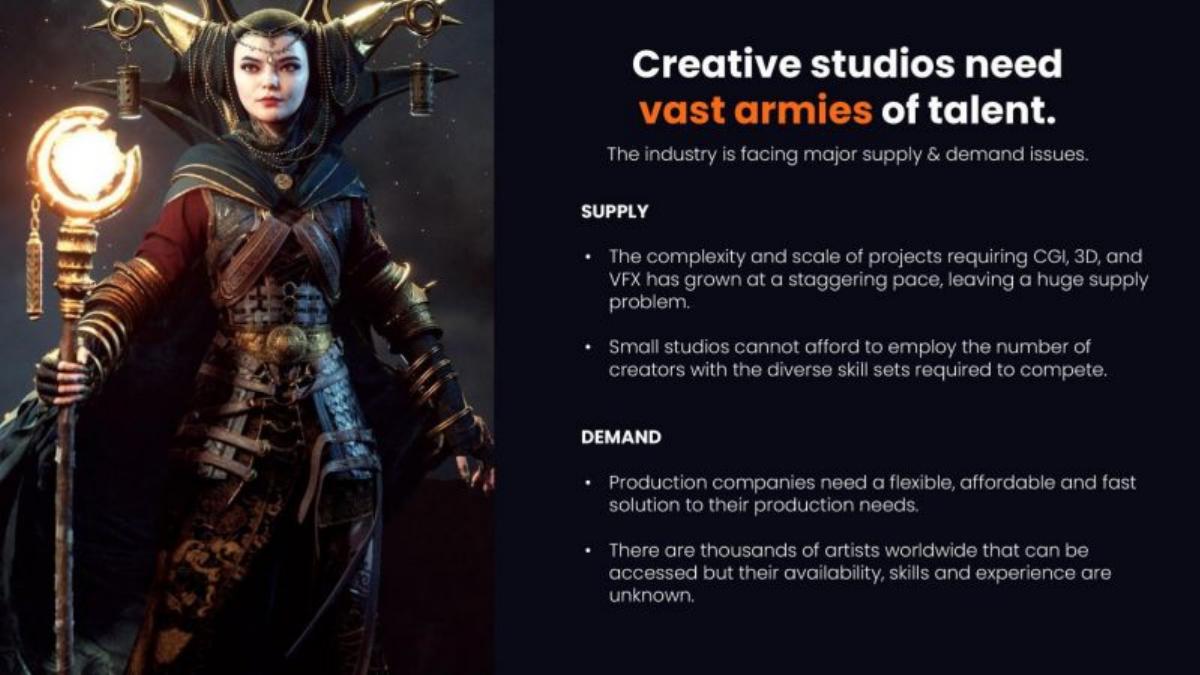
Slide 2 is a transition slide featuring dark, cinematic concept art. Slide 3 defines the problem: "Creative studios need vast armies of talent." It breaks this down into Supply and Demand issues. Supply is constrained by the complexity and scale of CGI/3D/VFX projects, which small studios cannot afford to staff internally. Demand is driven by production companies needing flexible, affordable, and fast solutions. The slide notes that while thousands of artists exist, their "availability, skills and experience are unknown."
Slide 4 & 5: The Solution
Slide 4 is another visual transition. Slide 5 introduces CGHero as "The collaborative talent platform for CGI, 3D, and VFX production." It provides three key traction metrics: 5,500 Industry Heroes, 400 Studio Clients, and 1,000 Productions. The stated aim is to become the "platform of choice for sourcing production ready industry talent."
Slide 6: Global Reach
This slide features a world map with a network of nodes, illustrating "Industry collaboration on a worldwide scale from over 5,500 industry Heroes across 100 countries." This emphasizes the decentralized nature of their workforce, which is a key component of their ability to scale.
Slide 7: Production Scale
Slide 7 uses a staircase graphic to show the evolution of production scale from 2019 to 2023. It moves from "Internal Hires" to "Freelance & Contract," then "Managed Outsource," "Co-dev Studio," and finally "Liquid Super Teams." This progression suggests a shift from simple staff augmentation to a more integrated, managed service model.
Slide 8: Client Roster
Titled "Powering up studio teams," this slide is a classic 'logo soup.' It features 15 prominent logos, including Disney, Epic Games, Sega, Netflix, BBC, LG, Unilever, and the NHS. The text claims they have worked with over 400 leading agencies and publishers.
Slide 9 & 10: Market Opportunity
Slide 9 is a transition. Slide 10 quantifies the market. It cites a $270bn global studio market but narrows the "CGHero opportunity" to an $8bn total addressable market (TAM) for non-core outsource production. This is segmented into TV & Film ($3.3bn), Gaming ($2.1bn), Retail ($1.6bn), Automotive ($0.8bn), and Architecture ($0.3bn).
Slide 11, 12 & 13: The Team and Backers
Slide 11 is a transition. Slide 12 focuses entirely on founder Jonathan Lloyd, detailing his 2006 founding of Falling Pixel and its 2011 acquisition by TurboSquid. It positions CGHero as the natural evolution of his career. Slide 13 introduces the broader team and board, including Ron Ashtiani (Founder of Atomhawk Design), Chris Lawrence (COO), and Eyal Malinger (Board). It also lists investors: Beringea, Fuel Ventures, and an Epic MegaGrant recipient badge.
Slide 14 & 15: Closing
Slide 14 repeats the title visual. Slide 15 is a promotional slide for the platform where the deck was hosted, rather than a contact or 'ask' slide from the company itself.
What Works
Visual Identity: The deck uses high-quality CGI and concept art on every slide. For a company selling creative services, this is essential. It proves they understand the quality bar of their own industry.
Founder-Market Fit: Slide 12 makes a powerful case for Jonathan Lloyd. Having already built and sold a marketplace in the exact same niche (3D content), he is the ideal person to lead this venture. This reduces perceived execution risk for investors.
Traction with Blue-Chip Clients: The inclusion of Disney, Netflix, and Epic Games on Slide 8 is a massive validator. It shows that the platform can meet the rigorous standards of the world's most demanding content producers.
Realistic TAM: Instead of claiming they will capture the entire $270bn studio market, they intelligently narrow their focus to an $8bn niche (Slide 10). This level of specificity makes the business plan feel more grounded and achievable.
What is Missing
Financial Performance: There is no mention of revenue, GMV (Gross Merchandise Volume), or profitability. Investors need to see if the 1,000 productions mentioned on Slide 5 are generating meaningful margins.
The Ask: The deck ends without telling the investor what the company wants. There is no mention of the round size, the valuation, or how the $4M (mentioned in the catalogue facts) will be spent to achieve the next milestone.
Unit Economics: For a marketplace, understanding the take rate (the percentage CGHero keeps from each transaction) and the cost to acquire both artists and studios is critical. None of this is present.
Competitive Landscape: The deck assumes CGHero is the only solution. It does not address how they compete against traditional VFX houses or other freelance platforms like Upwork or ArtStation.
What a Founder Should Copy
The 'Liquid Team' Concept: The staircase graphic on Slide 7 is an excellent way to visualize a product roadmap and the increasing value provided to the customer. It moves the conversation from "we provide freelancers" to "we provide scalable infrastructure."
Market Segmentation: Founders should follow CGHero's lead on Slide 10 by breaking down their TAM into specific industry verticals. It shows a deep understanding of where the actual money is flowing within a larger, noisier market.
Leveraging Previous Success: If a founder has a previous exit, they should dedicate a full slide to it as CGHero did on Slide 12. It is the strongest piece of evidence for future success.
Final Thoughts
The CGHero deck is a masterclass in industry-specific positioning and visual storytelling. It clearly identifies a pain point—the need for massive, flexible creative teams—and shows that the company has already gained the trust of the industry's biggest players. However, as a fundraising tool, it is incomplete. It functions more as a high-level company profile or a sales deck than a comprehensive investment memorandum. To secure a round, a founder using this style would need a robust appendix or a second 'data-heavy' deck to answer the inevitable questions about revenue, margins, and the specific terms of the raise.
Frequently asked questions
- What is CGHero's core business model?
- CGHero operates as a collaborative talent platform for CGI, 3D, and VFX production. It acts as a managed marketplace that connects creative studios needing scale with a global network of vetted freelance artists. According to the deck, they facilitate everything from individual freelance contracts to 'Liquid Super Teams' for large-scale productions.
- Who are CGHero's primary customers?
- The deck lists over 400 studio clients. High-profile examples include Disney, Epic Games, Sega, Netflix, and the BBC. They also serve non-media sectors like Automotive (LG, Valvoline) and Retail (Unilever, Kingfisher), highlighting the broad application of CGI across various industries.
- What is the background of the founding team?
- The deck focuses heavily on founder Jonathan Lloyd, who founded the 3D content marketplace Falling Pixel in 2006 and led it to an acquisition by TurboSquid in 2011. He later served as VP of Strategic & Product Development at TurboSquid before launching CGHero in 2017.
- How large is the market CGHero is targeting?
- While the global studio market is valued at $270 billion, CGHero specifically targets the 'non-core outsource production' segment. They value this specific opportunity at $8 billion, broken down into Gaming ($2.1bn), TV & Film ($3.3bn), Retail ($1.6bn), Automotive ($0.8bn), and Architecture ($0.3bn).
- What information is missing from the CGHero pitch deck?
- The deck is notably missing a financial slide showing historical revenue or future projections. It also lacks a 'The Ask' slide, meaning there is no information on how much capital is being raised, the valuation, or how the funds will be allocated. Unit economics, such as take rates or customer acquisition costs, are also omitted.