Cerebrium’s 19-slide deck is a masterclass in identifying a specific, high-cost pain point—GPU inefficiency—and positioning a technical solution as the only viable path to scale. By highlighting that $24B was wasted on GPU compute in 2024 (Slide 7), the founders immediately establish the magnitude of the problem. The deck leans heavily on traction, showing a steep ARR growth curve over nine months (Slide 3) and a technical case study that claims to reduce cold starts from 250s to just 20s (Slide 9). While the deck lacks a specific 'Ask' slide or detailed unit economics, the strength of the te…
Key takeaways
- Cerebrium identifies a massive market inefficiency, noting that 30% of the $80B AI compute spend in 2024 was wasted (Slide 7).
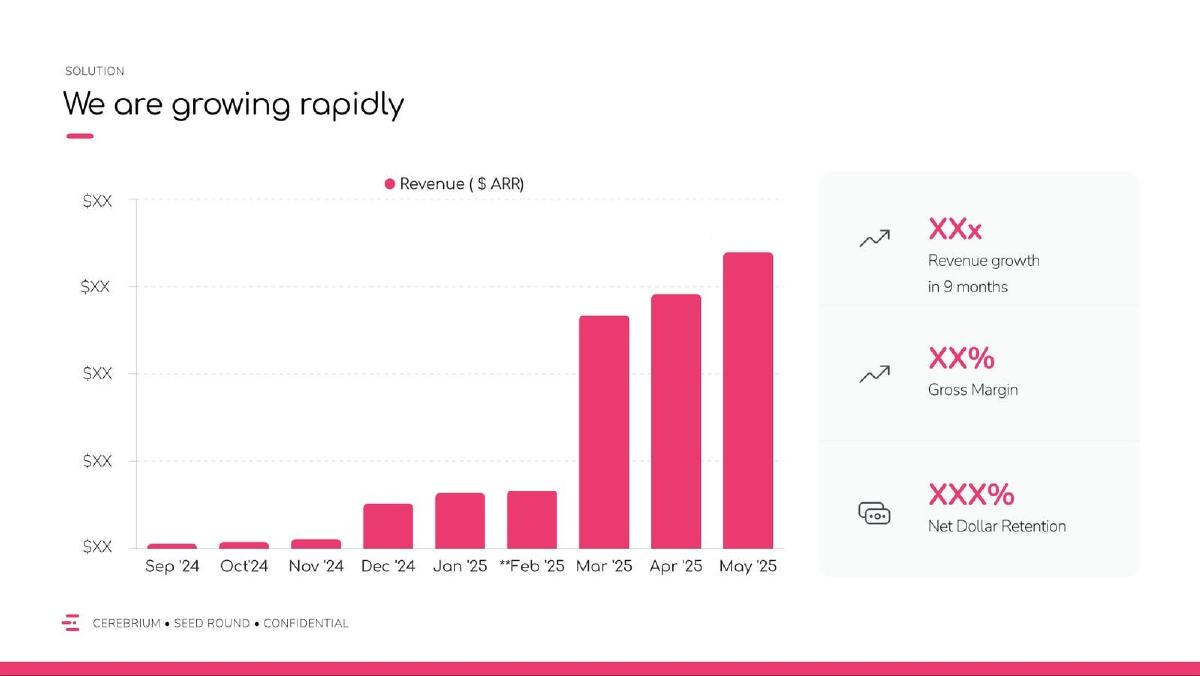
- The company demonstrates significant early traction with a bar chart showing consistent ARR growth from September 2024 through May 2025 (Slide 3).
- A technical case study compares Cerebrium against a 'Previous Provider,' showing a reduction in build times from over 300s to under 60s (Slide 9).
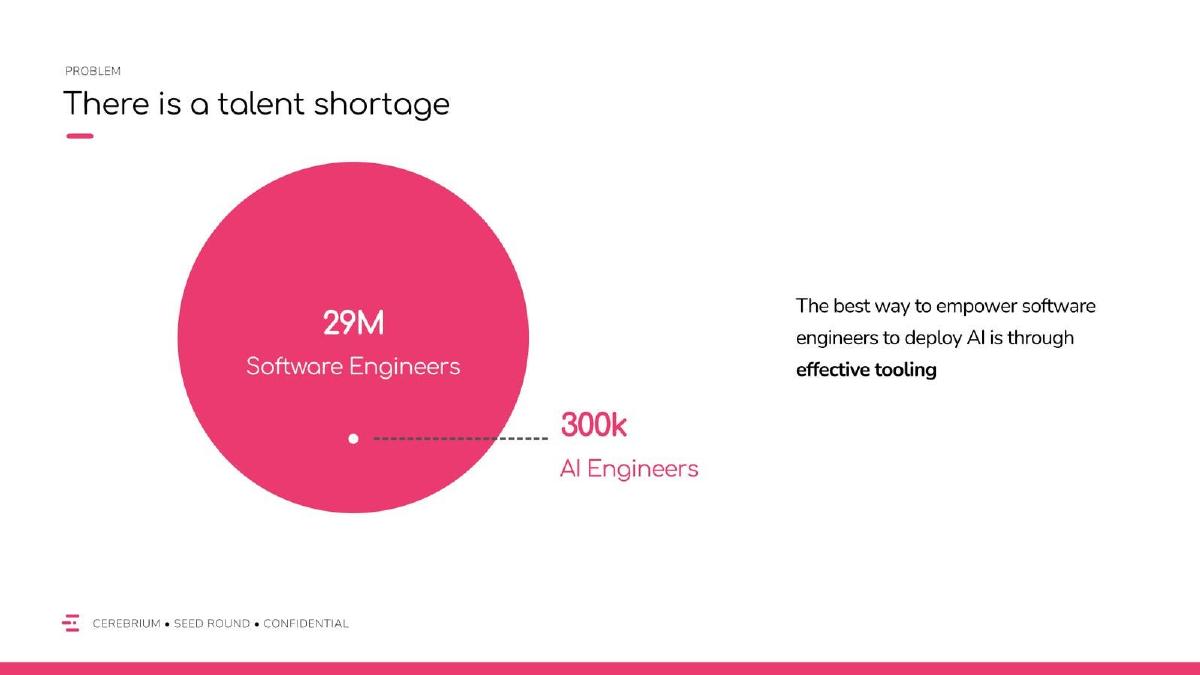
- The deck highlights a talent gap, showing only 300k AI engineers compared to 29M general software engineers, positioning their tool as the bridge (Slide 5).
- Cerebrium claims to save customers an average of 40% on infrastructure costs through serverless technology (Slide 11).
- The team slide emphasizes pedigree, noting that both co-founders had previous exits to Walmart and hold advanced degrees in Data Science (Slide 15).
- The deck targets a specific ICP of startups with 5-40 employees and $2M-$30M in funding, focusing on Voice, LLM, and Video/Image sectors (Slide 13).
- Future market projections suggest that inferencing for 100M users will require 80 billion petaflops daily, dwarfing the 21 billion required for a one-off GPT-4 training (Slide 19).
Cerebrium Pitch Deck Teardown: The Infrastructure Play for the AI Era
Cerebrium’s Seed deck, which helped secure $8.5 million in 2024, is a highly focused document that prioritizes technical validation and market timing. In a landscape where GPU scarcity and high compute costs are the primary bottlenecks for AI startups, Cerebrium positions itself not as a hardware provider, but as the intelligent software layer that makes existing hardware actually usable for production-grade applications.
Slide 1-3: The Hook and the Growth
Slide 1 introduces the company as 'The Infrastructure Platform Powering AI.' It is a clean, minimalist start that avoids the 'Uber for X' tropes. Slide 2 follows with a broad vision statement: 'AI is changing the world -- We want to be the infrastructure that powers it.' While generic, it sets the stage for the massive scale they intend to capture.
Slide 3 is the most critical early slide. It displays a bar chart of Annual Recurring Revenue (ARR) growth over a nine-month period (September 2024 to May 2025). Although the Y-axis values are redacted as '$XX,' the visual representation shows a massive inflection point in March 2025. Beside the chart, they highlight three key metrics: 'XXX Revenue growth in 9 months,' 'XX% Gross Margin,' and 'XXX% Net Dollar Retention.' By leading with these metrics, Cerebrium signals to investors that they have found product-market fit and are ready to scale.
Slide 4-7: Defining the Problem Space
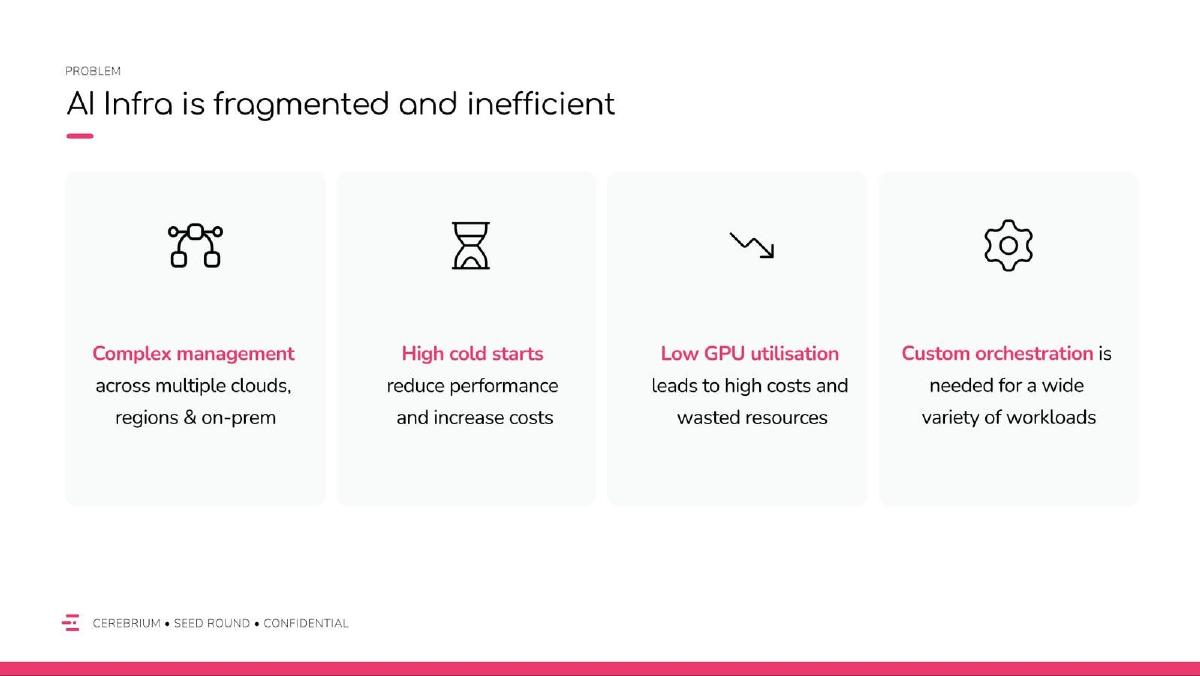
The deck moves quickly into the 'Why Now?' and 'What’s Broken?' sections. Slide 4 notes that AI infrastructure is currently 'fragmented and inefficient.' Slide 5 introduces a compelling talent-based argument: there are 29 million software engineers but only 300,000 specialized AI engineers. Cerebrium’s solution is positioned as the 'effective tooling' that allows the 29 million to deploy AI without needing the specialized knowledge of the 300,000.
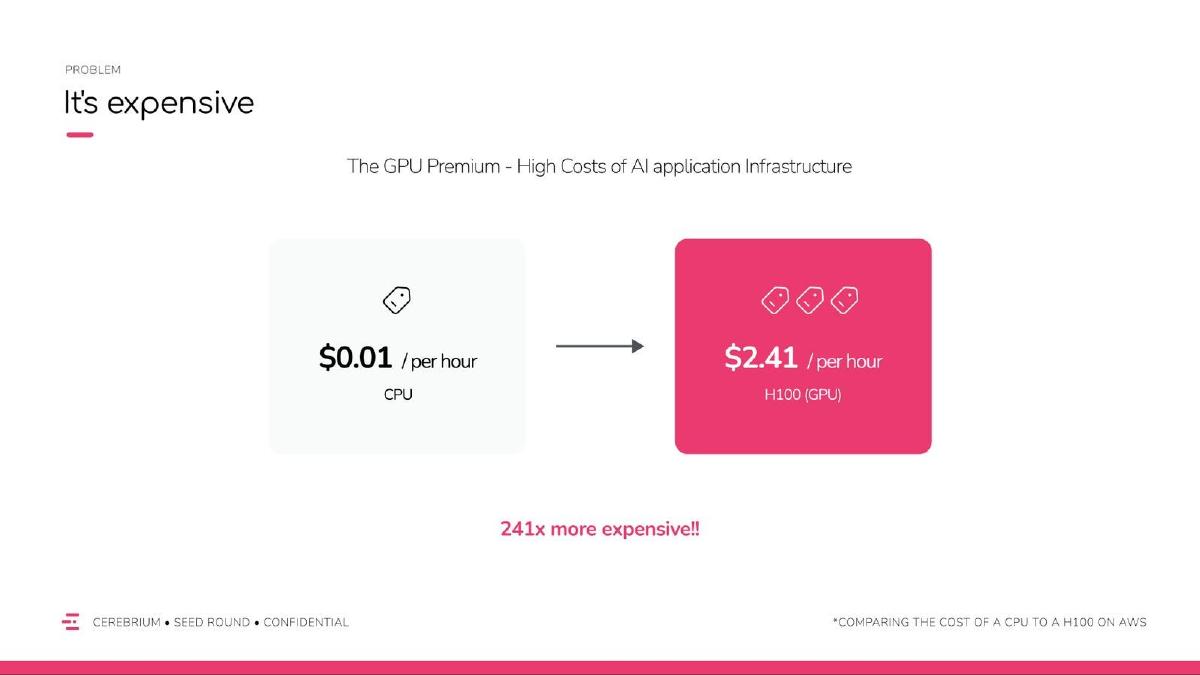
Slide 6 and Slide 7 tackle the 'GPU Premium.' Slide 7 is particularly data-heavy, citing a 'State of AI Infrastructure at Scale 2024 Report' which claims that $24B was wasted on GPU compute in 2024. The slide notes that 68% of surveyed companies have GPU utilization below 70% even during peak periods. This establishes a clear, quantifiable enemy: waste. Cerebrium argues that AI workloads require 'fundamentally different orchestration' than traditional cloud computing, which is their entry point into the market.
Slide 8-11: The Solution and Technical Proof
Slide 8 defines the product: a serverless infrastructure platform. The emphasis is on ease of use, performance, and cost-efficiency. To prove this isn't just marketing fluff, Slide 9 presents a detailed case study for 'Company X.' This customer, who raised $24.2M from Sequoia and YC, evaluated Cerebrium against three other competitors. The results are stark: cold starts dropped from 250 seconds to 20 seconds, and average build times dropped from over 300 seconds to under 60 seconds. Reliability and capacity also saw significant upticks to >99% and 100%, respectively.
Slide 10 uses a stack diagram to show exactly where Cerebrium lives. They are the 'Infrastructure Optimizations and Software' layer, sitting above the data centers but below the application layer. This is a strategic 'asset-light' positioning—they don't need to buy the GPUs; they just need to make them work better. Slide 11 summarizes the impact: 40% average savings for customers, 80% faster time to production, and 40% more revenue opportunities by meeting strict enterprise data requirements.
Slide 12-15: Go-To-Market and Team
Slide 12 mentions 'Founder-led Sales,' a common and expected stage for a Seed-round company. Slide 13 provides a look at their Ideal Customer Profile (ICP). They are targeting startups with 5-40 employees and $2M-$30M in funding, specifically in the Voice, LLM, and Video/Image spaces. The slide lists several customers (names redacted) with impressive pedigrees, including one with $40M in revenue and others backed by a16z, BVP, and SVP. This proves they can win high-quality, high-growth accounts.
Slide 14 claims they are 'lean, focused, and innovating faster,' which leads into the Team Slide (Slide 15) . The team is high-pedigree. CEO Michael Louis and CTO Jonathan Irwin both have 'Prev Exit to Walmart' on their resumes. The technical depth is reinforced by Elijah Roussos (Founding ML Engineer) with a Masters in AI from Cornell and Kyle Gani (Senior Technical PM) with experience in Series A/B startups. The slide also prominently features the Y Combinator and Authentic Ventures logos, providing third-party social proof.
Slide 16-19: The Appendix and Future Market
The deck concludes with an appendix that doubles down on the market opportunity. Slide 17 visualizes the expansion of the engineer pool, suggesting that AI will lower the barrier to software creation, eventually reaching 100M+ engineers. Slide 18 (text only) notes the rapid growth of AI compute spend. Slide 19 provides a final, powerful chart: 'Inferencing is going to outpace training.' It compares the one-off cost of training GPT-4 (21 billion petaflops) to the daily cost of serving 100M users (80 billion petaflops). This slide justifies Cerebrium’s long-term viability; even after the initial training hype dies down, the ongoing need for efficient inferencing infrastructure will only grow.
What Cerebrium Does Well
Quantifiable Pain Points: The deck doesn't just say GPUs are expensive; it cites a specific $24B waste figure and links it to a 70% utilization ceiling. This makes the problem feel urgent and solvable.
Technical Benchmarking: In the infrastructure space, 'faster' is a vague claim. By providing a table with specific TTFB (Time to First Byte) and build time comparisons, Cerebrium speaks the language of the engineers who will actually use the product.
Strategic ICP: Many startups try to sell to everyone. Cerebrium’s Slide 13 shows they know exactly who their early adopters are: well-funded, small-to-mid-sized AI startups that are currently feeling the burn of inefficient compute spend.
What is Missing from the Cerebrium Deck
The Ask: The deck, as presented, does not include a slide detailing how much they are raising or what the specific milestones for the next 18 months are. While the publisher reports an $8.5M raise, the deck itself leaves the 'call to action' blank.
Unit Economics: While they mention a 40% saving for customers and 'XX% Gross Margin,' there is no breakdown of their own cost of goods sold (COGS). Since they are an infrastructure layer on top of other providers, understanding their margin profile at scale is a key question for investors.
Competitive Landscape: Slide 9 mentions 'Competitors X, X, and X,' but a dedicated competitive matrix is missing. In a crowded field with players like Together AI, CoreWeave, and Lambda Labs, a clearer articulation of their defensive moat would have been beneficial.
Founder Takeaways: Copy These Moves
Lead with Traction: If you have a growth chart that looks like Slide 3, put it at the front. It changes the tone of the meeting from 'if this works' to 'how big can this get.' · Use 'The Gap' Visualization: Slide 5’s comparison of 29M software engineers vs. 300k AI engineers is a brilliant way to illustrate a market bottleneck. It makes the need for 'tooling' feel like a mathematical certainty. · Focus on Inferencing: For AI founders, Slide 19 is a great example of how to frame a long-term market. Investors worry about the 'AI bubble' bursting after training is done; showing that inferencing is the larger, recurring cost addresses that fear head-on. · Pedigree Matters: If you have an exit to a major corporation like Walmart, don't bury it. Cerebrium put it in bold text right under the founders' names.
Frequently asked questions
- What is Cerebrium's core value proposition?
- Cerebrium positions itself as a serverless infrastructure platform that simplifies the deployment of AI applications. According to Slide 8, their goal is to make it easy for engineers to build and scale performantly and cost-efficiently. They specifically target the 'GPU Premium,' claiming on Slide 11 that customers save an average of 40% by using their technology compared to traditional cloud orchestration.
- How does Cerebrium differentiate itself from traditional cloud providers?
- Slide 7 argues that AI workloads require fundamentally different orchestration and cost models than traditional cloud computing. Slide 10 further clarifies their position in the stack: they provide infrastructure optimizations and software but do not own data centers. This allows them to focus on performance metrics like reducing cold starts from 250s to 20s, as shown in their Slide 9 case study.
- What kind of traction did Cerebrium show to raise $8.5M?
- The deck includes a growth chart on Slide 3 showing nine months of ARR growth. While the exact dollar amounts are redacted as '$XX,' the visual trend shows a significant spike starting in March 2025. Additionally, Slide 11 claims they help customers get applications to production 80% faster, and Slide 13 lists customers backed by top-tier VCs like a16z, Sequoia, and BVP.
- Who are the founders of Cerebrium?
- The team is led by Co-Founder & CEO Michael Louis and Co-Founder & CTO Jonathan Irwin. Both founders are described on Slide 15 as having previously exited companies to Walmart. The team also includes a Founding ML Engineer with a Masters in AI from Cornell and a Senior Technical PM with experience at Series A/B startups, supported by Y Combinator and Authentic Ventures.
- What market trends is Cerebrium betting on?
- Cerebrium is betting on the shift from AI training to AI inferencing. Slide 19 notes that while GPT-4 training was a 'once-off' cost, daily inferencing for 100M users will require 4x the computational need per day. They also predict that compute will eventually become a larger expense for companies than salaries as the number of engineers building with AI grows from 300k to over 100M (Slide 17).