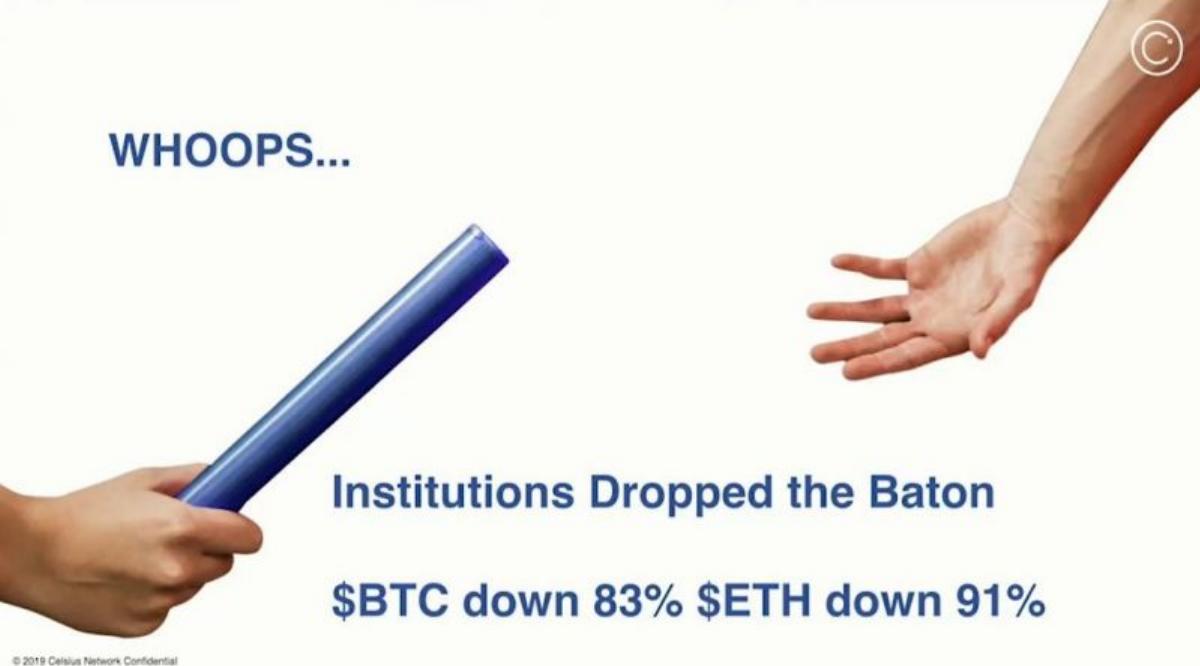
The Celsius Network Series A deck is a masterclass in narrative-driven fundraising. Rather than leading with dense financial spreadsheets, the deck focuses on the 'evolutionary' necessity of its platform. By positioning cryptocurrency as a relay race passing from anarchists to speculators and finally to institutions, Celsius framed its lending product as the essential infrastructure for the next phase of global finance. The deck successfully leveraged early traction—65,000 downloads in nine months—to validate its 'Unbank Yourself' mantra. While it leans heavily on metaphors and pop-culture im…
Key takeaways
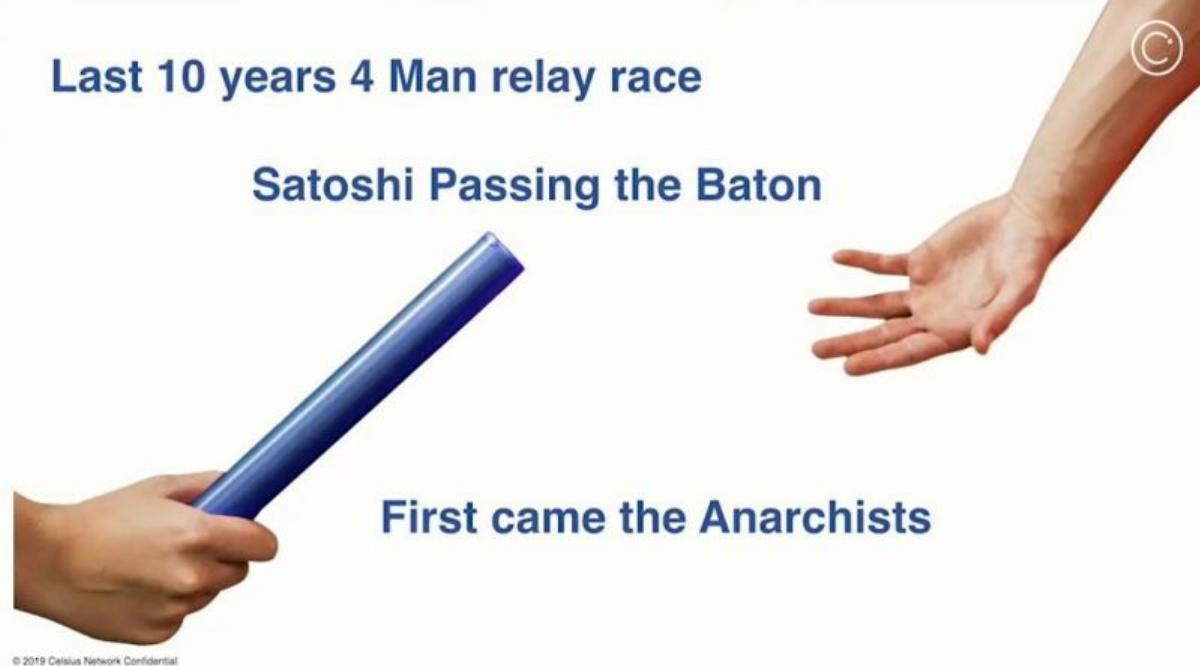
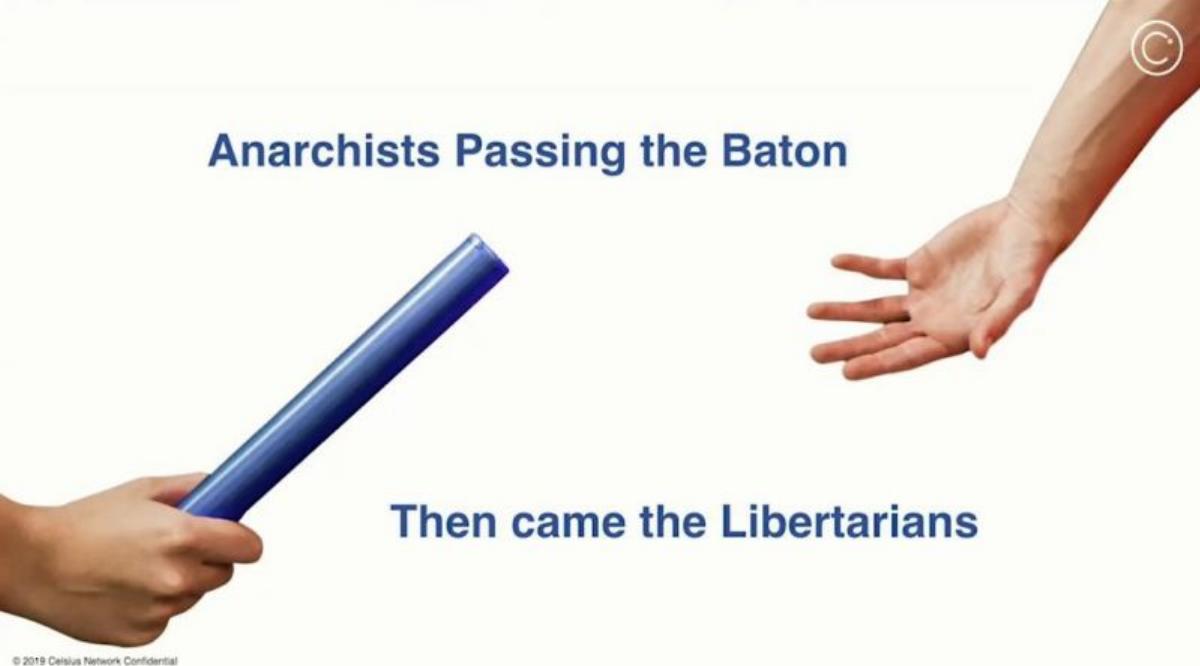
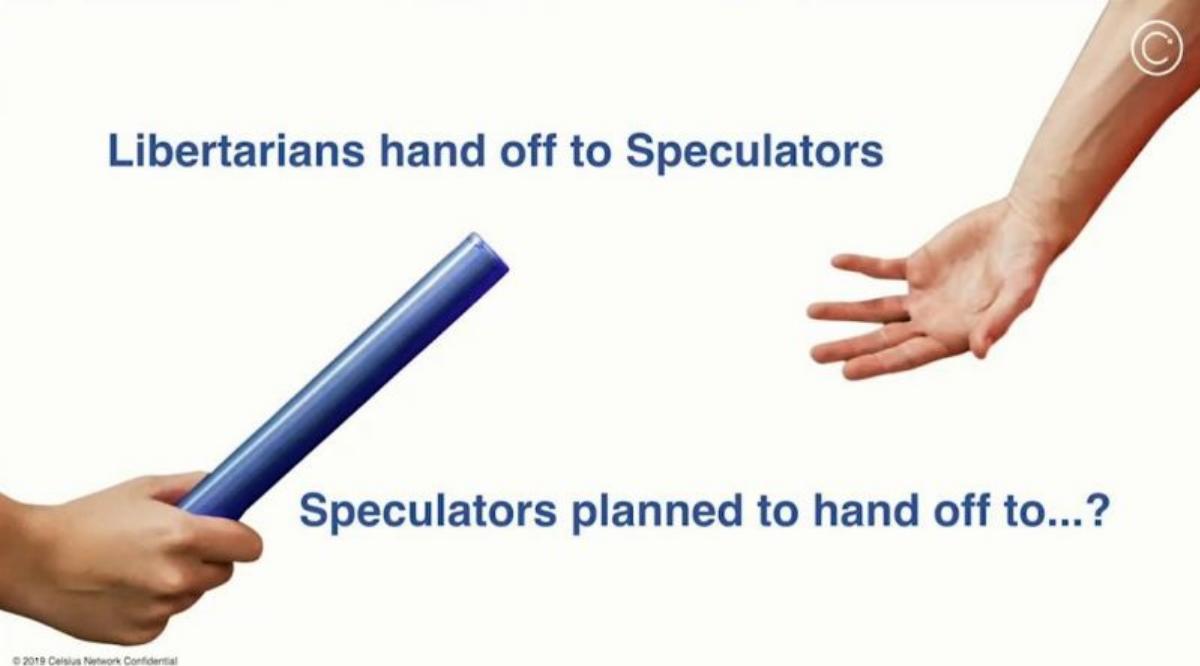
- The deck uses a relay race metaphor to explain market evolution from anarchists to speculators (Slides 2-3).
- Celsius claims 65,000 downloads in 9 months with 90% organic growth (Slide 16).
- The business model is simplified to a single spread: depositors get 7% while borrowers pay 9% (Slide 15).
- The company positions itself at the intersection of DApps, Token Economics, and Secure Ledgers (Slide 7).
- A 'Crossing the Chasm' graphic identifies stablecoins as the final step before mass adoption (Slide 11).
- The deck highlights Scott Stornetta, a co-inventor of blockchain technology, as a key advisor or affiliate (Slide 18).
- A flow-of-funds diagram illustrates the ecosystem connecting custodians, exchanges, and banks (Slide 19).
- The pitch relies on a 'Crypto will eat Fiat' thesis, targeting a $95T liquid money market (Slide 9).
The Narrative Arc of the Celsius Series A Deck
The Celsius Network pitch deck from 2019 is a fascinating artifact of the pre-DeFi summer era. It captures a moment when crypto was transitioning from a niche speculative asset class into a broader financial service ecosystem. The deck, which helped secure $20.5M in Series A funding, relies less on traditional SaaS metrics and more on a grand historical narrative. It positions the company not just as a lending app, but as the inevitable conclusion of a decade-long financial evolution.
Slides 1-3: The Evolutionary Metaphor
The deck opens with the tagline "From VOIP to MOIP: Unbank Yourself on the Blockchain" on Slide 1. This is a strategic callback to the early internet; by comparing 'Money over IP' to 'Voice over IP,' Celsius suggests that the disruption of banking will be as total and inevitable as the disruption of long-distance telephony. The slide features clean mobile UI mockups, immediately grounding the high-level concept in a tangible consumer product.
Slides 2 and 3 introduce the "4 Man relay race" metaphor. This is a clever way to explain the crypto market's maturity to investors who might be wary of the space's volatility. Slide 2 notes that "First came the Anarchists," followed by Slide 3's assertion that "Libertarians hand off to Speculators." By framing the current state as a hand-off from speculators to a new, unnamed group (implied to be the mass market), Celsius creates a sense of urgency. The question "Speculators planned to hand off to...?" invites the investor to see Celsius as the answer to that transition.
Slides 4-6: Market Segmentation and the War of Systems
Slide 4 uses a concentric circle diagram to map the institutional landscape. It moves from Retail at the center out to Pension Funds . This slide identifies the barriers for each group—such as "Regulatory clarity" for Long-only Funds and "Execution infrastructure" for Hedge Funds—positioning Celsius as the layer that solves these friction points. It is a sophisticated way of saying their market is everyone, but acknowledging that different segments have different needs.
Slide 5, titled "Centralization War vs. Decentralization," is the most ideological slide in the deck. It pits a pyramid representing the current global wealth distribution (where 0.7% of the population holds a massive share of wealth, represented by logos for Google, Facebook, and Amazon) against a decentralized Blockchain circle. This slide isn't about numbers; it's about a mission. It tells investors that Celsius is on the 'right side' of a global shift in how value is distributed.
Slide 6 uses a 'big fish eats little fish' graphic to show the evolution of networking protocols, ending with "Quantum blockchain POS Net." This reinforces the idea that blockchain is simply the next logical step in technology infrastructure, following X.25, Frame Relay, and TCP/IP.
Slides 7-9: The Economics of Disruption
Slide 7 places Celsius at the center of a Venn diagram consisting of Decentralised DApps , Token Economics , and Secure & Immutable ledgers. The text claims this intersection represents "the opportunities where the public blockchain will change the world." It is a high-level positioning slide that justifies the company's existence within the broader tech stack.
Slide 8 attempts to create a proprietary formula for their success: E=MC^2 . In this version, E stands for Ethereum (or any coin) , M for # of Members , and C for Community Credit Consensus . While mathematically dubious, it serves as a mnemonic for their growth strategy: the value of the network increases exponentially with the number of members and their collective participation.
Slide 9 is the 'Moonshot' slide. Titled "Crypto Will Eat Fiat Money in the Next 20 Years," it shows a crypto Pac-Man poised to consume $95 Trillion in "All Liquid Money." It cites a date of 2/20/2018 for its data points, which include the USD in Circulation ($1.61T) and the Gold Market Cap ($8.2T) . This slide is designed to make the $20.5M investment seem small relative to the total addressable market.
Slides 10-12: Crossing the Chasm
Slides 10 and 11 utilize the classic "Crossing the Chasm" framework. Slide 10 shows characters representing BTC and ETH helping each other up a cliff toward "Mass Adaption." Slide 11 adds a "Stable Coin" step to this climb, suggesting that price stability is the final hurdle before reaching the late majority and skeptics (humorously represented by names like Jamie Dimon and Nouriel Roubini at the far end of the curve).
Slide 12 is a pop-culture reference, depicting the Teenage Mutant Ninja Turtles with crypto logos (Monero, Litecoin, Bitcoin, Ethereum, and Celsius) on their shells, led by a Splinter-like figure. This slide is likely intended to show 'Team Crypto' as a unified front against the traditional financial establishment, though it adds little in the way of hard data.
Slides 13-16: The Product and Traction
Slide 13 is minimalist, showing only the numbers 9 and 7 under the header "Earn Money on your Money." This is a teaser for the business model explained in Slide 15. Slide 14 provides historical context, showing a chart of Average Interest Rates from 1990 to 2009, illustrating a steady decline toward the 0.12% seen in 2009. This sets the stage for the Celsius alternative.
Slide 15 is the core business model slide. Titled "Unbank Yourself," it states that "Depositors get 7%" and "Borrowers pay 9%." This 2% spread is presented as a fairer alternative to traditional banks. It is the most important slide for a financial investor, as it explains exactly how the machine makes money.
Slide 16 provides the 'Proof of Life.' It shows the Celsius Network Wallet UI and lists two key metrics: 65,000 downloads in 9 months and 90% organic growth. For a Series A, these are strong signals. They prove that the 'Unbank Yourself' message is resonating with actual users without requiring a massive marketing budget.
Slides 17-20: The Ecosystem and Team
Slide 17 is a transition slide asking "What is the Public Blockchain?" which leads into Slide 18, a profile of Scott Stornetta . By highlighting Stornetta and his citations in "Satoshi's white paper page #9," Celsius is borrowing authority. It tells investors that the very people who invented this technology are involved with or endorse this project.
Slide 19 is a technical flow chart. It shows how Celsius sits at the center of Lenders (Coin Holders) , Borrowers (Traders) , Custodians , Coin Exchanges , and Banks & Financial Institutions . It maps the movement of "Coin Deposits," "$ Profits," and "Escrow Deposits." This slide is crucial for demonstrating that the founders understand the plumbing of the financial system they are trying to disrupt.
Finally, Slide 20 shows "Team Celsius" in a group photo. While it lacks the individual bios and logos of previous successful exits typically found in a Series A deck, it conveys a sense of scale and culture. The team is shown wearing Celsius and "HODL" branded apparel, reinforcing the community-first image of the company.
What Works in the Celsius Deck
1. Strong Narrative Hook: The transition from VOIP to MOIP is a powerful analogy. It takes a complex, scary new technology (crypto) and makes it feel familiar and inevitable by comparing it to the internet's past successes.
2. Radical Simplicity: Slide 15, which boils the entire business model down to 7% for depositors and 9% for borrowers, is excellent. It removes the 'crypto-jargon' and speaks the language of traditional finance (spreads and interest rates).
3. Organic Growth: Highlighting that 90% of their 65,000 downloads were organic is a major win. It suggests that the brand has 'viral' potential and that the cost of customer acquisition (CAC) is low.
4. Borrowed Authority: The inclusion of Scott Stornetta (Slide 18) is a brilliant move for a crypto project. In a space filled with anonymous founders and 'scams,' having a cited inventor of the technology provides immense credibility.
What is Missing from the Celsius Deck
1. Unit Economics: While we see the 2% spread, we don't see the cost to serve those customers, the churn rates, or the Lifetime Value (LTV). For a $20.5M raise, investors usually want to see a deeper dive into the math.
2. Risk Mitigation: There is no mention of regulatory risk, hacking, or collateral liquidation mechanics. In the lending space, these are the primary concerns for any sophisticated investor.
3. Competitive Landscape: The deck assumes Celsius is the only player 'crossing the chasm.' It fails to mention other lending platforms or how it differentiates itself from emerging DeFi protocols.
4. The Ask: The provided slides do not include a clear statement of how much money is being raised or how it will be spent. While we know the outcome was $20.5M, a standard pitch deck should explicitly state the funding goal and milestones.
Founder's Playbook: What to Copy
Use Analogies for New Markets: If you are building in a frontier tech space, don't explain the 'how' first. Explain the 'what' using an analogy from a previous tech cycle (like VOIP). It helps investors place your company in a mental bucket they already understand.
Visualise the Flow of Funds: Slide 19 is a great template for any fintech founder. Showing exactly where the money goes—from the user to the custodian to the exchange—demystifies the business and proves operational competence.
Focus on 'Organic' Traction: If you have organic growth, shout it from the rooftops. Investors are tired of seeing companies that only grow by 'buying' users through Facebook ads. Organic growth proves that people actually want what you are building.
Lead with a Mission: The 'War vs. Centralization' slide (Slide 5) is polarizing, but it's memorable. For a Series A, you aren't just selling a product; you are selling a vision of the future. Don't be afraid to be bold about the world you want to create.
Frequently asked questions
- What was the primary value proposition of Celsius Network in this deck?
- Celsius positioned itself as a bridge between the high-yield opportunities of the crypto world and the traditional financial needs of retail and institutional users. The core message, 'Unbank Yourself,' suggested that users could earn significantly higher interest (7%) than traditional banks offered, while borrowers could access capital at competitive rates (9%).
- How did Celsius demonstrate early market traction?
- On slide 16, the company highlights that it achieved 65,000 downloads within its first nine months of operation. Crucially, they noted that 90% of this growth was organic, suggesting a strong product-market fit and a community-driven acquisition model that didn't rely heavily on paid marketing spend at that stage.
- Who were the key people mentioned in the deck?
- Beyond the 'Team Celsius' group photo on slide 20, the deck places significant emphasis on Dr. Scott Stornetta (Slide 18). He is described as a 'Blockchain Inventor' whose work was cited in Satoshi Nakamoto's original Bitcoin white paper. This inclusion served to provide the company with deep technical and historical credibility.
- What market size did Celsius target?
- Celsius presented an extremely aggressive TAM (Total Addressable Market). Slide 9 shows a 'Pac-Man' graphic of crypto ($500B) preparing to consume larger financial markets, including Gold ($8.2T), Stock Markets ($80T), and eventually All Liquid Money, which they valued at $95 trillion.
- What is missing from the 20 slides provided in this teardown?
- The provided slides lack a detailed breakdown of unit economics, a specific 'Ask' slide (though the listing confirms a $20.5M raise), a roadmap for future product features, and a detailed competitor matrix. The deck is more focused on the macro-opportunity and philosophical shift than on granular operational details.