Cedar’s 2020 pitch deck is a masterclass in identifying a massive, systemic inefficiency and presenting a high-traction solution. By focusing on the 'frustrated consumer' in the U.S. healthcare billing cycle, Cedar positions itself not just as a financial tool, but as a patient relationship platform. The deck highlights a staggering $149B in annual bad debt for providers and counters it with Cedar's proven 30% increase in collections. With a heavy emphasis on integration with major Electronic Medical Records (EMRs) like Epic and Athena, the company demonstrates its ability to sit at the cente…
Key takeaways
- The deck identifies a $345 billion out-of-pocket billing market, with $149 billion currently lost to bad debt (Slide 7).
- Cedar reports a 30% increase in collections and a 70% digital adoption rate among its users (Slide 17).
- The platform integrates directly with major EMR systems including Epic, Athena, and Cerner to act as the sole patient-provider connection (Slide 11).
- Patient satisfaction is cited at 95%, alongside a Provider NPS of 88, indicating strong dual-sided market fit (Slide 17).
- The 'Strategizer' engine uses EHR data, demographics, and census data to personalize outreach for every patient (Slide 15).
- Cedar positions COVID-19 and new price transparency legislation as significant secular tailwinds for digital billing adoption (Slide 21).
- The company highlights that current collections are only a tiny fraction of the projected $274B out-of-pocket market for 2027 (Slide 19).
- The team slide features 10 senior leads, including a Chief Commercial Officer with an MD, emphasizing industry expertise (Slide 25).
The Cedar 2020 Pitch Deck Teardown
In May 2020, Cedar used this presentation to secure $102M in funding. At the time, the healthcare industry was facing unprecedented pressure from the COVID-19 pandemic, which accelerated the need for digital-first patient interactions. This deck focuses on the 'financial experience' of the patient, a traditionally neglected part of the healthcare journey.
Introduction and the Problem Landscape
Slide 1: Title The deck opens with a clean, high-resolution image of a smiling consumer using a smartphone, immediately signaling that this is a consumer-tech-focused healthcare play. The title 'Cedar overview' is simple, dated May 2020.
Slide 3: The problem with healthcare billing in the US This is a transition slide that sets the stage for a macro-economic argument. It uses a minimalist design to focus the viewer's attention on the upcoming problem statement.
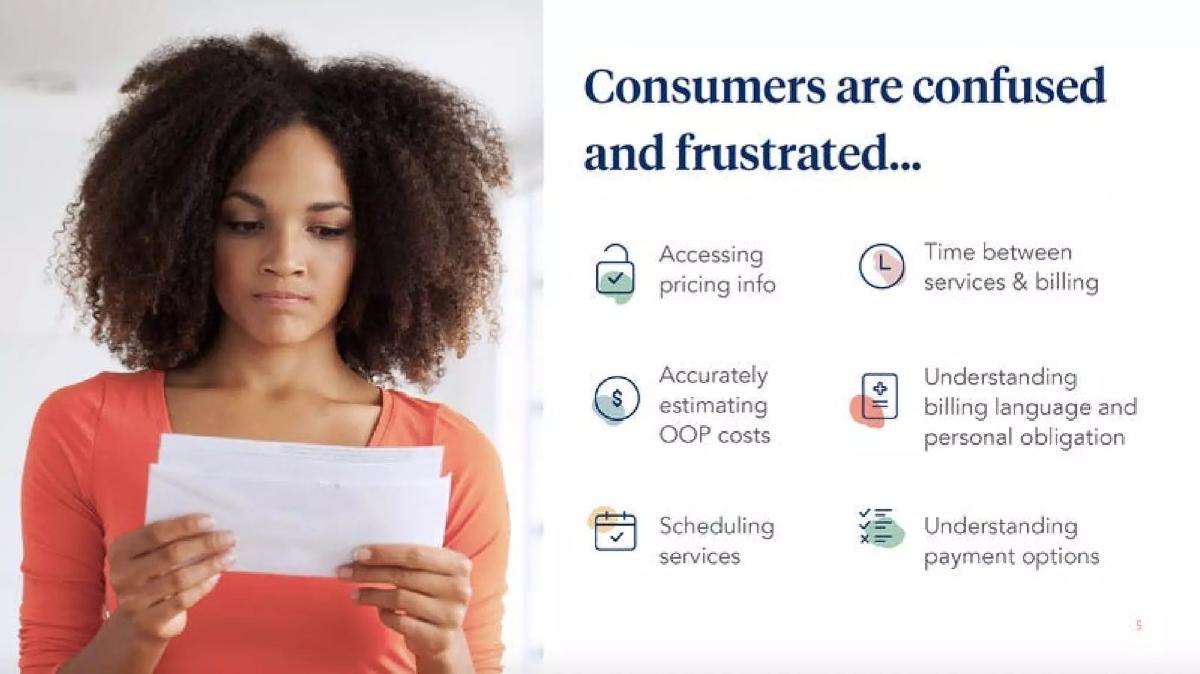
Slide 5: Consumers are confused and frustrated... Cedar breaks down the consumer pain points into six specific categories: accessing pricing info, time between services and billing, accurately estimating out-of-pocket (OOP) costs, understanding billing language, scheduling services, and understanding payment options. By framing the problem through the lens of 'confusion' and 'frustration,' Cedar justifies the need for a better User Experience (UX) in a sector known for being opaque.
Slide 7: Providers are struggling with unpaid bills... This slide shifts the focus from the patient to the provider's bottom line. It presents a massive market opportunity: $345 billion in out-of-pocket billings. Crucially, it notes that 43% of invoiced amounts go unpaid, resulting in $149 billion of 'bad debt.' This is the 'hook' for investors: a massive, quantifiable inefficiency that Cedar intends to capture.
The Cedar Solution and Product Ecosystem
Slide 9: How has Cedar solved the consumer experience problem? Another transition slide, moving from the 'Why' to the 'How.'
Slide 11: The solution This is a critical architecture slide. It positions Cedar as the 'sole patient-provider connection.' It shows Cedar sitting between various providers (Hospitals, Physician groups, Medical systems) and the patient. Most importantly, it lists 'Epic,' 'Athena,' and 'Cerner' as the data sources. In healthcare, integration is the highest barrier to entry; by showing these logos, Cedar claims it has solved the interoperability challenge.
Slide 13: Cedar Pay was our first product... This slide introduces 'Cedar Pay,' describing it as a patient billing and payment solution. Features listed include dynamic patient outreach, easy-to-understand statements, customizable payment plans, self-serve insurance capture, and live chat. A mobile mockup on the right shows a clean UI with a clear '$233.18' balance and a 'Pay total' button, mimicking modern fintech apps like Venmo or PayPal.
Slide 15: Cedar’s strategizer is personalizing the outreach This slide explains the 'intelligence' behind the platform. It shows how Cedar combines EHR Data (treatment, frequency, history), Demographics (DOB, address), and external Data (Census, Marketing, Real Estate) into the 'Cedar Database.' This data then informs the 'Strategizer' to optimize the channel (mail vs. digital), time of engagement, and the patient's 'propensity to pay.' This moves the product from a simple payment portal to a sophisticated data engine.
Traction, Market, and Future Outlook
Slide 17: Patients and providers rave about Cedar’s impact This is the 'proof' slide. Cedar presents four key metrics: a 30% increase in collections, 70% digital adoption, 95% patient satisfaction, and a Provider NPS of 88. The right side of the slide features testimonials from patients and a VP at U.S. Dermatology Partners, providing qualitative support for the quantitative claims.
Slide 19: Cedar has not scratched the surface... This slide visualizes the TAM (Total Addressable Market). It shows 'Current Cedar collections' as a tiny green dot compared to the $196 billion current OOP market and the projected $274 billion market by 2027. This tells investors that despite their current success, the growth ceiling is still incredibly high.
Slide 21: Cedar is in the right place, at the right time... Cedar identifies three 'secular tailwinds': client growth through market consolidation, COVID-19 accelerating the shift to digital billing, and new legislation regarding price transparency. This slide is designed to create a sense of urgency—the market is shifting now, and Cedar is the primary beneficiary.
The Team and Appendix
Slide 23: Appendix A simple transition to supplementary materials.
Slide 25: Cedar’s team leads The deck concludes with a team slide featuring 10 executives. Notable roles include Chief Security Information Officer, Head of Design, Chief Commercial Officer (an MD), and Head of Data Science. The diversity of roles—from design to clinical to data science—suggests a well-rounded leadership team capable of handling the multi-faceted challenges of healthcare tech.
What Works in the Cedar Deck
Quantifiable Pain Points: The deck doesn't just say billing is 'bad'; it cites a $149 billion bad debt figure. This makes the ROI for providers immediately obvious. · Integration Credibility: By naming Epic, Athena, and Cerner on Slide 11, Cedar addresses the number one concern of healthcare investors: 'How do you get the data?' · Dual-Sided Value: The deck successfully argues that what is good for the patient (95% satisfaction) is also good for the provider (30% more money). · The 'Strategizer' Concept: It moves the narrative from 'we send emails' to 'we have a data-driven engine that predicts behavior,' which justifies a higher tech valuation.
What is Missing from the Cedar Deck
Unit Economics: The deck omits Customer Acquisition Cost (CAC), Lifetime Value (LTV), or specific payback periods for their enterprise sales cycle. · Competitive Landscape: There is no slide comparing Cedar to other players in the patient engagement or RCM (Revenue Cycle Management) space, such as Flywire or Waystar. · Financial Projections: While it shows market growth, it does not show Cedar's internal revenue targets or historical revenue growth. · The 'Ask': The attached slides do not include a specific funding request or a breakdown of how the $102M would be spent.
What a Founder Should Copy
The Problem/Solution Bridge: Use slides 5 and 7 as a template. Show the emotional pain of the user (Slide 5) and then immediately translate that into the financial pain of the buyer (Slide 7). · Visualizing the 'Engine': Slide 15 is an excellent way to show how 'boring' data inputs result in 'smart' outputs. It visualizes the 'black box' of your software. · Macro Tailwinds: Slide 21 is a great example of how to use external factors (like COVID or legislation) to prove that your startup is an inevitability rather than just a good idea. · Clean Mockups: The mobile UI on Slide 13 is uncluttered and focuses on a single action. Founders should avoid 'busy' product slides and focus on the core user action.
Frequently asked questions
- What is the primary problem Cedar is solving?
- Cedar addresses the fragmentation and confusion in U.S. healthcare billing. According to Slide 7, $149 billion of the $345 billion in out-of-pocket billings goes unpaid as 'bad debt.' This is driven by consumer frustration with pricing opacity, confusing billing language, and a lack of flexible payment options, as detailed on Slide 5.
- How does Cedar's technology actually work?
- Cedar acts as a middleware layer between healthcare providers (hospitals, physician groups) and patients. As shown on Slide 11, it integrates with EMRs like Epic and Cerner. Its 'Strategizer' engine (Slide 15) then uses data—including EHR history, demographics, and third-party census data—to personalize the timing and method of patient outreach.
- What are the key performance metrics mentioned in the deck?
- On Slide 17, Cedar claims a 30% increase in collections for providers, a 70% digital adoption rate, and a 95% patient satisfaction score. They also boast a Provider Net Promoter Score (NPS) of 88, which is exceptionally high for healthcare enterprise software.
- What is the market opportunity for Cedar?
- The deck defines the market by out-of-pocket (OOP) payments. Slide 19 shows the current market at $196 billion in paid OOP billings, projected to grow to $274 billion by 2027. Cedar notes that their current collections haven't 'scratched the surface' of this total addressable market.
- Who is on the leadership team?
- Slide 25 lists ten 'team leads,' including Aaron Zollman (CISO), Hassan Sultan (CTO), and Niren Gandra, MD (Chief Commercial Officer). The team structure suggests a heavy focus on security, data science, and clinical/commercial alignment, which are critical for scaling in the healthcare sector.