Sollis Health’s 2021 Series A deck is a masterclass in gap analysis within the healthcare sector. By identifying that traditional concierge medicine lacks emergency capabilities and that hospital ERs are overburdened, Sollis positioned itself in a 'high service, high acuity' quadrant that was previously unoccupied. The deck uses aggressive comparative metrics—such as a 3-minute in-office wait time versus the 300-minute ER average—to justify its membership model. While the deck is light on specific financial projections and the exact 'ask' for the round, it leans heavily on operational excelle…
Key takeaways
- Sollis identifies a massive market gap by positioning itself as the only provider offering both high service and high acuity care (Slide 12).
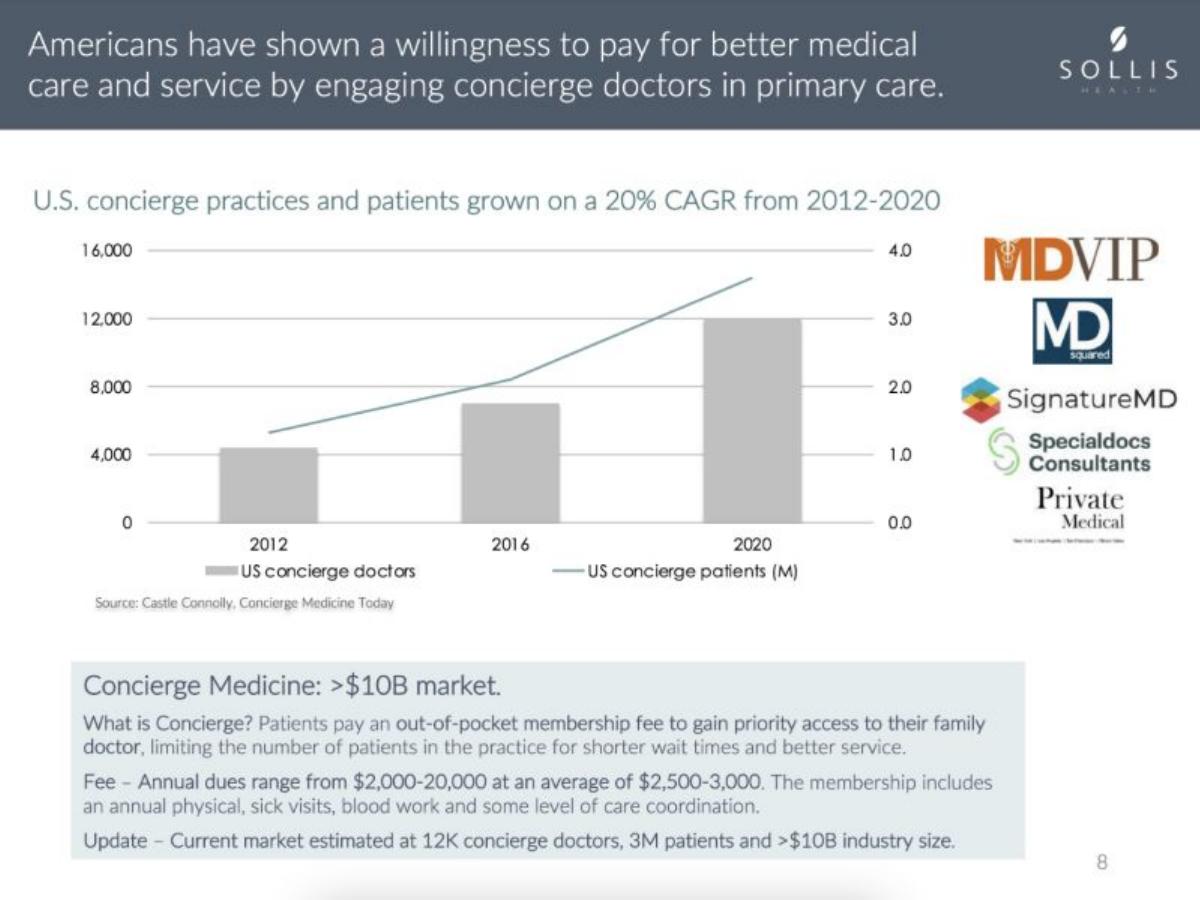
- The deck highlights a 20% CAGR in U.S. concierge practices and patients from 2012-2020, establishing a growing market of payers (Slide 4).
- Wait time comparisons are a central selling point, contrasting Sollis's 3-minute wait with the 300-minute average for hospital ERs (Slide 11).
- The 'Life Without Sollis' vs. 'Life as a Sollis Member' graphic effectively visualizes the reduction of a six-week surgical timeline into a single day (Slide 10).
- Member retention is exceptionally high, with the deck reporting an 85-90% renewal rate since inception (Slide 13).
- The company claims to handle 80-90% of ER acute cases, significantly higher than the 20-30% handled by standard Urgent Care centers (Slide 7).
- The management team combines deep healthcare investment experience with operational expertise from membership-based businesses like NeueHouse (Slide 14).
- The deck omits a specific 'Ask' slide, though catalogue data indicates a $30M Series A raise in 2021.
The High-Acuity Concierge Play
Sollis Health’s pitch deck is a clinical look at the inefficiencies of the American healthcare system and a roadmap for how to bypass them for a price. In a sector often crowded with 'digital health' apps, Sollis stands out by pitching a heavy-asset, service-first physical infrastructure. This teardown examines the 15 slides that helped secure a $30M Series A.
Slide 1: Title and Aesthetic
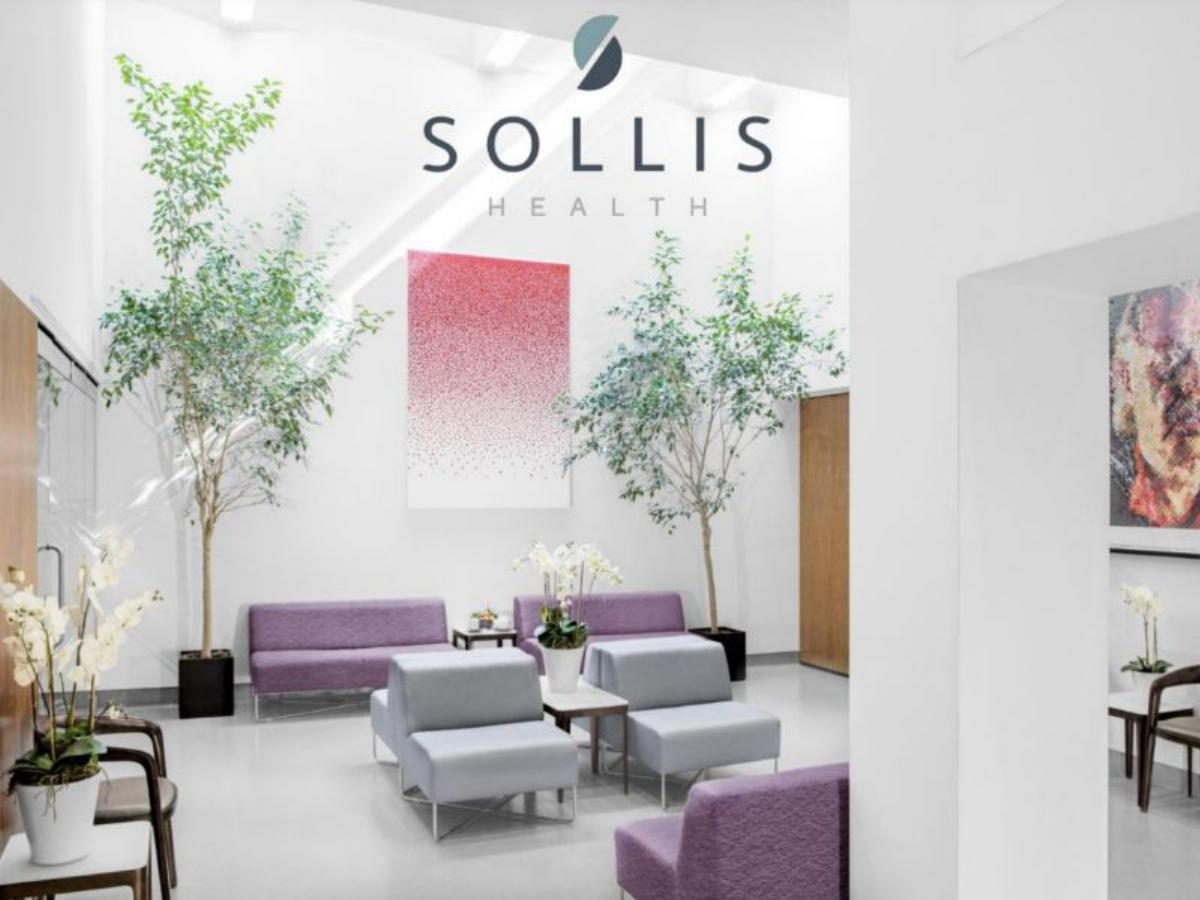
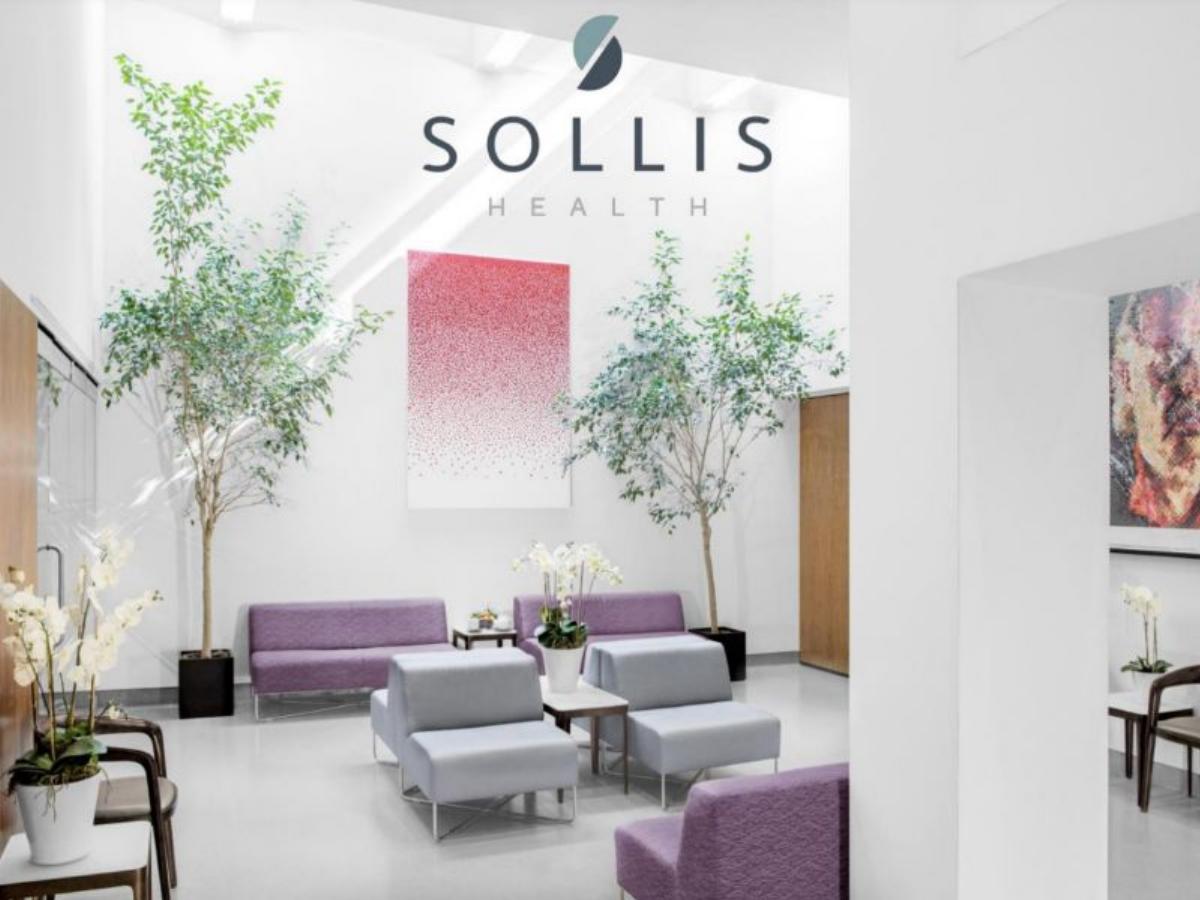
The deck opens with a high-resolution photograph of a Sollis Health facility. The aesthetic is more 'luxury hotel lobby' than 'medical clinic,' featuring minimalist furniture, indoor trees, and modern art. This immediately signals the brand's positioning: this is healthcare for a demographic that values environment and comfort as much as clinical outcomes. There is no tagline, only the logo, letting the visual identity do the heavy lifting.
Slide 2: The Macro Problem
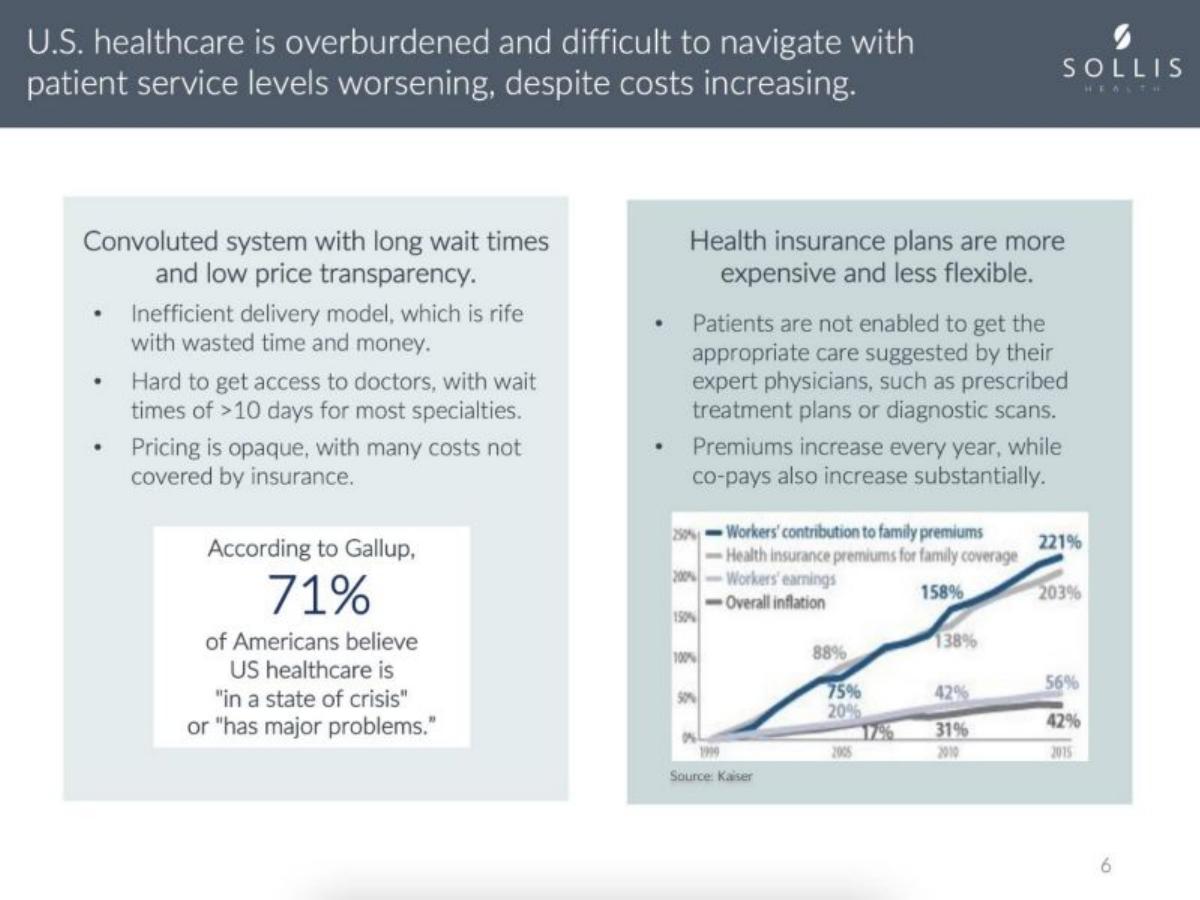
Slide 2 (labeled as page 6 in the footer) addresses the 'overburdened' U.S. healthcare system. It cites a Gallup poll stating that 71% of Americans believe the system is in a 'state of crisis.' The slide highlights two main pain points: long wait times (over 10 days for most specialties) and opaque pricing. A Kaiser graph shows that workers' contributions to family premiums have risen 221% since 1999, far outstripping inflation (56%) and earnings (42%). This sets the stage: the current system is expensive and slow.
Slide 3: The Covid Catalyst
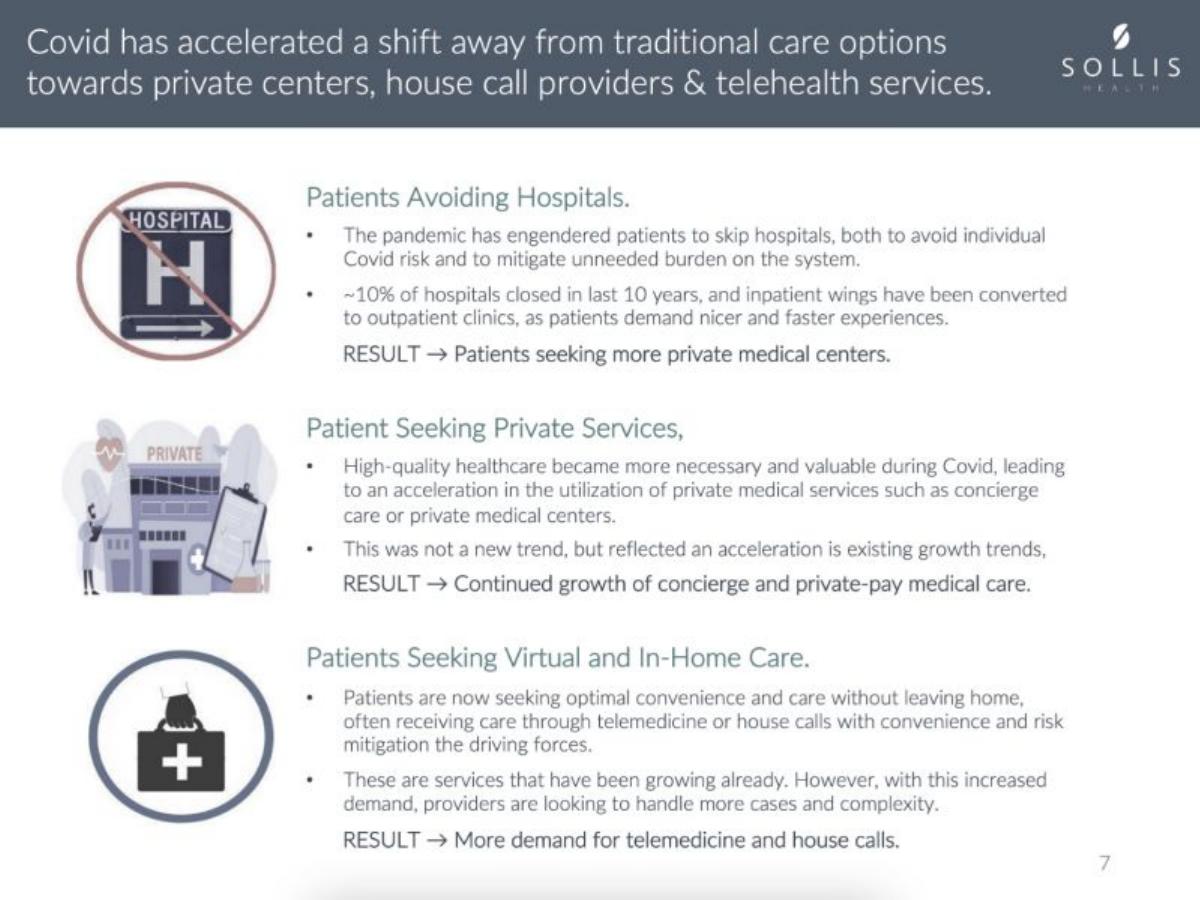
Slide 3 (page 7) explains why 'now' is the time for Sollis. It argues that the pandemic accelerated three trends: patients avoiding hospitals to mitigate risk, a shift toward private medical centers, and increased demand for virtual/in-home care. It notes that ~10% of hospitals closed in the last 10 years, creating a vacuum that private-pay medical care is filling.
Slide 4: Market Validation - Concierge Medicine
Slide 4 (page 8) quantifies the concierge medicine market, estimated at over $10B. It shows a 20% CAGR from 2012 to 2020 in both doctors and patients. The slide defines the model: patients pay $2,000–$20,000 annually for priority access. By listing competitors like MDVIP and SignatureMD, Sollis acknowledges the existing market but prepares to pivot to how they are different.
Slide 5: The ER Pain Point
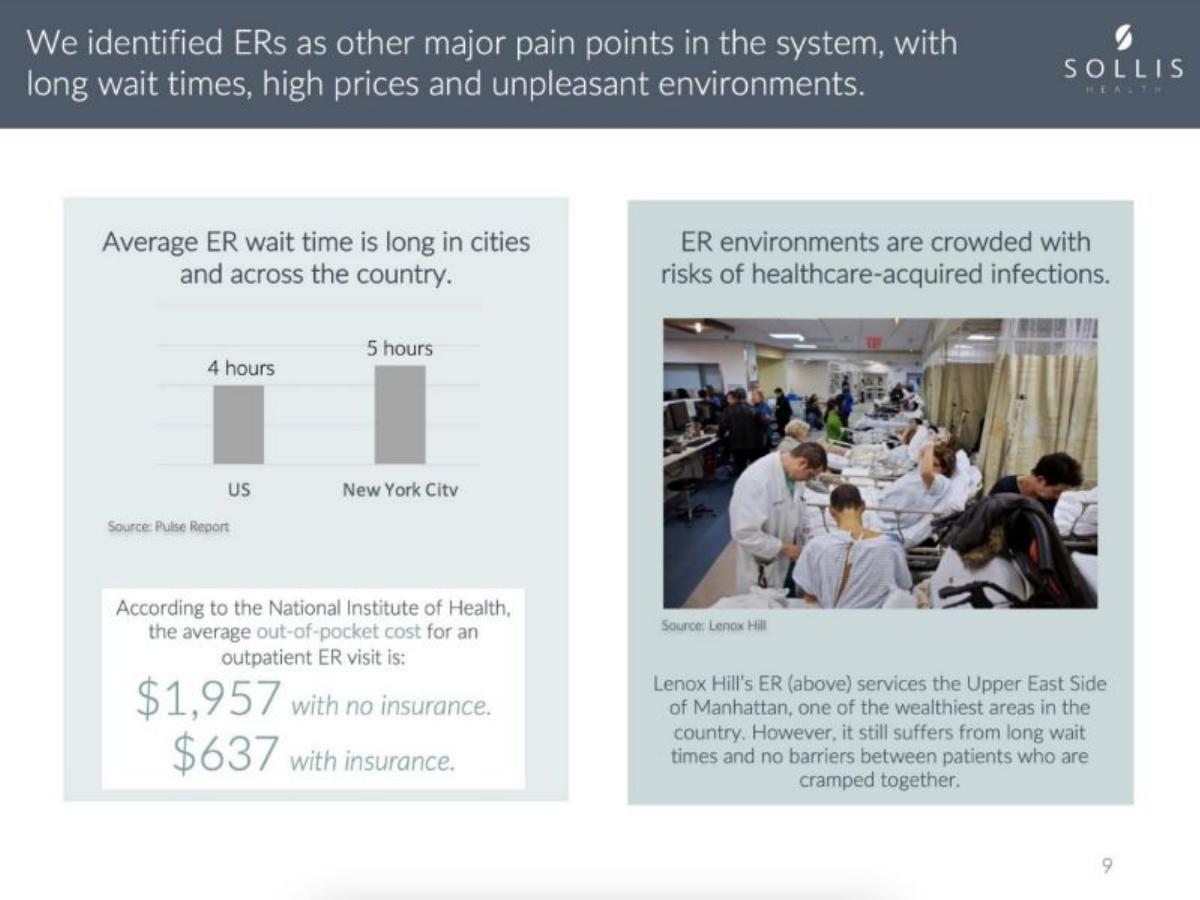
Slide 5 (page 9) focuses specifically on Emergency Rooms. It contrasts the 4-hour average US wait time with the 5-hour average in New York City. Crucially, it includes a photo of a cramped ER at Lenox Hill, noting that even in the 'wealthiest areas in the country,' patients suffer from long wait times and lack of barriers between patients. This is a direct appeal to the fear of healthcare-acquired infections and the discomfort of public facilities.
Slide 6: Market Validation - Urgent Care
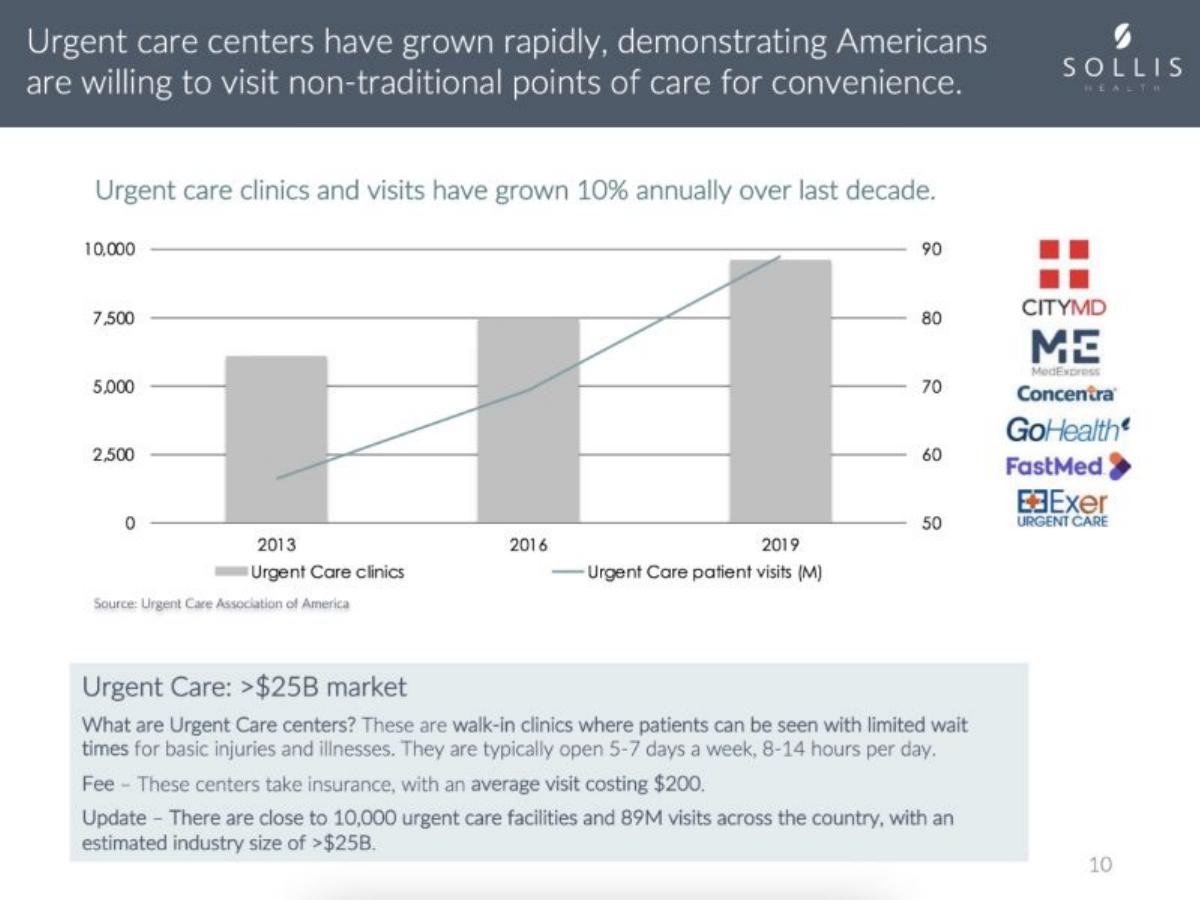
Slide 6 (page 10) looks at the $25B Urgent Care market, which has grown 10% annually. While these centers are convenient, the slide notes they are typically for 'basic injuries and illnesses.' This sets up the 'Acuity Gap' that Sollis intends to fill—the space between a basic urgent care clinic and a full-scale hospital ER.
Slide 7: The Sollis Solution
Slide 7 (page 5) introduces the Sollis value proposition. It breaks the service into four pillars: 24/7 care by ER-boarded doctors, on-site advanced imaging (MRI, CT), VIP access to specialists, and house calls/telemedicine. The most important claim here is that Sollis can handle 80-90% of ER acute cases, compared to just 20-30% for standard Urgent Care centers. This is the 'moat'—the ability to provide hospital-level diagnostics in a private setting.
Slide 8: The Patient Journey
Slide 8 (page 4) maps the operational flow: Telemedicine -> House Calls -> In-Clinic Care -> Care Navigation. A map shows current locations in Los Angeles, New York, and Miami. This slide demonstrates that Sollis is not just a clinic, but a coordinated system that 'continually tracks the patient throughout the care experience.'
Slide 9: Life With vs. Without Sollis
Slide 9 (page 6) is a classic 'Before and After' infographic. 'Life Without Sollis' involves a Sunday evening injury leading to a chaotic ER, weeks of specialist visits, and a 6-week wait for surgery. 'Life as a Sollis Member' shows the same injury resulting in immediate imaging and next-day surgery. It’s a powerful visual representation of time saved, which is the primary product Sollis is selling.
Slide 10: Comparative Metrics
Slide 10 (page 16) uses bar charts to drive home the efficiency. Sollis claims a 0-day time to appointment (vs. 3 days for a PCP) and a 3-minute in-office wait time (vs. 300 minutes for an ER). It also notes that Sollis physicians see only 1.0 patient per hour, compared to 4.5 in Urgent Care, suggesting a much higher level of personalized attention.
Slide 11: The Competitive Quadrant
Slide 11 (page 9) is the 'Magic Quadrant' of the deck. It plots providers on two axes: Service Level and Acuity. Hospital ERs are high acuity but low service. Concierge practices are high service but low acuity (no emergency care). Sollis places itself alone in the top-right quadrant: High Service and High Acuity. This is the most effective slide in the deck for an investor, as it clearly identifies an 'un-served niche.'
Slide 12: Traction and Social Proof
Slide 12 (page 18) provides the 'hard' numbers on customer satisfaction. It lists a Net Promoter Score of 75 (top 5% of companies), a complaint rate of Slide 13 (page 14) introduces the leadership. The team is a mix of finance and operations. CEO Andrew Olanow has a background as a healthcare investor at Morgan Stanley and Merrill Lynch. CMO Ian Leber was previously the CMO of an Optum-owned multispecialty chain. Notably, CCO Sabine Heller comes from NeueHouse (a membership-based coworking space), reinforcing the idea that Sollis is as much a 'membership business' as it is a 'healthcare business.'
Slide 14: Conclusion
Slide 14 is a simple 'Thank You' slide with the logo. There is no 'Ask' slide in this version of the deck, which is a significant omission for a standard pitch, though common in 'teaser' or 'vision' decks used to initiate Series A conversations.
What Sollis Health Does Well
Clarity of Positioning: The deck does an exceptional job of explaining why Sollis is not just 'another' concierge doctor. By focusing on 'high acuity' (ER-level care), they differentiate themselves from the thousands of primary care concierge practices. The competitive quadrant on Slide 11 is the definitive argument for the company's existence.
Metric-Driven Comparisons: Instead of saying they are 'fast,' they use specific numbers: 3 minutes vs. 300 minutes. This makes the value proposition tangible. The 85-90% renewal rate is a critical proof point for a membership model, showing that once people pay for the service, they find it indispensable.
Visual Storytelling: The 'Life Without Sollis' journey map is a highly effective way to communicate a complex, multi-week medical process and how Sollis collapses that timeline. It appeals to the 'time-poor' demographic they are targeting.
What is Missing from the Deck
The Financial Ask: There is no slide detailing how much money is being raised, the valuation, or the specific use of proceeds. While we know from catalogue data that they raised $30M, a founder using this as a template should ensure they include a clear 'Ask' slide.
Unit Economics: While the deck mentions membership fees of $2,000-$20,000 in the market context, it doesn't explicitly state Sollis's own pricing tiers, Customer Acquisition Cost (CAC), or Lifetime Value (LTV). For a Series A, investors usually want to see the 'money in vs. money out' math for a single location.
Growth Strategy: The deck shows three current markets (NY, LA, Miami) but doesn't detail the roadmap for the next 10 cities. There is no discussion of the 'playbook' for opening a new center, which is vital for a business that relies on physical real estate and local medical staffing.
What a Founder Should Copy
The Gap Analysis: Use the 'Acuity vs. Service' quadrant model if you are entering a crowded market. Finding the 'empty' corner of a graph is the fastest way to explain your moat to a VC.
The 'Now' Slide: Slide 3’s use of the pandemic as an 'accelerant' for existing trends is a great way to handle market timing. Don't just say your business is good; explain why the world changed in a way that makes your business necessary right now.
Focus on Retention: If you have a membership or SaaS model, highlight your renewal rate as prominently as Sollis does. An 85-90% renewal rate in a high-ticket service is a massive signal of Product-Market Fit.
The 'Anti-Competitor' Imagery: Using a photo of a crowded, unpleasant competitor facility (Slide 5) creates a visceral reaction that words cannot. It defines the 'enemy' clearly and makes your solution feel like a relief.
Frequently asked questions
- What is the core business model of Sollis Health?
- Sollis Health operates on a membership-based concierge model. Members pay an annual fee to access 24/7 medical centers that provide emergency-room-level care, including advanced imaging (MRI, CT, X-ray) and specialist navigation. Unlike traditional concierge medicine which focuses on primary care, Sollis focuses on high-acuity urgent and emergency situations, aiming to bypass the traditional hospital ER experience.
- How does Sollis Health differentiate itself from Urgent Care centers?
- According to Slide 7 and Slide 12, Sollis differentiates through equipment and acuity. Standard Urgent Care centers typically handle only 20-30% of ER acute cases and often lack on-site advanced imaging. Sollis employs ER-boarded physicians and maintains on-site MRI and CT capabilities, allowing them to handle 80-90% of cases that would otherwise require a hospital visit.
- What are the key performance indicators (KPIs) mentioned in the deck?
- The deck focuses on three main categories of KPIs: operational speed, patient satisfaction, and retention. Key figures include a 3-minute in-office wait time (Slide 11), a Net Promoter Score (NPS) of 75, a complaint rate of less than 1%, and a member renewal rate of 85-90% (Slide 13).
- Who is the target customer for Sollis Health?
- The deck targets individuals willing to pay out-of-pocket for premium access. It notes that concierge medicine annual dues typically range from $2,000 to $20,000 (Slide 4). By highlighting the 'state of crisis' in U.S. healthcare and the specific overcrowding of ERs in wealthy areas like the Upper East Side (Slide 5), Sollis targets high-net-worth individuals seeking efficiency and safety.
- What is missing from the Sollis Health pitch deck?
- The deck is notably missing a financial 'Ask' slide detailing the amount being raised and the intended use of funds. It also lacks a detailed revenue model or P&L projection. While it mentions a $30M raise in the catalogue data, the slides themselves focus almost entirely on the value proposition, market gap, and operational metrics rather than the investment terms.