Sogud Pack’s 2017 investor deck is a textbook example of a consumer packaged goods (CPG) startup seeking to bridge the gap between artisanal production and mass-market retail. By highlighting partnerships with the Rowett Institute and Queen Margaret University, the company establishes scientific credibility for its 'outrageously nutritious' snacks. The deck reports a strong 79% average month-on-month growth since its September 2016 launch, supported by three UK distributors and early exports to Germany. While the deck lacks specific financial projections or a clear funding 'ask' amount, it pr…
Key takeaways
- The company claims a 79% average month-on-month growth rate since its launch in September 2016 (Slide 9).
- Product development was supported by nutrition and sensory testing experts at the Rowett Institute and Queen Margaret University (Slide 3).
- The deck identifies a total addressable market of £654M in 2020, with cereal bars making up 62% of that figure (Slide 7).
- Sogud achieved early international traction with exports to Germany and a supplier role for the subscription service Chewy Moon (Slide 9).
- The sales strategy involves shifting away from direct sales to independent retailers in favor of larger distributor partnerships (Slide 11).
- The core team consists of two founders and a dedicated baker, with plans to add an Export/Marketing Manager and a sales rep in 2018 (Slides 11 and 13).
- The deck omits a specific funding target, valuation, or detailed breakdown of how the raised capital will be allocated.
- Future growth plans include developing own-label products for large retailers in the UK and EU (Slide 11).
Slide-by-Slide Analysis
Slide 1: Title Slide
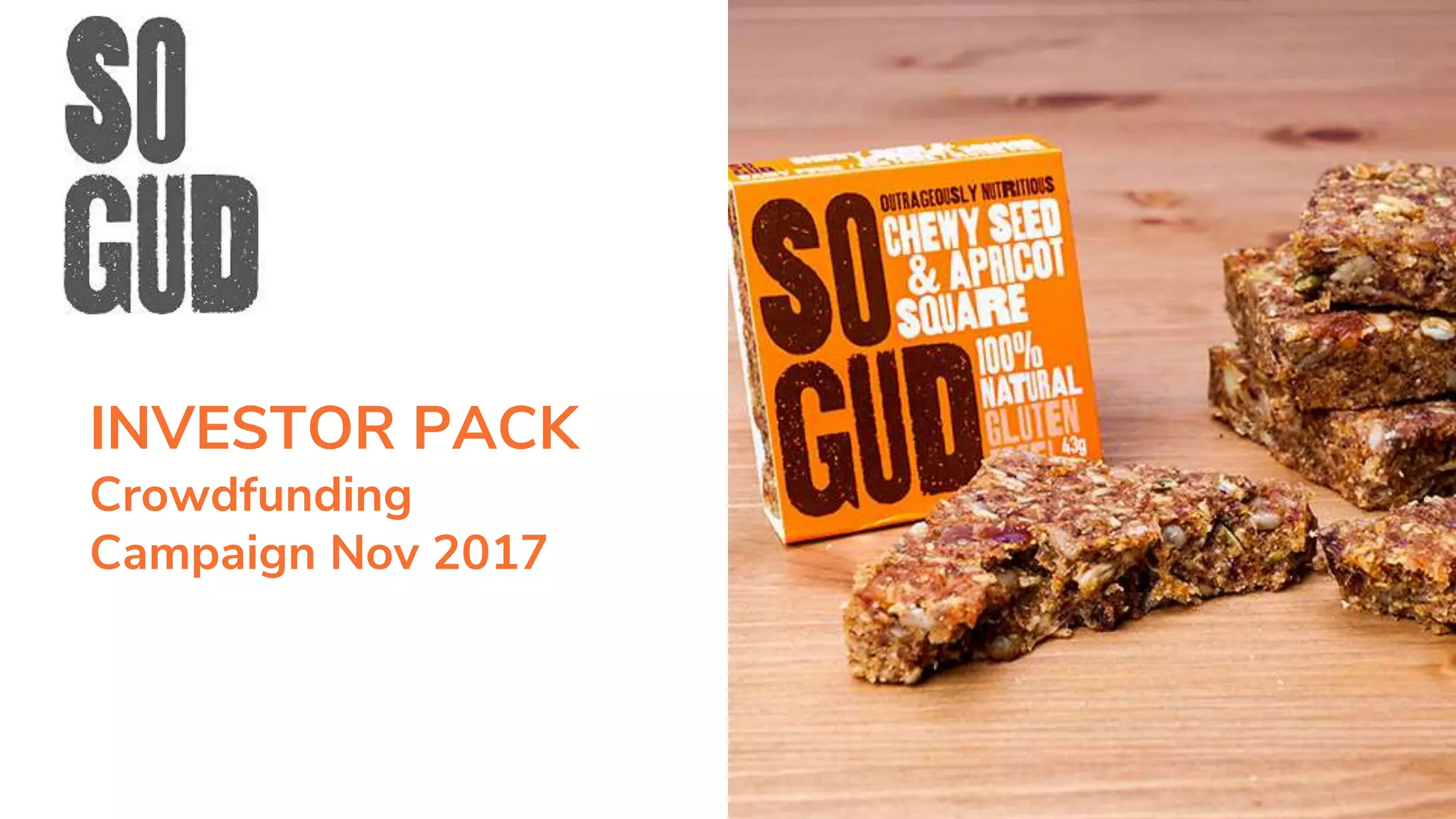
The cover slide introduces the brand 'SO GUD' with a bold, textured logo. It explicitly states this is an 'Investor Pack' for a 'Crowdfunding Campaign' in November 2017. A high-quality product photo shows the 'Chewy Seed & Apricot Square,' emphasizing its '100% Natural' and 'Gluten Free' status. This immediately establishes the brand identity and the specific purpose of the deck.
Slide 3: The Problem and Solution
Slide 3 uses a linear narrative to explain the company's origin. The problem is defined as a lack of snacks with 'proper whole ingredients.' The solution involved seeking experts in nutrition and product development from the Rowett Institute and Queen Margaret University in Scotland. The result, as stated on the slide, is a 'nutritionally dense, superbly tasty, gluten-free convenient' snack that has undergone sensory testing. This slide is effective because it backs up 'healthy' claims with academic partnerships rather than just marketing jargon.
Slide 5: Target Audience and Value Proposition
This slide breaks down the appeal of the product for five distinct groups. For health-conscious consumers, it highlights the lack of refined sugar and preservatives. For retailers, it emphasizes 'shelf-ready, distinctive packaging' and a 'proven track record.' For active people and commuters, it focuses on 'sustained energy' and convenience. Finally, for coeliacs, it claims the product is 'far tastier than most Gluten Free products.' By segmenting the value proposition, the company shows it understands the various stakeholders in the CPG ecosystem.
Slide 7: Market Potential
Slide 7 provides a quantitative view of the market. It cites a Total Addressable Market (TAM) of £654M in 2020, with a 4% annual growth rate. The market is segmented into Cereal Bars (62%, £362.4M), Fruit & Nut Bars (20%, £111.3M), Energy Bars (8%, £47.0M), and Other Snack Bars (9%, £51.2M). The slide also lists competitors like Kellogg, Alpen, Nakd, and Clif, positioning Sogud as a 'Premium, Natural' alternative that fits into all these categories. Citing specific competitors and market values shows a grounded understanding of the retail landscape.
Slide 9: Traction and Growth
This is the 'proof' slide. It claims a '79% average month on month growth since launch in Sept 2016.' Key milestones include securing three UK distributors, exporting to Germany, and supplying Chewy Moon (a children's subscription box). It also notes a staff increase from 3 to 5. These metrics are vital for a crowdfunding campaign, as they demonstrate momentum and the ability to scale beyond a local kitchen operation.
Slide 11: Sales Strategy and Roadmap
Slide 11 outlines future drivers for sales. It indicates a strategic shift: 'Direct sales to independent retailers should reduce as distributor sales increase.' It also mentions the hiring of an Export/Marketing Manager in January 2018 and an additional sales rep in July 2018. Notably, it mentions 'initial discussions' with the NHS, schools, and transport networks, and a plan to develop 'own-label products' for large retailers. This shows a clear path toward high-volume, B2B revenue streams.
Slide 13: The Core Team
The team slide introduces Terri Petrie (Operations), Neil Petrie (Sales), and Rosie Pillinger (Baker). Terri is credited with 'strategic and business expertise,' Neil with starting 'two successful companies,' and Rosie with product development alongside academic institutions. Neil is also noted as the 'professional photographer,' which explains the high quality of the product imagery throughout the deck. The team appears balanced between operations, sales, and product creation.
Slide 15: Contact and Call to Action
The final slide provides contact details for Terri Petrie, including a phone number, email, and social media links. The imagery of a rocket ship heading toward a planet reinforces the 'journey to success' theme. It is a standard closing slide that makes it easy for interested investors to reach out.
What Sogud Pack Does Well
Scientific Validation: By citing partnerships with the Rowett Institute and Queen Margaret University, Sogud moves beyond the 'homemade' label and establishes itself as a scientifically formulated product. This is a significant differentiator in the crowded healthy snack market.
Clear Distribution Strategy: The deck doesn't just say they want to sell more; it explains how . The move from direct sales to distributors and the focus on institutional contracts (NHS, schools) shows a sophisticated understanding of how to achieve scale in the UK market.
Visual Branding: The deck is visually consistent, using a bright orange palette that matches the product packaging. The professional photography makes the product look appetizing, which is essential for any food-based startup.
What is Missing from the Deck
The Ask: The most glaring omission is the lack of a specific funding target. While it mentions a 'Crowdfunding Campaign,' the slide deck does not state how much money they are looking to raise or what the valuation of the company is.
Use of Funds: While the roadmap mentions hiring two people, there is no detailed breakdown of how the investment will be spent. Investors typically want to see a pie chart or list showing allocations for marketing, production equipment, and working capital.
Unit Economics: There is no mention of the cost of goods sold (COGS), wholesale pricing, or retail margins. In the CPG world, these numbers are critical to determining if the business can actually become profitable at scale.
Financial Projections: While the deck mentions a 79% growth rate, it does not provide a forward-looking P&L or revenue targets for the next 3-5 years. The TAM is mentioned, but not Sogud's projected share of it.
Founder Takeaways
Leverage Academic Credibility: If you have worked with universities or research institutes to develop your product, highlight it. It provides a 'moat' of credibility that competitors may lack. · Show, Don't Just Tell, Your Growth: The '79% month-on-month growth' figure is the strongest piece of data in the deck. Hard percentages are much more convincing than vague statements like 'we are growing fast.' · Segment Your Value Proposition: Different stakeholders care about different things. Retailers care about packaging and track records; consumers care about ingredients. Addressing both in your deck shows you understand the whole supply chain. · Include the 'Ask': Even in a crowdfunding deck, you should be clear about what you need and what the investor gets in return. Never leave the audience guessing about the size of the round.
Frequently asked questions
- What is the primary value proposition of Sogud's products?
- According to Slide 5, the products are positioned as 'outrageously nutritious' snacks made from natural ingredients with no added preservatives, artificial colors, flavors, or refined sugar. They are specifically marketed as gluten-free and nutritionally dense, targeting health-conscious consumers, active individuals, commuters, and coeliacs who find existing gluten-free options less palatable.
- How does Sogud define its market opportunity?
- On Slide 7, the company cites a Total Addressable Market (TAM) of £654M for 2020, growing at 4% per annum. They break this down into four segments: Cereal Bars (£362.4M), Fruit & Nut Bars (£111.3M), Energy Bars (£47.0M), and Other Snack Bars (£51.2M), positioning Sogud as a premium, natural alternative across these categories.
- What is the company's distribution strategy?
- Slide 11 outlines a transition from direct sales to independent retailers toward a distributor-led model. The company expects distributors to be the major income contributor. They also plan to target high-volume contracts with transport providers (rail/airways), universities, the NHS, and schools, while developing own-label products for major retailers.
- Who are the key members of the Sogud team?
- Slide 13 introduces Terri Petrie (Operations), who has experience with global organizations and startups; Neil Petrie (Sales), who previously started two successful companies including a food business; and Rosie Pillinger (Baker), who developed the products in collaboration with academic institutions.
- What traction had the company achieved by late 2017?
- Slide 9 reports that since launching in September 2016, the company secured three UK distributors, achieved exports to Germany, and became a supplier for Chewy Moon. They also grew their internal staff from three to five members and maintained a 79% average month-on-month growth rate.