Softr’s 19-slide Series A deck is remarkably light on traditional financial metrics and heavy on functional proof. Raised in 2022, the $13.5M round led by FirstMark Capital was secured through a narrative of extreme usability. The deck uses a 'show, don't tell' approach, dedicating nearly 40% of its slides to specific customer-built applications like client portals, internal directories, and marketplaces. By positioning the product as a 'zero learning curve' layer on top of existing data sources like Airtable and Google Sheets, Softr successfully argued for a bottom-up SaaS adoption strategy.…
Key takeaways
- The deck emphasizes a 'zero learning curve' value proposition on slide 1, targeting the SME market.
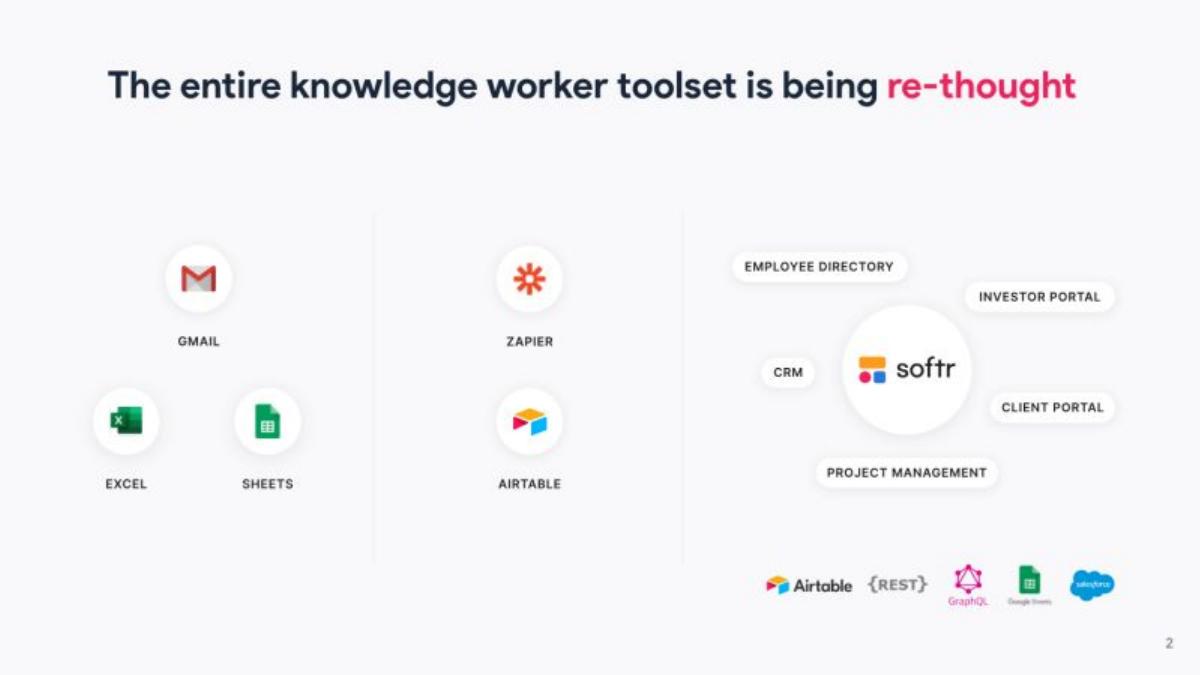
- Softr positions itself as the missing interface layer for data sources like Airtable, Google Sheets, and Salesforce on slide 2.
- Six consecutive slides (5-10) are dedicated to specific customer use cases, providing concrete evidence of product versatility.
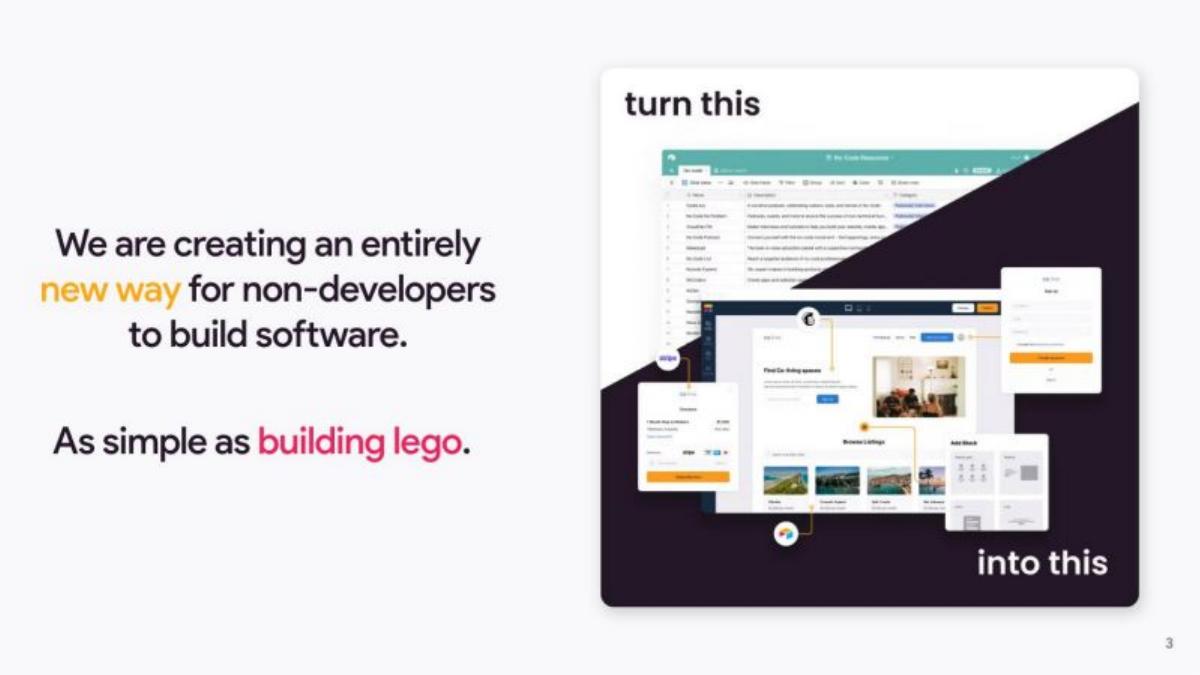
- The 'Lego' analogy is used on slides 3 and 12 to simplify the technical complexity of app development for non-developers.
- The pricing model on slide 16 highlights a 'unique free plan' designed to drive a bottom-up SaaS adoption strategy.
- A high-level vision on slide 17 sets a specific North Star metric: 1 million apps created on the platform by 2025.
- The team slide (15) leverages logos from PayPal, Zalando, and Workfront to establish technical and operational credibility.
- The deck omits a traditional competitor matrix, choosing instead to focus on the 'new way' of building software.
The Narrative: From Data to Apps Without the Friction
Softr’s Series A pitch deck is a masterclass in product-led storytelling. In a crowded no-code market, Softr chose to win by being the 'easiest' rather than the 'most powerful.' The deck, used to raise $13.5M in 2022, focuses almost entirely on the transition from raw data (Airtable, Sheets) to functional business applications. It avoids the dense jargon of software architecture and instead uses a 'Lego' analogy to make the prospect of app building feel accessible to any SME employee.
Slide 1-3: The Value Proposition and the 'Lego' Analogy
The deck opens with a bold claim on Slide 1 : "Zero learning curve." This is the core differentiator. While other no-code tools often require weeks of tutorials, Softr positions itself as the immediate solution for SMEs. Slide 2 contextualizes this by showing the evolution of the knowledge worker's toolset. It places Softr at the center of a new ecosystem, pulling from data sources like Airtable, Google Sheets, and Salesforce to create specific business outputs like Investor Portals and CRMs. Slide 3 introduces the 'Lego' metaphor, showing a visual 'before and after'—turning a spreadsheet-like Airtable base into a polished, branded web application. This visual proof is essential for a Series A round where the product must be shown to work in the real world.
Slide 4-11: The Power of Social Proof and Use Cases
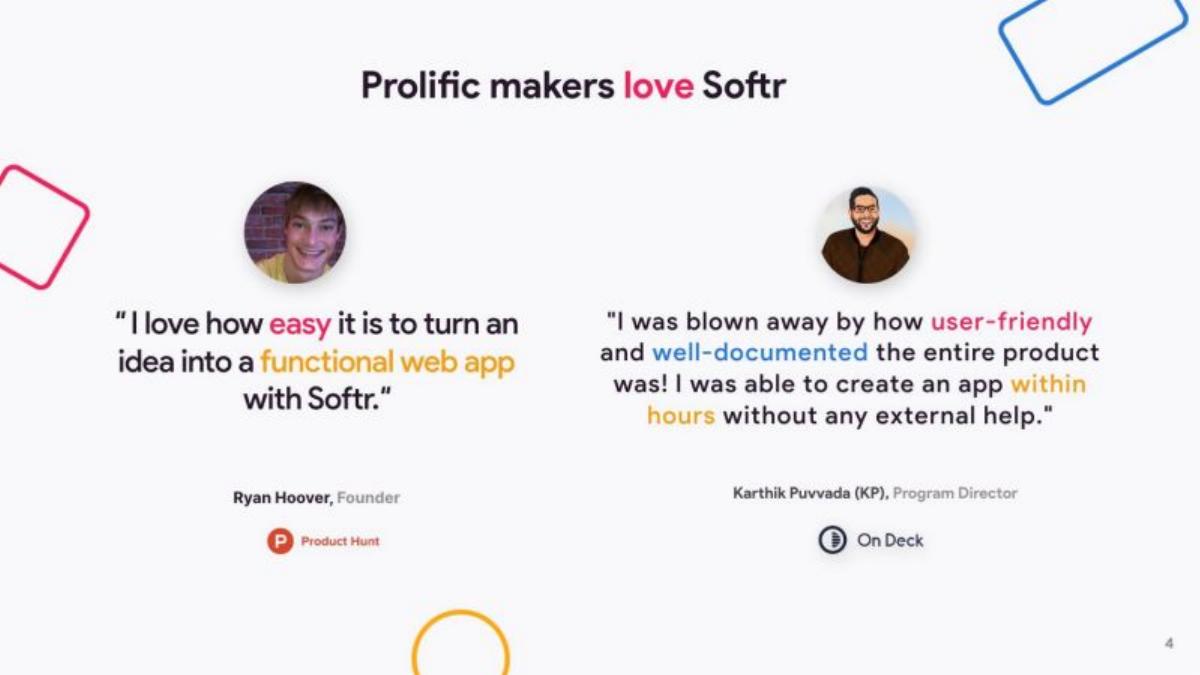
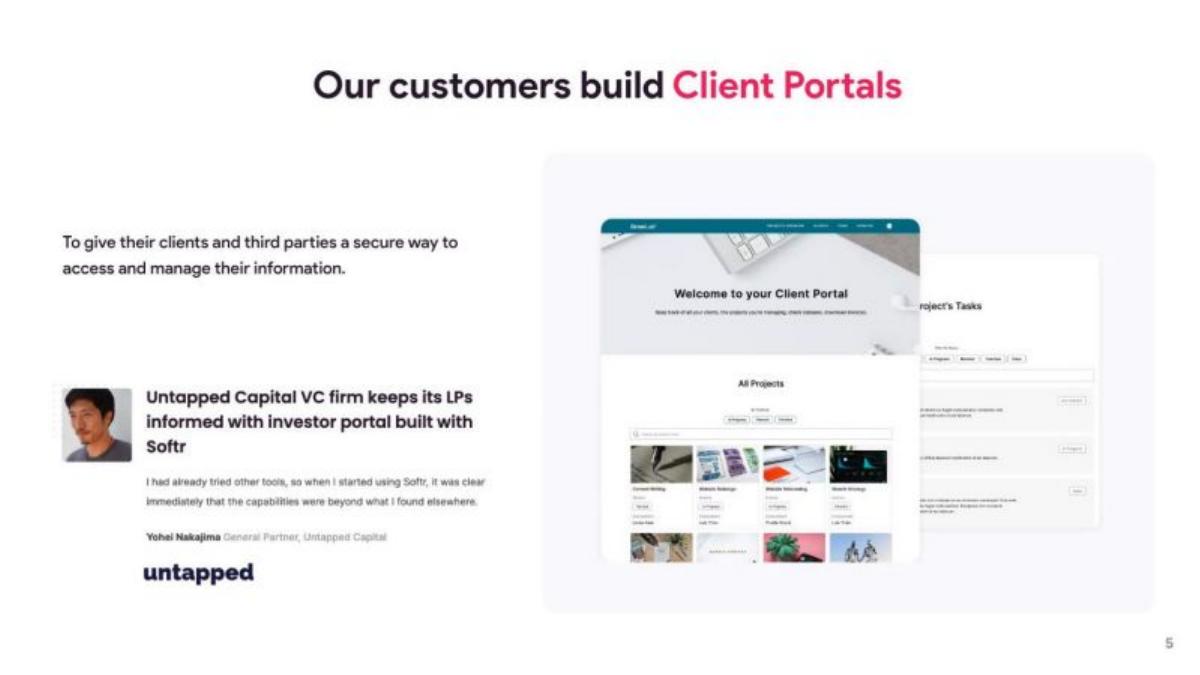
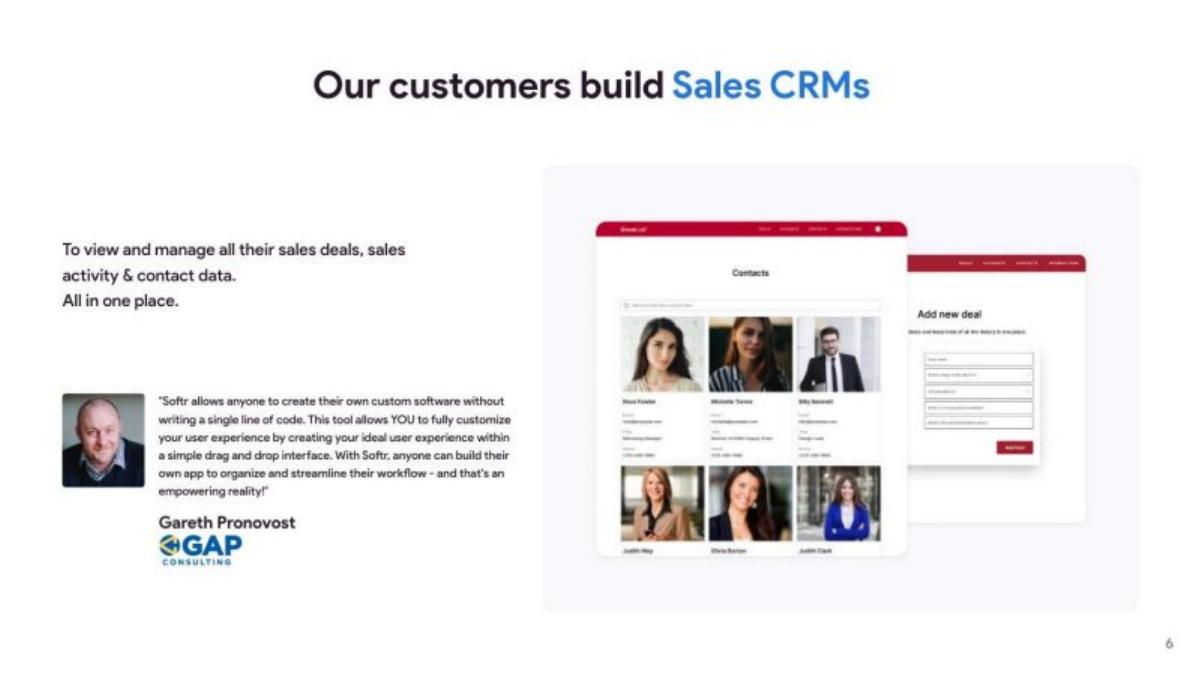
One of the most striking features of this deck is the sheer volume of social proof. Slide 4 features testimonials from Ryan Hoover (Founder of Product Hunt) and Karthik Puvvada (On Deck), two major influencers in the 'maker' community. This establishes immediate credibility with VCs who follow these tech hubs. From Slide 5 to Slide 10 , the deck walks through six distinct use cases: Client Portals, Sales CRMs, Employee Directories, Applicant Tracking Systems, Marketplaces, and Online Communities. Each slide follows a consistent format: a headline, a brief description of the benefit, a customer quote, and a screenshot of the finished product. This repetitive structure hammers home the versatility of the platform. Slide 11 rounds this out with a 'wall of love' featuring Twitter (X) screenshots, showing that the product has organic, viral momentum.
Slide 12-14: Product Mechanics and Future Roadmap
Slide 12 breaks down the 'superpowers' given to business users into a four-step process: Connect data, build with blocks, add auth/payments, and publish. It highlights specific features like '1 click Stripe checkout' and 'real-time search & filtering,' which are often complex to build from scratch. Slide 13 is a placeholder for a product demo video, a staple of modern SaaS decks. Slide 14 shifts from the 'now' to the 'future.' It illustrates the transition from a tool with integrated data sources to a full-scale ecosystem featuring a Component Store, a Template Marketplace, and a network of 'Softr Experts.' This slide is crucial for justifying a Series A valuation, as it shows how the company will move beyond a simple subscription model into a platform with its own economy.
Slide 15-16: Team and Business Model
The team slide ( Slide 15 ) is clean and focuses on pedigree. Co-founders Mariam Hakobyan and Artur Mkrtchyan highlight their backgrounds with logos from PayPal, Zalando, and Workfront. The 'Team Members' section adds further weight with logos from PicsArt, TeamViewer, and VMware, suggesting a high-caliber engineering and product culture. Slide 16 details the pricing strategy. It explicitly mentions a 'bottom-up SaaS adoption strategy' driven by a unique free plan that includes custom domains. The tiers—Starter ($24/m), Professional ($65/m), and Business ($165/m)—show a clear path to expansion revenue as customers scale their record counts and member lists.
Slide 17-19: The Vision and The Goal
The deck concludes with a high-level vision. Slide 17 sets a concrete goal: "1M apps created on Softr by 2025." This gives investors a clear metric to track success. Slide 18 reiterates the ambition to become the "biggest ecosystem for building custom apps without code." The deck ends without a specific 'Ask' slide (the amount being raised is not listed on the final slides), which is common in decks that are shared after an initial verbal agreement or in highly competitive rounds where the terms are still fluid.
What Softr Does Well
Visual Clarity: The deck is uncluttered. It uses high-quality screenshots and consistent branding to make the product look professional and easy to use. · Use Case Depth: By showing six different types of apps, Softr proves it isn't a 'niche' tool. It demonstrates a broad Horizontal SaaS potential. · Influencer Validation: Including Ryan Hoover early in the deck is a strategic move to signal 'Product-Market Fit' to the tech-savvy VC audience. · Focus on the 'Non-Developer': Every slide reinforces that this is for people who cannot code, which is a much larger market than the developer community.
What is Missing from the Softr Deck
Financial Traction: There is no mention of MRR, ARR growth, or Churn. While the Series A was successful, most founders would need to include these metrics to prove the business is viable, not just the product. · Competitive Landscape: The deck ignores competitors like Bubble, Stacker, or Glide. Investors usually want to know why a user would choose Softr over a more established or more powerful alternative. · Unit Economics: There is no data on Customer Acquisition Cost (CAC) or Lifetime Value (LTV), which are standard requirements for a Series A teardown. · The 'Ask': The deck does not state how much capital is being raised or how the funds will be allocated (e.g., 50% Engineering, 30% Marketing).
Founder's Guide: What to Copy
The 'Show, Don't Tell' Approach: If your product is visual, use screenshots of what your customers have built, not just your own marketing mockups. · The Evolution Slide: Slide 14 is a great template for showing how a simple tool becomes a defensible platform. Map out your 'Today' vs. 'Tomorrow.' · Pedigree Logos: On your team slide, don't just list titles. Use the logos of the prestigious companies your team has worked for to build instant trust. · Clear North Star: Have one big, round number (like Softr's 1M apps) that defines what success looks like for the next three years.
Frequently asked questions
- How does Softr handle the competition in this deck?
- Surprisingly, Softr does not include a traditional competition slide or a 2x2 matrix. Instead, it frames the competition implicitly on slide 2 by showing the 'old' toolset (Excel, Gmail) versus the 'new' ecosystem. It positions itself as a complementary layer to existing data tools like Airtable rather than a direct replacement for every no-code tool, focusing on the speed of creation rather than feature parity with high-end development platforms.
- What is the primary growth lever identified in the pitch?
- The primary growth lever is 'Bottom-up SaaS adoption,' explicitly mentioned on slide 16. Softr uses a Freemium model that allows for custom domains even on the $0/month tier. This strategy is designed to get individual 'makers' and SME employees to build and deploy apps quickly, creating internal champions who eventually move the organization toward the Professional ($65/m) or Business ($165/m) tiers as they need more collaborators and records.
- Does the deck include financial projections or revenue metrics?
- No. The 19 slides provided do not contain a single revenue figure, MRR growth chart, or Burn Multiple. This is unusual for a Series A deck, which typically requires a 'Traction' slide. Softr relies entirely on 'Product Traction'—showing the types of apps built and quoting high-profile users like Ryan Hoover—to imply commercial success. The only forward-looking metric is the goal of 1 million apps by 2025 on slide 17.
- How does Softr define its target market?
- Softr specifically targets SMEs (Small and Medium Enterprises) and 'knowledge workers,' as stated on slides 1 and 2. By focusing on users who already use Airtable or Google Sheets but lack the technical skills to build custom interfaces, Softr carves out a niche between simple website builders and complex, high-learning-curve app builders like Bubble.
- What is the 'Tomorrow' vision for the company?
- On slide 14, Softr outlines an evolution from a tool to an ecosystem. The 'Tomorrow' vision includes a Component Store, a 'Softr Experts' marketplace for freelancers, and a Template Marketplace. This suggests the company intends to build a moat through network effects and third-party contributions, moving beyond a simple SaaS utility into a platform play.