Sofía’s 16-slide Series A deck is a clinical example of how to pitch a regional disruption play. By highlighting a massive $65 billion healthcare market in Mexico with only 7% private insurance penetration, the company established a clear 'latent market' opportunity. The deck emphasizes a full-stack approach, combining telehealth with a proprietary insurance product to bypass traditional, inefficient broker networks. While the deck is light on specific unit economics and historical growth metrics, it leans heavily on the strength of its existing institutional backers and a clear competitive c…
Key takeaways
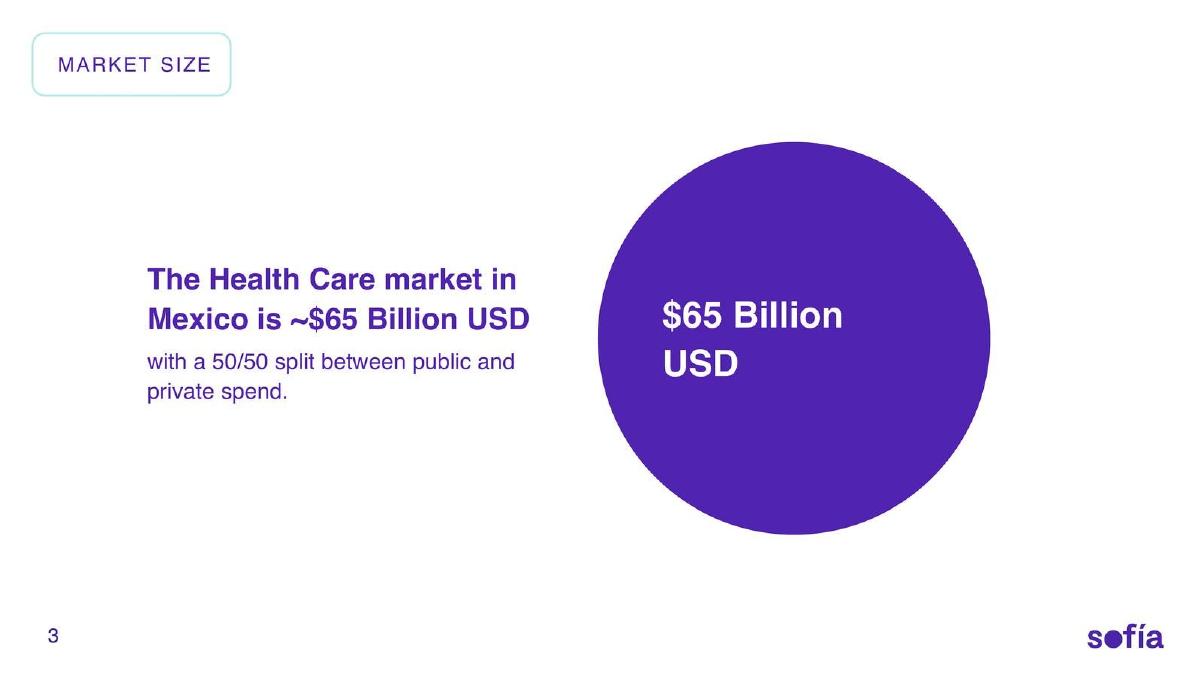
- The healthcare market in Mexico is valued at approximately $65 billion USD, split 50/50 between public and private spend (Slide 3).
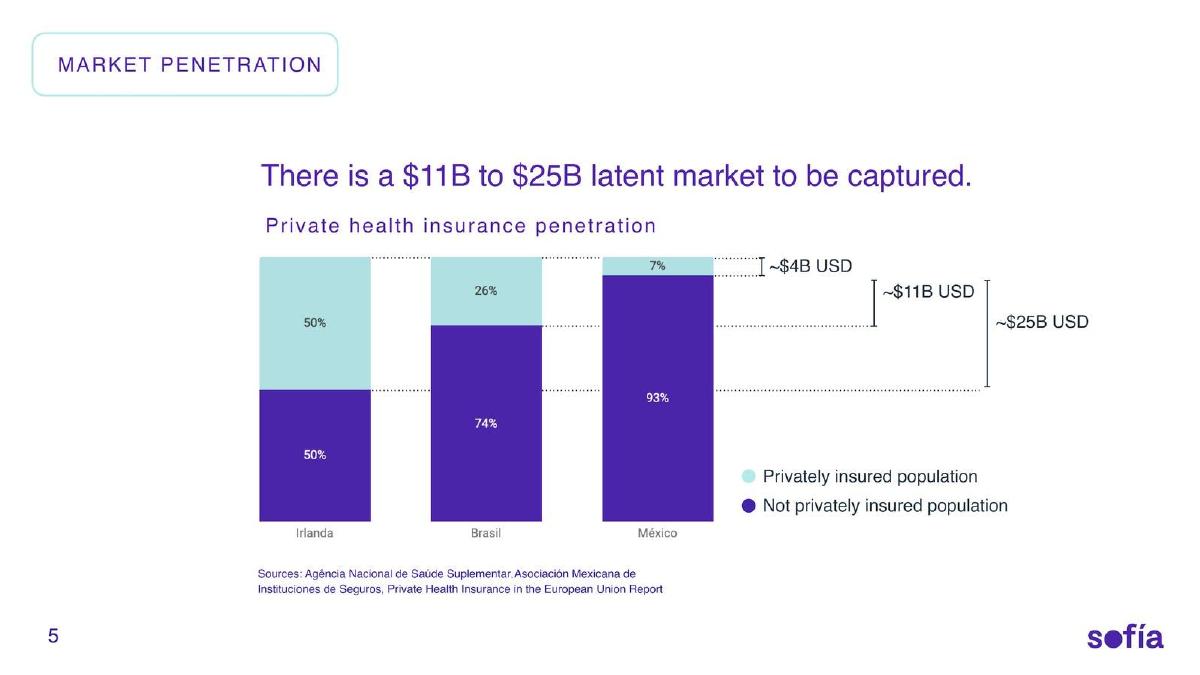
- Mexico has a significantly lower private health insurance penetration rate at 7% compared to Brazil (26%) and Ireland (50%) (Slide 5).
- The company identifies a latent market opportunity valued between $11 billion and $25 billion USD (Slide 5).
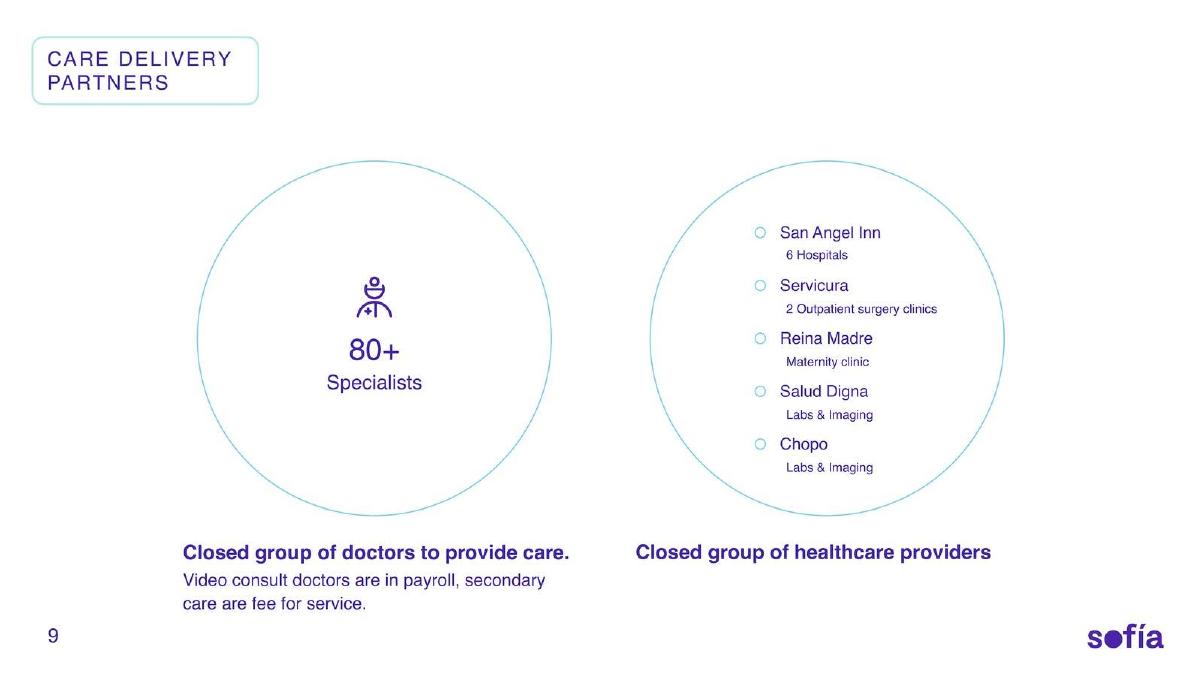
- Sofía utilizes a closed group of over 80 specialists and specific partner hospitals like San Angel Inn to control care quality (Slide 9).
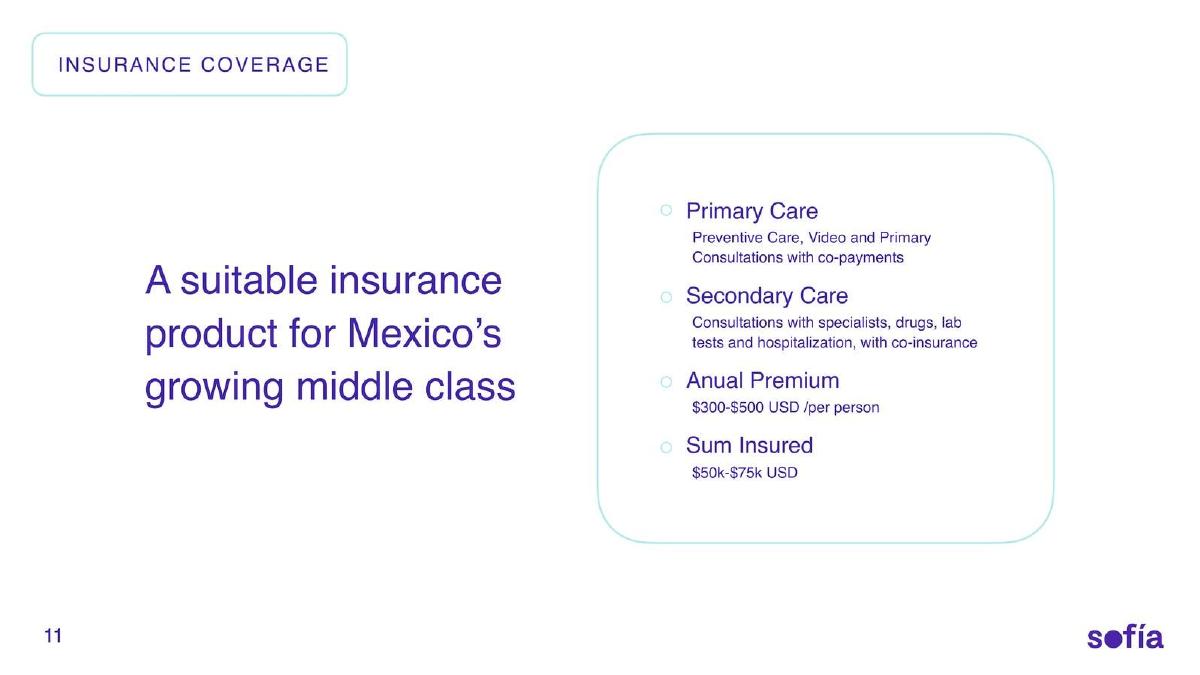
- The product targets the middle class with annual premiums between $300-$500 USD and a sum insured of $50k-$75k USD (Slide 11).
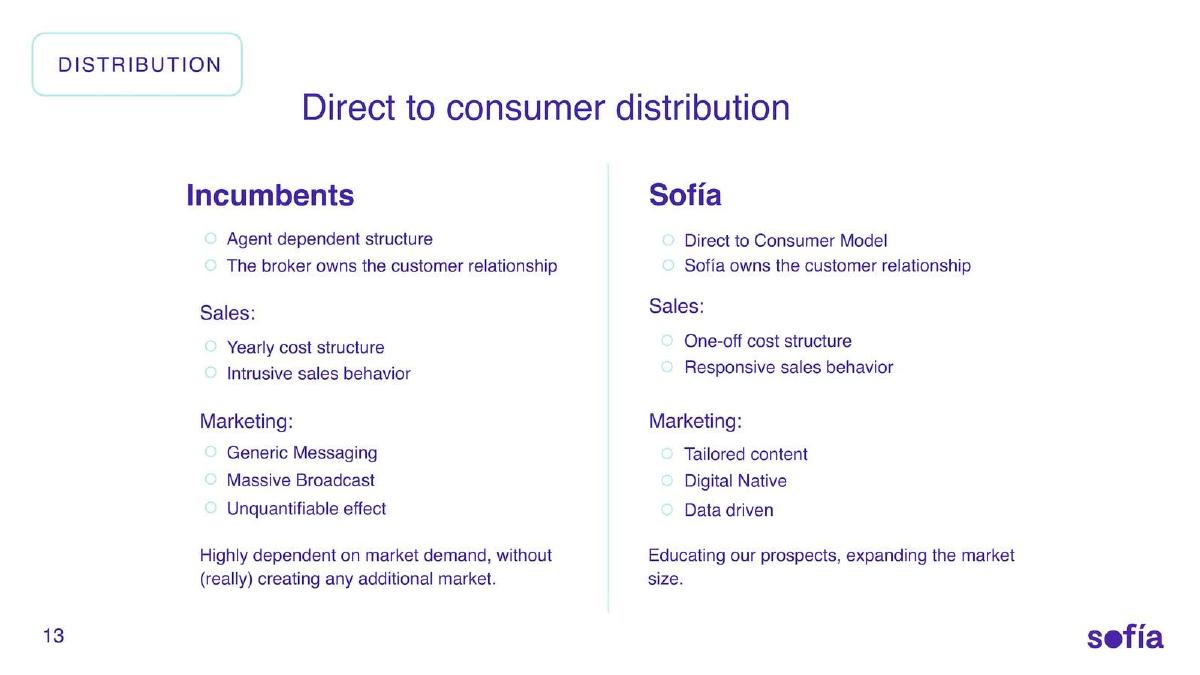
- A core differentiator is the Direct-to-Consumer (DTC) model, which removes the 'agent dependent structure' of incumbents (Slide 13).
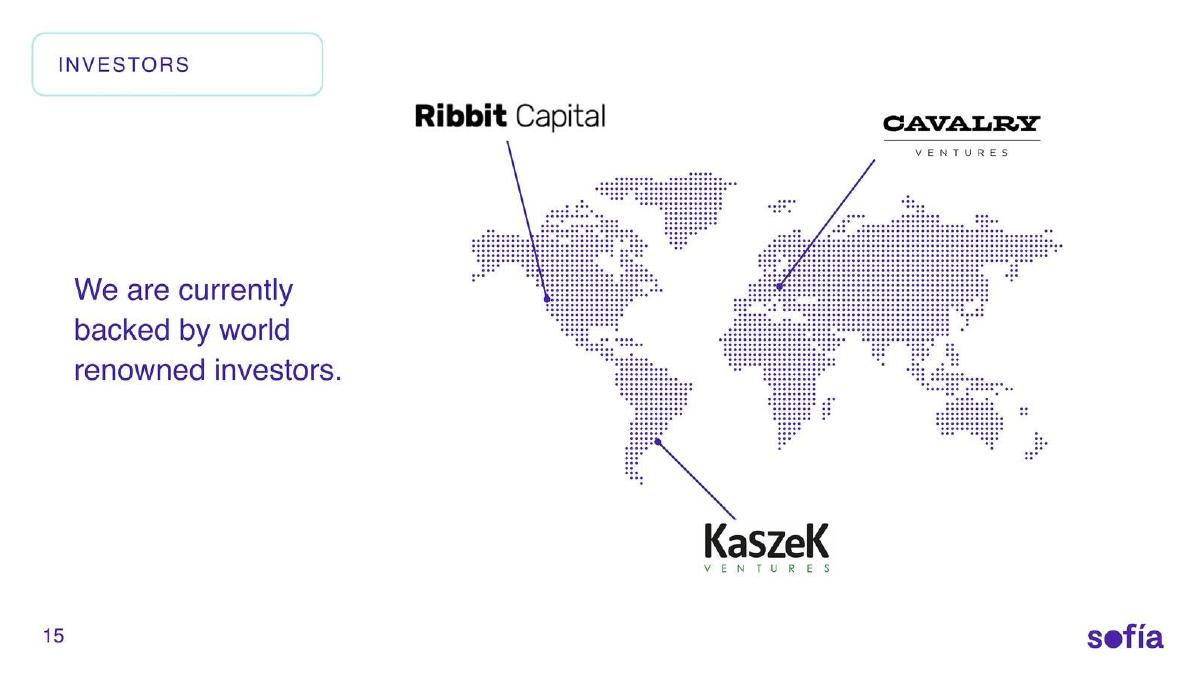
- The deck highlights existing backing from prominent VCs including Ribbit Capital, KaszeK Ventures, and Cavalry Ventures (Slide 15).
- The presentation lacks a dedicated team slide, financial projections, or a specific 'ask' for the Series A round.
The Strategy of Latent Demand
Sofía’s pitch deck for their $19 million Series A is a study in market-driven storytelling. Rather than leading with complex technology or a roster of features, the deck focuses on a systemic failure in the Mexican healthcare market. By contrasting Mexico's 7% private insurance penetration against other markets, Sofía creates a compelling narrative of inevitability: the market must grow, and a digital-first player is best positioned to capture it. As reported by Business Insider, this 2020 round was a significant milestone for the South American (specifically Mexican) healthtech ecosystem.
Slides 1-2: Brand Identity
The deck opens with two minimalist title slides. The first features the Sofía logo in white against a vibrant purple background. The second is identical. While this might seem redundant, in a professional pitch setting, it serves as a visual anchor while the presenters introduce themselves. There is no tagline or mission statement on these slides, relying entirely on the brand name to set the stage.
Slide 3: Market Size
Slide 3 introduces the macro opportunity. It states that the Health Care market in Mexico is ~$65 Billion USD . Crucially, it notes a 50/50 split between public and private spend . This is a vital distinction for investors; it proves that there is already a $32.5 billion private market in operation, reducing the perceived risk of consumer behavior change. The visual is simple: a large purple circle representing the total market size.
Slide 4: The Placeholder
Slide 4 is a transition slide, containing only the company name. This suggests a narrative break, moving from the 'what' (market size) to the 'why' (market penetration).
Slide 5: Market Penetration and Latent Opportunity
This is arguably the most important slide in the deck. It compares private health insurance penetration across three countries: Irlanda (50%) , Brasil (26%) , and México (7%) . By showing that Mexico lags significantly behind even its regional peer, Brazil, Sofía illustrates a massive gap. The slide explicitly labels this as a $11B to $25B latent market to be captured . By quantifying the 'latent' market, Sofía shifts the conversation from competing for existing customers to creating new ones—a much more attractive prospect for venture capital.
Slide 6: Transition
Another minimalist transition slide featuring only the logo. This serves to reset the audience's attention before moving into the solution phase of the pitch.
Slide 7: The Solution Statement
Slide 7 simply says "our solution" . The use of circular motifs in the typography (replacing the 'o' in 'solution' with a solid white dot) mirrors the logo and maintains the deck's high-design, minimalist aesthetic.
Slide 8: Transition
Again, a logo-only slide. The frequency of these transition slides suggests this deck was designed for a live presentation where the speaker provides the bulk of the context, rather than a 'leave-behind' deck intended to be read in isolation.
Slide 9: Care Delivery Partners
Slide 9 addresses the 'how' of their medical service. It highlights a Closed group of doctors to provide care , featuring 80+ Specialists . It notes that video consult doctors are on payroll, while secondary care is fee-for-service. On the right, it lists specific healthcare providers: San Angel Inn (6 Hospitals) , Servicura (2 Outpatient surgery clinics) , Reina Madre (Maternity clinic) , Salud Digna (Labs & Imaging) , and Chopo (Labs & Imaging) . This slide builds credibility by showing that Sofía is not just an app, but a gateway to a physical infrastructure of reputable medical institutions.
Slide 10: Transition
A logo-only slide, separating the operational partners from the insurance product details.
Slide 11: Insurance Coverage
Slide 11 defines the product for the "growing middle class." It breaks down the offering into Primary Care (preventative, video, and consultations with co-payments) and Secondary Care (specialists, drugs, labs, and hospitalization with co-insurance). The pricing is clear: an Anual Premium of $300-$500 USD per person and a Sum Insured of $50k-$75k USD . This slide is critical for demonstrating that Sofía has a clear grasp of its unit economics and target demographic.
Slide 12: Transition
A logo-only slide, moving the narrative toward distribution and competition.
Slide 13: Distribution and Competitive Advantage
This slide uses a side-by-side comparison to attack the status quo. It labels traditional insurers as Incumbents with an Agent dependent structure where the broker owns the relationship. It characterizes their sales as 'intrusive' and their marketing as 'unquantifiable.' In contrast, Sofía is described as a Direct to Consumer Model where the company owns the relationship. Key advantages listed include a One-off cost structure , Responsive sales behavior , and Data driven marketing. The footer note is powerful: incumbents are 'dependent on market demand,' while Sofía is 'expanding the market size.'
Slide 14: Transition
Slide 15: Investors
Validation is provided through a map showing their global backing. The slide states they are "currently backed by world renowned investors." It points to Ribbit Capital in North America, Cavalry Ventures in Europe, and KaszeK Ventures in South America. For a Series A, showing this level of institutional support from a previous seed round is a massive signal of quality to new investors.
Slide 16: Closing
The final slide is a simple logo, closing the loop on the brand identity established at the start.
What Sofía Does Well
The deck excels at market framing . By using the term 'latent market,' they avoid the 'red ocean' problem of fighting for the 7% of Mexicans who already have insurance. Instead, they position themselves as the company that will unlock the other 93%. This is a classic venture capital narrative: market creation is always more valuable than market share theft.
The visual consistency is also a major strength. The deck uses a limited color palette and plenty of white space, which conveys a sense of modernism and transparency—traits often lacking in traditional insurance companies. This design choice reinforces their 'digital native' identity mentioned on Slide 13.
Finally, the vertical integration story is clear. By showing both the 'Care Delivery Partners' (Slide 9) and the 'Insurance Coverage' (Slide 11), they demonstrate that they control the entire value chain. This reduces the 'middleman' costs and allows for the $300-$500 annual premium, which is a highly competitive price point for the middle class.
What is Missing from the Deck
The most glaring omission is a Team Slide . In a Series A round, the pedigree of the founders is usually a primary selling point, especially in a highly regulated industry like healthcare and insurance. The absence of this slide suggests it may have been presented separately or that the founders' reputations were already well-known to the target investors.
There is also a total lack of Traction Metrics . There are no charts showing user growth, Net Promoter Score (NPS), or revenue since their seed round. While the 'latent market' argument is strong, investors usually want to see that the 'Direct to Consumer' model is actually working in the real world before committing $19 million. Similarly, there is no Financial Projection or Use of Funds slide, leaving the specific goals of the Series A undefined in this document.
Founder Takeaways
Quantify the Gap: If you are in an under-penetrated market, don't just show the TAM (Total Addressable Market). Show how your market compares to others to prove the 'latent' opportunity, as seen on Slide 5. · Contrast the Experience: Use a side-by-side comparison to highlight not just feature differences, but structural differences. Sofía’s attack on the 'agent dependent structure' of incumbents (Slide 13) is more compelling than just saying their app is better. · Leverage Your Cap Table: If you have high-signal investors from previous rounds, give them their own slide. It acts as a powerful proxy for due diligence for new investors (Slide 15). · Price for Your Target: Be specific about your pricing and what it covers. Slide 11 removes the mystery of the business model by stating the exact premium and coverage amounts.
Frequently asked questions
- What is Sofía's primary business model based on the deck?
- Sofía operates as a vertically integrated healthtech company. According to Slide 11 and 13, they offer a direct-to-consumer health insurance product that includes primary care (telehealth and video consultations) and secondary care (specialists and hospitalization). By owning the customer relationship and the insurance product, they bypass traditional brokers and manage the care delivery through a closed network of doctors.
- How does Sofía define its target market?
- The company targets the 'growing middle class' in Mexico. Slide 11 specifies their pricing strategy with annual premiums ranging from $300 to $500 USD per person. They position themselves against a backdrop where 93% of the Mexican population is not privately insured, representing a massive untapped 'latent market' (Slide 5).
- What competitive advantages does Sofía claim over traditional insurance companies?
- On Slide 13, Sofía contrasts itself with 'Incumbents.' While incumbents rely on brokers who own the customer relationship and use 'intrusive sales behavior,' Sofía uses a digital-native, data-driven DTC model. They claim a 'one-off cost structure' for sales compared to the 'yearly cost structure' of traditional agents, allowing for more responsive and tailored marketing.
- Who were the key investors mentioned in the Series A deck?
- Slide 15 highlights three major venture capital firms: Ribbit Capital (based in North America), KaszeK Ventures (focused on Latin America), and Cavalry Ventures (based in Europe). This geographic spread of investors underscores the global interest in their regional solution.
- What critical information is missing from this pitch deck?
- The deck is notably missing a team slide, which is unusual for a Series A. It also lacks a slide detailing the specific use of funds (the 'Ask'), historical traction metrics (like user growth or revenue), and detailed financial projections. These were likely handled in a separate data room or supplemental document.