Opkit’s seed deck is a study in brevity and narrative clarity. Across just eight slides, the founders identify a specific, painful bottleneck in the telehealth workflow: insurance verification. The deck succeeds by using direct customer quotes to validate the problem and positioning the solution as a developer-friendly API, drawing a clear parallel to successful fintech models. While the deck lacks traditional financial projections and a specific 'Ask' slide, it compensates with strong founder-market fit, highlighting the team's early engineering experience at Brex. The narrative moves quickl…
Key takeaways
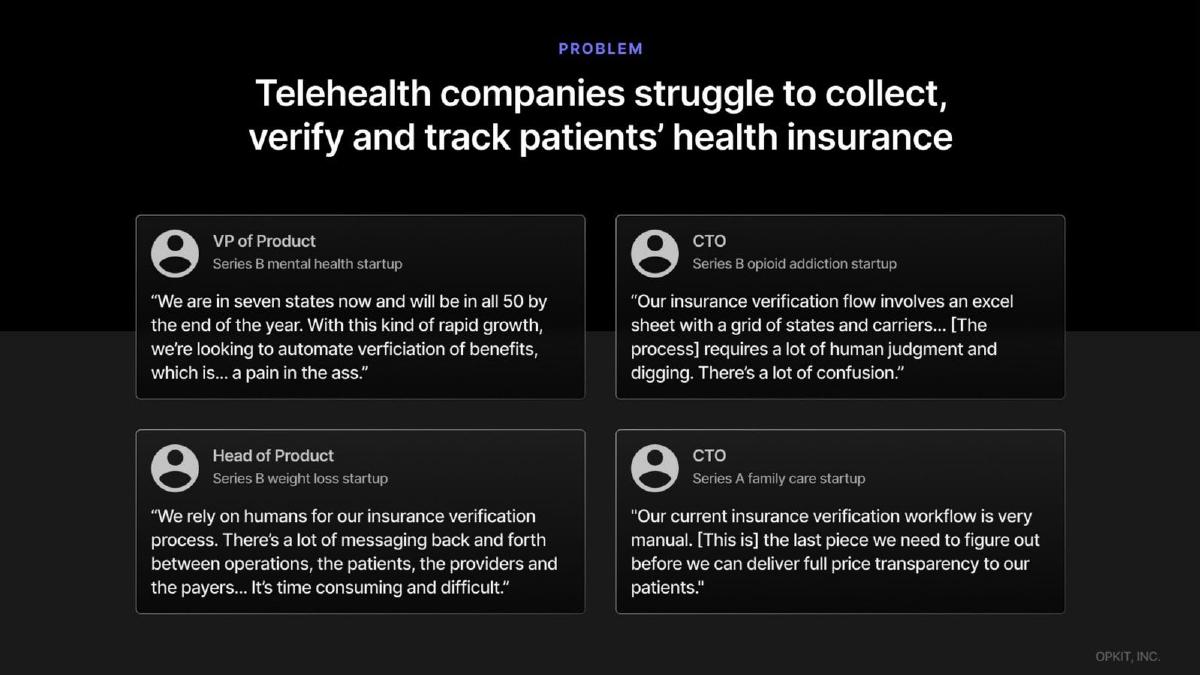
- The deck uses four specific quotes from VP-level and C-suite targets at Series A and B startups to validate the problem on slide 2.
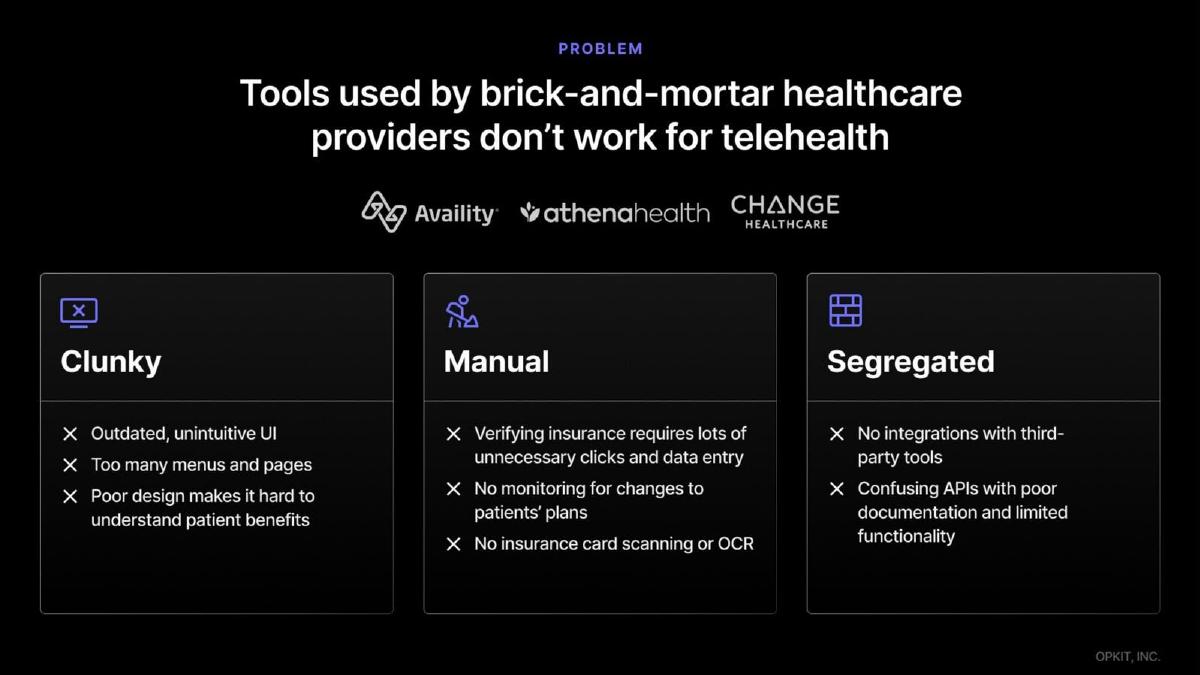
- Legacy competitors like Availity and Athenahealth are explicitly named and critiqued for being 'clunky' and 'segregated' on slide 3.
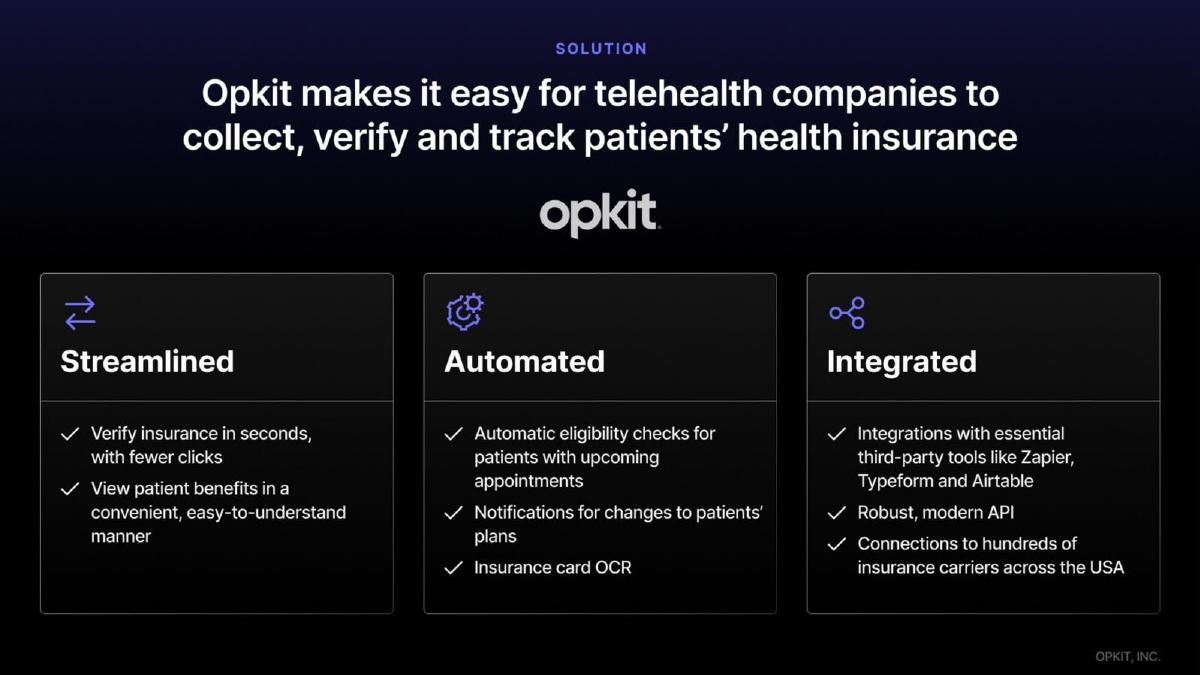
- Opkit positions itself as a developer-first platform, emphasizing a 'robust, modern API' and integrations with Zapier and Airtable on slide 5.
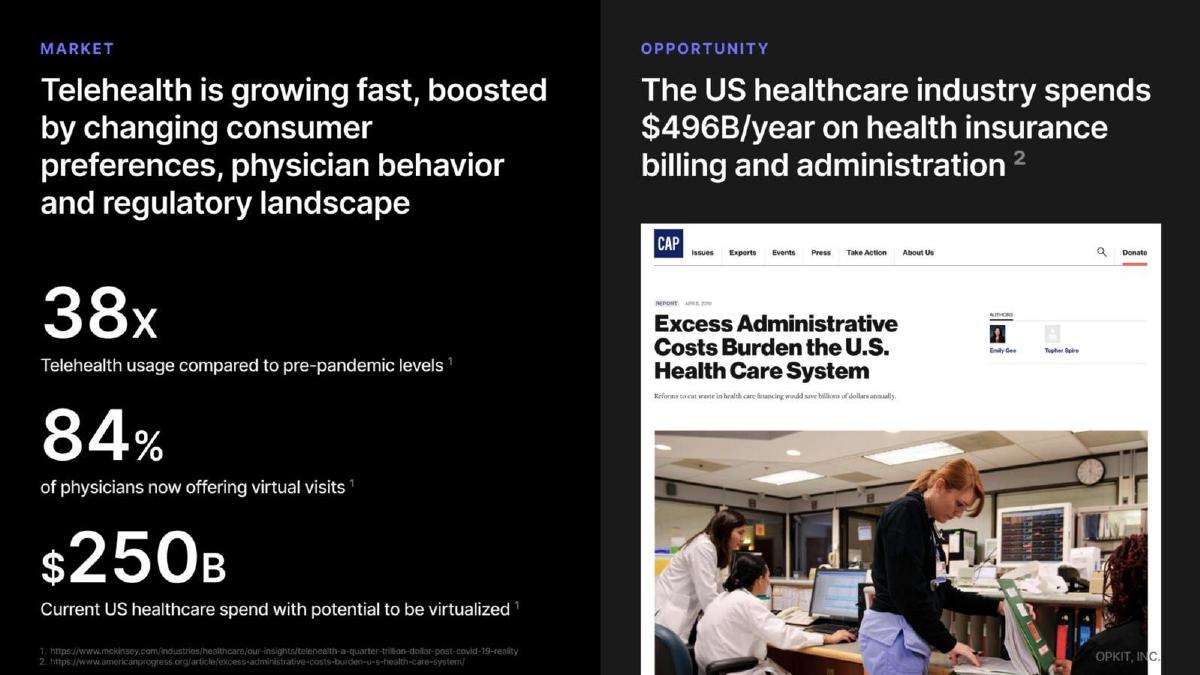
- Market size is framed through the lens of administrative waste, citing a $496B annual spend on health insurance billing and administration on slide 6.
- Telehealth growth is quantified as 38x pre-pandemic levels, creating a sense of urgency for new infrastructure on slide 6.
- The founders lean heavily on their 'early engineering' pedigree at Brex to establish technical credibility on slide 7.
- The deck concludes with a high-level vision statement—'Stripe for Healthcare'—rather than a traditional financial ask on slide 8.
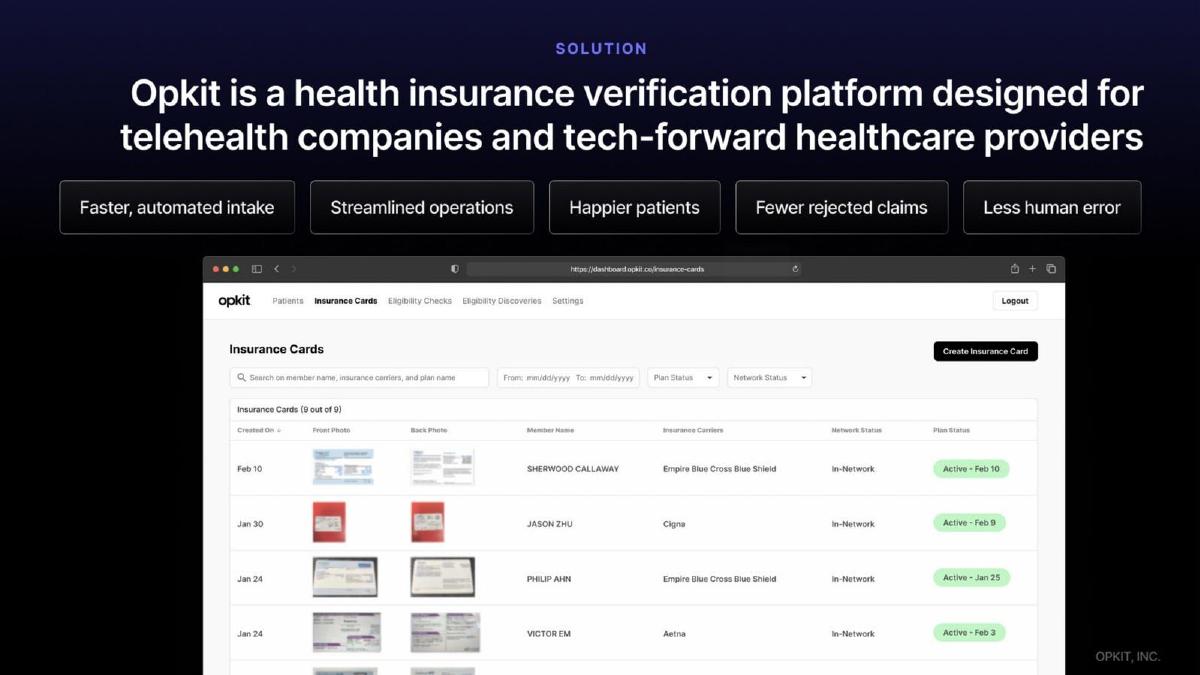
- Product functionality is demonstrated through a dashboard screenshot showing real-time insurance card status and network verification on slide 4.
The Anatomy of a $1M Seed Deck
Opkit’s pitch deck is a lean, 8-slide presentation that successfully raised $1M in 2024. As reported by Business Insider, the company targets the healthcare sector, specifically focusing on the friction inherent in insurance verification for telehealth providers. The deck is notable for its minimalist design—mostly white text on a black background—and its heavy reliance on the founders' previous experience at Brex to build investor confidence.
Slide 1: The Hook
The title slide is functional and direct. It defines Opkit as a "Modern, developer-friendly health insurance verification platform for telehealth companies." By including the date (October 2022) and contact information for Sherwood Callaway, the slide sets a professional, no-nonsense tone. The use of "developer-friendly" is a strategic choice, immediately signaling that this is an infrastructure play rather than a service-heavy healthcare consultancy.
Slide 2: Customer Validation via Proxy
Instead of listing abstract pain points, slide 2 uses four testimonials from anonymous but titled individuals (VP of Product, CTO) at Series A and B startups in the mental health, opioid addiction, weight loss, and family care sectors. One quote explicitly describes the current process as a "pain in the ass," while another mentions relying on an "excel sheet with a grid of states and carriers." This slide is highly effective because it proves that the founders have done their discovery work and that the problem is felt by high-growth companies with budgets.
Slide 3: The Incumbent Critique
Slide 3 identifies the "Problem" by naming names. Logos for Availity, Athenahealth, and Change Healthcare are displayed under the headline "Tools used by brick-and-mortar healthcare providers don’t work for telehealth." The slide breaks down the failures of these incumbents into three pillars: Clunky (outdated UI), Manual (no insurance card scanning), and Segregated (no integrations with third-party tools). This creates a clear gap in the market for a modern alternative.
Slide 4: The Product Reveal
The first "Solution" slide introduces the Opkit dashboard. It lists five high-level benefits: Faster, automated intake; Streamlined operations; Happier patients; Fewer rejected claims; and Less human error. The screenshot shows a clean interface for managing insurance cards, with columns for member names, carriers, network status, and plan status. It visualizes the end of the "Excel sheet" era mentioned in slide 2.
Slide 5: Feature Deep-Dive
Slide 5 mirrors the structure of slide 3, providing the counter-arguments to legacy problems. Under the headings Streamlined, Automated, and Integrated , Opkit lists its technical capabilities. Key highlights include "Insurance card OCR," "Automatic eligibility checks," and "Connections to hundreds of insurance carriers across the USA." The mention of a "Robust, modern API" reinforces the developer-first messaging from the title slide.
Slide 6: Market and Opportunity
This slide provides the macro-economic justification for the business. It cites McKinsey and American Progress to state that telehealth usage is 38x pre-pandemic levels and that 84% of physicians now offer virtual visits. The most significant figure is the $496B spent annually on health insurance billing and administration. By framing the opportunity as a slice of this massive administrative waste, Opkit makes the case that even a small market share represents a significant business.
Slide 7: The Brex Pedigree
The team slide is perhaps the strongest in the deck. Founders Sherwood Callaway (CEO) and Justin Ko (CTO) are described as a "full-stack early engineering team from Brex." The slide lists their specific roles (early backend and early frontend engineers) and includes logos for SpaceX, Amazon, and Y Combinator. Callaway also includes a personal note about being the "Son of Harvard-trained orthopedic surgeon," providing a narrative link to the healthcare industry. This slide is designed to tell investors: "We know how to build scalable fintech infrastructure, and we understand healthcare."
Slide 8: The Vision
The deck ends on a blue background with a bold vision statement: "We envision a world where using your health insurance is as easy as using your credit card." The sub-header explicitly calls this the "Stripe for Healthcare." This is a classic pitch technique—anchoring a new, complex concept to a well-known, successful business model. It leaves the investor with a clear understanding of the company's long-term ambition.
What Works in This Deck
Specific Problem Validation: Using quotes from actual target customers (Slide 2) is much more powerful than generic bullet points. It proves there is a "hair on fire" problem. · Technical Credibility: The founders don't just say they are engineers; they highlight their "early engineering" status at Brex, a company famous for its high-quality infrastructure. · Naming Competitors: By naming Availity and Athenahealth, the founders show they aren't afraid of the giants and have a specific thesis on why those giants are vulnerable in the telehealth niche. · Brevity: At only 8 slides, the deck is designed to be read in under two minutes, making it an ideal "teaser" deck for securing a first meeting.
What is Missing
The Ask: There is no slide detailing how much money is being raised or how it will be spent. While common in some circles, it leaves the reader guessing about the round's structure. · Business Model: The deck never explains how Opkit makes money. Is it per-verification? A monthly SaaS fee? A percentage of claims? This is a significant omission for a seed round. · Traction Metrics: While slide 6 gives market stats, there are no company-specific metrics. We don't know how many customers Opkit has, how many verifications they've processed, or their current revenue. · Roadmap: Aside from the broad "Stripe for Healthcare" vision, there is no tactical roadmap showing what the company plans to build over the next 12-18 months.
What You Should Copy
The "Stripe for X" Framing: If you are building infrastructure, use a well-known analogy to simplify your vision. It helps investors categorize your business immediately. · The Pedigree Slide: If your team has worked at high-growth startups, don't just list the company name. Specify that you were "early" or "lead" to emphasize your role in building the foundation. · The Problem/Solution Mirror: Slide 3 and Slide 5 are perfectly mirrored. Every problem identified in the first is solved in the second. This creates a satisfying narrative loop for the reader. · High-Quality Screenshots: The dashboard on Slide 4 is clean and professional. Even if the product is in beta, showing a polished UI suggests a high level of execution.
Frequently asked questions
- Why did Opkit omit a slide for their fundraising 'Ask'?
- In early-stage seed rounds, especially for teams with high-pedigree backgrounds like Brex and Y Combinator, the 'Ask' is often handled in the verbal pitch or a follow-up memo. By omitting it from the deck, the founders keep the document evergreen and focused entirely on the problem-solution narrative, which is more effective for securing the initial meeting.
- How does the deck handle competition without a standard grid?
- Instead of a feature-by-feature comparison grid, Opkit uses slide 3 to categorize the failures of incumbents like Change Healthcare and Athenahealth. By labeling them as 'Clunky,' 'Manual,' and 'Segregated,' they define the competitive landscape based on user experience and technical debt rather than just a list of features.
- Is the market slide effective despite being high-level?
- Yes. Slide 6 uses a 'Top-Down' approach that works because it connects the massive $496B administrative spend to the specific 38x growth in telehealth. It establishes that the sector is expanding rapidly while the underlying infrastructure remains broken, justifying the need for a modern API solution.
- What is the significance of mentioning the founder's father on the team slide?
- On slide 7, Sherwood Callaway notes he is the 'Son of Harvard-trained orthopedic surgeon.' While unusual for a tech deck, this is a subtle way to signal 'Founder-Market Fit' by implying lifelong proximity to the healthcare industry's administrative frustrations, supplementing his technical experience at Brex.
- Why focus on 'developer-friendly' as a primary value proposition?
- Telehealth startups are built by engineers. By emphasizing a 'modern API' and integrations with tools like Zapier (slide 5), Opkit signals that their product is easy to adopt. This reduces the perceived 'friction to sale' for investors, as developers are often the gatekeepers for infrastructure tools in this sector.