OppZo's pitch deck is a masterclass in demonstrating institutional credibility for a capital-intensive fintech business. By securing $1.25B in debt capital from established players like Arcadia Funds and TAB Bank before their primary equity raise, the founders effectively de-risked the business model for Seed investors. The deck focuses heavily on the massive $1T government contracting market, specifically the $230B niche for small and minority-owned businesses. With a lean 12-slide structure, OppZo emphasizes rapid traction—reaching ~$4M in annualized ARR within one year—and a clear path to…
Key takeaways
- The company secured $1.25B in debt capital from Arcadia Funds and TAB Bank prior to the round, as noted on Slide 2.
- OppZo reached ~$4M in annualized ARR within one year of launch, according to Slide 2.
- The deck targets a $230B market opportunity within the $1T total U.S. government contracting spend, cited on Slide 5.
- Slide 4 highlights a competitive advantage of offering interest rates as low as 8% with no personal guarantee.
- The technology claim on Slide 2 suggests an 80% reduction in underwriting costs through automated origination and servicing.
- The team slide (Slide 6) emphasizes deep institutional experience with logos from J.P. Morgan, the U.S. Treasury, and Columbia University.
- OppZo reports a pipeline of over 2,000 customers to sustain demand, as stated on Slide 2.
- The business model relies on a circular ecosystem involving investors, bank partners, and SMBs, illustrated on Slide 3.
OppZo Pitch Deck Analysis
OppZo entered the fintech market with a highly specialized focus: financing the gap between government contract awards and actual payment for small businesses. Their 12-slide deck, used to secure a reported $260M Seed round in 2024, is a study in institutional positioning. Rather than focusing on a long-term vision of 'disrupting banking,' the deck focuses on the immediate mechanics of a high-scale lending operation: debt facilities, underwriting efficiency, and a massive, underserved regulatory niche.
Slide 1: Title Slide
The deck opens with a minimalist title slide featuring the OppZo logo—a purple and blue gradient circle. The background image is a high-contrast, black-and-white photo of what appears to be a community setting, subtly nodding to the company's focus on social impact and minority-owned businesses without explicitly stating it yet. It establishes a professional, modern fintech aesthetic.
Slide 2: Traction and Credibility
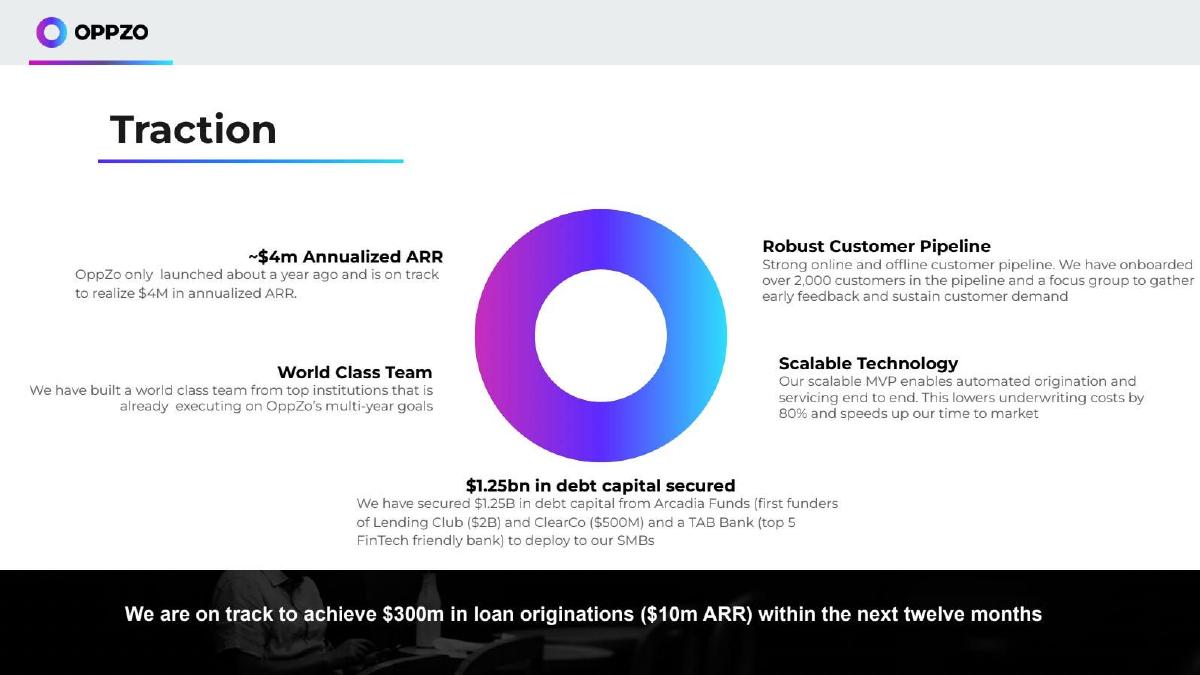
OppZo breaks traditional deck flow by placing traction immediately after the title. This is a power move usually reserved for companies with undeniable numbers. The slide lists four key pillars: ~$4M Annualized ARR achieved within one year, a World Class Team , a Robust Customer Pipeline of over 2,000 customers, and Scalable Technology that reduces underwriting costs by 80%. The most significant figure on this slide, however, is the $1.25bn in debt capital secured from Arcadia Funds and TAB Bank. For a lending startup, securing debt is harder than securing equity; by leading with this, OppZo proves their business model is already 'bankable' by institutional standards. They conclude the slide with a forward-looking statement: 'We are on track to achieve $300m in loan originations ($10m ARR) within the next twelve months.'
Slide 3: The Ecosystem Model
This slide uses a simple hub-and-spoke diagram to explain the business model. OppZo sits at the center, connecting three groups: Investors Looking for Social Impact , Bank Partners looking to serve their community , and Small or Medium Businesses in need of working capital . This positioning frames OppZo not just as a lender, but as a platform that facilitates the flow of ESG (Environmental, Social, and Governance) capital into underserved markets. It clarifies that OppZo isn't just taking balance sheet risk; they are managing an ecosystem.
Slide 4: The Product Value Proposition
Slide 4 addresses the 'Why now?' and the competitive advantage. It features a circular flow diagram showing the relationship between the Government (GOV), the Government Contractor, and OppZo. The headline is the primary hook: 'We can offer interest rates as low as 8% with no personal guarantee.' In the world of SMB lending, where rates often exceed 20% and personal assets are usually at risk, this is a disruptive offer. The diagram shows the government issuing an invoice, which OppZo then finances, providing the contractor with immediate cash flow ($) to execute the contract.
Slide 5: Market Size and Regulatory Tailwinds
The market slide provides three massive figures to justify the scale of the opportunity. First, it cites a $1T total U.S. Federal, State, and Local contracting spend, growing at 8% annually. Second, it highlights that ~23% of these contracts are legally required to go to small or minority-owned businesses. Third, it mentions a Biden administration announcement of an additional $100B in federal contracts for 'disadvantaged businesses.' By anchoring their TAM (Total Addressable Market) in legal requirements and government mandates, OppZo suggests that their demand is not just market-driven, but legally guaranteed.
Slide 6: The Founders
The team slide features CEO Warren Reed and President Randy Garrett. The slide relies heavily on 'logo-credibility.' Under Reed, logos for Columbia University, NYU, the U.S. Department of the Treasury, and J.P. Morgan are displayed. Under Garrett, logos include the U.S. Army Corps of Engineers and D. (likely representing a specific agency or firm). This combination of top-tier investment banking, federal treasury experience, and boots-on-the-ground contracting knowledge is designed to assure investors that the team understands both the financial engineering and the regulatory hurdles of the space.
What Works in the OppZo Deck
1. Debt Before Equity: The most impressive feat in this deck is the disclosure of $1.25B in secured debt capital on Slide 2. Most fintechs struggle to find warehouse lines or lending partners until they have significant equity. OppZo flipped the script, using their team's pedigree to secure the debt first, which made the equity raise significantly easier because the 'product' (the money to be lent) was already bought and paid for.
2. Specificity of the Niche: Instead of targeting all SMBs, they targeted government contractors. This is a brilliant risk-mitigation strategy. The 'payer' in their ecosystem is the U.S. government, which has a 0% default rate. By financing government invoices, they are essentially taking government credit risk while charging SMB interest rates.
3. The 'No Personal Guarantee' Hook: Slide 4 identifies the single biggest pain point for small business owners. By removing the personal guarantee, OppZo lowers the barrier to entry for borrowers, ensuring their 'Robust Customer Pipeline' remains full.
What is Missing from the OppZo Deck
1. Unit Economics: While the deck mentions an 80% reduction in underwriting costs, it does not provide a breakdown of the Net Interest Margin (NIM) or the cost of customer acquisition (CAC). Investors in a $260M round would typically want to see the spread between their cost of debt and the 8% interest rate they charge.
2. Competitive Landscape: The deck does not mention other players in the space, such as StreetShares or traditional banks. It assumes the $230B market is so underserved that competition is a non-factor, which is a bold assumption for a Seed stage company.
3. The 'Ask' and Use of Funds: The provided slides do not include a formal 'Ask' slide detailing how much equity they are raising or how they plan to spend it. While the publisher reports a $260M total raise, the deck itself focuses entirely on the business's existing momentum rather than its future capital requirements.
Lessons for Founders
1. Lead with your strongest asset: OppZo knew their $1.25B debt facility was their most impressive metric, so they put it on Slide 2. Don't bury your 'wow' factor at the end of the deck.
2. Solve for 'Fuel' early: If you are building a capital-intensive business, showing that you have secured the necessary infrastructure (in this case, lending capital) is more important than showing a flashy UI. Credibility in the capital markets is a product in itself.
3. Align with Macro Trends: By citing the Biden administration's $100B commitment to disadvantaged businesses, OppZo made their success seem inevitable. Aligning your startup with government mandates or massive regulatory shifts is a powerful way to de-risk the market opportunity for investors.
Frequently asked questions
- How did OppZo raise $260M at the Seed stage?
- The $260M figure reported by Business Insider includes both equity and debt components. The deck highlights a $1.25B debt capital facility from Arcadia Funds and TAB Bank (Slide 2). By securing the 'fuel' for their lending engine early, they demonstrated to equity investors that the primary barrier to scale—access to low-cost capital—had already been solved.
- What is OppZo's core value proposition for small businesses?
- OppZo provides working capital to government contractors with interest rates as low as 8% and, crucially, no personal guarantee (Slide 4). This is significantly more attractive than traditional merchant cash advances or high-interest SMB loans, which often require personal collateral and carry double-digit rates.
- What market segment does OppZo target?
- They focus on the $230B segment of government contracts legally required to go to small or minority-owned businesses (Slide 5). This is a subset of the $1T total annual U.S. public contracting spend, providing a massive, regulated, and reliable source of repayment (government invoices).
- How does the technology impact the bottom line?
- According to Slide 2, OppZo's 'Scalable Technology' enables automated end-to-end origination and servicing. The company claims this lowers underwriting costs by 80% compared to traditional manual processes, allowing them to maintain the low interest rates mentioned on Slide 4 while remaining profitable.
- Who are the founders and what is their background?
- The deck features CEO Warren Reed and President Randy Garrett (Slide 6). Their backgrounds include high-level finance and government experience, with Reed having ties to J.P. Morgan, the U.S. Treasury, and NYU/Columbia, and Garrett bringing experience from the U.S. Army Corps of Engineers and private sector contracting.