The OpenTest (Loom) pitch deck is a definitive example of how to leverage team pedigree and early traction to overcome a crowded market. Raising $600,000 in 2016, the founders focused heavily on their past successes at companies like Facebook, Weebly, and MyLife to establish immediate credibility. While the product was only three months old, the deck highlighted a user base of 14,550+ employees and a 57% retention rate for second-time recordings. By positioning themselves as an 'Enterprise Video CMS' rather than just a recording tool, they carved out a high-value niche. The deck lacks detaile…
Key takeaways
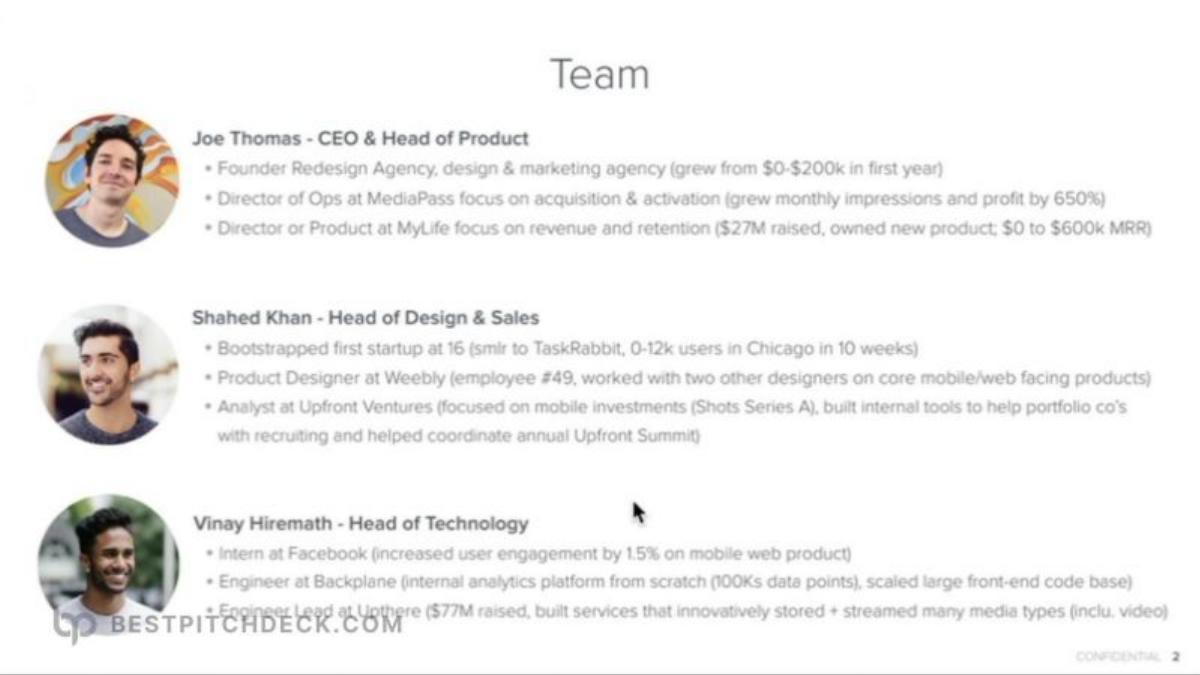
- The team slide (Slide 2) uses specific revenue and user growth metrics from previous roles to establish founder-market fit.
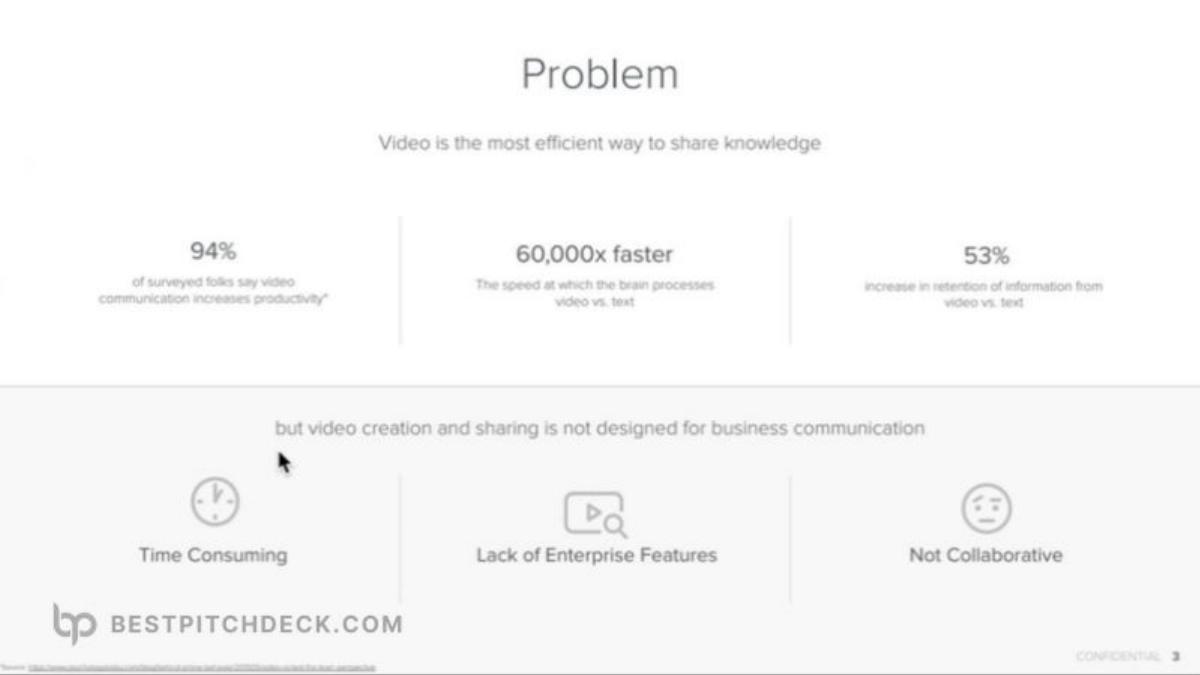
- OpenTest identifies a '60,000x faster' processing speed for video vs. text as a core psychological hook (Slide 3).
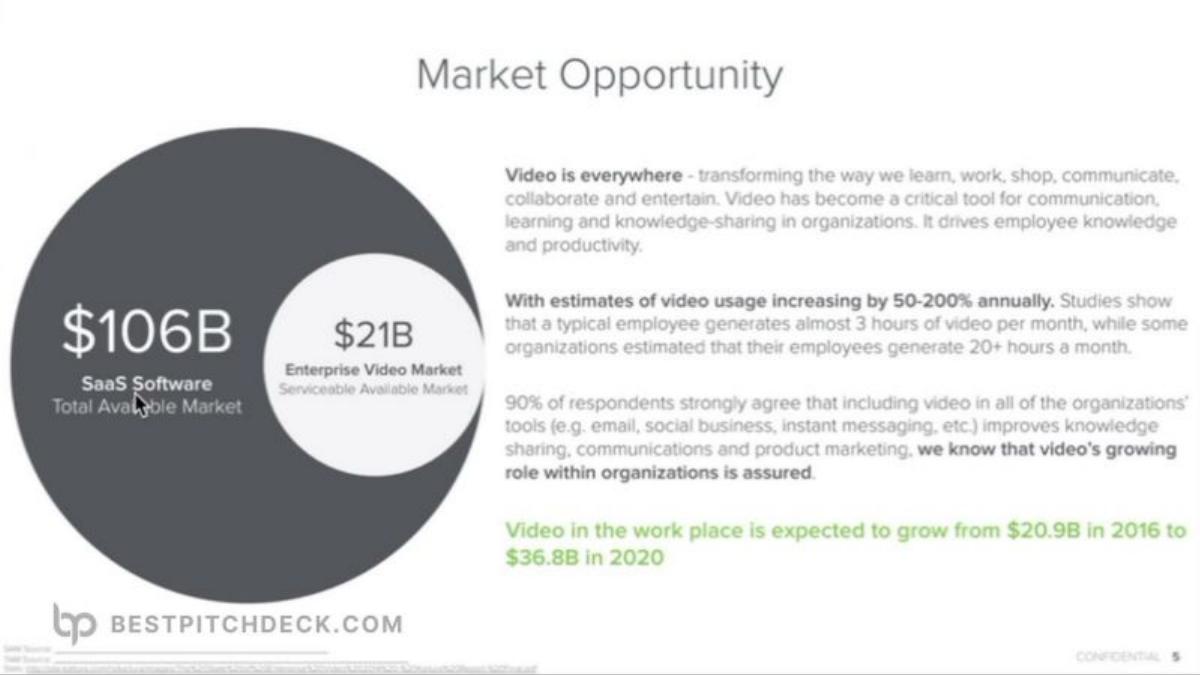
- The market opportunity is framed as a shift from a $21B Enterprise Video market to a $36.8B market by 2020 (Slide 5).
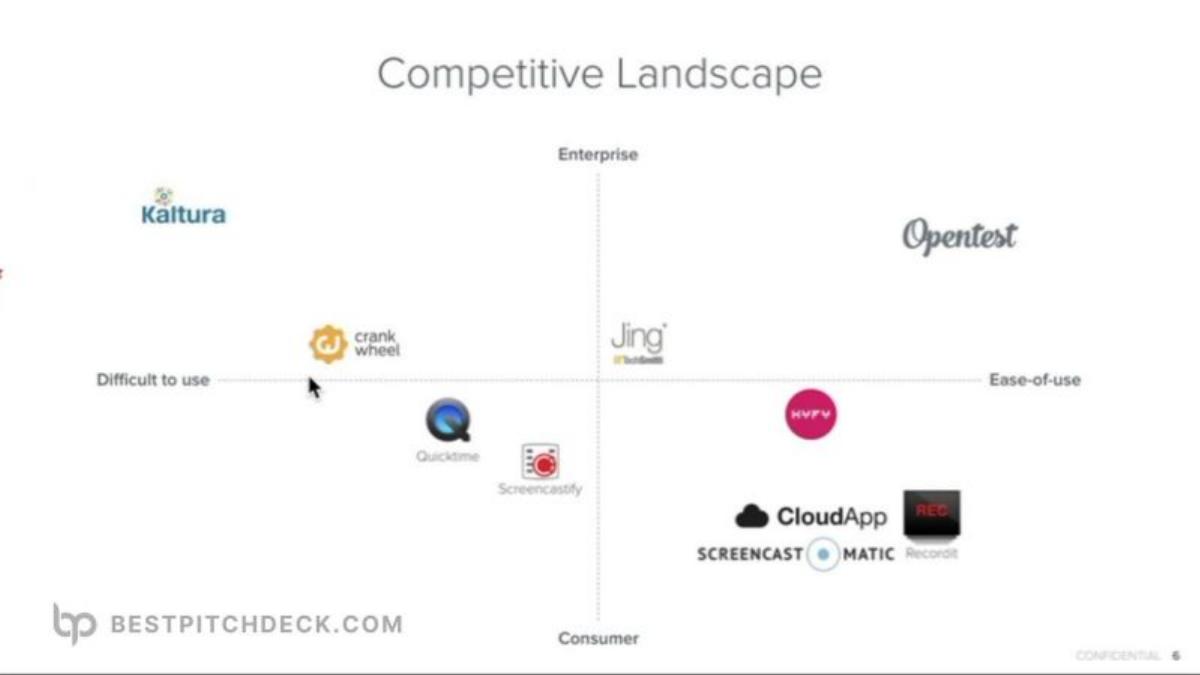
- The competitive landscape (Slide 6) positions the company in the 'Enterprise' and 'Ease-of-use' quadrant, away from consumer tools like Quicktime.
- Traction is validated by 14,550+ employees from companies including Uber, Airbnb, and Disney (Slide 7).
- Organic growth is visualized by showing 'land and expand' patterns within Vidyard, Uber, and Zuora (Slide 8).
- The monetization strategy (Slide 9) proposes a $10 per seat per month model for enterprise features.
- The roadmap (Slide 10) explicitly links 'Defensibility' to machine learning and feedback analysis planned for Q4 2017.
The Pre-Seed Blueprint: Analyzing the OpenTest (Loom) Pitch Deck
Before it became the ubiquitous video messaging platform Loom, the company was known as OpenTest. This 13-slide deck, used to raise a $600,000 pre-seed round in 2016, is a masterclass in how to present a simple utility as a massive enterprise opportunity. At a time when video was largely seen as a consumer or marketing tool, OpenTest successfully argued that asynchronous video was the future of internal business communication.
Slide 1: Title and Social Proof
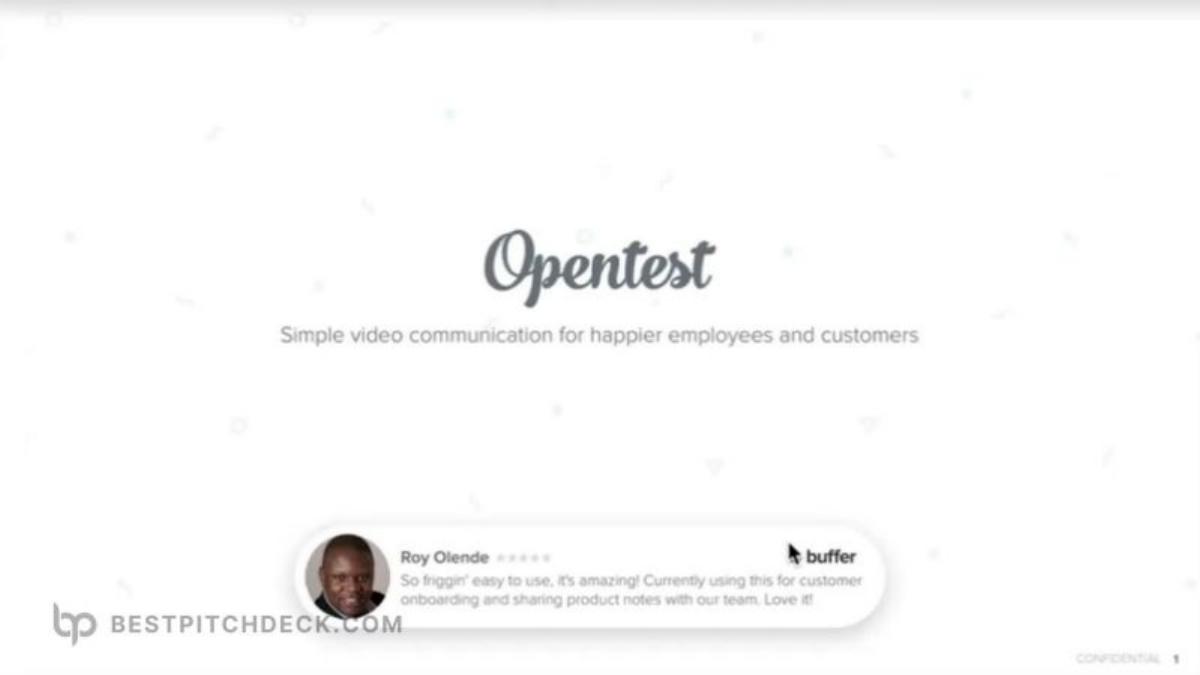
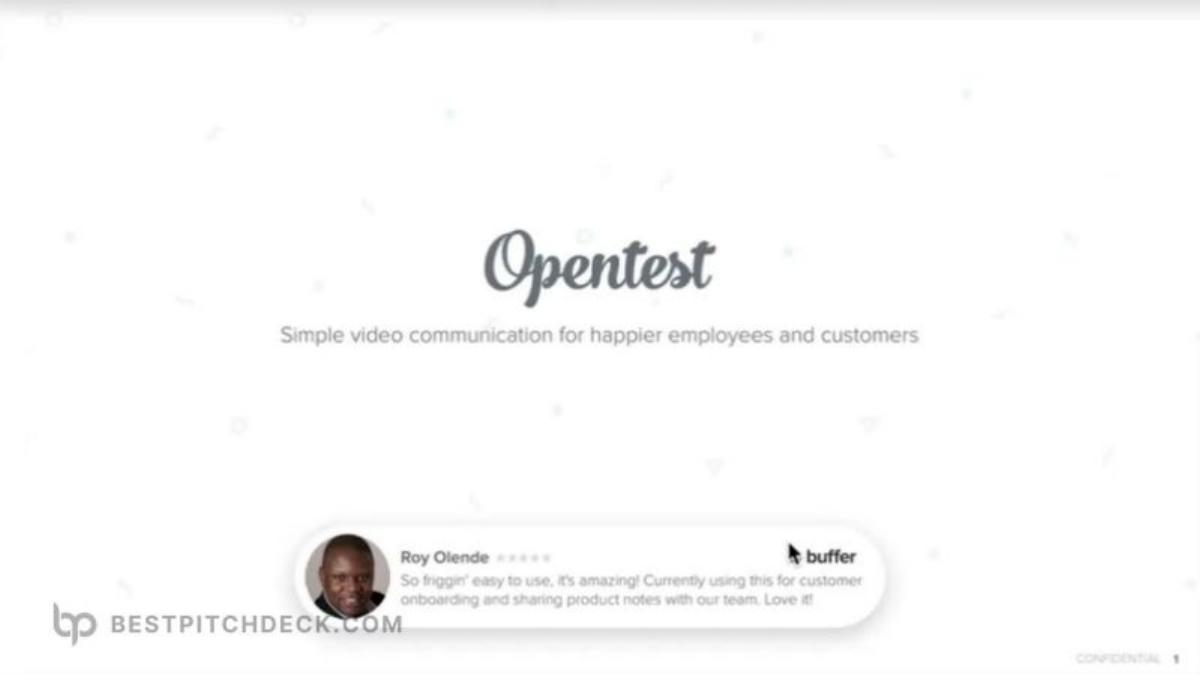
The cover slide is remarkably clean, featuring the original 'Opentest' cursive logo and the tagline: 'Simple video communication for happier employees and customers.' Notably, they include a testimonial from Roy Olende at Buffer at the bottom of the slide. This is a strategic move; by including a quote from a well-known remote-first company like Buffer on the very first page, they establish immediate credibility and define their target user persona.
Slide 2: The Pedigree Team
OpenTest places its team slide second, a common tactic for founders with strong backgrounds. Joe Thomas (CEO & Head of Product) is credited with growing a product from $0 to $600k MRR at MyLife. Shahed Khan (Head of Design & Sales) is noted as having bootstrapped a startup at age 16 and worked as an analyst at Upfront Ventures. Vinay Hiremath (Head of Technology) is highlighted for his time at Facebook and his role as an engineering lead at Upthere, which raised $77M. This slide isn't just a list of names; it uses hard numbers ($27M raised, 650% profit growth) to prove the team can execute.
Slide 3: The Problem with Text
The problem slide uses a 'hook' based on cognitive science. It claims that video is 60,000x faster for the brain to process than text and that 94% of surveyed individuals say video communication increases productivity. They then pivot to the business gap: existing video tools are 'Time Consuming,' have a 'Lack of Enterprise Features,' and are 'Not Collaborative.' This sets the stage for a tool that is both fast and built for teams.
Slide 4: The Three-Phase Solution
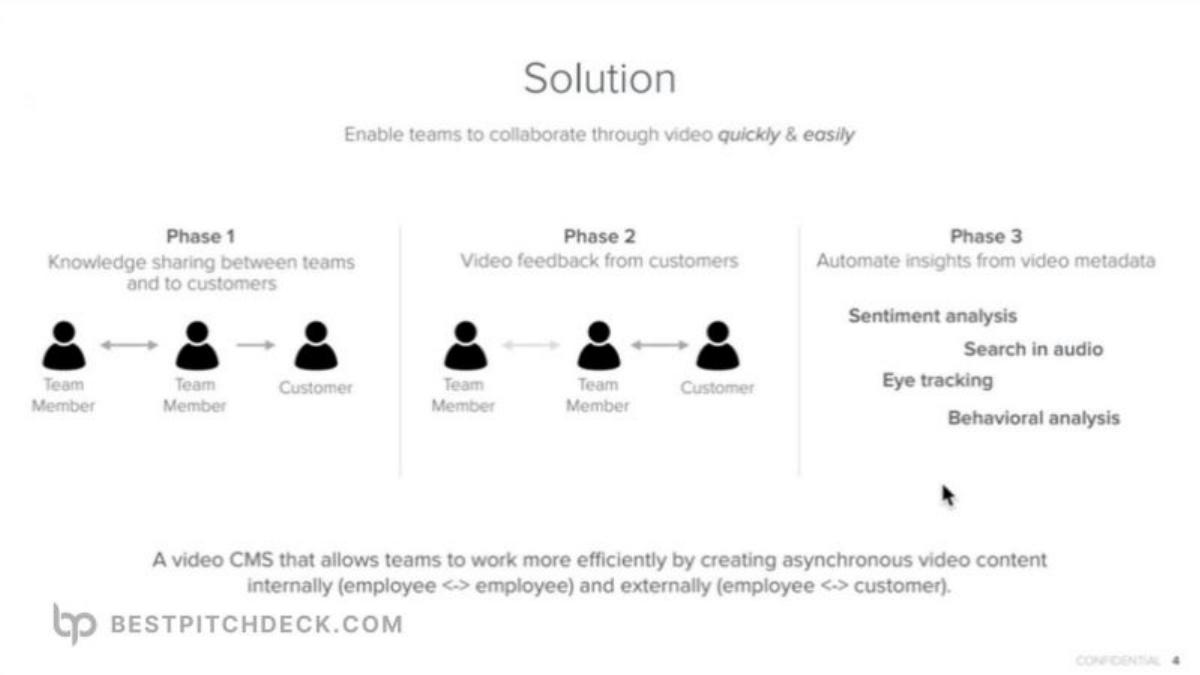
The solution is presented as an evolution. Phase 1 focuses on knowledge sharing between teams. Phase 2 introduces video feedback from customers. Phase 3—the 'big vision'—proposes automating insights through sentiment analysis and eye tracking. They define the product as a 'video CMS' (Content Management System). This terminology is critical because it sounds more valuable and 'sticky' than a simple screen recorder.
Slide 5: Market Opportunity
The deck cites a $106B Total Available Market for SaaS software, with a $21B Serviceable Available Market for Enterprise Video. They include a projection that video in the workplace would grow to $36.8B by 2020. By framing the product within the broader SaaS and Enterprise Video markets, they justify the potential for a venture-scale return.
Slide 6: Competitive Landscape
The 2x2 matrix is a standard pitch deck staple. OpenTest plots 'Ease-of-use' against 'Consumer vs. Enterprise.' They place themselves in the top-right quadrant (High Ease-of-use, Enterprise). They distance themselves from consumer tools like Quicktime and Screencastify, as well as complex enterprise legacy players like Kaltura, which they label as 'Difficult to use.'
Slide 7: Traction and Logo Soup
This is the 'wow' slide. Just three months after launch, they claim 14,550+ employees are using the tool. They display logos from Uber, Salesforce, Airbnb, Disney, and Zendesk. For a pre-seed company, having this level of penetration in 'world-class' companies is an incredibly strong signal of product-market fit.
Slide 8: Organic Growth Visualization
Slide 8 goes deeper into the traction. It shows 'Organic growth within teams' using icons to represent users. For example, they show 40 team members at Vidyard and 14 at Uber. They also include a vital retention metric: '57% of users came back and recorded 2 or more videos.' This proves the product isn't just being downloaded; it's being used repeatedly.
Slide 9: Monetization Strategy
The business model is a classic freemium SaaS play. A 'Consumer' tier at $0 and an 'Enterprise' tier at $10 per seat per month . They list enterprise-only features like 'Video CRM,' 'Integrations,' and 'Analytics.' This slide demonstrates a clear path to revenue and an understanding of how to upsell organizational users.
Slide 10: Product Roadmap
The roadmap is divided into two phases. Phase 1 (2016) focuses on growth and monetization. Phase 2 (2017) focuses on 'Differentiation' and 'Defensibility.' They explicitly mention using 'unique data sets and machine learning' to surface insights, which addresses the common investor concern: 'What stops a competitor from copying this?'
Slide 11: Short-term Milestones
This slide provides a timeline of their rapid ascent. It notes they were in the 'Top 1% on Product Hunt' in June 2016. It sets aggressive targets: 25,000 users by October and 75,000 users by December. These milestones give investors a way to measure the team's progress immediately after the round closes.
Slide 12: Contact Information
The final slide is a simple contact page for Shahed Khan. It includes a call to action: 'Want to see how teams are using Opentest? I’d be happy to send over examples via email or in person.' This invites further engagement without being overly aggressive.
What Works in the OpenTest Deck
1. Velocity of Traction: The most compelling part of this deck is the '3 months ago' launch date contrasted with the 14,000+ users. It suggests a product that is 'pulling' itself into the market.
2. Land and Expand Proof: Slide 8 is the strongest slide in the deck. By showing that they started with one user in a company and grew to 40, they prove the viral nature of the product, which is the holy grail for SaaS investors.
3. Specificity of Team Achievements: Instead of saying 'Experienced Product Manager,' they say 'owned new product; $0 to $600k MRR.' This level of detail builds trust.
What Is Missing from the OpenTest Deck
1. The Ask: There is no slide detailing how much they are raising, what the terms are, or how they will spend the $600k. While this is often left for the conversation, a 'Use of Funds' slide is generally expected.
2. Unit Economics: While they have a monetization plan, there is no data on Customer Acquisition Cost (CAC) or Lifetime Value (LTV). Given the organic growth, their CAC was likely near zero, which would have been a powerful metric to include.
3. Detailed Financial Projections: The deck is very product and growth-focused but lacks a 3-5 year financial forecast. This is common at the pre-seed stage but can be a hurdle for more traditional VCs.
What Founders Should Copy
1. The 'Phase' Approach to Vision: Don't just pitch what you have today. Pitch the 'Phase 3' version of the company that uses data and AI to become a platform. This turns a 'tool' into a 'category leader.'
2. Visualizing Growth: If you have 'land and expand' traction, don't just put it in a bullet point. Use icons or charts to show how you are moving through an organization. It makes the abstract concept of 'virality' feel tangible.
3. Leading with Social Proof: If you have a quote from a respected person in your industry, put it on the title slide. It sets the tone for the entire presentation.
Frequently asked questions
- Why is the team slide placed so early in the deck?
- In pre-seed rounds, the team is often the most important asset. OpenTest placed their team slide second to immediately signal that they were experienced operators. By citing specific achievements, like Joe Thomas growing a product from $0 to $600k MRR, they reduced the perceived risk for investors before even explaining the product.
- How did OpenTest differentiate itself from free tools like Quicktime?
- Slide 6 uses a standard 2x2 matrix to place OpenTest in the 'Enterprise' and 'Ease-of-use' quadrant. They argued that while consumer tools existed, they lacked 'Enterprise Features' and were 'Not Collaborative' (Slide 3). Their solution was a 'Video CMS' rather than just a screen recorder.
- What specific traction metrics did they use to prove product-market fit?
- They used three key metrics on Slide 8: total users (14,550+), average video length (1m 40s), and retention (57% of users recorded 2 or more videos). Most importantly, they visualized 'Organic growth within teams' to show that the product was spreading virally inside large organizations without ad spend.
- Is there a financial 'Ask' in this deck?
- No. The 13-slide deck ends with a contact slide (Slide 12) and does not explicitly state the amount of capital being raised or the valuation. This is common in decks designed for first meetings where the 'Ask' is delivered verbally or in a follow-up document.
- What was the 'Phase 3' vision for the company?
- According to Slide 4, the long-term vision involved 'Automated insights from video metadata.' This included sentiment analysis, search in audio, eye tracking, and behavioral analysis. This moved the narrative from a simple utility tool to a sophisticated data platform.