OpenSponsorship’s 12-slide deck is a study in minimalist persuasion. Eschewing dense bullet points, the company relies on large-scale figures and visual metaphors to explain its marketplace. The deck highlights a $60 billion market opportunity (Slide 2) and demonstrates rapid traction with a $1.7 million GMV (Slide 4). The core of the pitch is a three-slide visual sequence (Slides 5-7) that illustrates how a single $1,000,000 sponsorship can be fragmented into smaller, more accessible deals for brands like Suja and Rhone. While the deck is light on financial projections and specific unit econ…
Key takeaways
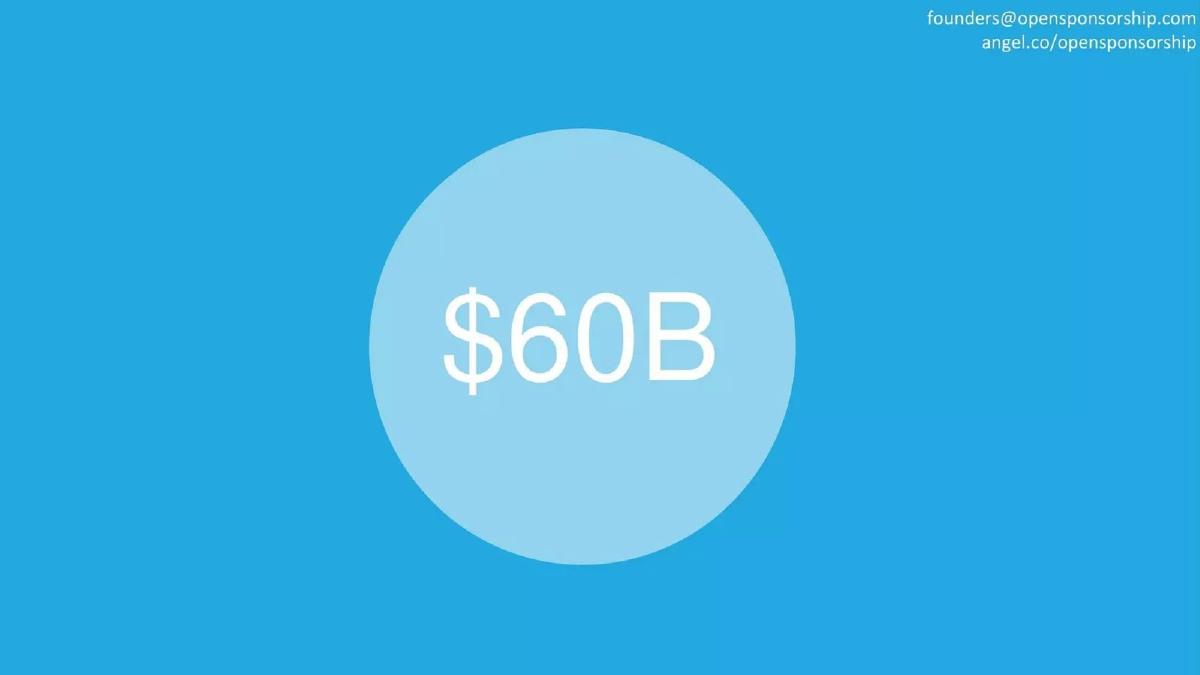
- The deck establishes a massive $60 billion total addressable market on Slide 2 without needing additional text.
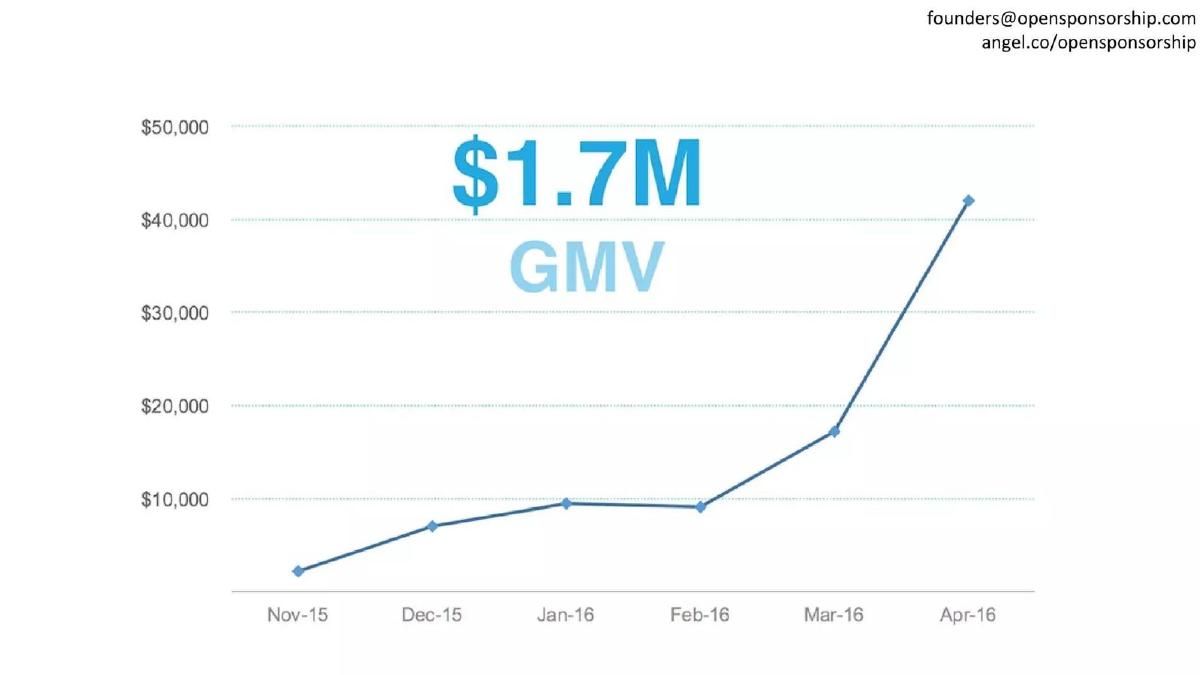
- Traction is presented through a steep growth curve reaching $1.7 million in GMV by April 2016 on Slide 4.
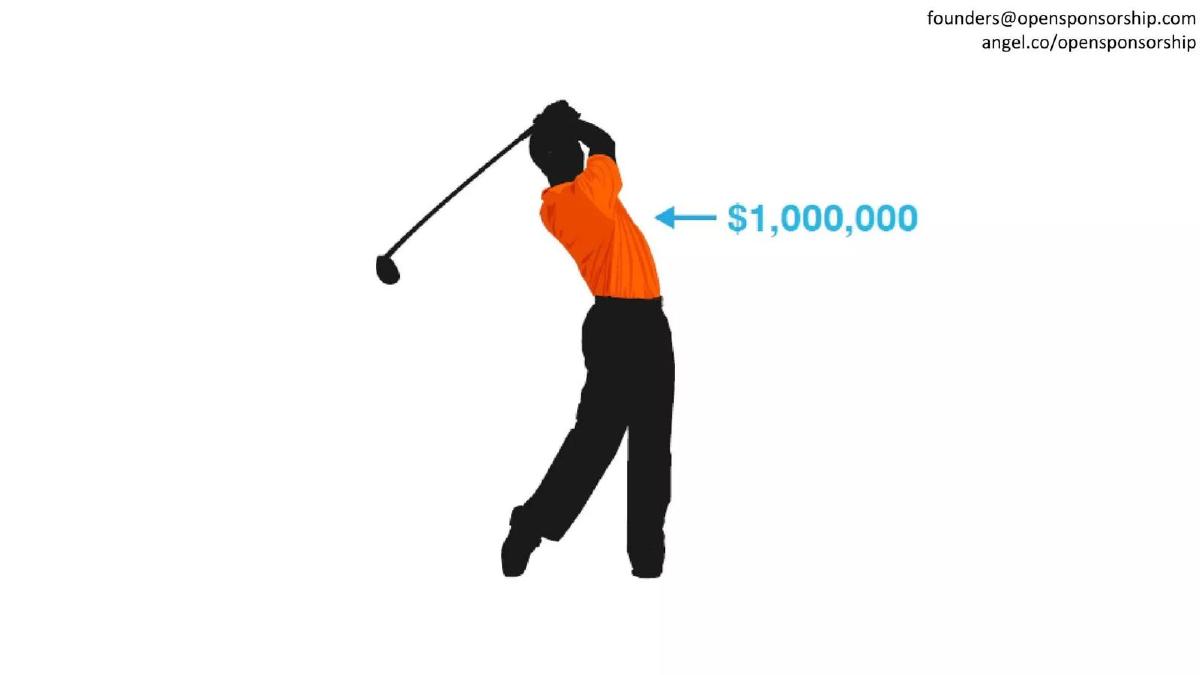
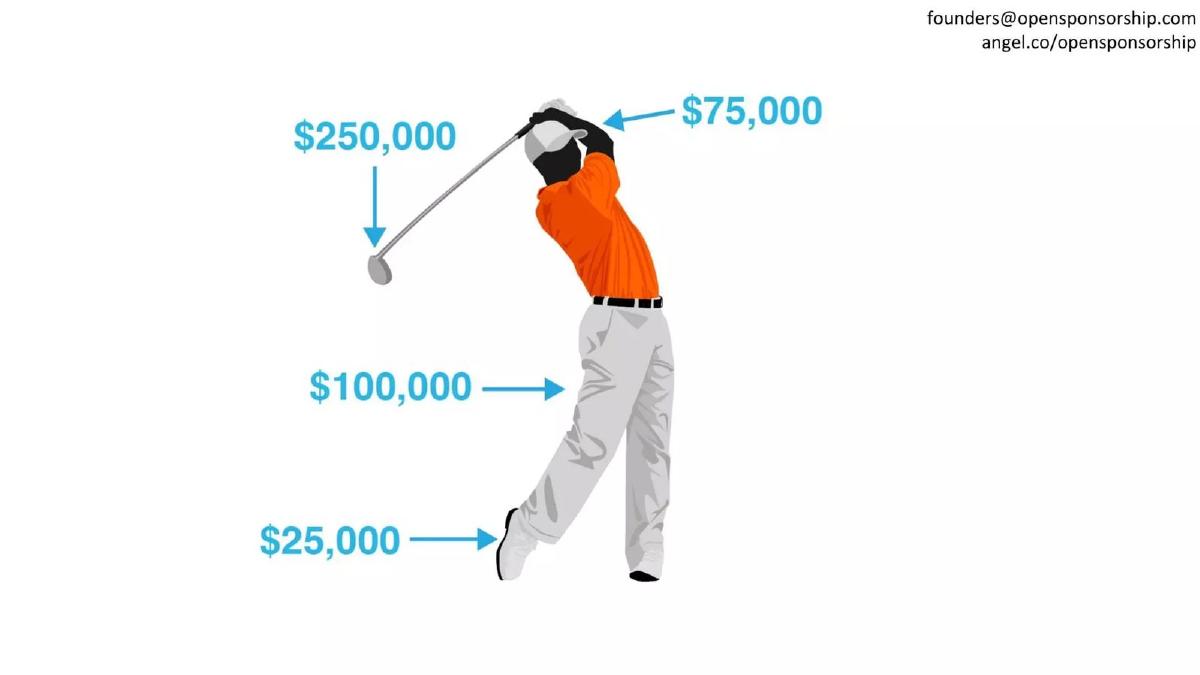
- A visual metaphor on Slides 5 and 6 effectively communicates the problem of high-entry barriers for traditional sports sponsorship.
- Slide 7 demonstrates the solution: a fragmented marketplace where multiple brands can sponsor different assets of a single athlete.
- The product interface is simplified into four key actions: Discover, Connect, Sponsor, and Manage on Slide 8.
- Retention is a primary highlight, with the company claiming a 90% retention rate among brands like Tito's and Hero on Slide 9.
- Supply-side depth is proven on Slide 10 with 1,700+ athletes across 50 countries.
- The team slide (Slide 11) emphasizes domain expertise with logos from the Mumbai Indians and Sport Draftr.
The Minimalist Marketplace: OpenSponsorship’s $5.2M Narrative
OpenSponsorship’s pitch deck is a notable example of the 'less is more' philosophy in startup fundraising. With only 12 slides and a very low word count, the deck relies on the inherent power of the sports industry’s imagery and clear, upward-trending data. The company, which operates a two-sided marketplace connecting brands with professional athletes, used this deck to bridge the gap between a fragmented market and a scalable digital solution. By the time this deck was circulating in 2014-2016, the company had already established significant GMV, allowing the founders to focus on the 'why' and 'how' rather than just the 'what.'
The Hook: Market Size and Immediate Traction
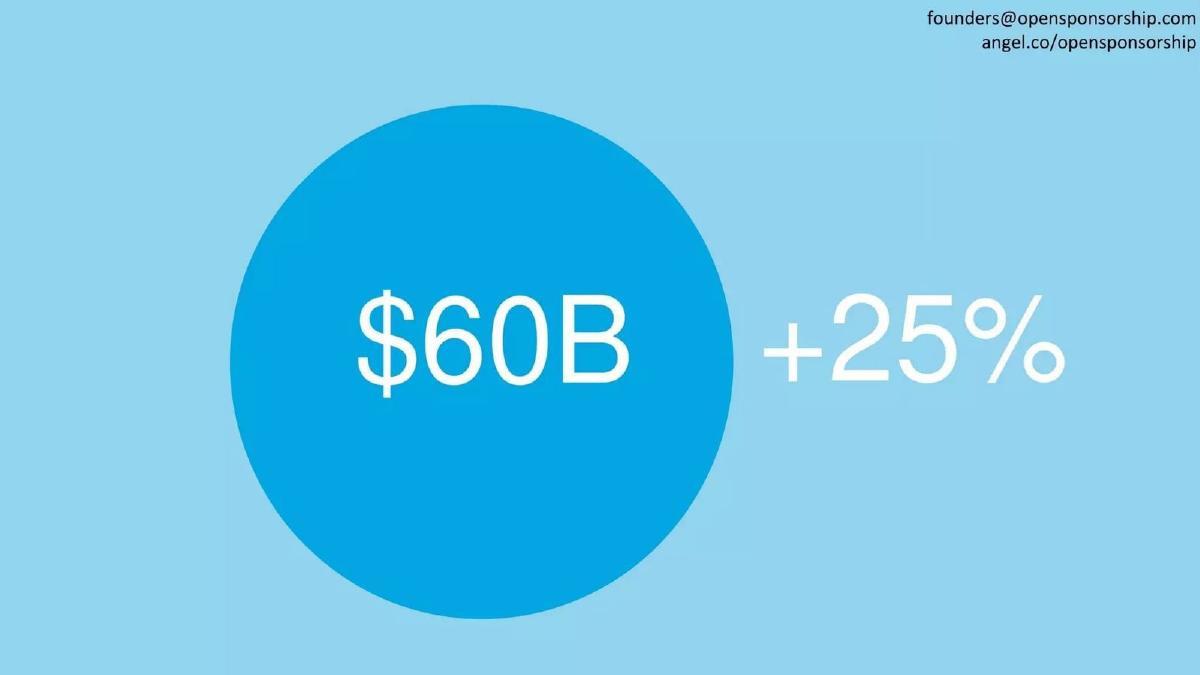
The deck opens with a standard title slide (Slide 1) featuring the company logo and the tagline 'Search • Connect • Sponsor.' It immediately moves into a market validation phase. Slide 2 displays a large '$60B' figure in a circle, and Slide 3 adds '+25%' next to it. While these slides lack citations or specific definitions (TAM vs. SAM), they serve a psychological purpose: establishing that the playground is massive and growing. In a later-stage deck, these figures are often accepted as industry standard, but for a seed-stage founder, more context would usually be required.
Slide 4 is perhaps the most important slide in the deck. It shows a line graph of Gross Merchandise Volume (GMV) from November 2015 to April 2016. The graph shows a steady climb followed by a sharp hockey-stick inflection point in the final two months, culminating in a '$1.7M GMV' callout. This slide validates that the marketplace is not just a concept but a functioning engine. The decision to lead with traction so early in the deck suggests that the founders knew their numbers were their strongest selling point.
The Visual Metaphor: Solving Fragmentation
This three-slide sequence is a masterclass in visual communication. Slide 5 shows a silhouette of a golfer with a single arrow pointing to a '$1,000,000' price tag. This represents the traditional, high-barrier-to-entry model of sports sponsorship where one brand takes all. Slide 6 breaks this down, showing arrows pointing to different parts of the athlete (head, club, pants, shoes) with smaller price points ranging from $25,000 to $250,000. Slide 7 completes the thought by replacing the dollar amounts with actual brand logos like Suja, Jelt, and Rhone.
Without using a single bullet point, OpenSponsorship explains its entire business model: they take a million-dollar asset and fractionalize it, making it accessible to a wider array of brands. This visualizes the 'long tail' of sports sponsorship, moving away from Nike-level deals to mid-market brand partnerships.
Product and Retention
Slide 8 shows a mobile mockup of the platform. The UI is clean, showing athlete profiles, a messaging interface, a PayPal integration for payments, and a digital signature field. To the right, four words summarize the user journey: Discover, Connect, Sponsor, and Manage. This slide effectively communicates that the platform handles the end-to-end workflow of a sponsorship deal, which is traditionally a manual, agency-heavy process.
Slide 9 features the logos of OM Signal, Suja, Tito’s Handmade Vodka, and Hero, overlaid with a large '90% retention' figure. In marketplace businesses, retention is the ultimate health metric. By showing that 9 out of 10 brands come back to the platform, OpenSponsorship addresses the 'leaky bucket' concern that plagues many early-stage marketplaces. It proves that the value provided is recurring, not a one-off transaction.
Supply-Side Scale and Team
A marketplace is only as good as its supply. Slide 10 uses photos of high-profile athletes (including Russell Westbrook and Richard Sherman) alongside the stats: '1700+ athletes,' '45 sports,' and '50 countries.' This demonstrates that the platform has achieved a critical mass of supply across diverse geographies and disciplines, making it a one-stop shop for brands regardless of their target demographic.
The team slide is concise. CEO Ishveen Anand and CTO Nick Van Der Meulen are presented with their educational credentials (Oxford and Imperial College London) and previous industry experience. The inclusion of the Mumbai Indians logo is a strategic 'trust signal,' indicating that the CEO has worked within one of the most valuable sports franchises in the world. This domain expertise is crucial for a marketplace that requires navigating the complex world of athlete agents and sports lawyers.
What Works
The deck’s greatest strength is its clarity. By avoiding 'wall-of-text' slides, the founders force the investor to listen to the pitch rather than read the slides. The visual breakdown of the golfer (Slides 5-7) is an incredibly efficient way to explain a complex market shift. Furthermore, the focus on GMV and retention provides the 'hard data' necessary to back up the 'soft' visual narrative. The deck feels modern, professional, and confident.
What Is Missing
Despite its success, the deck leaves many questions unanswered. There is no mention of the business model—specifically, the take rate or how the company actually makes money from that $1.7M GMV. There is no competitive landscape analysis; while the deck implies they are disrupting traditional agencies, it doesn't mention other digital competitors. Most notably, there is no 'Ask' slide. While this may have been removed for public distribution, a standard pitch deck should always include the amount being raised and the intended use of funds. Finally, there are no unit economics (CAC/LTV), which are usually mandatory for a 'Later' stage round.
What a Founder Should Copy
Founders should emulate the visual storytelling used in the problem/solution section. If your business involves 'democratizing' an expensive service or 'fragmenting' a large asset, use a silhouette or a diagram to show the 'before and after' rather than listing it in text. Additionally, the use of 'trust signals'—like the specific athlete photos and the Mumbai Indians logo—is a highly effective way to build immediate credibility in a niche industry. Finally, the 'four-word product summary' (Discover, Connect, Sponsor, Manage) is an excellent way to distill a complex software platform into a digestible process.
Frequently asked questions
- What is the primary value proposition of OpenSponsorship according to the deck?
- The primary value proposition is the democratization and fragmentation of sports sponsorship. As shown in the visual sequence on slides 5 through 7, the platform allows brands to break down large, million-dollar sponsorships into smaller, manageable pieces (e.g., $25,000 for footwear or $75,000 for headwear). This makes professional athlete endorsements accessible to mid-market brands that were previously priced out of the market.
- How does the deck demonstrate market traction?
- Traction is demonstrated through three key metrics. First, Slide 4 shows a Gross Merchandise Volume (GMV) of $1.7 million with a significant upward trend between November 2015 and April 2016. Second, Slide 9 claims a 90% retention rate among participating brands. Finally, Slide 10 highlights the scale of the marketplace supply, citing over 1,700 athletes across 45 different sports and 50 countries.
- Who are the key team members and what is their background?
- The deck features two co-founders on Slide 11. Ishveen Anand, the CEO, is an Oxford University graduate with experience at the Mumbai Indians (a major cricket franchise). Nick Van Der Meulen, the CTO, is an Imperial College London alumnus with a background at Sport Draftr. This combination suggests a balance between deep sports industry connections and technical execution capabilities.
- What major elements are missing from this pitch deck?
- This is a minimalist deck that omits several standard components. There is no 'Ask' slide detailing how much capital is being raised or how it will be spent. It lacks a competitor matrix, a detailed business model slide explaining take rates or subscription fees, and any forward-looking financial projections. It relies almost entirely on past traction and the conceptual strength of the marketplace.
- How does the deck use visual storytelling to explain the product?
- The deck uses a 'show, don't tell' approach. Instead of listing features, Slide 8 uses a mobile mockup to highlight the four-step process: Discover, Connect, Sponsor, and Manage. The most effective storytelling occurs in the transition from Slide 5 to Slide 7, using a silhouette of a golfer to visually represent how a single athlete's 'real estate' can be partitioned among various brand sponsors.