OpenLaw’s 13-slide pitch deck focuses on the inefficiencies of the traditional legal intake process, positioning itself as a data-driven marketplace that connects clients with vetted attorneys. The company raised a $3.5 million Seed round in 2024 to scale its platform, which targets high-volume practice areas like civil litigation and family law. The deck relies heavily on a 'Traditional vs. OpenLaw' comparison to illustrate value, claiming potential client savings of 30% to 70% in legal fees. While the deck is visually clean and emphasizes a strong founding team with backgrounds from Google,…
Key takeaways
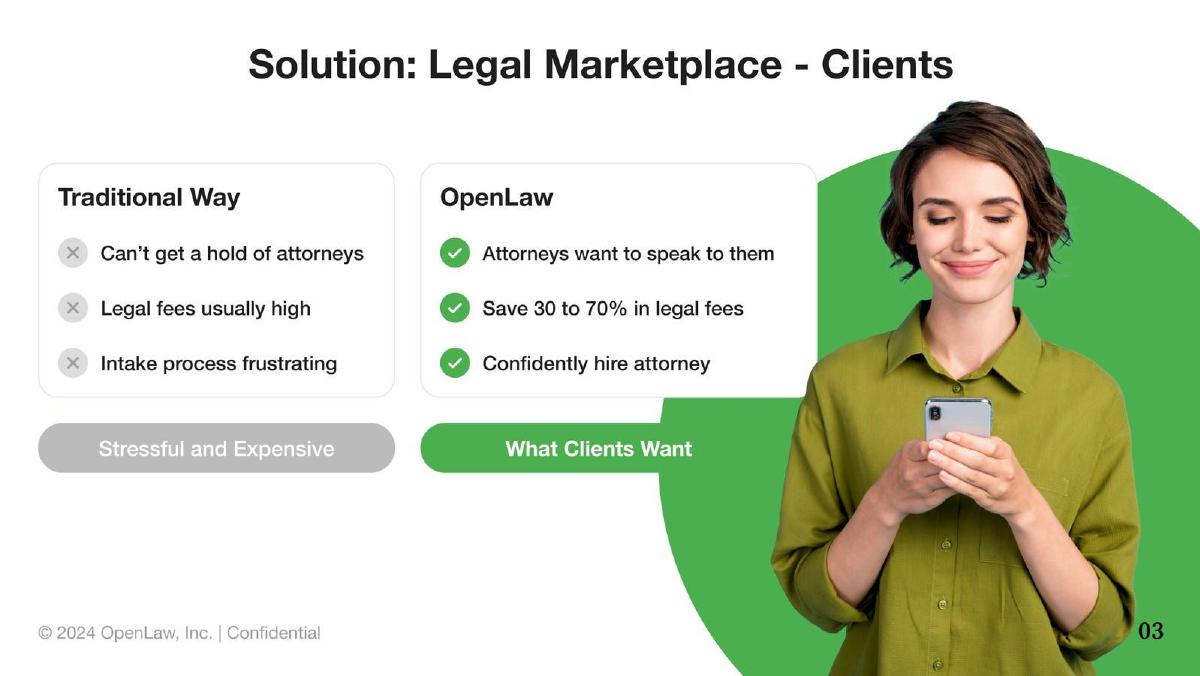
- OpenLaw positions its value proposition on saving clients 30% to 70% in legal fees compared to traditional methods (Slide 3).
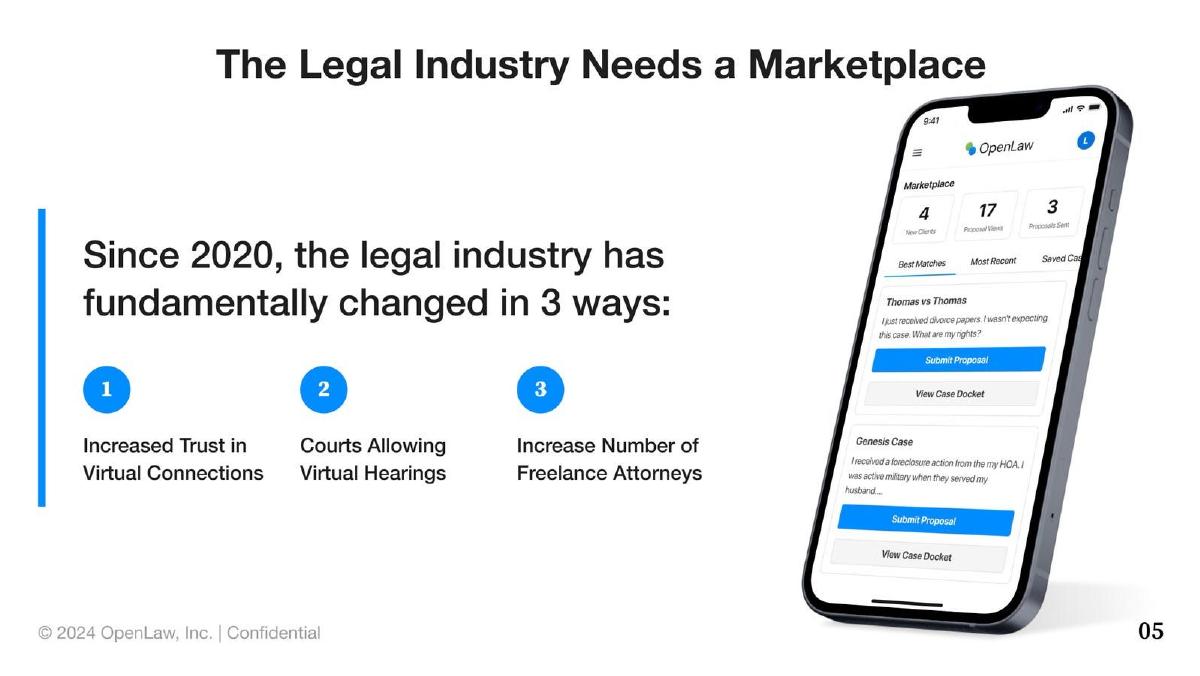
- The company identifies three post-2020 industry shifts: increased trust in virtual connections, virtual hearings, and a rise in freelance attorneys (Slide 5).
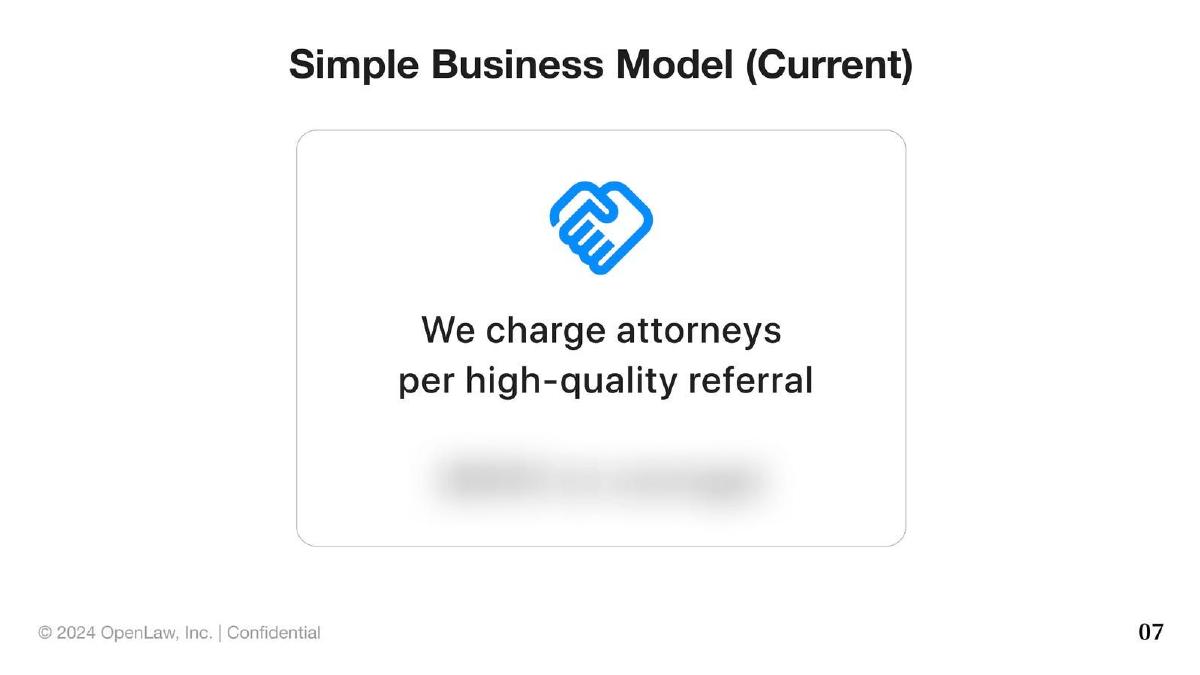
- The current business model is a simple referral fee charged to attorneys for 'high-quality' leads (Slide 7).
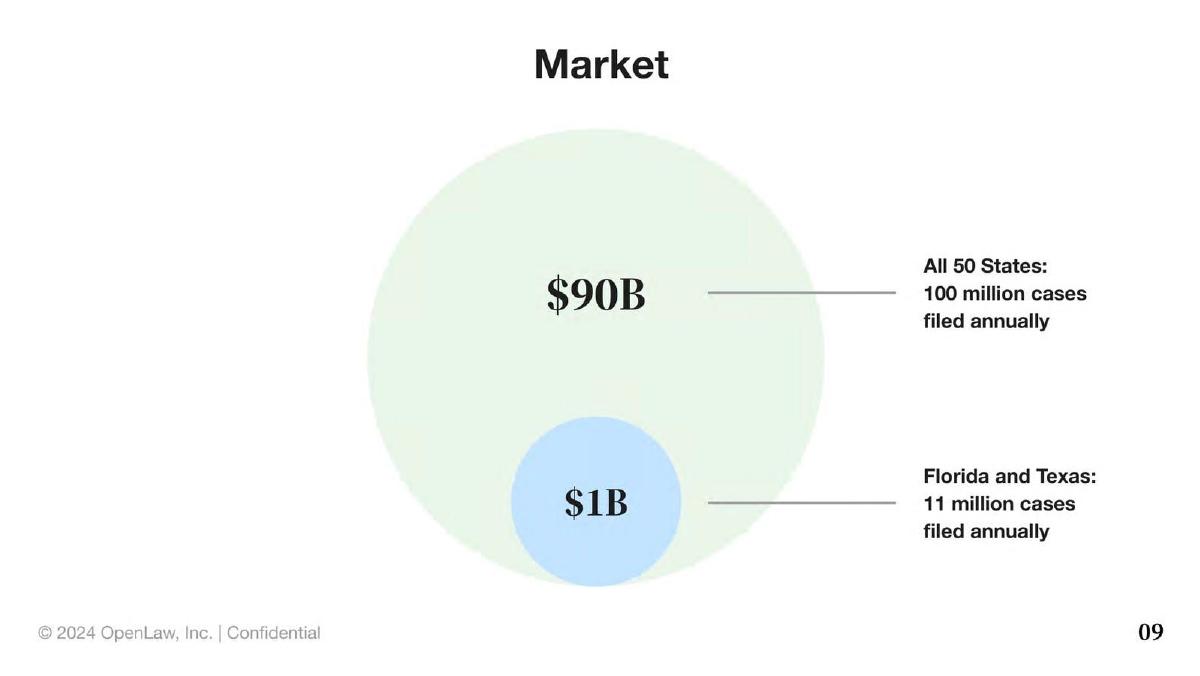
- The total addressable market is defined as $90 billion across 100 million cases filed annually in all 50 states (Slide 9).
- Initial market focus is narrowed to Florida and Texas, representing a $1 billion segment and 11 million annual cases (Slide 9).
- The founding team features deep expertise in behavior design, legal sales, and large-scale systems development (Slide 11).
- CEO Andrew Guzman brings 14+ years of legal industry experience and a track record of generating $50M+ in revenue (Slide 11).
- The deck omits a specific 'Ask' slide detailing the $3.5M raise or the intended use of funds.
The Narrative: Modernizing the Legal Intake Funnel
OpenLaw’s pitch deck is a study in simplicity and market timing. The legal industry has long been criticized for its lack of transparency and high barriers to entry for average consumers. By raising $3.5 million in a Seed round in 2024 (as reported by Business Insider), OpenLaw is betting that the post-pandemic shift toward virtual legal proceedings has created a permanent opening for a digital-first marketplace. The deck focuses on the 'why now' by citing specific structural changes in the legal system, such as the acceptance of virtual hearings and the growth of the freelance attorney workforce.
Slide 1: Title and Vision
The cover slide establishes the company’s identity with a clean logo and a clear value proposition: "Transforming How Clients Find Lawyers With Proprietary Data Insights." The use of a high-quality lifestyle image of a person using a smartphone immediately signals that this is a B2C-facing marketplace designed for mobile accessibility. It sets an expectation for a data-driven approach, though the 'proprietary' nature of that data is something the rest of the deck must prove.
Slide 3: The Solution - Client Perspective
Slide 3 uses a classic 'Traditional Way' vs. 'OpenLaw' comparison. It identifies the 'Traditional Way' as being characterized by an inability to reach attorneys, high fees, and a frustrating intake process, summarized as "Stressful and Expensive." In contrast, OpenLaw claims to offer attorneys who actually want to speak to clients, a 30% to 70% reduction in legal fees, and a confident hiring process. This is a bold claim on pricing; saving 70% on legal fees suggests a fundamental shift in how legal work is sourced or executed, likely through the freelance model mentioned later.
Slide 5: The 'Why Now' - Industry Shifts
This is one of the most critical slides in the deck. It argues that since 2020, the legal industry has changed in three fundamental ways: 1) Increased trust in virtual connections, 2) Courts allowing virtual hearings, and 3) An increase in the number of freelance attorneys. By highlighting these shifts, OpenLaw justifies its existence as a platform that couldn't have existed—or at least couldn't have scaled—a decade ago. The inclusion of a mobile app mockup showing a 'Marketplace' with 'New Clients' and 'Proposals Sent' gives a tangible look at the product interface.
Slide 7: The Business Model
OpenLaw keeps its monetization strategy straightforward. Slide 7 states: "We charge attorneys per high-quality referral." While the specific pricing is blurred, the model is clear: OpenLaw acts as a top-of-funnel lead generation engine for law firms. This is a common model in legal tech (similar to Avvo or LegalZoom), but the emphasis on 'high-quality' suggests that their proprietary data is used to vet leads before they reach the attorney, theoretically increasing the conversion rate and justifying the referral fee.
Slide 9: Market Opportunity
The market slide uses a concentric circle visualization to show the scale of the opportunity. The total U.S. market is valued at $90 billion with 100 million cases filed annually across all 50 states. However, the deck shows maturity by narrowing its immediate focus to Florida and Texas, which represent a $1 billion market and 11 million annual cases. This 'land and expand' strategy is generally favored by investors as it shows a realistic path to dominance in specific jurisdictions before attempting a national rollout.
Slide 11: The Founding Team
The team slide is a strong point for OpenLaw. It features three founders with complementary skill sets. CEO Andrew Guzman brings the domain expertise with 14+ years in the legal industry and a history of generating $50M+ in revenue. CPO David Ngo provides the product rigor, citing his background at Stanford’s Behavior Design Lab and stints at Google and Spotify. CTO Abtin Gramian rounds out the trio with technical experience in large-scale systems from Warner Brothers and PlayStation. The inclusion of recognizable logos (Google, Stanford, UNICEF, Spotify, WB, PlayStation) adds significant social proof.
Slide 13: The Closing
The final slide is a simple call to action: "We’re building the future of law. Join us." It features a grid of eight team members, suggesting that the company already has a foundational staff beyond the three main founders. However, this slide lacks contact information or a specific mention of the funding round details, which is common in decks shared publicly after a round has closed.
What OpenLaw Does Well
The deck excels at identifying a specific market window. By tying their growth to the rise of virtual hearings and freelance attorneys, they move beyond being just another 'lawyer directory' and position themselves as a necessary infrastructure for a changing industry. The team slide is exceptionally well-constructed, mapping specific past achievements to their current roles. Furthermore, the focus on two specific states (Florida and Texas) for their initial market shows a disciplined go-to-market strategy that avoids the 'boil the ocean' trap many Seed-stage startups fall into.
What is Missing from the Deck
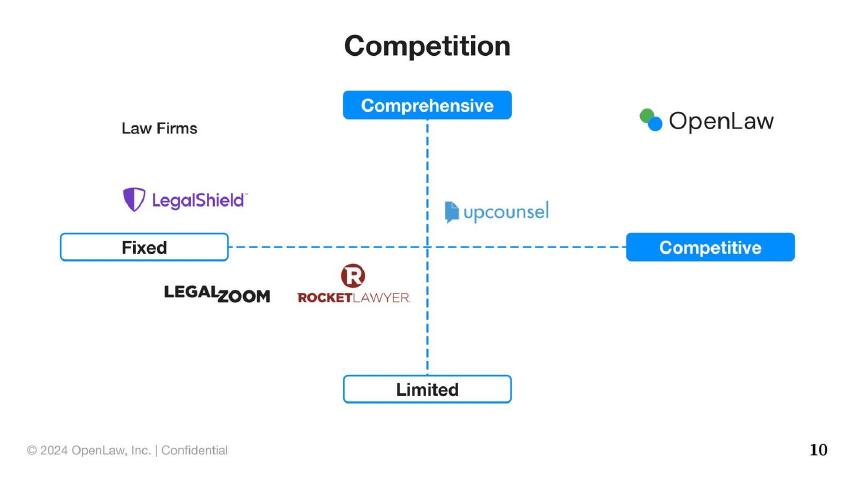
Despite the $3.5 million raise, the deck is missing several key components that sophisticated investors usually look for. First, there is no mention of competition. The legal tech space is crowded with incumbents and other startups; failing to address how OpenLaw differs from existing referral networks is a notable omission. Second, the 'Proprietary Data Insights' mentioned on the cover are never fully explained. Investors would want to know what specific data they are collecting that others aren't. Finally, the deck lacks a financial slide. There are no projections, no current burn rate, and no breakdown of how the $3.5 million will be spent (e.g., % to engineering, % to marketing).
Founder Takeaways: Copy the Clarity, Detail the Tech
Founders should emulate OpenLaw’s use of the 'Why Now' slide. Identifying specific regulatory or cultural shifts (like virtual hearings) is the best way to prove market urgency. The 'Traditional vs. New' comparison is also a highly effective way to communicate value quickly. However, founders should be careful not to leave their 'secret sauce' too vague. If you claim to have proprietary data or AI, you must provide at least one slide that explains the logic of that technology without giving away the intellectual property. Additionally, always include a clear 'Ask' slide if the deck is being used for active fundraising, detailing exactly what the capital will achieve over the next 18-24 months.
Frequently asked questions
- How does OpenLaw make money?
- According to Slide 7, OpenLaw utilizes a referral-based business model. They charge attorneys a fee for each 'high-quality referral' generated through the marketplace. While the exact dollar amount per referral is blurred in the provided slide, the mechanism is clearly defined as a lead-generation cost for the law firms rather than a subscription or a percentage of the legal fees.
- What is the primary problem OpenLaw is solving for clients?
- Slide 3 outlines three main pain points: the inability to get a hold of attorneys, high legal fees, and a frustrating intake process. OpenLaw aims to solve these by ensuring attorneys are motivated to speak to clients, reducing fees by 30-70%, and providing a platform where clients can hire with confidence.
- What geographic markets is OpenLaw targeting first?
- Slide 9 indicates a phased market approach. While the total U.S. market is 100 million cases, OpenLaw is focusing its initial efforts on Florida and Texas. These two states combined represent 11 million cases filed annually and a $1 billion market opportunity, providing a significant but manageable starting point for a Seed-stage company.
- Does the deck explain the 'Proprietary Data Insights' mentioned on the cover?
- The cover slide (Slide 1) promises transformation through 'Proprietary Data Insights,' but the subsequent slides are light on technical details. Slide 5 hints at the shift toward virtual connections and freelance attorneys, but the deck does not explicitly detail the data science or AI algorithms used to match clients with lawyers.
- What is the background of the founding team?
- The team (Slide 11) is highly experienced. CEO Andrew Guzman has 14+ years in legal sales/marketing; CPO David Ngo is a Stanford Behavior Design Lab alum with experience at Google and Spotify; and CTO Abtin Gramian has 14+ years in computer science, having worked with Warner Brothers and PlayStation.