The OpenDoor Coliving deck is a study in 'less is more.' In just 11 slides, the founders communicate a clear problem (urban affordability), a massive market ($105B), and a validated business model (15% gross margin). Unlike many real estate decks that get bogged down in complex cap rates and development timelines, OpenDoor focuses on the 'human' element of the business—community—while backing it up with hard operational data like a 2% monthly churn rate. The deck successfully bridges the gap between a lifestyle brand and a scalable proptech platform by highlighting 'signed deals' for future M…
Key takeaways
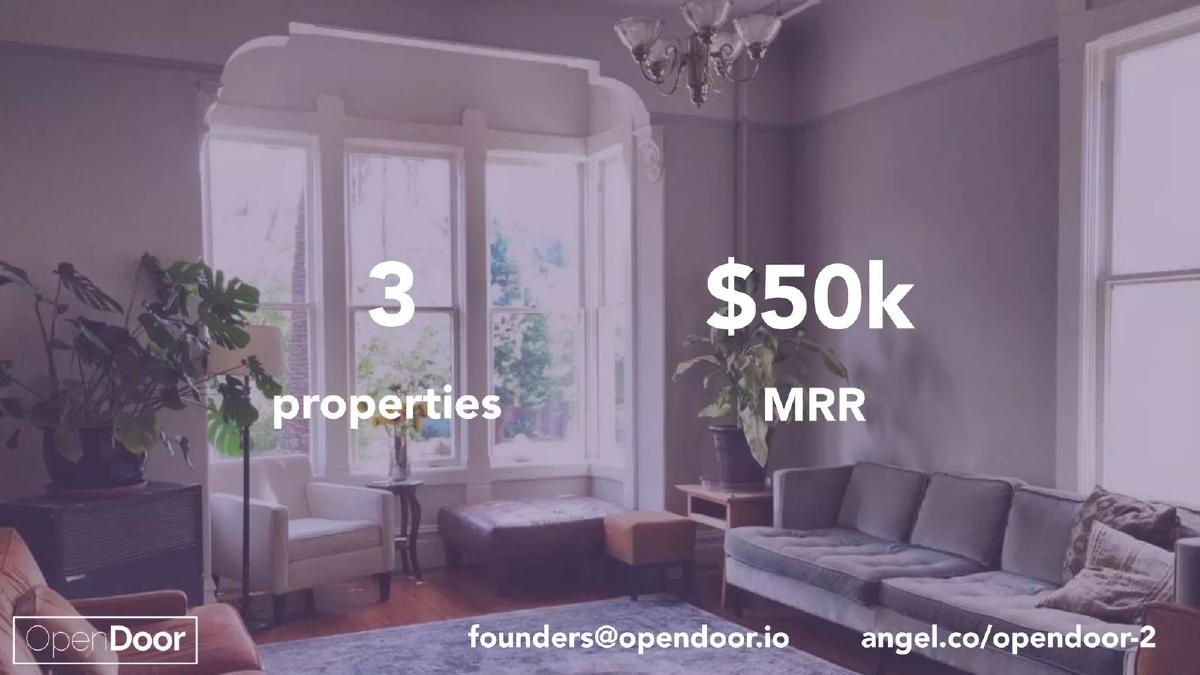
- The company reported $50k in Monthly Recurring Revenue (MRR) across 3 existing properties on slide 2.
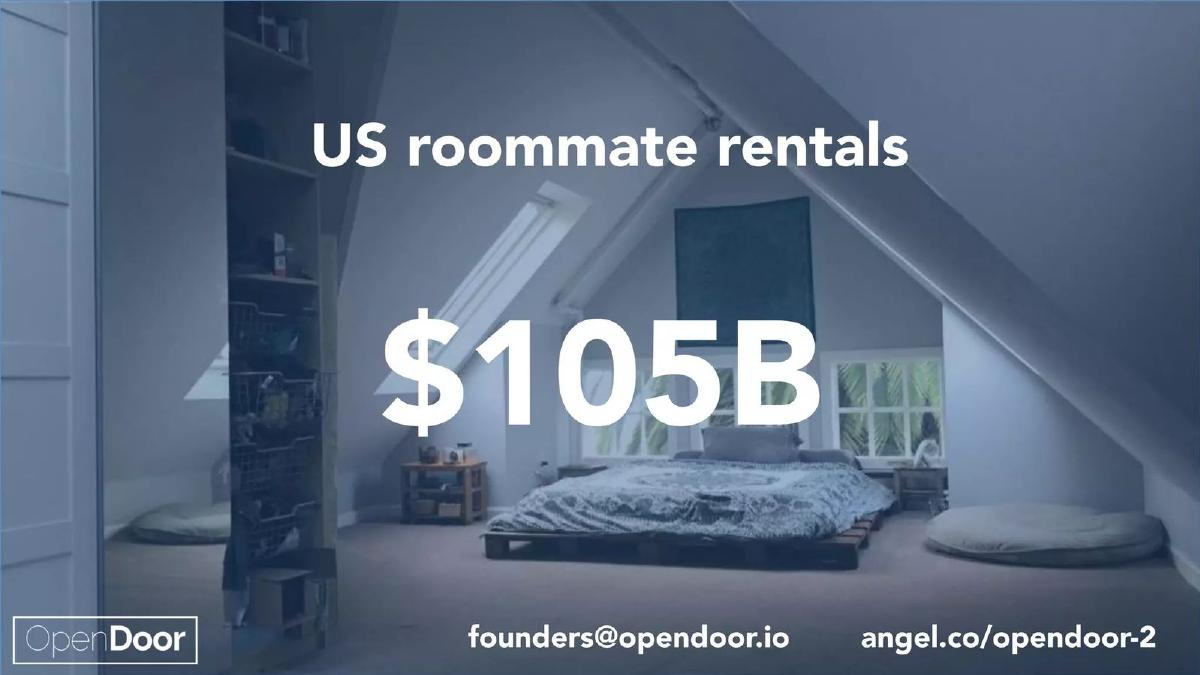
- OpenDoor identifies a $105B market opportunity specifically for US roommate rentals on slide 4.
- The business model relies on a 15% gross margin, which equates to roughly $200 per month in margin per resident as shown on slide 7.
- Operational efficiency is a core value proposition, with the deck claiming zero vacancy loss and a 100% referral rate on slide 8.
- Future growth is anchored in 'signed deals' representing $170k in potential MRR through six developer partnerships on slide 9.
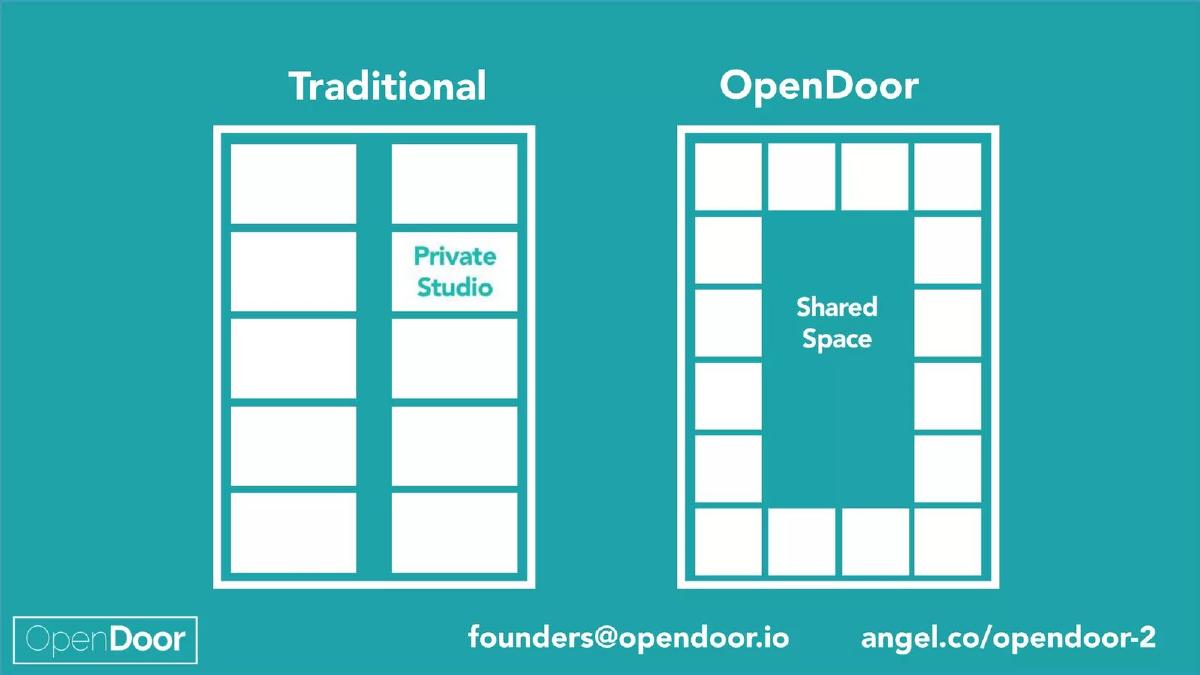
- The product vision shifts from 'Private Studios' to 'Shared Space' to maximize density and community, illustrated on slide 5.
- The founders, Ben Provan and Jay Standish, emphasize founder-market fit with the tagline 'We live it' on slide 10.
- The deck omits a traditional 'Ask' slide, failing to specify the exact amount of capital being raised or the intended use of funds.
The Power of High-Signal Minimalism
The OpenDoor Coliving deck from 2014 is a masterclass in minimalist storytelling. With only 11 slides, it manages to convey a lifestyle, a proven business model, and a clear path to scale. In an era where pitch decks often exceed 20 slides filled with dense charts, OpenDoor opted for full-bleed photography and massive, high-contrast typography. This approach works particularly well for real estate and community-based startups where the 'feeling' of the product is just as important as the numbers.
Slide 1: Title and Social Proof
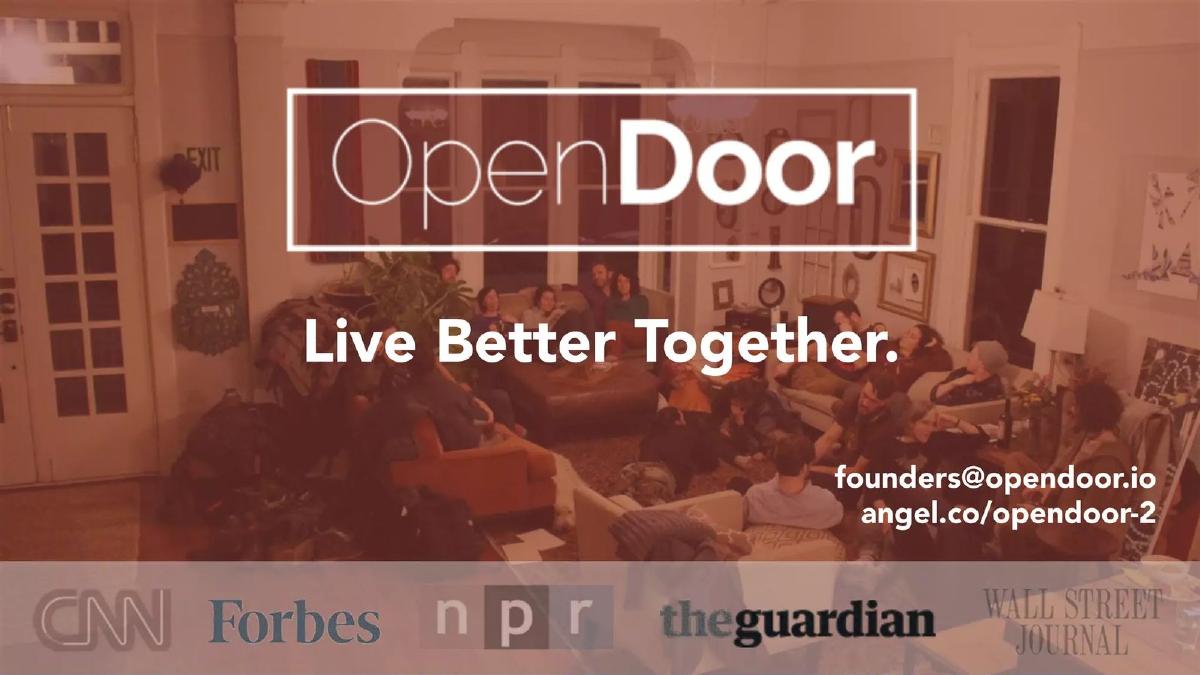
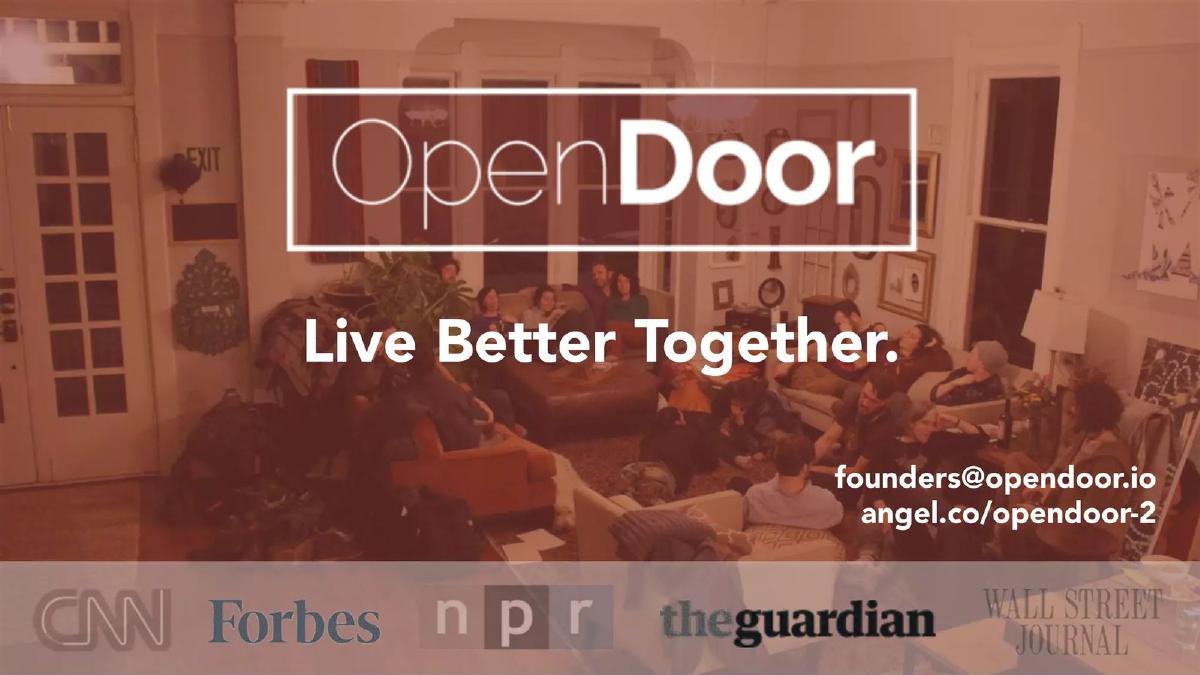
The cover slide sets the tone immediately. The tagline 'Live Better Together' sits over a warm, candid photo of a large group of people gathered in a living room. This isn't a stock photo; it looks like a real OpenDoor community event. Notably, the bottom of the slide features a heavy-hitting 'as seen in' bar including CNN, Forbes, NPR, The Guardian, and the Wall Street Journal. This provides immediate credibility before a single metric is shared.
Slide 2: The Hook (Traction)
OpenDoor doesn't wait until the end of the deck to show traction. Slide 2 features two massive numbers: '3 properties' and '$50k MRR.' By placing this at the front, they immediately answer the investor's most pressing question: 'Is this a real business or just an idea?' The background photo of a well-lit, tastefully decorated interior reinforces the premium nature of the brand.
Slide 3: The Problem
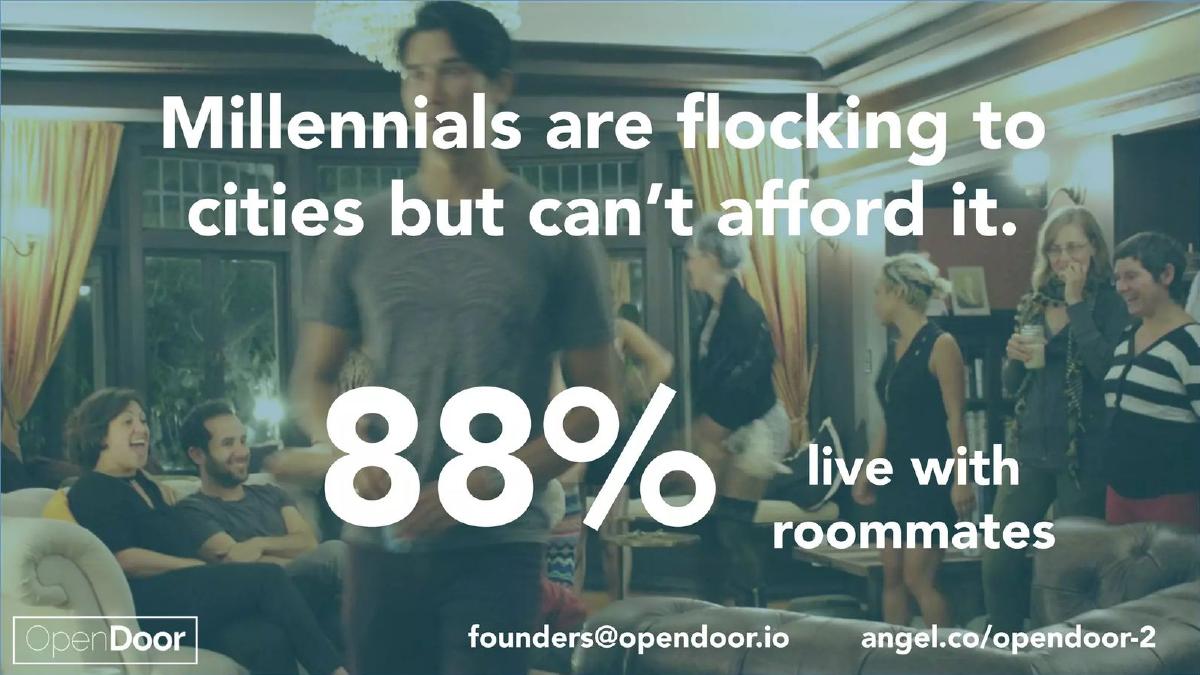
The problem statement is concise: 'Millennials are flocking to cities but can't afford it.' They back this up with a startling statistic: '88% live with roommates.' This slide identifies the target demographic and the economic pain point (affordability) without needing a list of bullet points. The blurred photo of young people in a social setting keeps the focus on the human element of the problem.
Slide 4: Market Size
To prove this isn't a niche hobby, slide 4 defines the market: 'US roommate rentals $105B.' This is a classic TAM (Total Addressable Market) slide. By narrowing the market to 'roommate rentals' rather than 'all real estate,' they show they understand their specific vertical while still presenting a number large enough to interest venture capitalists.
Slide 5: The Solution (Product Architecture)
This is the only slide in the deck that uses a diagram. It compares a 'Traditional' floor plan (private studios separated by a hallway) to the 'OpenDoor' floor plan (smaller private rooms surrounding a large 'Shared Space'). It visually explains how they achieve higher density and foster community simultaneously. It is a simple, effective way to show how they re-engineer physical space for better economics and social outcomes.
Slide 6: The Value Proposition
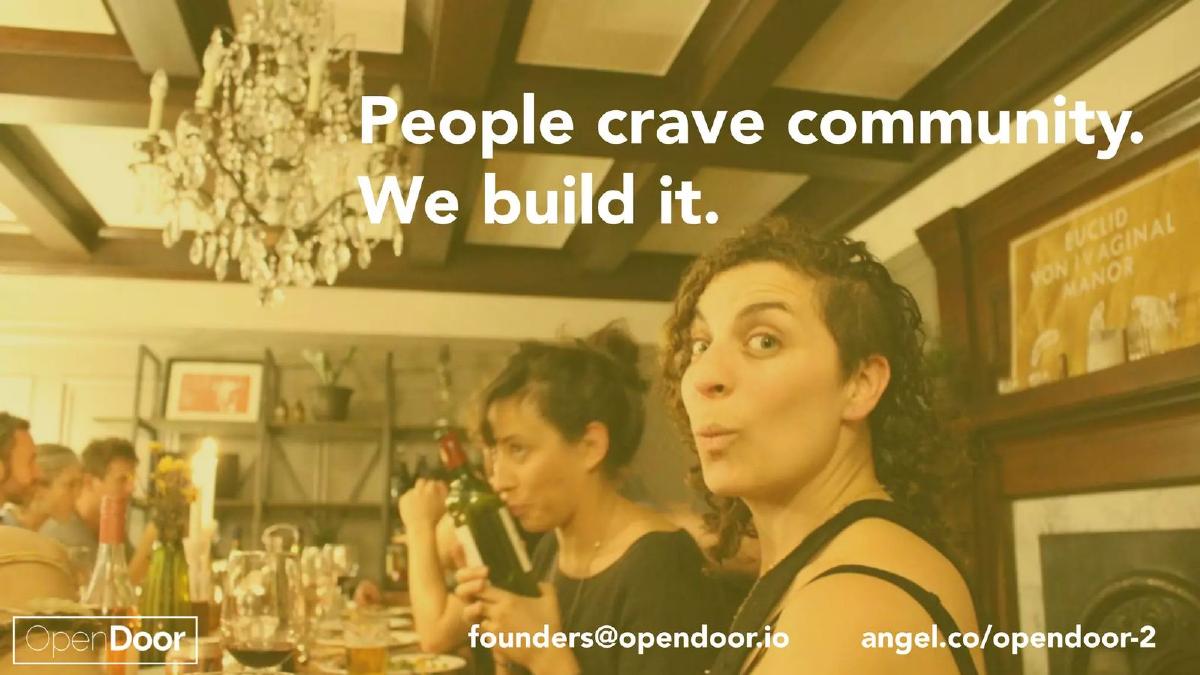
The text 'People crave community. We build it.' serves as the emotional core of the deck. The photo shows residents sharing a meal and wine, emphasizing the 'social' part of the business. This slide reinforces that OpenDoor isn't just a landlord; they are a community curator.
Slide 7: The Business Model
Slide 7 gets into the unit economics. They define their revenue as a 'Recurring fee on rents.' The key figures are a '15% gross margin' which equals '$200/mo margin per resident.' This is a critical slide because it shows the business is profitable at the individual level. It transforms the 'community' talk into a 'margin' talk, which is what investors need to see to believe in the scalability of the model.
Slide 8: Operational Efficiency
This slide is a 'flex' on their operational capabilities. They list three impressive metrics: 'ZERO Vacancy Loss,' '2% Monthly Churn,' and '100% Referral Rate.' In the world of rental real estate, these numbers are nearly unheard of. Zero vacancy loss suggests a massive waitlist, and 2% churn suggests high resident satisfaction. This slide proves that their 'community' focus leads to superior business performance.
Slide 9: Scaling Strategy
Titled 'Scaling via Developers,' this slide shows the future. They move from 3-property pilots to '50-100 bedrooms per building.' They claim '$170k MRR in signed deals' and 'SIX developer partnerships.' This tells the investor that the growth engine is already primed; they just need the capital to execute these larger projects. The 3D architectural render provides a visual sense of the increased scale.
Slide 10: The Team
The team slide is unconventional. Instead of headshots and resumes, it features a photo of the two founders, Ben Provan (COO) and Jay Standish (CEO), sitting on a couch with the caption 'We live it.' While this establishes founder-market fit and authenticity, it is arguably the weakest slide in the deck. It provides no information about their professional backgrounds, previous exits, or specific expertise in real estate or technology.
Slide 11: The Summary
The final slide repeats the core metrics: '$105B market,' '140 pipeline bedrooms,' and '$50k MRR.' It serves as a final reminder of the scale, the immediate future, and the current reality. It includes the contact information and an AngelList link, which was a common call to action in 2014.
What Works in This Deck
Visual Consistency: The deck uses a consistent color palette (muted tones with white text) and high-quality, authentic photography. It feels like a lifestyle brand, which is exactly what coliving needs to be to attract residents.
High-Signal Metrics: By focusing on 15% margins and zero vacancy, the founders speak the language of real estate investors while maintaining the 'cool' factor of a startup.
Clarity of Vision: There is no confusion about what OpenDoor does. They take existing demand for roommates and wrap it in a managed community layer to increase margins and decrease vacancy.
What Is Missing
The 'Ask': There is no slide stating how much money they are raising or what the valuation is. While this may have been handled in the email or the meeting, its absence in the deck makes the narrative feel slightly unfinished.
Competitive Landscape: In 2014, the coliving space was starting to heat up with players like Common and WeLive. The deck doesn't address how OpenDoor is different or better than these competitors.
Technology: For a 'Proptech' company, there is zero mention of software. Is there an app for residents? A proprietary backend for managing vacancies? The deck makes the company look more like a traditional property management firm than a tech-enabled platform.
What Founders Should Copy
The 'Traction First' Approach: Don't bury your revenue. If you have $50k MRR, put it on slide 2. It changes the way investors view every subsequent slide.
Simplified Floor Plans: If your business involves physical space, use a simple 'Before vs. After' or 'Traditional vs. Ours' diagram. It is much more effective than a 500-word description of your layout.
Metric-Driven Operations: Don't just say your customers love you. Say you have a '100% referral rate.' Don't just say your rooms are full. Say you have 'Zero vacancy loss.' Specificity creates the illusion of inevitability.
Final Verdict: This deck is a 9/10 for its era. It successfully sells a 'vibe' while grounding it in the cold, hard reality of real estate margins. It proves that you don't need 30 slides to raise $10M; you just need the right numbers and a clear way to show how you got them.
Frequently asked questions
- Is this the same company as the famous iBuyer Opendoor?
- No. This teardown covers OpenDoor Coliving (opendoor.io), a community-focused residential company. It is distinct from Opendoor (opendoor.com), the multi-billion dollar real estate platform that focuses on instant home buying and selling. The coliving startup was founded earlier and focused on the 'roommate' and 'community' aspect of urban living.
- How does OpenDoor Coliving actually make money?
- According to slide 7, the company takes a 'recurring fee on rents.' They operate on a 15% gross margin, which they calculate as approximately $200 per month in margin per resident. This suggests a property management or 'brand-as-a-service' model where they overlay their community management and operations onto existing or new real estate assets.
- What is the 'Scaling via Developers' strategy mentioned?
- Slide 9 outlines a shift from small-scale properties to larger developments. By partnering with developers, OpenDoor aims to manage buildings with 50-100 bedrooms each. At the time of the deck, they claimed to have six such partnerships and $170k in MRR tied up in signed deals, indicating a move toward a more scalable, asset-light model.
- Why is 'Zero Vacancy Loss' such a significant metric in this deck?
- In traditional real estate, vacancy is a primary profit killer. By claiming 'Zero Vacancy Loss' on slide 8, OpenDoor is signaling to investors that their community-driven model creates such high demand and resident loyalty (supported by a 100% referral rate) that rooms never sit empty, significantly de-risking the investment compared to standard apartments.
- What are the most notable omissions in this pitch deck?
- The deck is missing several standard venture components: a detailed competitor slide, a specific 'Ask' (amount and terms), a roadmap of future locations, and a breakdown of the technology stack. It relies heavily on the 'vibe' of the photography and a few high-level financial figures to carry the narrative.