ZMassWalls' 18-slide 2019 seed deck asks for $250,000 to file provisional patents and build a prototype large-format 3D print head for zero-energy concrete wall molds. It is unusually well sourced - footnoted market data, two cited thermal experiments, California ZNE mandates and a stated price per square foot - but it claims the printer is already 'patent protected' on the same deck that asks investors to fund the filings, names nobody on its team slide, and shows no traction. The verdict: strong physical evidence, undermined by claims that contradict each other.
Key takeaways
- ZMassWalls' 2019 deck is an 18-slide seed pitch raising $250,000 to file provisional patents and build a prototype Iso-Linear 3D print head for concrete wall molds.
- The deck's strongest slide cites two independent thermal experiments (Borrego Springs, CA and Las Vegas, NV) with quantified results, giving its core product claim real third-party evidence.
- Slide 13 claims the printer is 'patent protected' while slide 18 asks investors to fund the filing of provisional patents - a direct internal contradiction that undermines every other claim.
- The team slide names nobody: four members are described only as archetypes such as 'Seasoned top 1% Software Engineer', which is fatal in a raise where the team is the only real asset.
- 'Printer is capable of 17MM per year in revenue' is the deck's most important number and appears as a bare bullet with no cycle time, utilisation or arithmetic behind it.
- The California ZNE mandate slide is a legally dated demand curve, but the deck never converts it into a bottom-up revenue estimate for ZMassWalls specifically.
- The deck states a price of $12.50 to $15.50 per square foot but never states cost, so it prices the product without ever showing whether the business has margin.
- An Uber analogy and a 2017 Elon Musk quote occupy the high-attention slide immediately before the ask, where a traction or pipeline slide belongs.
What this deck actually is
This is a genuine investor pitch deck, not a company brochure and not a recreation. The file's own metadata names it "Zero Energy Systems pitch Deck", it was built in Adobe InDesign 14, and the cover carries the line "Pitch Deck • Proprietary and Confidential" alongside a revision stamp of 2019-26-06. Eighteen slides, one named human being on the cover and on the closing slide, and an explicit ask on the last page: $250,000 seed round .
What makes it unusual is the stage. ZMassWalls is raising $250,000 — angel money, not a venture round — to file provisional patents and build a prototype print head. The deck is therefore pitching a machine that does not yet exist, wrapped around a wall product built on 37 years of prior research. That mismatch between the maturity of the material science and the immaturity of the manufacturing technology is the single most important thing to understand about these eighteen slides, and the deck never resolves it.
The construction category matters too. Prefabricated panel manufacturing, precast concrete and tilt-up are old, capital-heavy, regionally fragmented industries. A deck that walks into that world claiming Amazon-style fulfilment and a 100x-faster printer needs to be unusually careful about evidence. This one is careful in some places and reckless in others, sometimes on adjacent slides.
Slide-by-slide walkthrough
Slide 1 — Cover
Clean and correct. Company mark, the confidentiality line, and the founder's full contact block: Scott Long, CEO & Co-Founder, phone number and email. A revision date sits in the corner. Putting a phone number on slide one is a small act of confidence that most decks skip, and it costs nothing. The one omission is a one-line descriptor of what the company does — a reader who receives this file cold has to reach slide 2 before learning it is about walls.
Slide 2 — Who are we?
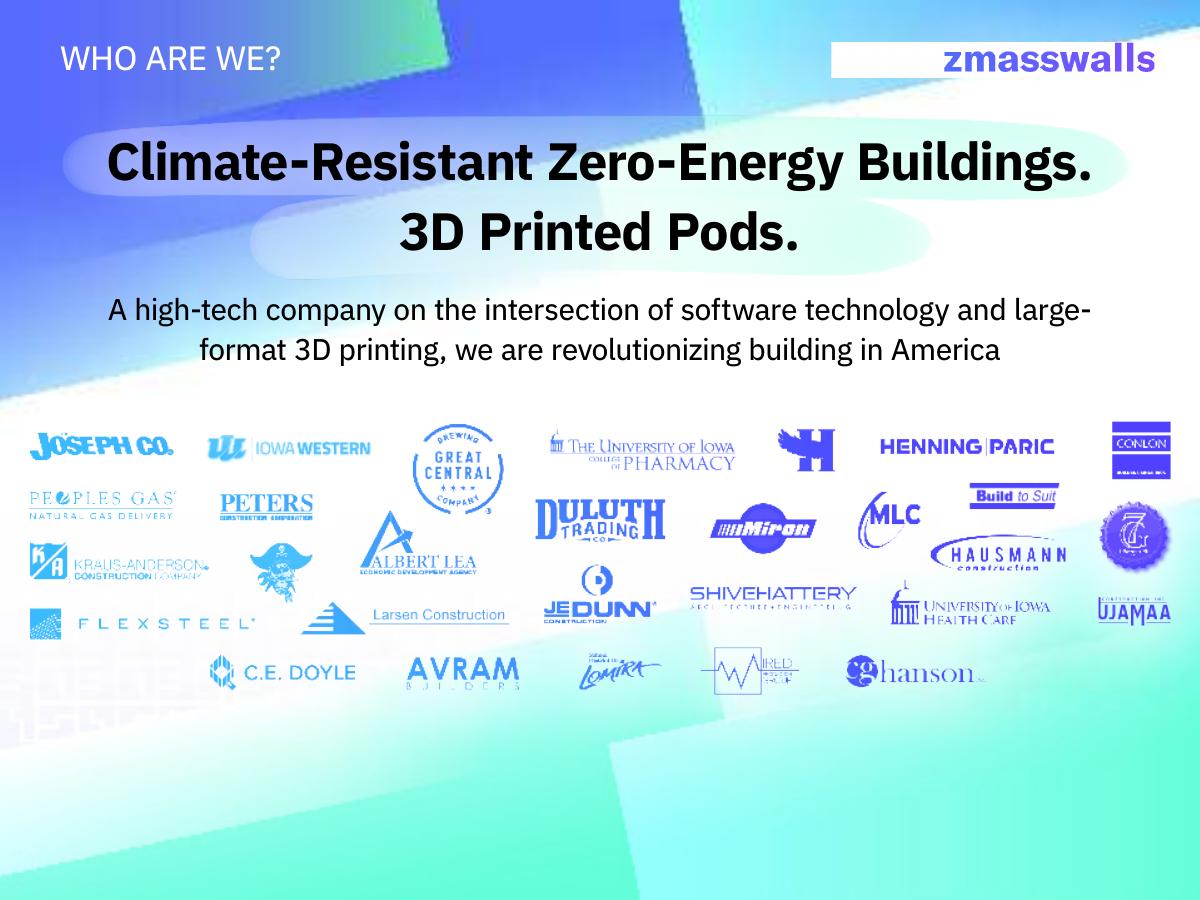
"Climate-Resistant Zero-Energy Buildings. 3D Printed Pods." Then the sub-line: "A high-tech company on the intersection of software technology and large-format 3D printing, we are revolutionizing building in America."
The two-line headline is the best writing in the deck. It is concrete, it names a physical product, and it makes a benefit claim (zero-energy, climate-resistant) that can be tested. The paragraph underneath then undoes it by reaching for "high-tech", "intersection" and "revolutionizing" in a single sentence. Cut the paragraph and the slide gets stronger.
Slide 3 — Our team
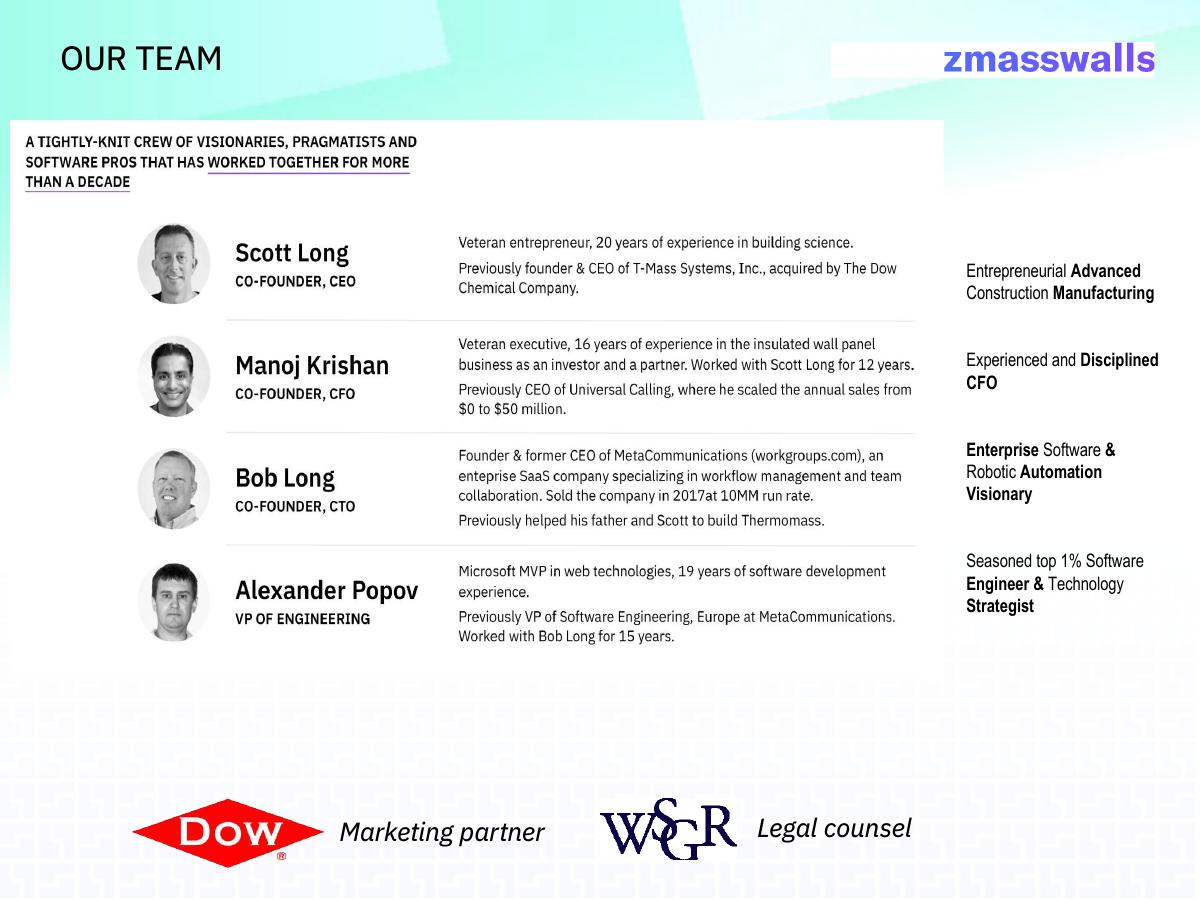
This is the deck's most damaging slide, and it is damaging because of what has been removed rather than what has been included. Four team members are described purely by archetype: "Entrepreneurial Advanced Construction Manufacturing", "Experienced and Disciplined CFO", "Enterprise Software & Robotic Automation Visionary", "Seasoned top 1% Software Engineer & Technology Strategist". Beneath them, two more slots labelled only "Marketing partner" and "Legal counsel".
No names. No prior companies. No years. No LinkedIn. In a $250K pre-prototype raise, the team is the asset — an investor at this stage is underwriting people, because there is nothing else to underwrite. "Top 1% software engineer" is a self-assessment with no referent; a single line reading "12 years at [named precast manufacturer], shipped 4M sq ft of panel" would have done more work than all four archetypes combined. The deck names Scott Long twice on the cover pages and nowhere in the team slide, which is a strange inversion.
Slide 4 — The machine
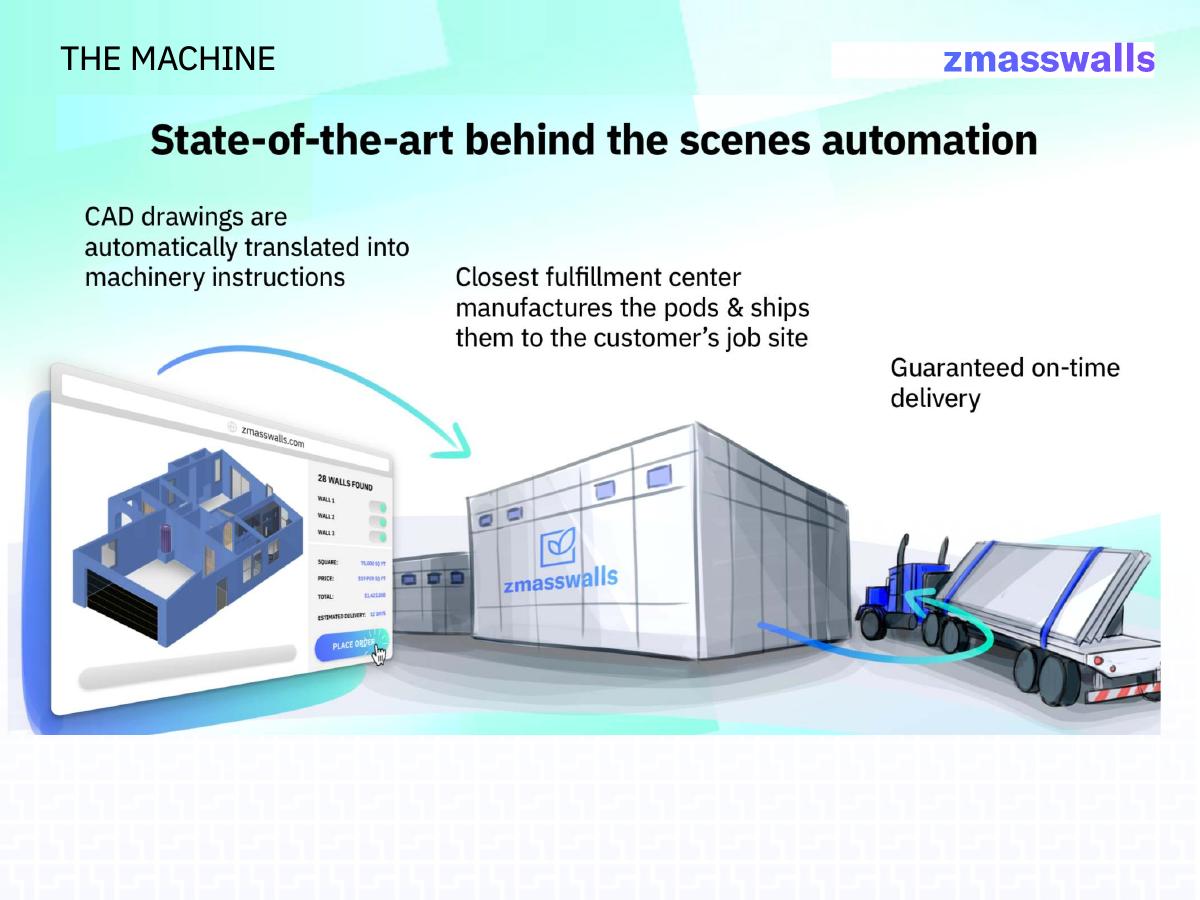
A full-bleed visual slide with a single title and no body text. Visually confident, informationally empty. Given that the entire raise is to build a prototype of this machine, this slide should have carried the honest label: concept rendering, not built hardware. A reader who skims will leave believing the printer exists.
Slide 5 — The platform
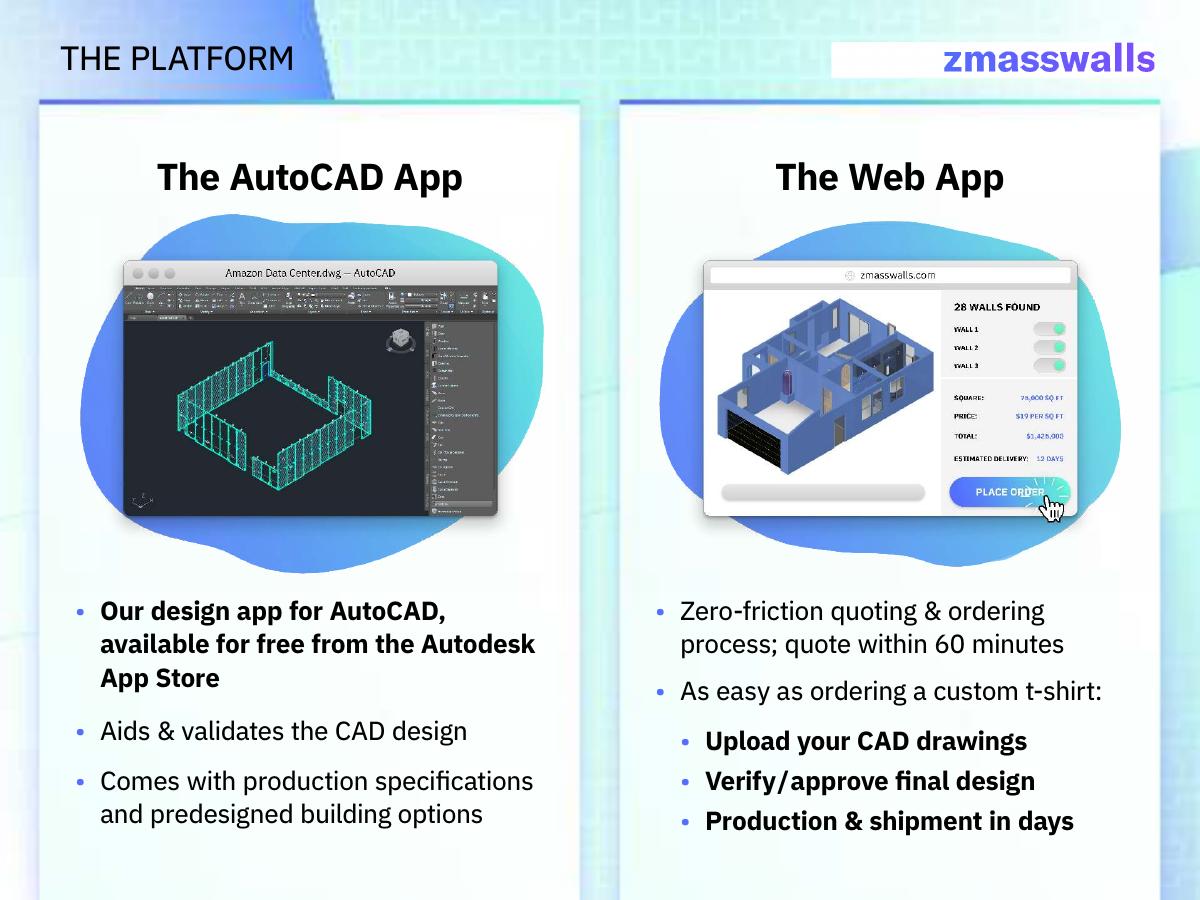
Two columns. The AutoCAD App: a free design plugin distributed through the Autodesk App Store that "aids & validates the CAD design" and ships with production specifications and predesigned building options. The Web App: "zero-friction quoting & ordering process; quote within 60 minutes", described as "as easy as ordering a custom t-shirt" — upload CAD drawings, verify and approve final design, production and shipment in days.
Strategically this is the smartest slide in the deck. Distributing a free plugin inside the tool architects already live in is a real wedge with a real distribution channel, and a 60-minute quote in an industry where quotes take days is a specific, checkable promise. But nothing here is dated or evidenced. Is the plugin live on the Autodesk App Store today, or planned? How many downloads? Is the 60-minute quote measured or aspirational? Three numbers would turn this from a plan into traction.
Slide 6 — The product
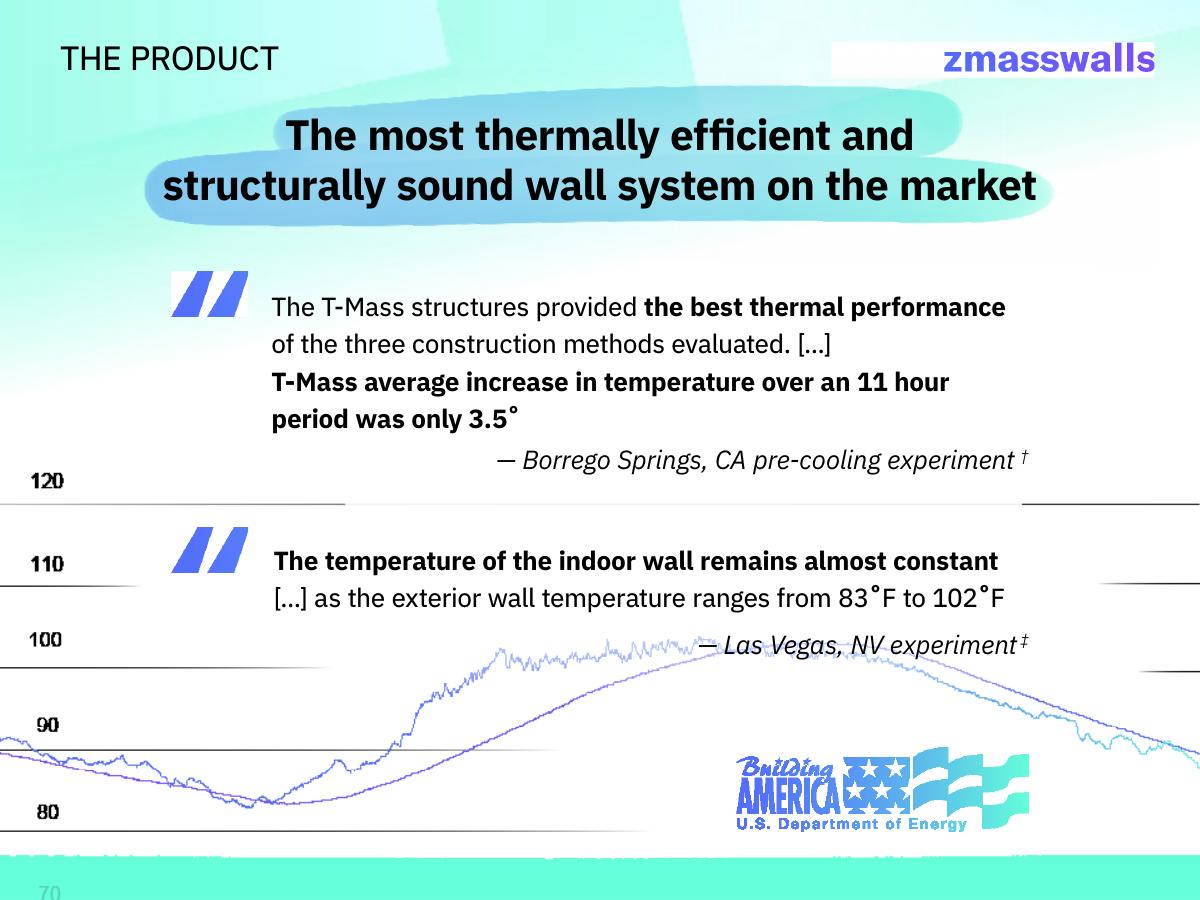
The claim: "the most thermally efficient and structurally sound wall system on the market." Then two cited experimental results. From a Borrego Springs, CA pre-cooling experiment: "The T-Mass structures provided the best thermal performance of the three construction methods evaluated… T-Mass average increase in temperature over an 11 hour period was only 3.5°." From a Las Vegas, NV experiment: "The temperature of the indoor wall remains almost constant… as the exterior wall temperature ranges from 83°F to 102°F."
This is the deck at its best. A superlative claim followed immediately by two independent, footnoted, quantified third-party results is exactly the structure investors want and almost never get. The weakness is that the results describe T-Mass, an existing insulated-sandwich wall technology — the deck does not draw a clean line between "this proven wall system works" and "and we are the ones who can now manufacture it cheaply". That distinction is the whole company.
Slide 7 — The product (cont.)
"The culmination of 37 years of research." Four annotated points about the wall assembly: a sandwich wall forces the two wythes of concrete to act together structurally, creating a much thinner panel; the exterior panel is available in hundreds of architectural finishes including traditional brick and stone; fiber composite binds the wythes, delivering flexibility that prevents thermal bowing; the interior panel acts as both a structural element and a "rechargeable thermal battery"; the insulation membrane is protected from the elements between the two wythes.
The "rechargeable thermal battery" framing is genuinely good — it converts a dull building-science concept into something a non-technical investor can hold. "37 years of research" is powerful and unattributed: whose research, at what institution, and does ZMassWalls own or license it? An IP question this large should never be left implicit.
Slide 8 — Competitive landscape
A two-by-two: energy efficiency on the vertical axis, technology/automation on the horizontal. ZMassWalls sits top-right as "hi-tech, zero-energy thermal mass walls", with "low-tech, low-fidelity concrete" bottom-left and "hi-tech timber" bottom-right.
The axes are well chosen and the positioning is arguable. What is missing is names. Not a single competitor is identified — no precast manufacturers, no ICF makers, no SIPs producers, no automated-formwork firms. A landscape slide with anonymous blobs tells an investor that the founder has either not mapped the market or does not want to be measured against anyone in it. Three named logos per quadrant would have made this slide credible instead of decorative.
Slide 9 — US market
Three figures with footnotes: $5.5B US market for prefab panels/buildings (NPCA market size trends, 12-11-17); 18% AGR (NPCA benchmarking report noting the precast industry grew 5% in 2016); and the US net-zero energy building market moving from $872M to $7.2B (Net-Zero Energy Buildings Market Research Report). Segments listed as residential, commercial, institutional and industrial.
Footnoting every number is above average discipline. The problem is internal consistency: the slide shows an 18% annual growth rate but cites a source describing 5% industry growth in 2016. Those are different claims and the deck does not reconcile them. There is also no bottom-up sizing — no serviceable market, no reachable market, no "at $13.50 per square foot, X million square feet in California alone is $Y". Top-down billions without a bottom-up path is the most common market-slide failure in the category.
Slide 10 — California market
Four regulatory facts, each footnoted to Bloomberg or the California Public Utilities Commission: new residential construction after 1 Jan 2020 must include solar; all new commercial construction must be Zero Net Energy by 2030; 50% of commercial buildings to be retrofit to ZNE by 2030; 50% of new major state-building renovations to be ZNE by 2025.
This is the strongest strategic slide in the deck and it should have come earlier. A legally mandated demand curve with dates on it is the closest thing a construction-materials startup gets to a growth engine. The deck states the mandates and then fails to do the one thing that matters: quantify what share of that mandated construction ZMassWalls could plausibly serve, and by when. The slide ends where the argument should begin.
Slide 11 — ZMassPods
"ZMassPods are a revolutionary way to deliver wall panels directly to our clients." Amazon-type fulfilment; direct-to-consumer (A-B) online system; standardised pricing; composite lightweight molds containing all engineered components except concrete; up to 10 Pods per truckload; water-tight sealed and storable onsite; concrete placed at the site; Pod material and strongbacks returned for recycle/reuse after erection; "reduces or eliminates the need for skilled labor".
The insight underneath is excellent: ship the mold rather than the finished panel, because concrete is heavy and locally available while engineering is not. "Up to 10 Pods per truckload" is a real, verifiable logistics claim. The overreach is "eliminates the need for skilled labor" — concrete placement, rebar and panel erection are all skilled trades, and a construction-literate investor will stop reading at that line.
Slide 12 — Scalability
"A highly-scalable Global opportunity." Low CAPEX allows massive scalability; production in leased warehouse space; "drop and build — follow natural disasters"; "printer is capable of 17MM per year in revenue"; printers can be licensed or sold to sophisticated contractor users; the product is usable by industry professionals, general contractors and owners.
"Printer is capable of $17M per year in revenue" is the single most important number in the deck and it is asserted with no working. At the deck's own stated price of $12.50–$15.50 per square foot, $17M implies roughly 1.1–1.4 million square feet of Pod output per printer per year. Is that at one shift or three? What is the cycle time per Pod? What is the machine's own cost? A three-line calculation would have converted the deck's boldest claim into its most defensible one. Instead it sits as a bullet.
Slide 13 — The Iso-Linear 3D printer
"Our Iso-Linear 3D Printer will revolutionize high-speed large-format industrial printing." Patent protected; highly detailed projects with greater margins; prints molds and all engineered coordinates, eliminating human error; "can print 100X faster than a nozzle printer"; will use ABS, PLA or other low-cost recyclable plastic pellets.
Two problems. First, "patent protected" contradicts the ask slide, which says the raise will be used for the filing of provisional patents . You cannot be patent-protected and pre-provisional at the same time; an investor who spots this will question everything else. Second, "100X faster than a nozzle printer" carries no basis, no comparison machine and no measured throughput — and this slide is also where the deck's text layer shows the Uber quote bleeding through from another layout, a production error visible in the file itself.
Slide 14 — Why precast fails today
High CAPEX facilities limit scalability; requires highly skilled labor; requires massive storage space and costs; requires heavy equipment; race-to-the-bottom pricing; next-generation "heavy steel" German automation does not benefit complex US design requirements.
A well-argued incumbent-weakness slide, and the German-automation point shows real category knowledge — it is the kind of detail only someone inside the industry would raise. It would land harder with one number: the typical CAPEX of a precast plant versus the CAPEX of a leased ZMassWalls warehouse.
Slide 15 — Why tilt-up fails today
Time consuming and unpredictable; requires highly skilled labor; significant on-site preparation; significant on-site waste; volatile pricing based on supply and demand; weather-dependent production.
Accurate and concise. But note the tension with slide 11: tilt-up is criticised for on-site dependence and weather exposure, while the ZMassPod model also pours concrete at the site location. The deck never addresses why site-poured concrete inside a Pod escapes the weather problem it just used against a competitor.
Slide 16 — The final product and pricing
The product is a lightweight composite mold with all ZMassWalls components except the concrete. Orders established and processed online; the closest fulfilment center produces the Pods; eliminates pain points for precast and tilt-up; also sold directly to general contractors; concrete placed by any concrete crew; "estimated sales price of $12.50 to $15.50 per square foot allows for predictable contractor margin".
A stated price on a stated unit is rare in early-stage decks and it deserves credit. What is missing is the other half of the equation: cost per square foot, and therefore gross margin. Price without cost is not a business model. One more line — "at an estimated $X per sq ft cost, that is Y% gross margin" — would have made this the deck's best slide.
Slide 17 — The Uber analogy
"Uber didn't set out to help the Yellow Cab industry, they built technology tools to create an entirely new industry. ZMassWalls is doing the same thing to disrupt the entire wall panel industry!" Alongside it, a 2017 Elon Musk quote: "Construction is the only sector of the economy that has not improved its productivity in the last 50 years."
Borrowed credibility, and by 2019 both the Uber analogy and the Musk construction quote were already deck clichés. The exclamation mark does not help. Worse, this slide occupies prime real estate immediately before the ask — the position where a traction, pipeline or letter-of-intent slide should sit. Every construction-tech investor has heard the Musk line; none of them have heard what ZMassWalls has actually built.
Slide 18 — The ask
"Raising $250,000 / Seed Round." Use of funds: filing of provisional patents on the Iso-Linear Print Head and the Pod; development of marketing materials for both the industry and investors; building of a prototype Iso-Linear Print Head. Footer: legal counsel WSGR; San Francisco, CA and Prague, Czech Republic; Scott Long's phone and email.
Naming Wilson Sonsini as counsel is a real, checkable credibility signal, and the dual San Francisco / Prague footprint hints at where the engineering sits. But the use of funds is thin for a raise this size: three bullets, no amounts against them, no milestone, no runway. And one of the three is "marketing materials for… investors" — asking investors to fund the production of investor materials is a hard sentence to read charitably. There is no valuation, no instrument (SAFE? note? equity?), and no statement of what $250,000 buys in terms of a demonstrable result.
What this deck does better than most startup pitch decks
It footnotes its numbers. The market and regulation slides carry named sources with dates — NPCA reports, Bloomberg, the California Public Utilities Commission. Most seed decks cite nothing at all. · It cites third-party physical evidence. Two independent thermal experiments with quantified outcomes back the core product claim. That is stronger proof than any customer logo. · It states a price. $12.50–$15.50 per square foot on a defined unit. Very few pre-revenue decks are willing to commit to a number that can be checked against them later. · It finds a regulatory tailwind with dates. The California ZNE mandate slide converts a policy fact into a demand curve, which is the correct instinct for a building-materials company. · It understands its incumbents. The precast and tilt-up critique slides show operator-level knowledge, right down to why German automated formwork struggles with US design variance. · It has a distribution wedge. A free AutoCAD plugin inside the Autodesk App Store puts the product in front of the exact person who specifies the wall. · It ends with an explicit ask and a reachable human. Amount, use of funds, name, phone, email, and named legal counsel — all on one page.
Where this deck would fail in an investor meeting
Nobody is named on the team slide. Four archetypes and two placeholders for a raise where the team is the only real asset. "Top 1% software engineer" is unfalsifiable and reads as a red flag rather than a credential. · "Patent protected" contradicts the ask. Slide 13 claims protection; slide 18 asks for money to file provisionals. A single inconsistency like this puts every other claim under suspicion. · The $17M-per-printer number has no derivation. It is the economic engine of the entire pitch and it appears as an unsupported bullet. · No traction of any kind. No pilot, no letter of intent, no signed contractor, no plugin download count, no prototype. Eighteen slides and not one piece of evidence that a third party wants this. · No costs, so no margin. The deck prices the product but never states what a Pod costs to produce, which means it never states whether the business works. · No financial model and no milestones. No revenue projection, no headcount plan, no timeline from $250K to working prototype to first paid Pod. · No competitor is named. An anonymous two-by-two in a mature, consolidated industry reads as avoidance. · "Eliminates the need for skilled labor" overclaims. Concrete placement and panel erection remain skilled trades; construction investors will catch this instantly. · Internal contradiction on weather. Tilt-up is attacked for weather dependence while the Pod model also pours on site. · The Uber slide occupies the traction slot. The highest-attention position before the ask is spent on a borrowed analogy and a Musk quote. · Unattributed "37 years of research". A claim that large without an owner raises an IP question the deck never answers. · A visible production error. The Uber copy bleeds into the printer slide's text layer — small, but in a document arguing for manufacturing precision, details signal.
How a 2019 hardware deck compares to what wins today
Dimension ZMassWalls, 2019 What a hardware seed deck needs today
Team Four unnamed archetypes Names, prior shipped products, why this team specifically
Technology status Rendering labelled "The machine" Photo or video of the actual prototype, however rough
IP "Patent protected" plus a request to fund filings Exact status: provisional filed, date, claim summary
Market Top-down $5.5B and $7.2B Bottom-up: units × price × reachable accounts
Unit economics Price only ($12.50–$15.50/sq ft) Price, cost, gross margin, payback per machine
Traction None shown LOIs, pilot contractors, plugin installs, waitlist square footage
Competition Unnamed two-by-two Named players with a factual comparison table
Ask $250K, three unpriced bullets Amount, instrument, milestone the money buys, runway in months
Persuasion Uber analogy + Musk quote Your own evidence; borrowed narratives are discounted
How you would rebuild this deck
Put names on the team slide. Four people, four photos, four one-line credentials with companies and years. If a role is unfilled, say "hiring" rather than describing an archetype. · Fix the patent contradiction in one pass. Choose the true statement — "provisional filings are the first use of this round" — and make every slide agree with it. · Show the derivation of $17M per printer. Cycle time, shifts per day, square feet per Pod, price per square foot, utilisation assumption. Five numbers on one line turns the deck's boldest claim into its most credible. · Add a cost line beside the price. $12.50–$15.50 revenue per square foot against an estimated cost gives a gross margin, which is the number an investor writes down. · Replace the Uber slide with a traction slide. Even at pre-prototype: named architects who have installed the AutoCAD plugin, contractors who signed LOIs, square footage in a pipeline, or the results of a single physical panel test you ran yourselves. · Label the machine honestly. Caption slide 4 "Iso-Linear print head — concept rendering, prototype funded by this round." Honesty about stage builds more trust than ambiguity buys. · Name three competitors. Put real companies in the two-by-two and add a small comparison table on thermal performance, price per square foot and lead time. · Convert the California mandate into a bottom-up number. X million square feet of mandated ZNE commercial construction per year, Y% addressable by panel systems, Z% target share, equals a revenue line with a date. · Soften the labor claim to what is true. "Reduces skilled-labor hours per panel by roughly N%" is both more defensible and more impressive than "eliminates". · Resolve the weather contradiction. Explain in one sentence why a sealed Pod poured on site is not exposed to the tilt-up weather risk you just criticised. · Rewrite the ask with amounts and a milestone. "$250K: $60K provisional filings, $150K prototype print head, $40K 6 months of operations — targeting a working print head producing a test Pod by Q2 2020." Add the instrument. · Attribute the 37 years. Name the research body, and state whether ZMassWalls owns, licenses or merely builds on it.
The transferable lesson
ZMassWalls did the hard part well. It found a real physical advantage, backed it with third-party experimental data, identified a legally mandated demand curve, priced its product and asked for a specific amount of money. Very few seed decks manage half of that.
What it failed to do was make its own claims survive contact with an attentive reader. The patent statement contradicts the ask. The revenue-per-printer figure has no arithmetic behind it. The team is anonymous. The competitors are anonymous. Each of these is a five-minute fix, and together they are the difference between a deck an investor forwards and a deck an investor quietly closes.
That is the pattern worth internalising: at seed stage, decks rarely fail because the idea is weak. They fail because a reader hits one sentence that cannot be true alongside another sentence, and from that moment reads defensively. Before you send your next deck, read it once as an adversary — find every number without a derivation, every claim without a source, and every two slides that disagree. Fix those, and the same idea gets a very different meeting.
Frequently asked questions
- What is ZMassWalls?
- ZMassWalls, whose deck metadata names it Zero Energy Systems, is a US construction-technology company pitching climate-resistant, zero-energy building walls made from insulated concrete sandwich panels. Its plan is to use a large-format 'Iso-Linear' 3D printer to produce lightweight composite molds, called ZMassPods, that ship to a job site where any concrete crew pours the concrete. The 2019 deck lists offices in San Francisco, CA and Prague, Czech Republic.
- Is the ZMassWalls deck a real investor pitch deck?
- Yes. The file's metadata names it 'Zero Energy Systems pitch Deck', the cover is marked 'Pitch Deck - Proprietary and Confidential' with a 2019 revision date, and the final slide carries an explicit ask: a $250,000 seed round with a three-item use of funds. It is a genuine fundraising document, not a company brochure or a recreated example.
- How much was ZMassWalls raising and what for?
- The closing slide states a $250,000 seed round. The three stated uses are filing provisional patents on the Iso-Linear print head and the Pod, developing marketing materials for both the industry and investors, and building a prototype Iso-Linear print head. No amount is assigned to each item, no milestone or runway is given, and no instrument or valuation is stated.
- What is the biggest problem with the ZMassWalls pitch deck?
- The internal contradiction between slide 13, which calls the printer 'patent protected', and slide 18, which asks investors to fund the filing of provisional patents. Those two statements cannot both be true. A close second is the team slide, which describes four members purely by archetype with no names, companies or track records in a raise where the team is the primary thing being underwritten.
- Which ZMassWalls slides should founders copy?
- Three. The product slide, which follows a superlative claim with two footnoted third-party thermal experiments. The California market slide, which turns state ZNE and solar mandates into a dated demand curve. And the pricing slide, which commits to a checkable $12.50 to $15.50 per square foot on a defined unit. Very few seed decks are willing to be that specific.
- Did ZMassWalls raise the $250,000?
- There is no public record confirming the outcome of the round described in this 2019 deck. The document circulated publicly as a pitch deck upload and names Scott Long as CEO and co-founder, with Wilson Sonsini listed as legal counsel. Treat the deck as a snapshot of a pre-prototype seed pitch rather than evidence of a completed raise.