Terra One secured $7.5M in Seed funding in 2024 to address the critical gap in Germany's renewable energy infrastructure: storage. The 15-slide deck highlights a massive market opportunity, noting that 19 TWh of renewable energy was wasted in Germany in 2023 alone. Terra One positions itself as a 'full-stack' platform, handling everything from property acquisition to AI-based energy trading. By aggregating battery assets into a virtual power plant, they aim to stabilize the grid and capture revenue from price volatility. The deck is notable for its clear problem-solution narrative and a high-…
Key takeaways
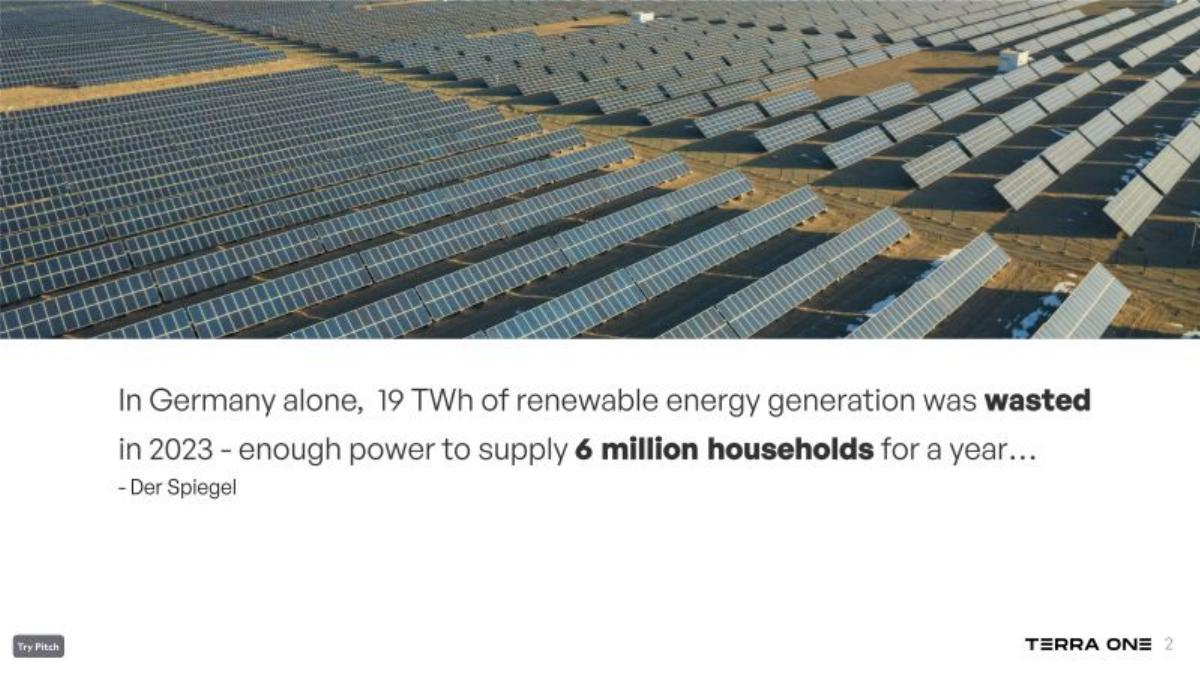
- Germany wasted 19 TWh of renewable energy in 2023, enough to power 6 million households (Slide 2).
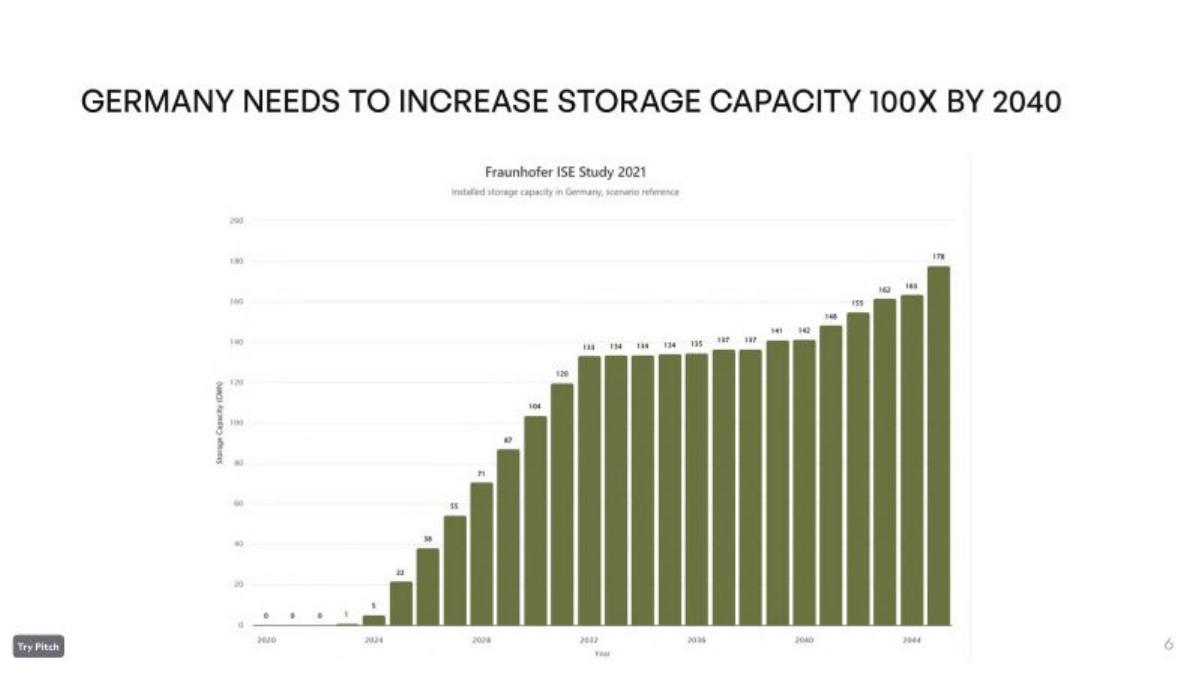
- The company identifies a 100x increase in storage capacity needed in Germany by 2040 (Slide 6).
- Terra One operates as a full-stack platform covering development, financing, and operations (Slide 8).
- The technology stack includes a GPT-based model for predicting power prices (Slide 10).
- The platform aggregates assets into a single virtual power plant to generate revenue via grid services and trading (Slide 7).
- The team boasts experience from high-profile organizations including OpenAI, Next Kraftwerke, and E.ON (Slide 12).
- Investors include PT1, neosfer, 468 Capital, and scout funds from a16z and Hedosophia (Slide 12).
- The deck lacks a specific slide detailing the financial 'ask' or the planned allocation of the $7.5M raised.
Terra One: Solving the Renewable Energy Paradox
Terra One’s pitch deck is a masterclass in identifying a massive, macro-economic bottleneck and positioning a company as the inevitable solution. The deck, used to raise a $7.5M Seed round in May 2024, focuses on the German energy market's transition to renewables. The core argument is simple: Germany is producing more green energy than it can handle, leading to waste and price volatility. Terra One proposes a full-stack battery storage platform to capture this value.
Slides 1-4: The Macro Problem
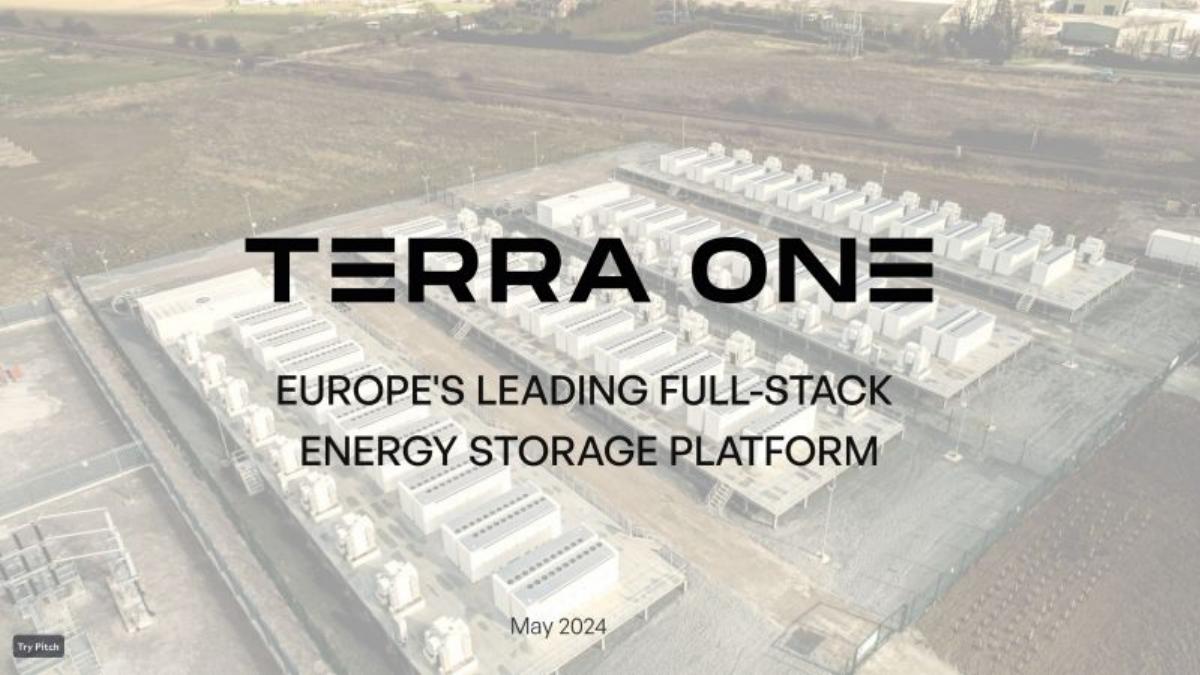
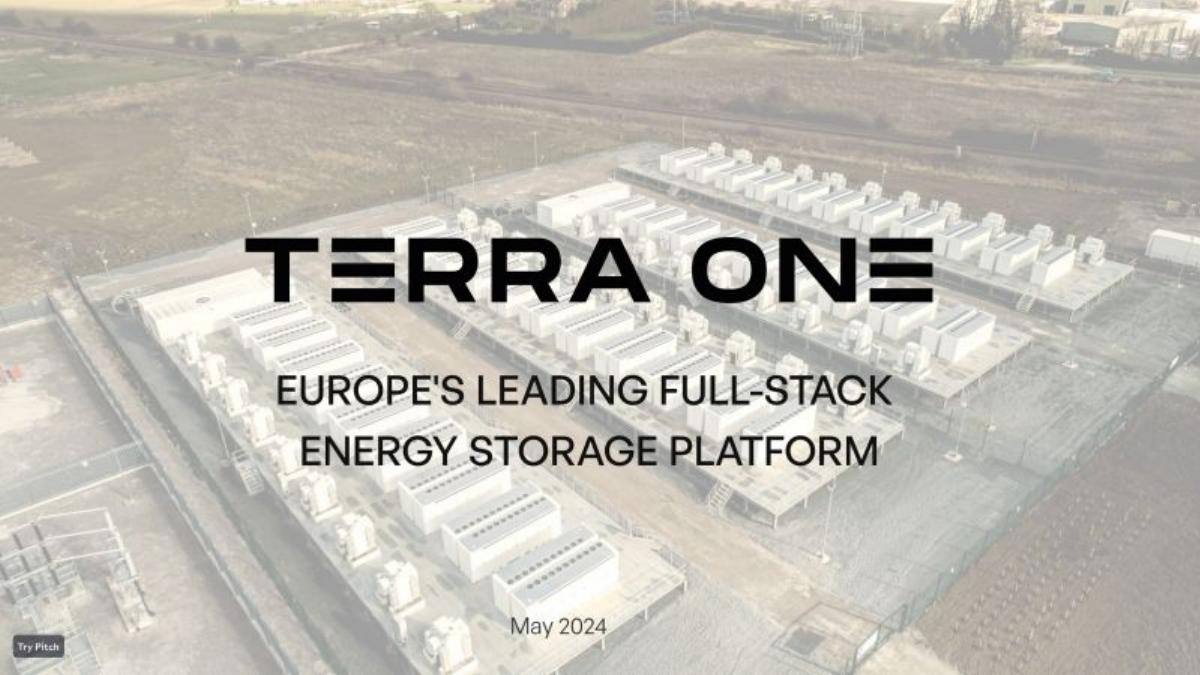
The deck opens with a high-impact cover slide (Slide 1) featuring an aerial view of a battery storage facility, immediately establishing the scale of the hardware involved. The title, "Europe's Leading Full-Stack Energy Storage Platform," sets an ambitious tone.
Slide 2 introduces the problem with a staggering statistic: "In Germany alone, 19 TWh of renewable energy generation was wasted in 2023 – enough power to supply 6 million households for a year." Citing Der Spiegel adds third-party credibility to the claim. This is a classic 'hair on fire' problem for the German government and grid operators.
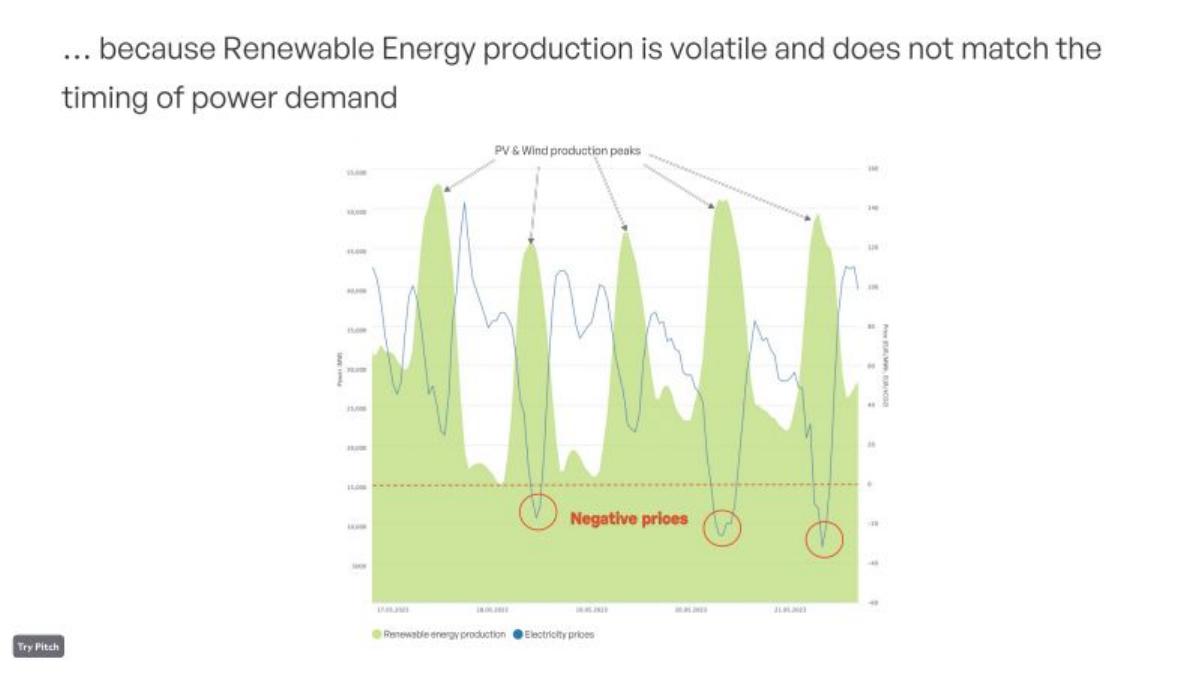
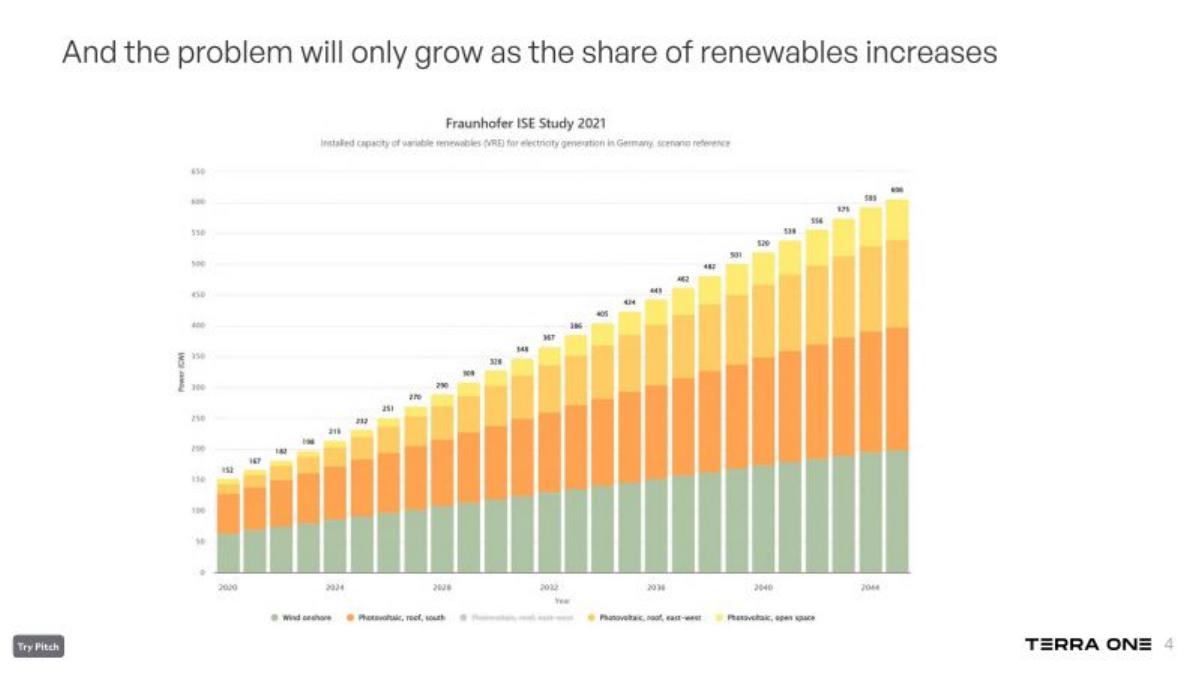
Slide 3 visualizes the volatility. A graph shows renewable energy production peaks (green) often occurring when electricity prices (blue line) dip into the negative. This clearly illustrates the economic opportunity: buy energy when prices are negative (or low) and sell when demand spikes. Slide 4 uses a Fraunhofer ISE study to show that this problem will only intensify as the installed capacity of variable renewables is projected to grow from roughly 152 GW in 2020 to over 600 GW by 2045.
Slides 5-6: The Solution and Market Need
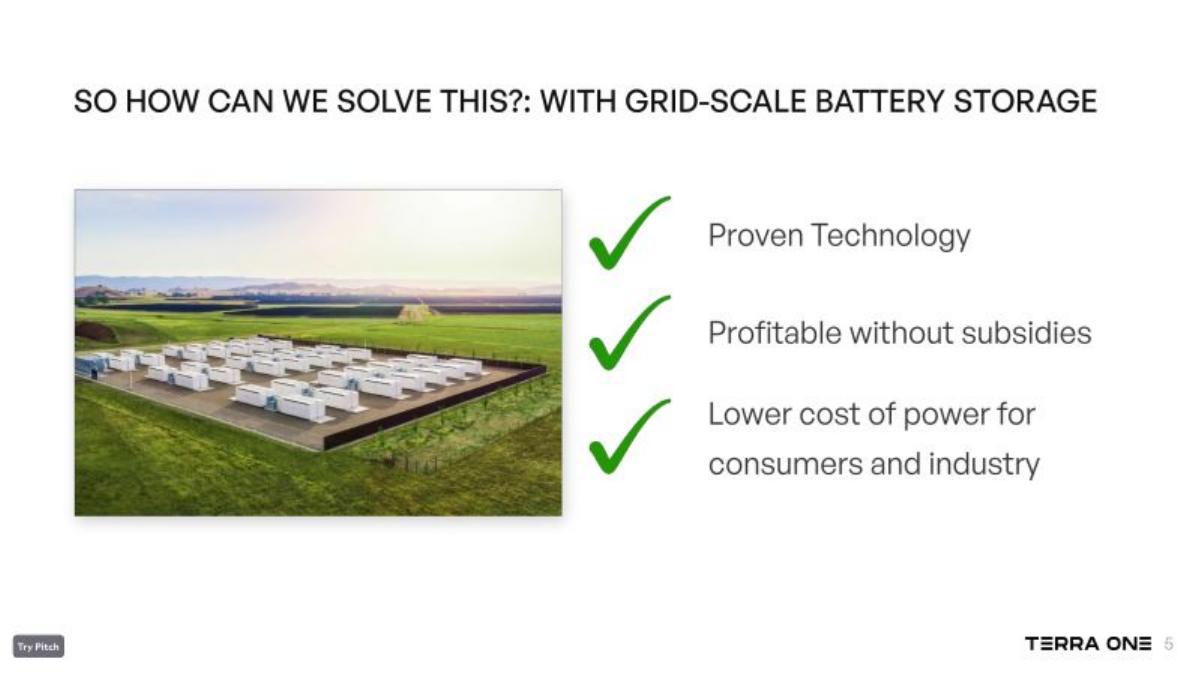
Slide 5 presents grid-scale battery storage as the solution, noting it is "Proven Technology," "Profitable without subsidies," and leads to "Lower cost of power for consumers and industry." This is a crucial slide for investors wary of 'clean tech 1.0' failures that relied heavily on government handouts.
Slide 6 doubles down on the market size, stating that "Germany needs to increase storage capacity 100x by 2040." The accompanying bar chart shows a steep climb from near-zero capacity in 2024 to 178 GWh by 2045. This frames Terra One not just as a good business, but as a necessary infrastructure player for a national energy transition.
Slides 7-8: The Full-Stack Business Model
Slide 7 introduces the Terra One platform. The company describes itself as a "Virtual Power Plant" that aggregates millions of batteries to generate revenue via "grid services" and "energy trading." The diagram shows Terra One sitting between grid operators/energy exchanges and various energy assets like industrial consumers and wind farms.
Slide 8 defines their "Full-Stack" approach. Many companies in this space only handle one piece of the puzzle (e.g., software or development). Terra One claims to do it all: 1. Develop (property acquisition), 2. Finance & Build , and 3. Operate & Trade . They argue that digitalizing this entire chain speeds up development and "dramatically increases the ROI" of battery energy storage systems (BESS).
Slides 9-11: The Technology Layer
Slides 9 through 11 focus on the software that powers the hardware. Slide 9 shows a dashboard of various projects (Warstein, Eisenach, Bad Düben, etc.) in different stages of construction. This provides tangible proof that the company is already executing on multiple sites.
Slide 10 is perhaps the most 'buzzy' slide in the deck, claiming a "GPT-based model predicts power prices." While the use of Large Language Models (LLMs) for time-series forecasting is a specific technical choice, it signals to investors that the company is leveraging cutting-edge AI. Slide 11 shows the output of these projections, claiming they are used to generate "best-in-class revenues." However, the deck does not provide specific figures to define what 'best-in-class' means in Euro terms.
Slide 12: Team and Investors
For a Seed stage company, the pedigree on Slide 12 is exceptional. The team includes Tony Schumacher (CEO) , Thomas Antonioli (CFO) , and Charles Gilmour (VP EPC) . The "Team Experience" section features logos from OpenAI, Next Kraftwerke, E.ON, Macquarie, RWE, and Statkraft . This mix of high-growth tech (OpenAI) and deep energy industry expertise (RWE, E.ON) is a significant de-risking factor.
The investor list is equally impressive for a $7.5M round, featuring PT1, neosfer, 468 Capital, a16z (scout fund), and Hedosophia (scout fund) . Having a16z and Hedosophia involved, even via scout funds, suggests the company has captured the attention of top-tier global firms.
What Works in This Deck
Clear Macro Narrative: The deck does an excellent job of moving from a massive problem (wasted energy) to a logical solution (storage) to a specific execution strategy (full-stack). · Tangible Progress: Slide 9 shows actual project locations and statuses, proving this isn't just a theoretical software play. · High-Quality Visuals: The use of aerial photography and clean, professional UI mockups gives the impression of a mature, well-organized operation. · Credibility by Association: The team and investor slide is the strongest part of the deck, leveraging recognizable logos to build immediate trust.
What is Missing
The Ask: Surprisingly, the deck does not have a slide stating how much they are raising or how they plan to use the capital. While we know from the listing it was $7.5M, a standard deck usually includes a 'Use of Funds' slide. · Unit Economics: There is no breakdown of the cost to build a single storage site versus the expected annual revenue. Investors in hardware-heavy businesses usually want to see the payback period for a single asset. · Competitive Landscape: The deck assumes Terra One is the only player or the clear leader. It does not mention other BESS developers or virtual power plant operators like Tesla (Autobidder) or Fluence. · Financial Projections: Beyond the claim of 'best-in-class revenues,' there are no forward-looking financial statements or targets.
Founder Takeaways
1. Lead with the 'Why Now': Terra One uses Slide 4 to show why their solution is more relevant today than it was five years ago. Founders should always explain why the market timing is perfect.
2. The Power of 'Full-Stack': By claiming the entire value chain, Terra One positions itself as a higher-margin, more defensible business than a pure-play software or hardware company. If you can realistically own the whole process, pitch the increased ROI that comes with integration.
3. Use Third-Party Data: Citing Der Spiegel and Fraunhofer ISE makes the problem feel objective and undeniable rather than just a founder's opinion.
4. AI as an Optimizer, Not Just a Buzzword: Terra One links their AI (GPT-based model) directly to their revenue generation (trading). This is more effective than just saying 'we use AI.'
Final Thoughts
Terra One’s deck is a highly professional, vision-led presentation that successfully navigated a $7.5M Seed round. It relies heavily on the strength of the market opportunity and the pedigree of the team. While it leaves out the 'nitty-gritty' of project finance and competition, it clearly succeeded in its primary goal: convincing top-tier investors that Terra One is the right team to build Germany's next-generation energy infrastructure.
Frequently asked questions
- What is Terra One's core business model?
- Terra One follows a B2B full-stack model in the energy storage sector. They develop, finance, and operate grid-scale battery networks. Their platform aggregates these physical assets into a 'virtual power plant,' allowing them to generate revenue through two primary channels: providing grid services to operators and engaging in intraday energy trading to capitalize on price volatility.
- How does Terra One use AI in its operations?
- The company utilizes a GPT-based model to predict power prices, as shown on slide 10. This AI-driven forecasting is integrated into their trading platform to optimize when energy is stored and when it is sold back to the grid. This technological layer is intended to maximize the return on investment for their battery energy storage systems (BESS).
- What market problem is the company solving?
- Terra One addresses the mismatch between volatile renewable energy production (wind and solar) and actual power demand. Slide 3 illustrates that production peaks often coincide with negative electricity prices, leading to massive energy waste. In 2023, Germany wasted 19 TWh of renewable energy, a problem expected to grow as the share of renewables increases.
- Who are the key investors in Terra One's Seed round?
- The $7.5M Seed round was co-led by PT1 and neosfer. Other participants include 468 Capital, BIT Capital, and the scout funds of major Silicon Valley and European firms such as Andreessen Horowitz (a16z) and Hedosophia. The round also included various business angels, signaling strong institutional and individual confidence in the team and model.
- What is missing from the Terra One pitch deck?
- While the deck is strong on vision and team, it omits several standard fundraising components. There is no slide detailing the specific 'ask' or how the $7.5M will be spent. Additionally, the deck lacks a detailed competitor analysis, specific unit economics for a single battery site, and long-term financial projections beyond high-level revenue claims.