RoboForce successfully raised $10M in a 2025 Seed round by positioning itself as the solution to labor shortages in high-stakes, harsh environments. The deck is heavily weighted toward team pedigree and market opportunity, specifically targeting the solar industry as a $1T 'beachhead.' By highlighting a technical breakthrough in '1mm accuracy' and a 66% reduction in labor costs, the company makes a compelling case for replacing human labor in dangerous or remote settings. However, the deck is notably light on financial projections, competitive analysis, and a specific use-of-funds breakdown,…
Key takeaways
- The company identifies Solar Labor as its primary beachhead market, valued at a $1T opportunity (Slide 5).
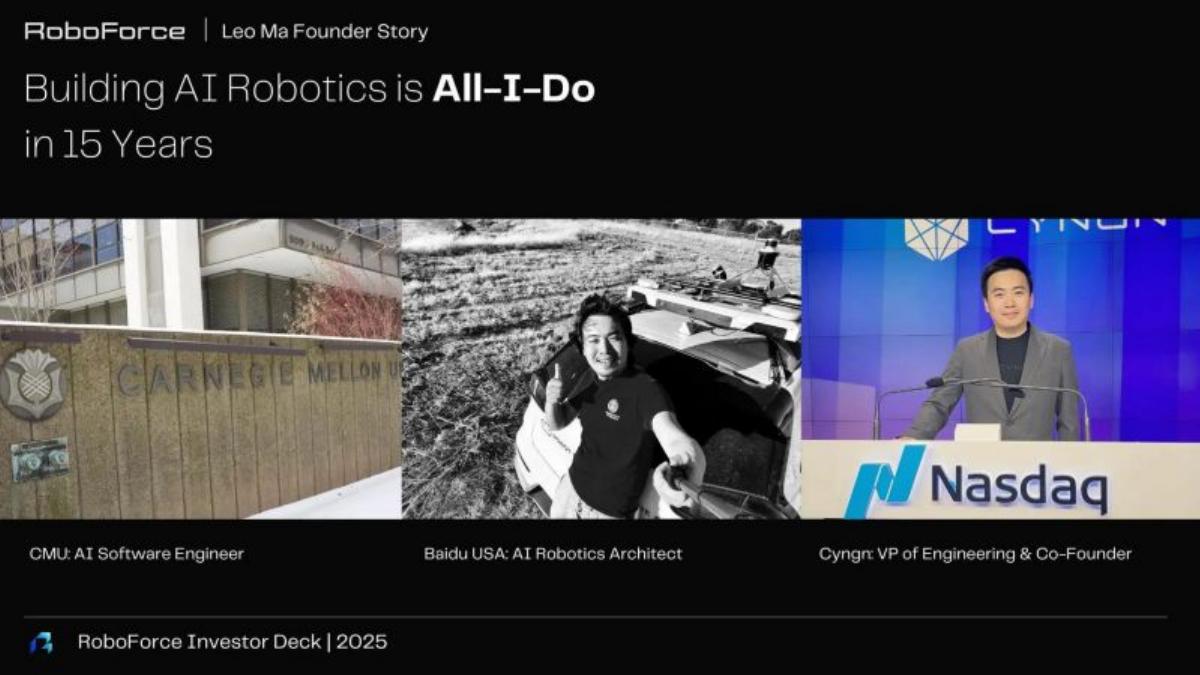
- Founder Leo Ma highlights a 15-year background in AI robotics, including a co-founder role at Cyngn (Slide 2).
- RoboForce claims a significant technical differentiator: an AI Expert Model capable of 1mm accuracy (Slide 9).
- The value proposition centers on a 66% reduction in labor costs, dropping from $300k/year for humans to $100k/year for RoboForce (Slide 11).
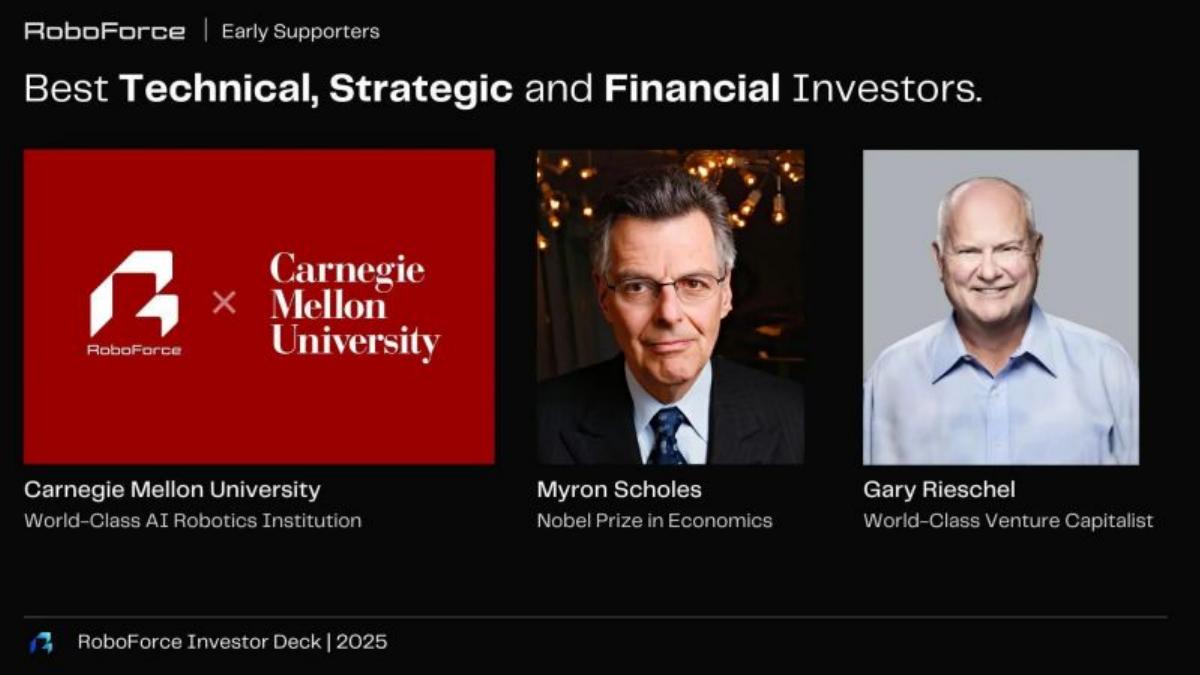
- The startup has secured high-profile backing from Nobel Prize winner Myron Scholes and venture capitalist Gary Rieschel (Slide 4).
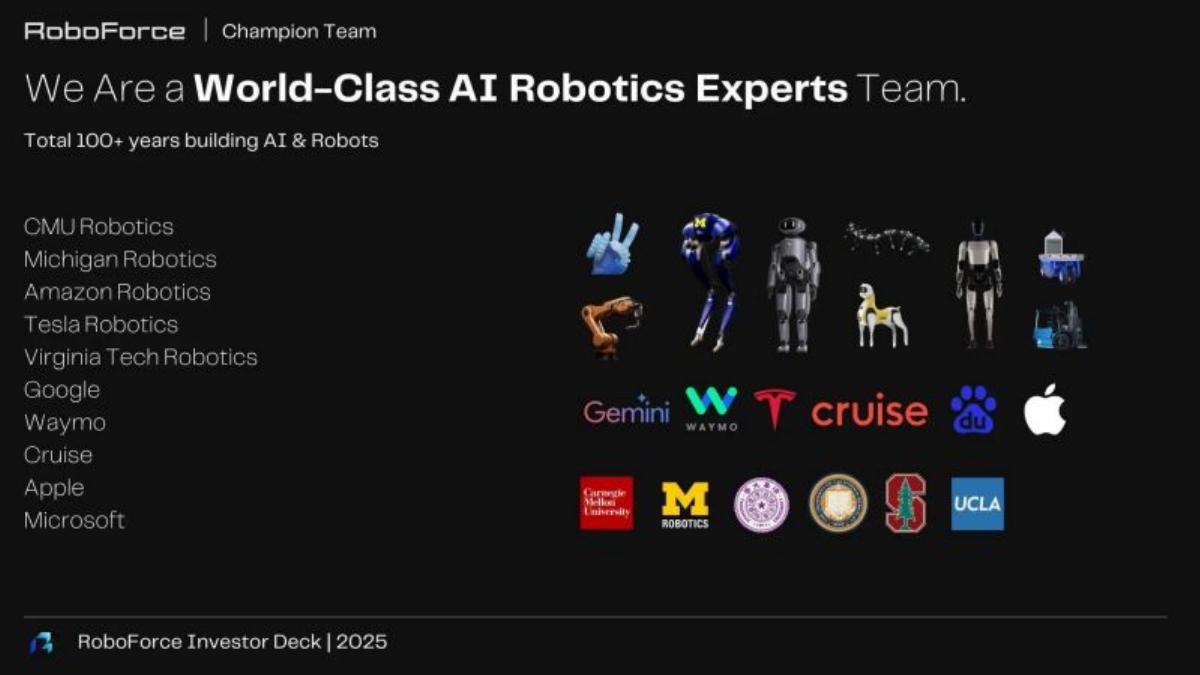
- The team boasts over 100 years of collective experience from institutions like CMU, Tesla, and Google (Slide 3).
- Operational efficiency is a key selling point, with recruitment and training time reduced by 90% compared to human workers (Slide 11).
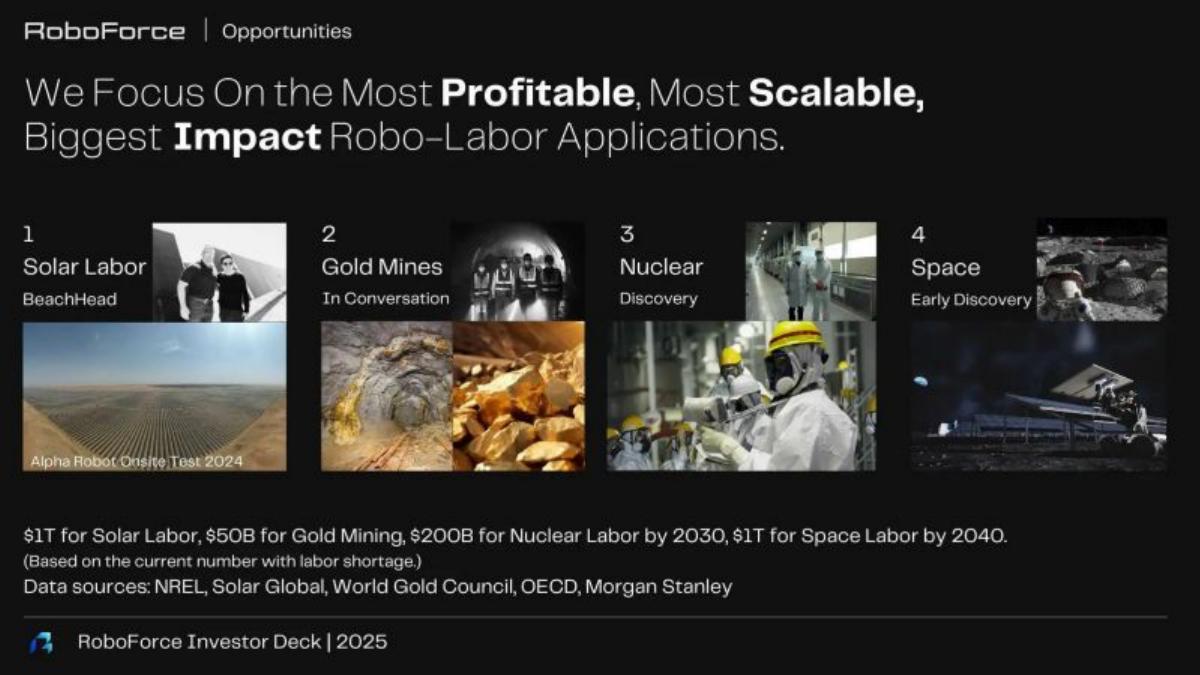
- Future expansion targets include Gold Mines, Nuclear Labor, and Space Labor, with the latter estimated at $1T by 2040 (Slide 5).
Executive Summary: The Rise of Robo-Labor
RoboForce enters the robotics market with a bold claim: becoming the "World’s Most Advanced Robo-Labor Provider." In a 12-slide deck used for their 2025 Seed round, the company successfully raised $10M. The narrative is built on three pillars: extreme technical pedigree, a massive addressable market in harsh environments, and a clear economic advantage over human labor. While the deck lacks traditional financial modeling, it compensates with high-signal social proof and a focused beachhead strategy in the solar energy sector.
Slide 1: Title and Vision
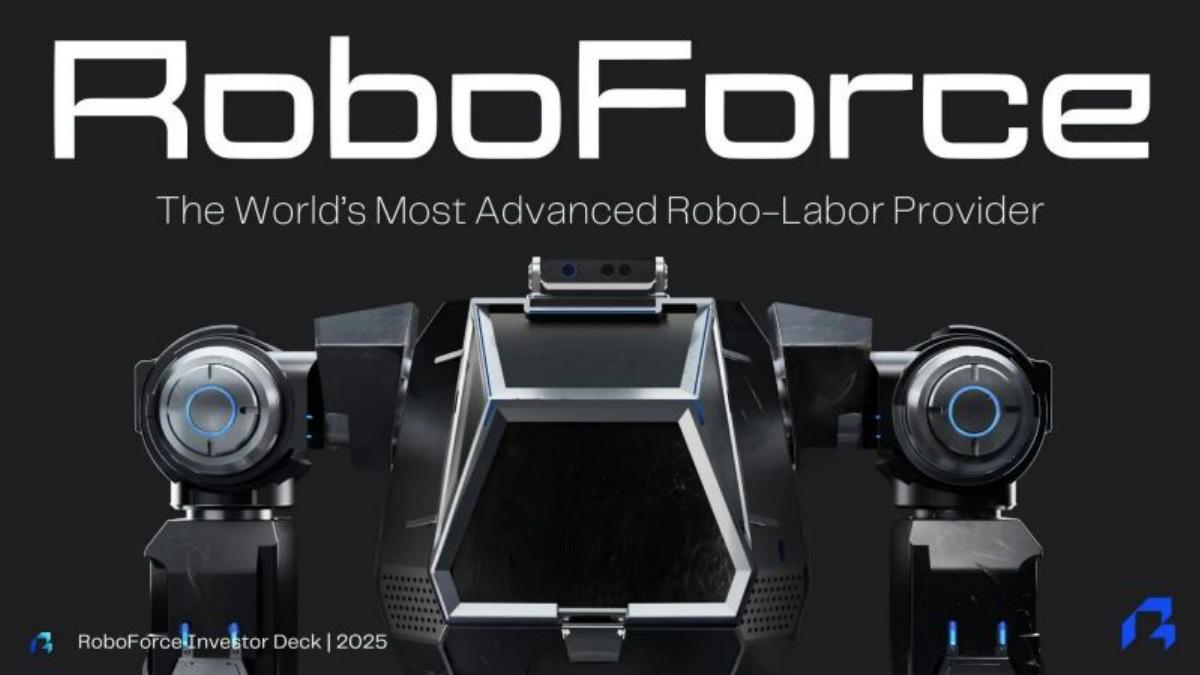
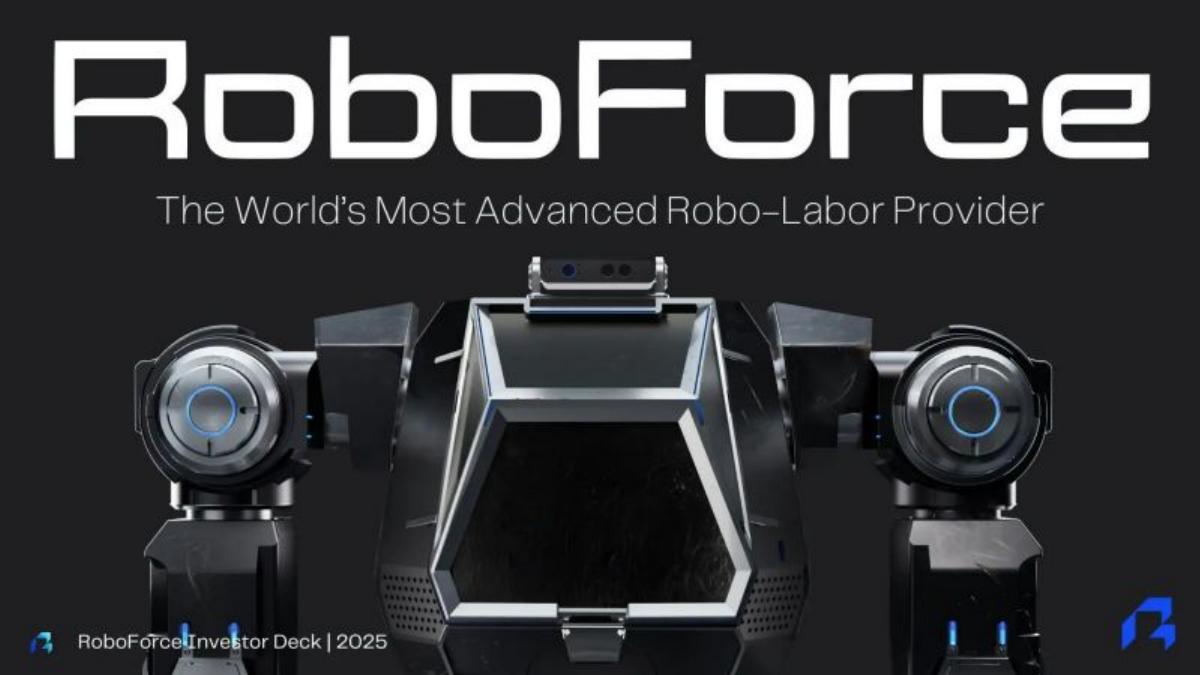
The cover slide features a high-fidelity render of a rugged, industrial robot. The branding is clean, and the subtitle, "The World’s Most Advanced Robo-Labor Provider," immediately establishes the company's category. The 2025 date indicates this is a current-cycle pitch, reflecting the latest trends in AI-integrated hardware.
Slide 2: The Founder Story
Slide 2 focuses exclusively on Leo Ma . It uses a "Founder Story" format to establish deep domain expertise. Ma highlights 15 years in AI robotics, citing roles as an AI Software Engineer at CMU, an AI Robotics Architect at Baidu USA, and a Co-Founder/VP of Engineering at Cyngn. The inclusion of a photo at Nasdaq provides a subtle but powerful cue of previous exit or scale experience.
Slide 3: The "Champion Team"
This slide is a "logo wall" of talent. It claims a total of 100+ years of experience building AI and robots. The list of former employers and institutions is exhaustive: CMU, Michigan, Amazon, Tesla, Google, Waymo, Cruise, Apple, and Microsoft. By showing the diverse types of robots these team members have worked on (humanoids, quadrupeds, industrial arms), RoboForce suggests they have the collective knowledge to solve any hardware challenge.
Slide 4: Early Supporters and Investors
RoboForce leverages high-profile names to de-risk the investment. They list Carnegie Mellon University as a strategic institution. More notably, they feature Myron Scholes (Nobel Prize in Economics) and Gary Rieschel (Venture Capitalist). This slide serves to tell the investor that the "smart money" has already done the due diligence on both the economics and the technology.
Slide 5: Market Opportunities
This slide defines the company's roadmap. It identifies four key verticals:
Solar Labor (Beachhead): $1T market. · Gold Mines (In Conversation): $50B market. · Nuclear (Discovery): $200B market by 2030. · Space (Early Discovery): $1T market by 2040.
The slide notes that an "Alpha Robot Onsite Test" occurred in 2024 for the solar sector, providing a hint of current traction.
Slide 6 & 7: The Solar Opportunity Deep Dive
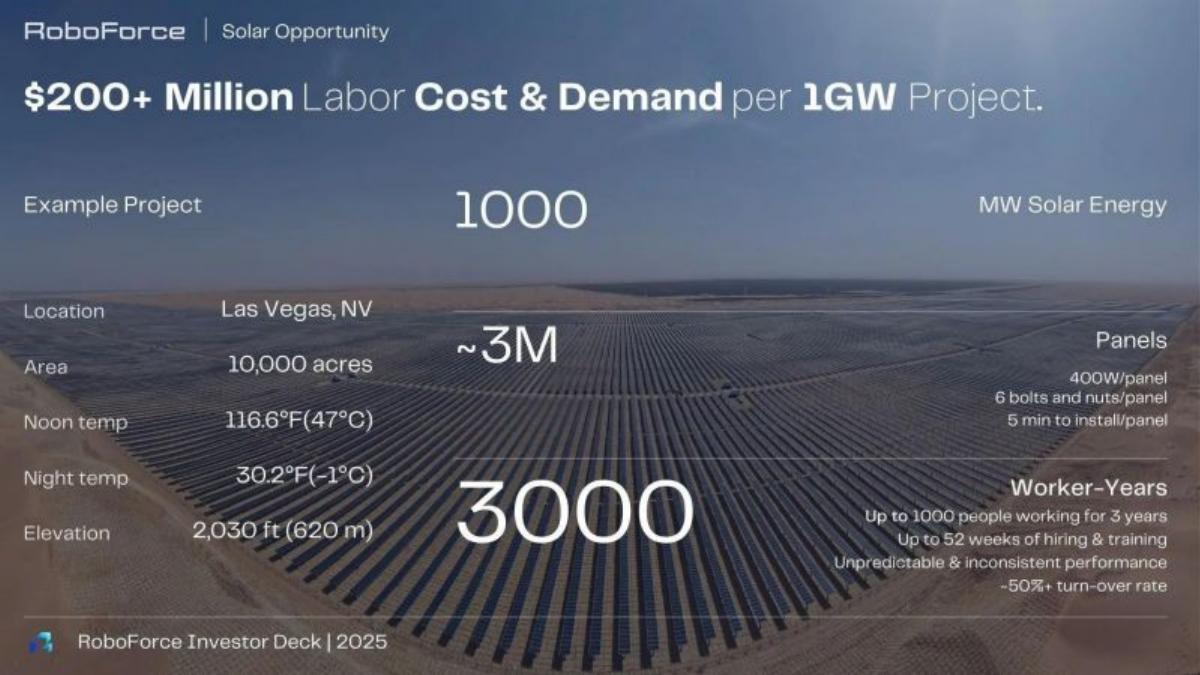
Slide 6 provides the unit economics of a typical 1GW solar project in Las Vegas, NV. It cites $200+ Million in labor costs per project, requiring 3,000 worker-years. The slide highlights the pain points of human labor: 52 weeks of hiring/training and a ~50%+ turnover rate . Slide 7 uses a visual of a solar farm in a snowy, mountainous environment to reinforce the "Harsh Environments" theme, suggesting that human labor is not just expensive, but often impractical.
Slide 8 & 9: Technical Capabilities and Differentiation
Slide 8 claims the system has "Cracked the Biggest Technical Barrier." It lists five core competencies: Mobility (3m/s peak), Manipulation (1mm accuracy), Learning (Self-Evolving Spatial AI), Communication (3 layers), and Safety Compliance. Slide 9 doubles down on the 1mm accuracy , calling it the "First and Only AI Expert Model" capable of complex tasks like twisting and connecting components. This is the "moat" of the pitch.
Slide 10: Product in Action
This slide shows the robot performing the specific tasks mentioned previously: picking, placing, and connecting. It emphasizes that the system is powered by the "RoboForce Brain," positioning the software as the primary intelligence behind the hardware's physical capabilities.
Slide 11: The Customer Value Proposition
This is the most critical slide for the business case. It breaks down the value into three metrics:
Cost: 66% reduction. Human labor is cited at $300k/year vs. RoboForce at $100k/year. · Time: 90% reduction in recruitment and training (4 weeks vs. 52 weeks). · Performance: Moving from "Uncertainty" to "Consistent & High-Performance."
The $100k/year price point for the robot suggests a RaaS (Robot-as-a-Service) or high-margin lease model, though the specific business model is not explicitly named.
Slide 12: The Invitation
The final slide is a call to action, inviting investors to visit for a "Live Demo & Tech" session. It lists the topics available for deeper discussion, including the Product, Roadmap, and Financials. Interestingly, these are the exact sections missing from the main deck, suggesting this deck is intended as a "teaser" to secure a meeting rather than a full disclosure document.
What RoboForce Does Well
The deck is a masterclass in pedigree-based fundraising . By the fourth slide, the investor has seen a Nasdaq-experienced founder, a team from every major robotics lab in the US, and a Nobel Prize-winning investor. This creates an aura of inevitability. Furthermore, the choice of the solar industry as a beachhead is brilliant; it is a massive, well-funded sector with a clear, quantifiable labor problem in inhospitable locations. The 66% cost reduction is a "no-brainer" ROI for project developers.
What is Missing from the Deck
Despite raising $10M, the deck leaves several questions unanswered: 1. Competitive Landscape: There is no mention of other robotics companies (like Terabase or Built Robotics) that are also targeting the solar and construction sectors. 2. Financial Projections: There are no charts showing projected revenue, burn rate, or the path to profitability. 3. The Ask: The deck does not state how much they are raising or how the funds will be allocated. (We know from the catalogue it was $10M, but it isn't on the slides). 4. Business Model: It is unclear if RoboForce sells the robots, leases them, or operates as a full-service labor contractor.
Founder Takeaways: What to Copy
Use specific site data: Slide 6 is excellent because it doesn't just say "solar is big." It gives the exact coordinates (Las Vegas), acreage (10,000), and temperature swings of a real-world project. This groundedness makes the solution feel real. Quantify the human pain: Don't just say labor is hard to find; cite the "52 weeks of hiring" and "50% turnover." Lead with your moat: If you have a technical breakthrough like "1mm accuracy," make it a standalone slide. In hardware, precision is often the difference between a toy and a tool.
Frequently asked questions
- What is RoboForce's primary market focus?
- RoboForce is targeting 'Solar Labor' as its initial beachhead market. According to slide 5, they estimate this market at $1T. They are also exploring opportunities in gold mining, nuclear labor, and space, positioning themselves as a provider for industries where labor is scarce, expensive, or dangerous.
- How does RoboForce compare to human labor in terms of cost?
- On slide 11, the company provides a direct cost comparison. They state that human labor costs $300,000 per year (calculated as 3 humans at $100k each), whereas the RoboForce system costs $100,000 per year, representing a 66% reduction in annual labor expenses.
- Who are the key investors in RoboForce?
- The deck and catalogue listing identify several high-profile supporters. These include Myron Scholes (Nobel Prize in Economics), Gary Rieschel (described as a world-class venture capitalist), Leo Ma, and Calvin Zhou. Carnegie Mellon University is also listed as a strategic institutional supporter.
- What is the 'biggest technical barrier' RoboForce claims to have solved?
- Slide 8 and 9 detail their technical capabilities. The company claims to have developed the 'first and only AI Expert Model with 1mm accuracy.' This allows their robots to perform complex manipulation tasks like picking, placing, pressing, twisting, and connecting in all terrains.
- What is missing from the RoboForce pitch deck?
- The 12-slide deck omits several standard fundraising elements. There is no slide dedicated to a competitive landscape, no detailed financial roadmap or projections, and no specific 'Ask' slide detailing how the $10M will be spent. It also lacks a formal business model slide explaining if they sell or lease the hardware.