Ajinomatrix is tackling the subjective and expensive nature of sensory evaluation in the food industry. By utilizing AI, 'eNoses,' and 'eMouths,' the company proposes a digital standard for taste and smell, moving away from human panels that cost between 5k € and 25k € per unit. Their product is positioned as an open-source B2B software available via GitLab, aiming to create a universal JSON-based sensory file format. While the deck outlines a clear path from pilot to 50+ clients within 18 months and highlights strong academic partnerships, it notably lacks a financial funding request, instea…
Key takeaways
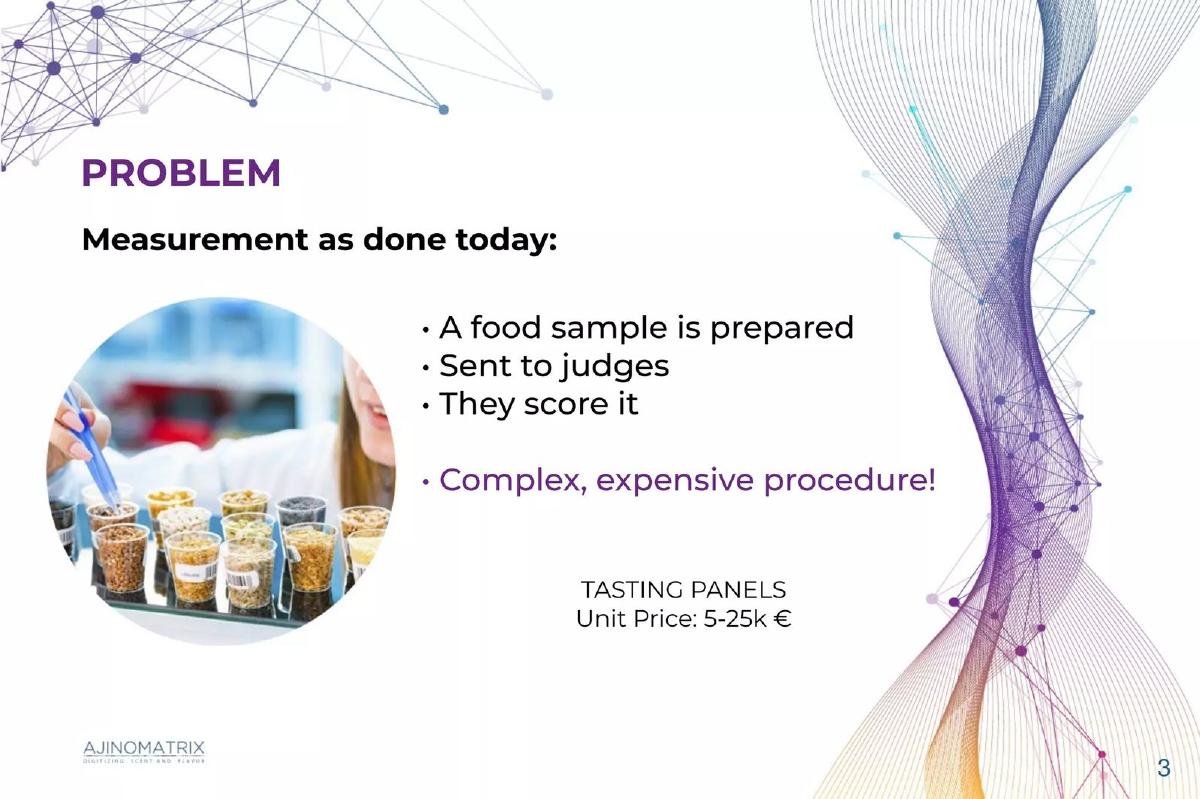
- The current industry standard for food measurement relies on human tasting panels costing between 5k € and 25k € per unit (Slide 3).
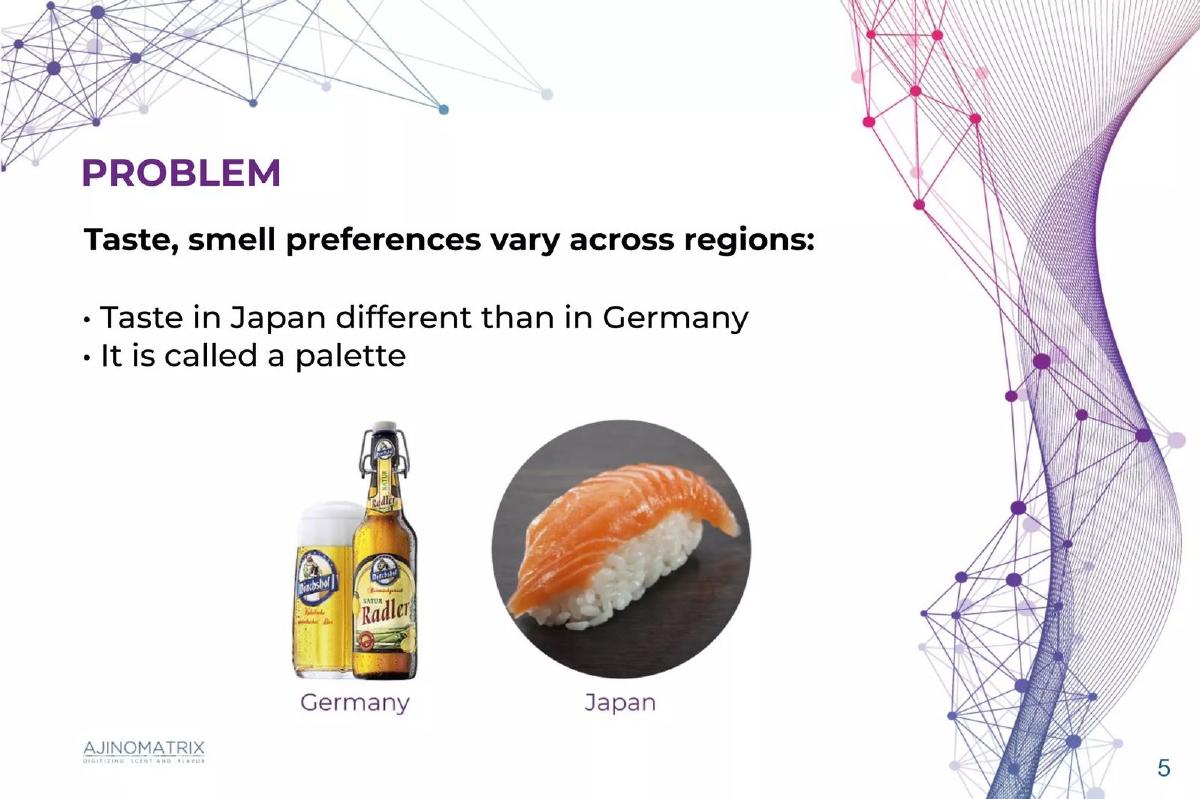
- Ajinomatrix identifies regional taste variations, such as differences between Japan and Germany, as a primary problem for global food consistency (Slide 5).
- The solution involves a digital pipeline converting data from human judges, eNoses, and eMouths into a standardized JSON file using neural networks (Slide 7).
- The product is delivered as open-source B2B software that can be installed directly from GitLab (Slide 9).
- The Total Addressable Market is estimated at $1.7T, with a specific target of 250k installations among food suppliers with >$40M turnover (Slide 11).
- Go-to-market unit economics cite a Customer Acquisition Cost (CAC) of 1500€ and a Lifetime Value (LTV) of 55k€ (Slide 13).
- The company has established R&D partnerships with four universities, including The Hebrew University of Jerusalem and ULB (Slide 15).
- The final 'Ask' slide does not request capital, but rather a Chief Marketing Officer to lead product development and sensory standards (Slide 17).
Ajinomatrix Pitch Deck Analysis
Ajinomatrix presents a technical solution to a highly subjective problem: the digitization of taste and smell. The deck, produced for the Founder Institute, follows a logical progression from the inefficiencies of human-centric testing to a scalable, AI-driven software model. It positions itself at the intersection of food science and data engineering.
Slide 1: Title and Vision
The cover slide introduces the company name, Ajinomatrix, and the tagline "Digitizing Scent and Flavor." It immediately defines the value proposition: measuring taste and smell digitally through open-source software using AI. The contact information for Francois Wayenberg is provided, establishing the primary point of contact for the venture.
Slide 3: The Problem - Cost and Complexity
This slide identifies the friction in the current food industry. The process of preparing samples, sending them to human judges, and waiting for scores is labeled a "Complex, expensive procedure!" The key metric provided is the unit price for tasting panels, which ranges from 5k € to 25k €. This sets a clear financial benchmark that the digital solution intends to disrupt.
Slide 5: The Problem - Regional Subjectivity
The deck highlights that taste and smell preferences are not universal. Using the examples of Germany (beer) and Japan (sushi), it notes that preferences vary across regions, referred to here as a "palette." This slide establishes the need for a system that can account for regional differences in sensory data, which is difficult to achieve consistently with local human panels.
Slide 7: The Solution - The Digital Pipeline
The solution is visualized as a technical workflow. It shows data flowing from three sources—Human Judges, eNose, and eMouth—into an interface. This data is then processed through a Machine & Deep Learning Neural Network. The output is twofold: an AI model and a standardized JSON file. This slide is critical as it explains how the company intends to turn subjective biological signals into portable, digital data.
Slide 9: The Product - Open Source B2B
Ajinomatrix defines its product as an "open source B2B software." It emphasizes the use of JSON as an open-source file standard and notes that the software can be installed from GitLab. This approach suggests a strategy focused on rapid adoption and standardization within the developer and food science communities rather than a closed, proprietary black box.
Slide 11: Market Opportunity
The market slide provides a macro view of the industry. It cites a $1.7T global food industry size with a growth rate of >5%. The Total Addressable Market (TAM) is further refined to 250k installations, specifically targeting food scientists at suppliers with a turnover of at least $40 million. This shows a focused B2B approach rather than a broad consumer play.
Slide 13: Go To Market and Unit Economics
The roadmap is defined by the "1 - 10 - 50" rule over 18 months. The stages include a Pilot PoC, an MVP with 10 clients, and finally selling to 50-60 clients. Interestingly, it mentions using "Forums as e-Market" for taste and smells. The unit economics are clearly stated: a Customer Acquisition Cost (CAC) of 1500€, a Lifetime Value (LTV) of 55k€, and a Unit Price of 10k€.
Slide 15: Partnerships
To establish credibility in a scientific field, Ajinomatrix lists its academic cooperations. Partners include HTW Berlin, The Hebrew University of Jerusalem, UMons, and ULB. The focus of these partnerships is twofold: developing a sensory standard and conducting R&D in AI and sensory science. This suggests the company is deeply embedded in the academic research necessary to validate their digital sensors.
Slide 17: The Ask
The final slide is unconventional for an investor deck. Instead of asking for a specific dollar amount, the company states, "We look for a CMO." The responsibilities for this role include product development with universities and further developing the sensory standard. This indicates that at the time of this presentation, the founder prioritized leadership and marketing strategy over immediate capital injection.
What Ajinomatrix Does Well
Clear Economic Contrast: By stating the 5k-25k € cost of human panels on Slide 3 and contrasting it with a 10k € unit price on Slide 13, the deck makes a strong case for ROI. · Standardization Focus: The emphasis on creating a "JSON file standard" (Slide 9) is a smart play for a B2B software company. It suggests they want to be the infrastructure layer for sensory data, not just a tool. · Academic Validation: Listing four specific universities on Slide 15 provides the necessary scientific weight to a claim as bold as "digitizing smell."
What is Missing from the Deck
The Team Slide: While a contact email is on the first slide, there is no dedicated team slide detailing the backgrounds of the founders or the technical experts building the neural networks. · Financial Ask: There is no mention of how much money the company is raising, the valuation, or the specific milestones that a capital infusion would accelerate. · Competitive Landscape: The deck does not mention other players in the electronic nose or digital flavor space, leaving the investor to wonder how Ajinomatrix differentiates itself from existing hardware-centric competitors. · Hardware Specifics: The deck mentions 'eNose' and 'eMouth' but does not clarify if Ajinomatrix builds this hardware, partners with a manufacturer, or if the software is hardware-agnostic.
Founder Takeaways
Quantify the 'Old Way': If you are replacing a manual process, give it a price tag. Ajinomatrix's use of the "5-25k €" figure for tasting panels is the most effective part of their problem statement. · Define the Output: Don't just say you use AI; show what the AI produces. The visual of the "JSON FILE" on Slide 7 makes a complex technical process feel tangible and useful. · Use a Phased Roadmap: The "1-10-50" model on Slide 13 is a great way to show a realistic, staged approach to scaling that feels achievable to an observer.
Frequently asked questions
- What is the primary technology behind Ajinomatrix?
- Ajinomatrix utilizes a combination of hardware sensors, referred to on Slide 7 as 'eNose' and 'eMouth,' and a software layer consisting of Machine and Deep Learning Neural Networks. This system processes sensory data into a standardized JSON file format, intended to create a digital twin of human taste and smell perceptions.
- How does the company plan to make money?
- While the software is described as 'open source B2B' on Slide 9, the Go-to-Market slide (Slide 13) lists a 'Unit Price' of 10k€. This suggests a commercial model likely based on implementation, support, or specialized hardware integration, supported by a projected Lifetime Value (LTV) of 55k€ per unit.
- Who are the target customers for this digital sensory technology?
- According to Slide 11, the company is targeting food scientists at large-scale food supply companies. Specifically, they are looking at suppliers with a turnover of at least $40 million, estimating a total of 250,000 potential installations globally.
- What is the timeline for their business expansion?
- Slide 13 outlines a three-stage '1 - 10 - 50' plan spanning 18 months. This starts with a single Pilot Proof of Concept (PoC), moves to a Minimum Viable Product (MVP) with 10 clients, and concludes with scaling to 50-60 clients and establishing forums as an e-Market for sensory data.
- Is Ajinomatrix currently raising capital?
- Based on Slide 17, the deck is not being used for a traditional capital raise. The 'Ask' is specifically for a Chief Marketing Officer (CMO). There is no mention of a target investment amount, valuation, or use of funds for operational scaling beyond talent acquisition.