ALAF Corp’s pitch deck outlines a vertically integrated cannabis ecosystem, but its primary value proposition is industrial real estate and infrastructure. By acquiring and renovating large commercial properties into 'PRO-16 PODS'—secure, 3,000-5,000 sq. ft. cultivation units—ALAF aims to solve the scarcity of compliant grow space in California. The deck is notable for its highly specific investment offer: $5,000 blocks of preferred stock in individual LLCs with a promised 100% return over a 15-month term. While the deck provides extensive detail on facility specs and site plans, it lacks tra…
Key takeaways
- The company operates six existing verticals including delivery, edibles, and CBD skincare to support the core real estate business (Slide 2).
- California's medical marijuana market is cited as a $5,000,000,000 cash business with projections to quadruple following anticipated 2016 legalization (Slide 3).
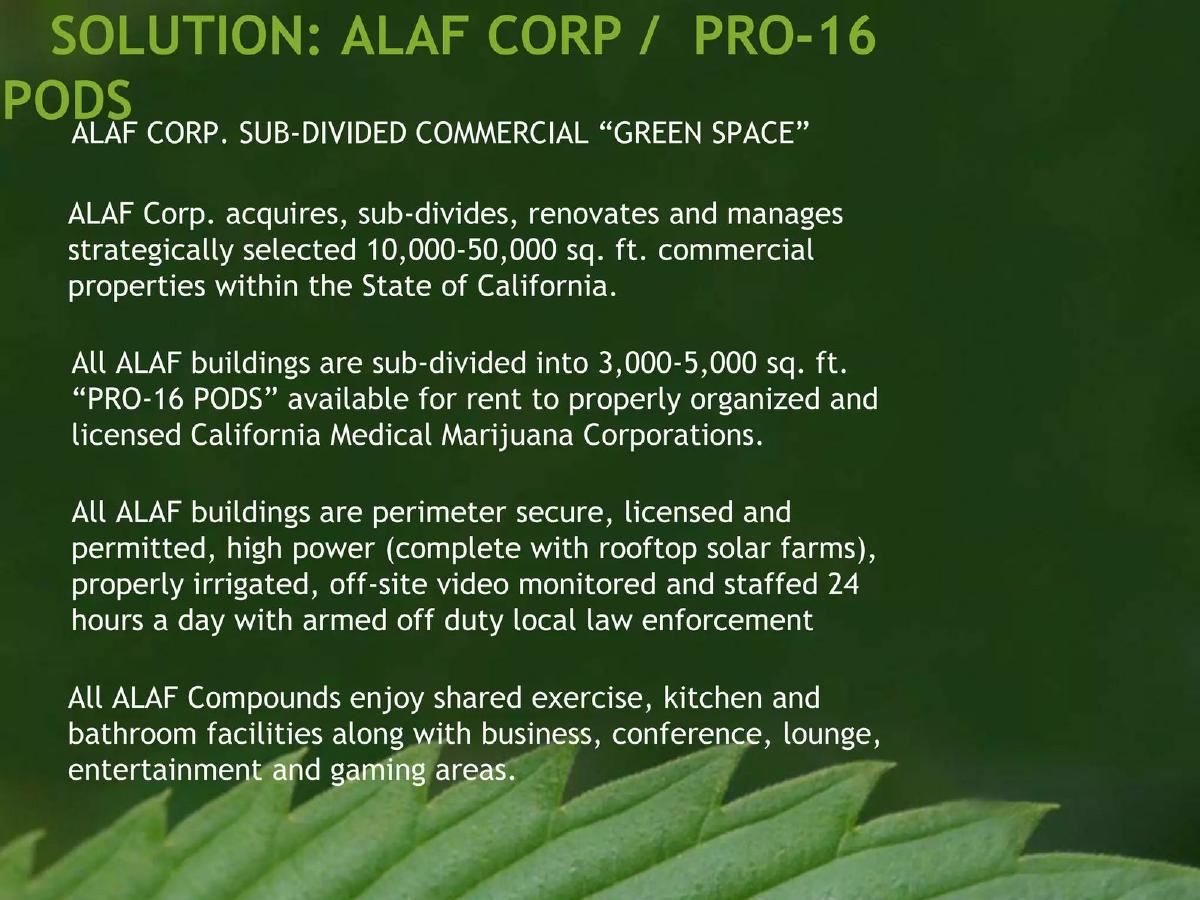
- The core product is the PRO-16 POD, a sub-divided 3,000-5,000 sq. ft. commercial space equipped with solar power and armed security (Slide 4).
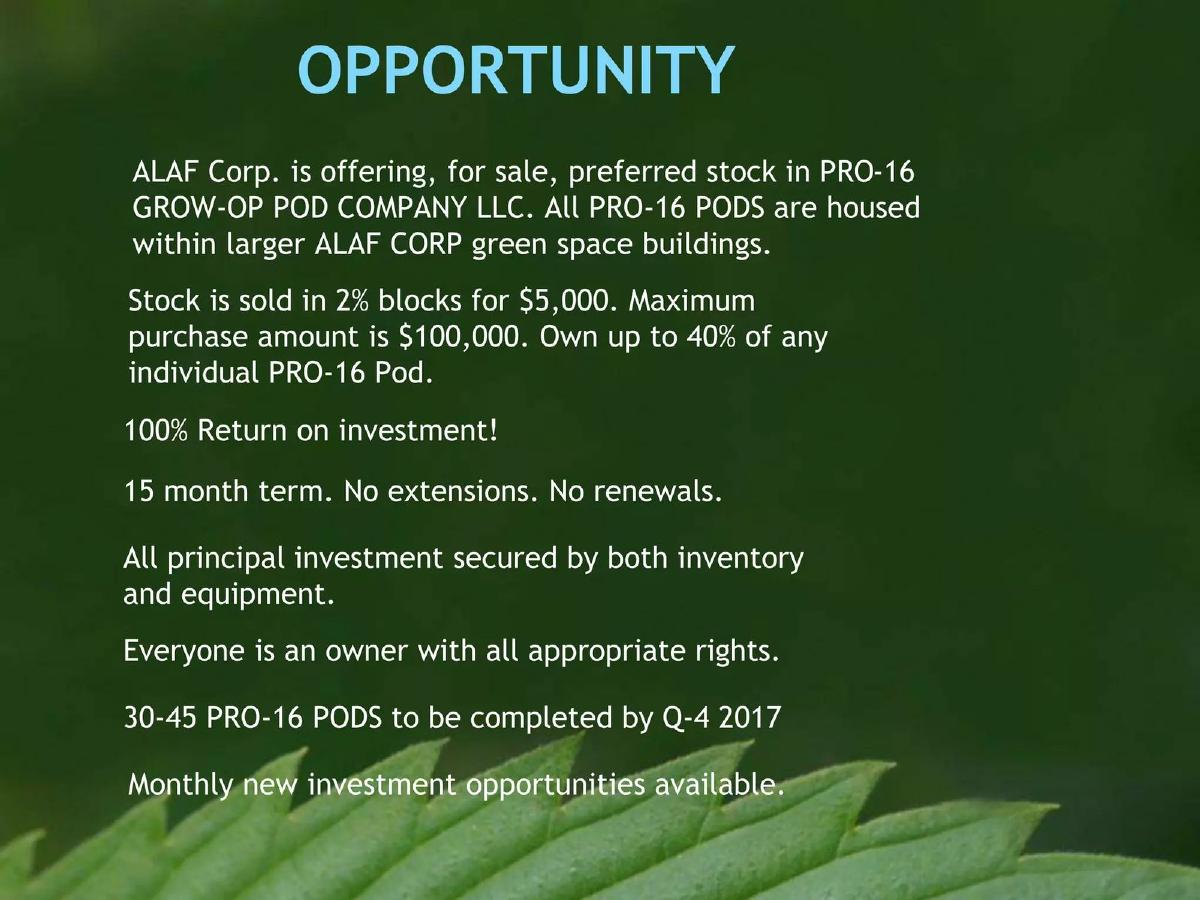
- Investment is structured as preferred stock in individual LLCs, sold in $5,000 blocks for a 2% stake (Slide 6).
- The deck explicitly promises a 100% return on investment within a 15-month term with no extensions (Slide 6).
- ALAF Corp retains a 50% operations stake in the equity allocation example, while a Pod Manager holds 10% (Slide 7).
- The company markets a specific facility in Desert Hot Springs, claiming it as the only city in California issuing cultivation permits at the time (Slide 9).
- Future developments include a massive 153.43-acre site entitled for four buildings totaling 2,645,617 sq. ft. (Slide 14).
Executive Summary and Corporate Structure
Slide 1: Title Slide
The deck opens with the ALAF Corp logo superimposed over a cannabis leaf. There is no tagline or mission statement on the cover slide.
Slide 2: Who is ALAF CORP?
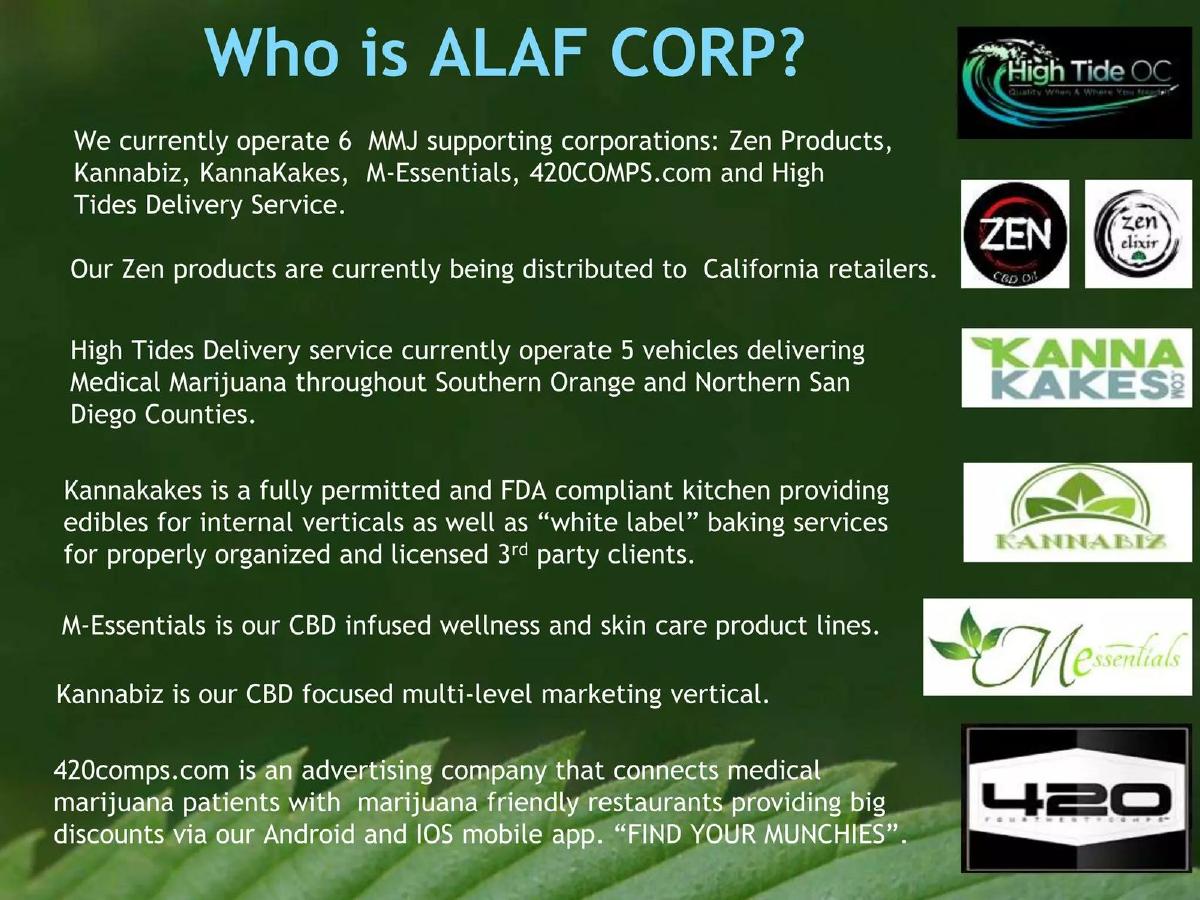
This slide establishes the company as a multi-vertical operator. They list six "MMJ supporting corporations": Zen Products, Kannabiz, KannaKakes, M-Essentials, 420COMPS.com, and High Tides Delivery Service. Specific operational details include Zen products being distributed to California retailers and High Tides operating five vehicles in Southern Orange and Northern San Diego Counties. KannaKakes is described as an FDA-compliant kitchen for internal and white-label use. M-Essentials focuses on CBD skincare, while Kannabiz is a multi-level marketing vertical. 420comps.com is presented as an advertising app connecting patients with restaurants.
Market Opportunity and Problem Statement
Slide 3: Problem
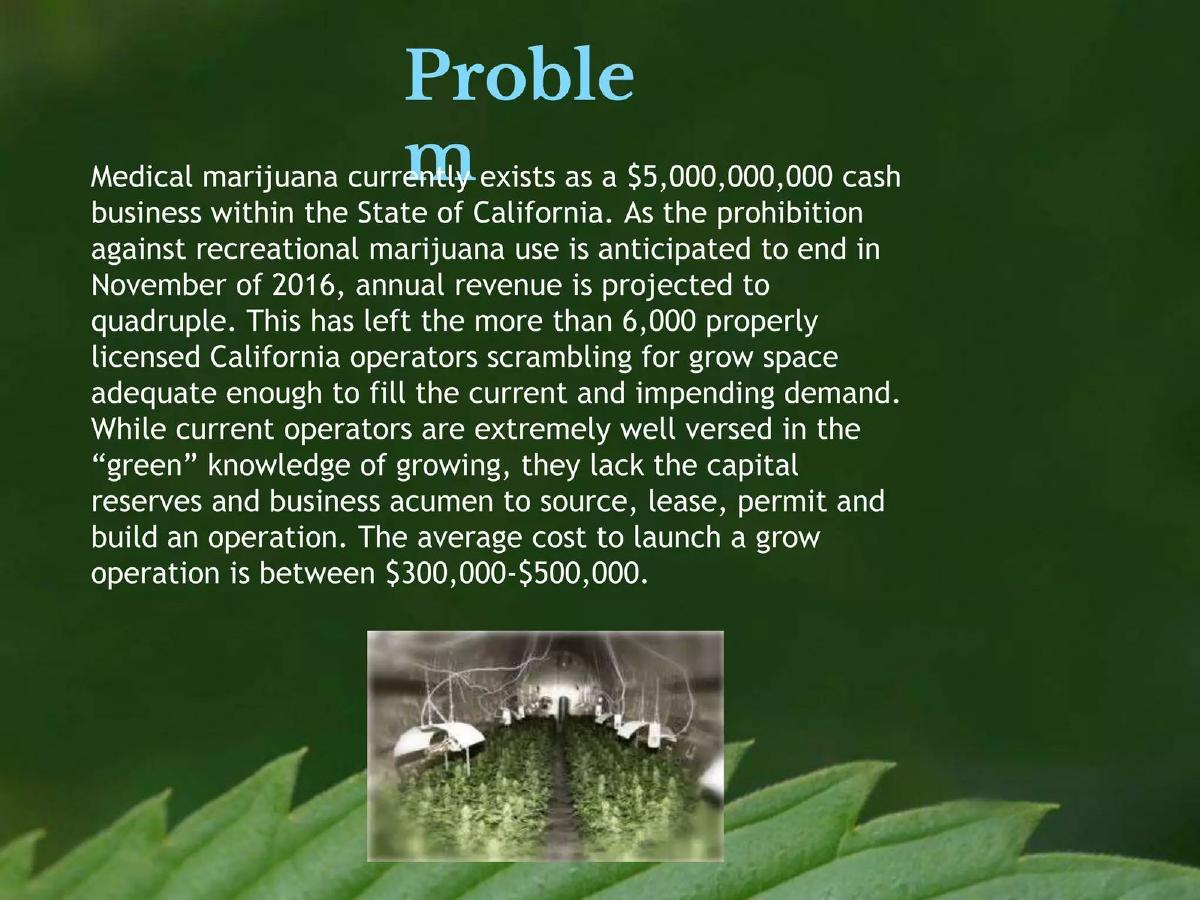
The slide (titled "Proble m" due to a formatting error) values the California medical marijuana market at $5,000,000,000. It anticipates recreational legalization in November 2016 will quadruple annual revenue. The core problem identified is that 6,000+ licensed operators lack the capital reserves and business acumen to source and build grow operations, which cost between $300,000 and $500,000 to launch.
Slide 4: Solution: ALAF CORP / PRO-16 PODS
ALAF proposes sub-divided commercial "green space." They acquire 10,000-50,000 sq. ft. properties and divide them into 3,000-5,000 sq. ft. "PRO-16 PODS" for rent. The facilities include perimeter security, rooftop solar, irrigation, and 24-hour staffing by armed off-duty law enforcement. Shared amenities include kitchens, bathrooms, conference rooms, and gaming areas.
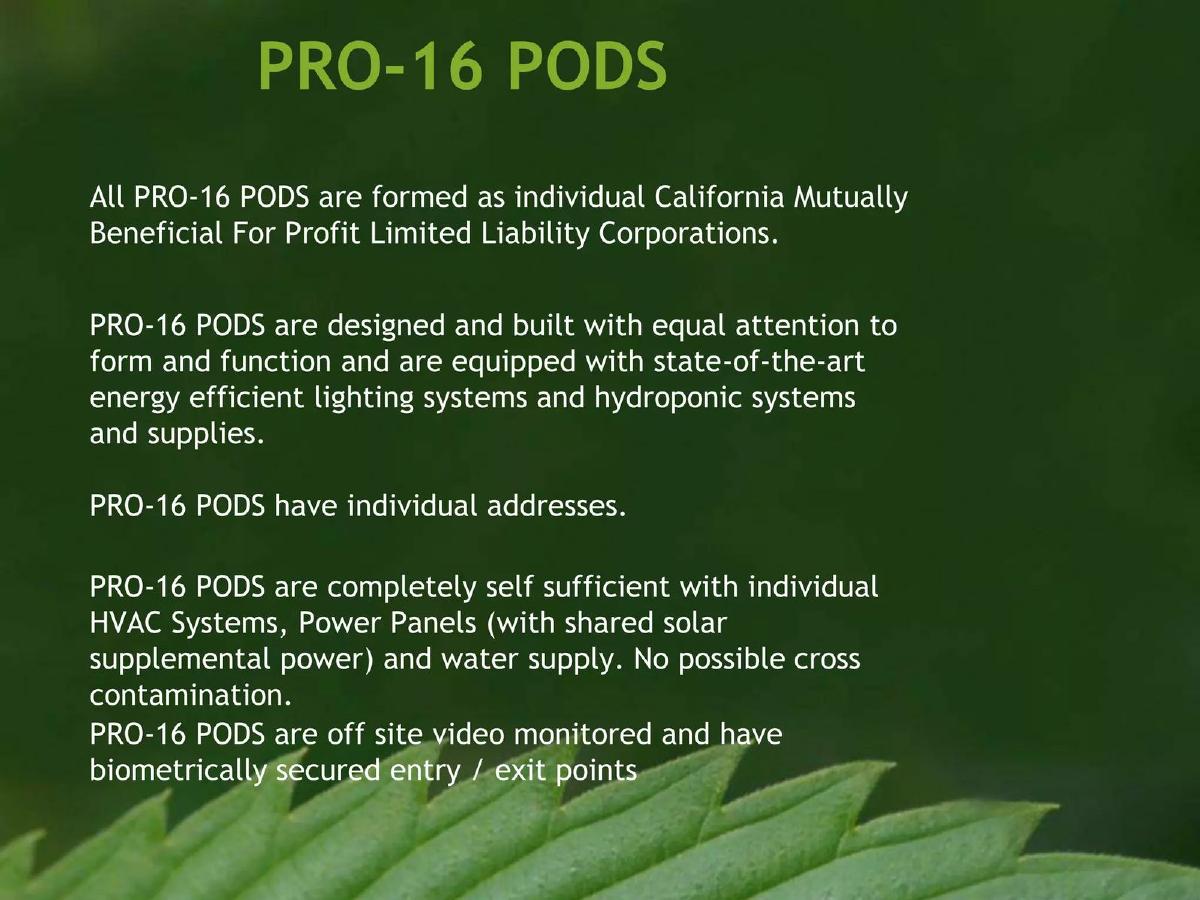
Slide 5: PRO-16 PODS Specifications
Each pod is formed as an individual California Mutually Beneficial For Profit LLC. The pods feature individual addresses, self-sufficient HVAC systems, dedicated power panels, and biometrically secured entry points to prevent cross-contamination between tenants.
Investment Terms and Financial Modeling
Slide 6: Opportunity
This slide outlines the investment offer. ALAF is selling preferred stock in specific Pod LLCs. Blocks of 2% equity are priced at $5,000, with a $100,000 cap per investor. The slide explicitly states a "100% Return on investment!" over a 15-month term with no extensions. It claims principal is secured by inventory and equipment. The goal stated is 30-45 pods completed by Q4 2017.
Slide 7: Equity Allocation (Example)
A flow chart illustrates the ownership of a specific pod in Desert Hot Springs (DHS). ALAF Corp takes 50% for operations ($125,000 value), a Pod Manager takes 10% ($25,000 value), and the remaining 40% is split among various JV (Joint Venture) investors in 2% and 4% increments. Every investor block is labeled with "100% ROI" and a "15 MONTHS" duration.
Real Estate and Facility Assets
Slide 8: Current Developments
A transition slide featuring the ALAF logo and the text "CURRENT DEVELOPMENTS."
Slide 9: Facility For Sale Flyer
This slide appears to be a marketing flyer for a facility in Desert Hot Springs. It lists a price of $275.00/SF for shell delivery. It highlights 1,200 AMP power per building and claims to be the only project in California with city approval for medical cannabis cultivation at that time. Brian Kissinger is listed as the contact.
Slide 10: Building Types & Availability
A site plan for the industrial park shows four building types (A, A-1, B, and C) ranging from 6,026 sq. ft. to 31,008 sq. ft. The slide lists the number of units and required parking spaces for each building type.
Slide 11 & 12: Interior Photos
These slides show actual cultivation environments. Slide 11 features plants under high-intensity discharge lighting in a rack system. Slide 12 shows a larger room with fans, ducting, and a separate image of harvested plants hanging to dry. These serve as proof of operational capability.
Slide 13: Large Scale Cultivation Renderings
A rendering of a massive industrial complex on 153.43 gross acres. The text claims this is a "Brand new state-of-the-art facility first of its kind in California." Brian Kissinger (CEO) and Khal Sadiq (VP Operations) are listed with contact information.
Slide 14: Site Plan for 153-Acre Facility
A technical site plan detailing four licensed buildings totaling 2,645,617 sq. ft. Building 1 is 946,642 sq. ft., and Building 2 is 1,170,859 sq. ft. The corporate office address is listed in Newport Beach, CA.
Slide 15: Thank You
What ALAF Corp Does Well
The deck excels at defining a very specific, tangible product. By focusing on the "PRO-16 POD" as a standardized unit of real estate, the company moves away from the volatility of plant-touching retail and into the more stable world of industrial infrastructure. The inclusion of detailed site plans (Slide 10) and massive future entitlements (Slide 14) suggests a high level of preparation regarding local zoning and land use, which is the primary barrier to entry in the cannabis space.
The investment structure is also clearly defined. While the 100% ROI promise is aggressive, the breakdown of $5,000 blocks makes the opportunity accessible to a wider range of individual investors compared to typical venture capital rounds that require much higher minimums.
What is Missing from the ALAF Corp Deck
The most glaring omission is a comprehensive "Team" slide. While names like Brian Kissinger and Khal Sadiq appear on the real estate flyers (Slides 9 and 13), there are no biographies, past successes, or credentials listed for the leadership team. In a highly regulated industry like cannabis, the background of the founders is critical for trust.
Furthermore, the deck lacks a detailed breakdown of unit economics for the pods. While it mentions a $275/SF sale price and a 100% ROI for investors, it does not show the underlying math: what is the monthly rent per pod? What are the utility costs? What is the expected yield per square foot that allows a tenant to pay that rent? Without these figures, the 100% ROI claim lacks a logical foundation.
Finally, there is no discussion of the competitive landscape. ALAF claims to be "one-of-a-kind," but other industrial REITs and specialized cannabis developers exist. A slide addressing how they defend their position against other well-capitalized developers would have strengthened the pitch.
Founder Takeaways: What to Copy and What to Avoid
Copy the specificity of the asset: ALAF doesn't just say they "do cannabis." They define exactly what a "pod" is, down to the HVAC and biometric security (Slide 5). Founders should aim for this level of detail when describing their core product to remove ambiguity.
Copy the use of real-world evidence: Including photos of actual grow rooms (Slides 11-12) and official site plans (Slide 14) proves that the company isn't just a "paper startup." It shows they have moved past the ideation phase and into physical development.
Avoid guaranteed returns: Promising a "100% Return on investment!" (Slide 6) is a significant red flag for sophisticated investors and can lead to regulatory scrutiny. It is better to show a range of projected outcomes based on conservative, moderate, and aggressive market scenarios rather than guaranteeing a specific figure.
Avoid typos in headers: The "Proble m" header on Slide 3 is a simple formatting error that detracts from the professionalism of a deck asking for millions of dollars in investment. Always perform a final design review on a different screen to catch text wrapping issues.
Frequently asked questions
- What is the primary business model of ALAF Corp?
- ALAF Corp acts as a specialized industrial landlord and infrastructure provider for the cannabis industry. They acquire large commercial properties (10,000-50,000 sq. ft.) and sub-divide them into 'PRO-16 PODS.' These pods are turnkey cultivation environments equipped with high-power utilities, solar supplements, and 24/7 armed security, which they rent to licensed California medical marijuana corporations.
- How is the investment opportunity structured?
- Unlike traditional equity in a parent company, ALAF offers preferred stock in specific 'PRO-16 GROW-OP POD COMPANY LLCs.' Investors buy 2% blocks for $5,000, with a maximum investment of $100,000 (40% ownership) per pod. The deck claims the investment is secured by inventory and equipment, promising a full return of principal plus profit within 15 months.
- What specific problem does ALAF claim to solve?
- The deck identifies a 'scramble for grow space' among 6,000 licensed California operators. It argues that while these operators understand cultivation, they lack the capital ($300,000-$500,000 average launch cost) and business acumen to navigate the complex leasing, permitting, and building requirements for a compliant facility.
- What geographical area does ALAF target?
- The company focuses exclusively on California, with specific mentions of Southern Orange and Northern San Diego Counties for delivery. Their real estate developments are highlighted in Desert Hot Springs, which they claim was the only city issuing cultivation business permits under MMJ Ordinance 552 and 553 at the time of the deck's creation.
- What supporting businesses does ALAF operate?
- ALAF lists six supporting entities: Zen Products (CBD distribution), High Tides Delivery Service (5-vehicle fleet), KannaKakes (FDA compliant kitchen/white label), M-Essentials (CBD skincare), Kannabiz (multi-level marketing), and 420comps.com (an advertising app for 'munchies' discounts).