Alation’s Series E pitch deck is a lean, 14-slide document that prioritizes market validation and high-level financial health over granular product explainers. Raising $123M in 2022, the company positions itself as the creator and leader of the 'Data Intelligence' category. The deck is notable for its heavy reliance on third-party analyst reports from Gartner, Forrester, and IDC to prove its dominance. By the time a company reaches Series E, the 'how it works' is often less important than the 'how big it can get,' and Alation answers this with a projected $25B market size and a clear path tow…
Key takeaways
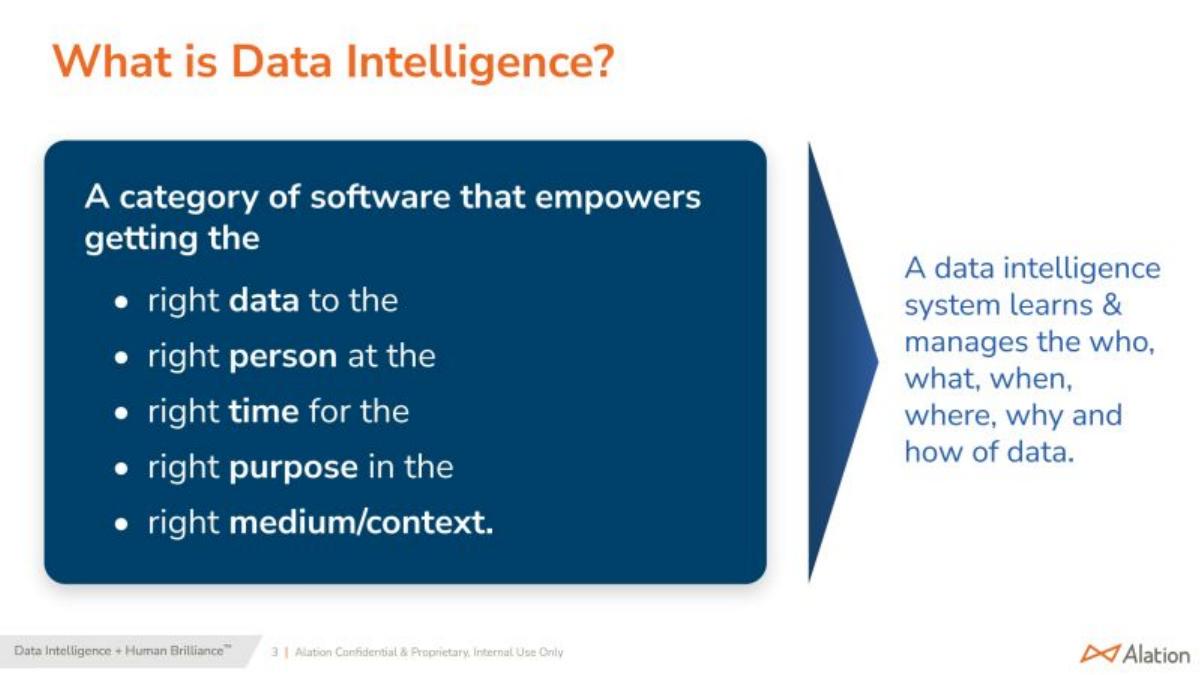
- The deck defines 'Data Intelligence' as a distinct software category to move beyond the narrow 'Data Catalog' label (Slide 3).
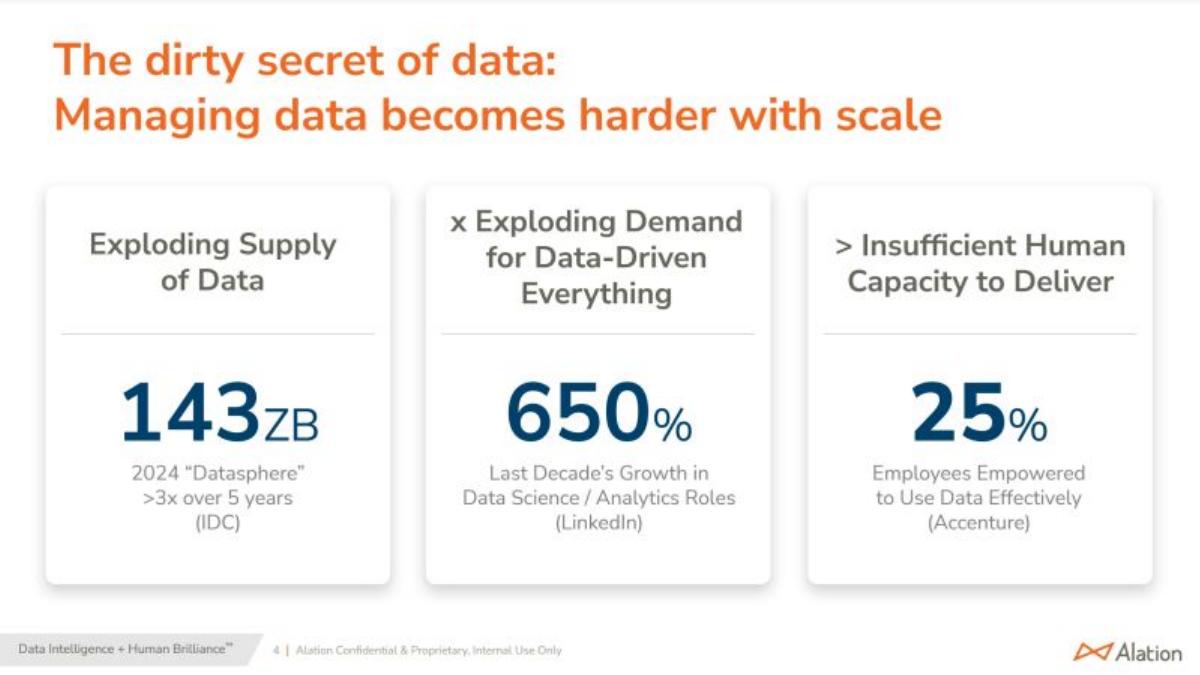
- Alation uses a 'Data Chaos' narrative to justify the urgent need for their solution, citing a 3x growth in the 'Datasphere' over five years (Slide 4).
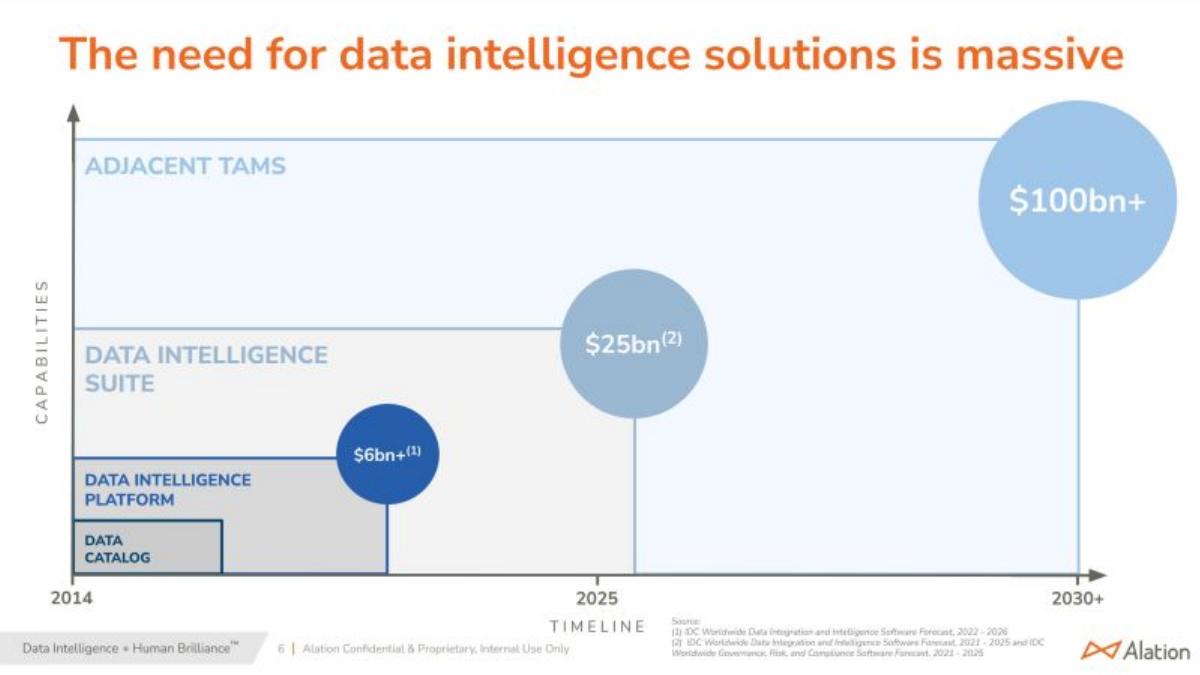
- The company claims a massive market expansion path, moving from a $6B+ platform market to a $100B+ adjacent TAM by 2030 (Slide 6).
- Third-party validation is the core of their credibility, featuring logos and leadership rankings from Forrester, Gartner, and IDC across two full slides (Slides 7-8).
- The platform's ubiquity is demonstrated through an integration map featuring major players like Snowflake, Databricks, and AWS (Slide 9).
- Customer proof is presented through a diverse logo wall including Cisco, Salesforce, and Nasdaq, claiming adoption by 'everyone' from analysts to business users (Slide 10).
- Company culture is highlighted as a competitive advantage, citing a 4.7 Glassdoor score and >90% employee engagement (Slide 11).
- Financial maturity is signaled by surpassing the $100M ARR milestone and achieving >25% Fortune 100 penetration (Slide 13).
The Series E Narrative: From Product to Powerhouse
Alation’s 2022 pitch deck is a masterclass in late-stage storytelling. At the Series E level, investors are no longer looking for proof of concept; they are looking for proof of dominance and a clear path to a massive exit or IPO. This 14-slide deck, titled 'Business Overview,' moves away from the 'problem/solution' mechanics of early-stage decks and focuses instead on category leadership, institutional validation, and scale metrics.
Slides 1-2: Vision and Identity
The deck opens with a clean title slide (Slide 1) dated August 2022. Slide 2 immediately pivots to a high-level vision: 'To empower a curious and rational world.' This is a classic late-stage move—positioning the company not just as a tool provider, but as a fundamental pillar of modern business intelligence. The imagery of a connected globe reinforces the scale of their ambition.
Slides 3-5: Defining the Category and the Chaos
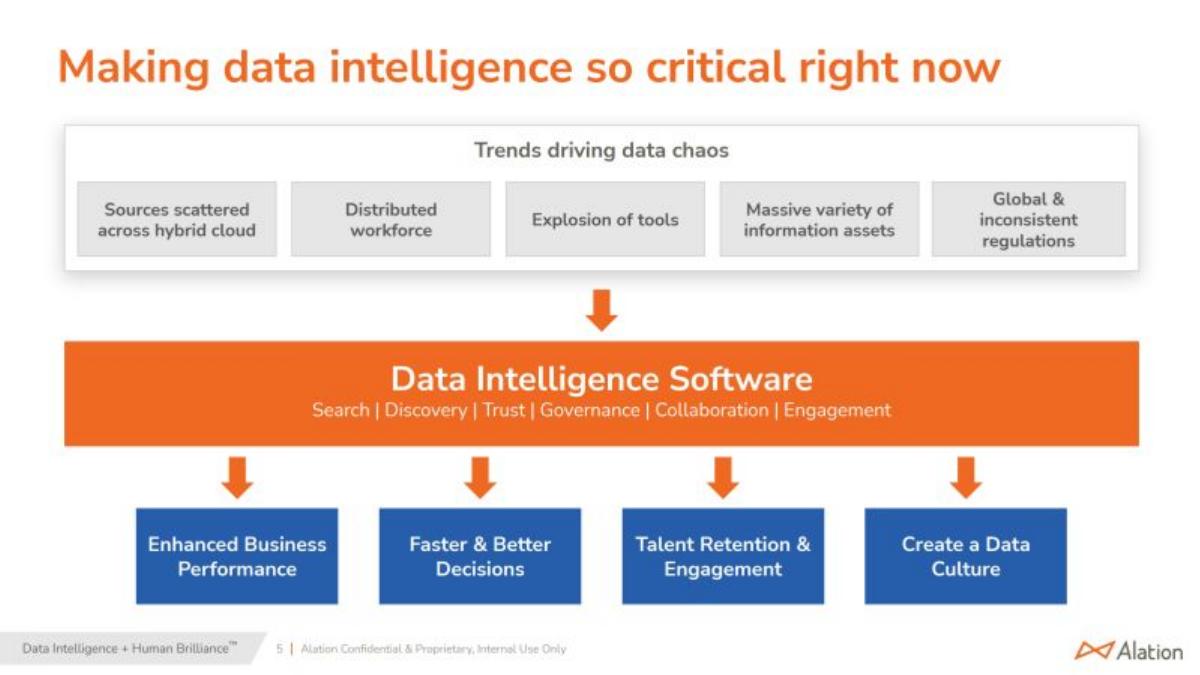
In Slide 3, Alation defines 'Data Intelligence' as a category of software that ensures the 'right data' gets to the 'right person' at the 'right time.' This is a strategic framing; by defining the category, Alation sets the rules by which it is judged. Slide 4 provides the 'Why Now' context, citing the 'dirty secret of data': that managing it becomes harder with scale. They cite a 143ZB 'Datasphere' by 2024 and a 650% growth in data roles over the last decade. Slide 5 connects these trends to 'Data Intelligence Software,' positioning it as the solution to 'data chaos' caused by scattered sources and an explosion of tools.
Slide 6: The $100 Billion Opportunity
Slide 6 is the 'TAM' (Total Addressable Market) slide, but it is structured as a timeline of capability expansion. It shows Alation moving from a 'Data Catalog' to a 'Data Intelligence Platform' ($6bn+ market), then to a 'Data Intelligence Suite' ($25bn market by 2025), and finally toward 'Adjacent TAMs' exceeding $100bn by 2030. This tells investors that while Alation is already large, it is only at the beginning of its total market capture.
Slides 7-8: The Wall of Validation
Slides 7 and 8 are arguably the most important for a Series E round. They feature a 'Wall of Validation' from every major industry analyst. Slide 7 highlights Alation as a leader in 'Machine Learning Data Catalogs' according to Forrester, IDC, Dresner, Constellation, GigaOm, and KuppingerCole. Slide 8 continues this with 'Data Governance' and 'Active Metadata Management' accolades, including being a '4x MQ Leader' for Gartner and a 'Technology Pioneer' for the World Economic Forum. For a lead investor like Thoma Bravo, this level of third-party consensus significantly de-risks the investment.
Slides 9-10: Ecosystem and Customer Ubiquity
Slide 9 uses a hub-and-spoke diagram to show that Alation 'connects to EVERYTHING in your data stack,' featuring logos of partners and competitors alike, such as Snowflake, Databricks, AWS, and Google Cloud. This positions Alation as the essential 'connective tissue' of the enterprise. Slide 10 follows up with a massive customer logo wall, claiming adoption by 'everyone' from Data Analysts to Governance Officers. The logos are blue-chip: Cisco, Salesforce, Nasdaq, DocuSign, and DraftKings, among others.
Slides 11-12: Culture and Capital
Slide 11 focuses on the internal health of the company, citing a >90% employee engagement score from Culture Amp and a 4.7 Glassdoor score. In a competitive talent market for data engineers, this is a key metric for operational stability. Slide 12 lists their 'Marquee Investors,' which includes a mix of traditional VCs (Costanoa, Sapphire) and strategic corporate investors (Salesforce Ventures, Snowflake Ventures, Databricks). This indicates that the major players in the data ecosystem are financially aligned with Alation’s success.
Slide 13: The Scorecard
The final content slide (Slide 13) provides the hard numbers that justify a $123M round. Alation reports forecasted metrics as of FQ3’23: ARR >$100M , ~450 Customers , and 700+ Employees . Two specific metrics stand out for late-stage investors: a >25% Fortune 100 penetration , proving they can win at the highest level of the enterprise, and a ~1.5x cumulative cash burn to ARR ratio , which signals high capital efficiency compared to many high-growth SaaS peers.
What Alation Does Well
Category Ownership: Alation doesn't just call itself a data catalog; it claims to have 'started the ML Data Catalog trend' and defines the broader 'Data Intelligence' category. This allows them to command higher valuations by appearing as a platform rather than a feature.
Analyst Dominance: The sheer volume of 'Leader' badges from Gartner, Forrester, and others is overwhelming. For enterprise software, these rankings are often the primary gatekeepers for procurement, making Alation an 'easy buy' for CIOs.
Capital Efficiency: Highlighting the 1.5x burn-to-ARR ratio is a sophisticated touch. It tells investors that the company isn't just growing at all costs, but is building a sustainable, scalable business model.
What is Missing
The Human Element: There is no team slide. While the company has 700+ employees and marquee investors, the lack of a slide highlighting the executive leadership team is unusual. At Series E, investors usually want to see the 'bench strength' of the C-suite that will take the company to IPO.
The 'How': The deck is very light on product screenshots or technical architecture. It assumes the audience already understands the product or has seen a demo elsewhere. While appropriate for a high-level business overview, it leaves the 'moat' to be explained primarily through market share rather than technical defensibility.
The Ask: There is no slide detailing how the $123M will be spent. While late-stage rounds are often about 'fueling the fire' (sales and marketing expansion), a specific breakdown of geographic expansion or R&D priorities is missing.
What Founders Should Copy
The 'Validation First' Approach: If you have awards, rankings, or high-profile partnerships, lead with them. Alation spends nearly 15% of its deck on third-party validation. It is much more powerful to have Gartner say you are a leader than to say it yourself.
Market Expansion Visualization: Slide 6 is an excellent template for showing how a company grows its TAM over time. It shows a logical progression from a niche product to a broad platform, giving investors a reason to believe in a 10x return even at a high entry valuation.
Efficiency Metrics: Don't just show growth; show the cost of that growth. Including the burn-to-ARR ratio demonstrates a level of financial maturity that is highly attractive to private equity-style lead investors like Thoma Bravo.
Frequently asked questions
- What is Alation's primary business model and stage?
- Based on the catalogue facts, Alation operates on a B2B SaaS business model within the Enterprise Software and Big Data sectors. This specific deck was used for their Series E round in 2022, which successfully raised $123M led by Thoma Bravo.
- How does Alation prove its market leadership in the deck?
- Alation relies heavily on external validation. Slides 7 and 8 are dedicated entirely to awards and 'Leader' designations from major industry analysts like Gartner (4x MQ Leader), Forrester (2x Leader), and IDC. They also quote Forrester stating that Alation 'started the ML Data Catalog trend.'
- What are the key financial metrics Alation shared for its Series E?
- On Slide 13, Alation discloses several 'Forecasted Metrics' as of October 2023: ARR exceeding $100M, approximately 450 customers, over 700 employees, and a cumulative cash burn to ARR ratio of ~1.5x. They also report over 25% penetration into the Fortune 100.
- Who are Alation's major investors according to the deck?
- Slide 12 lists 'Marquee Investors' including Costanoa Ventures, Icon Ventures, Sapphire, Riverwood Capital, Thoma Bravo, Sanabil Investments, Data Collective, Blackstone, Salesforce Ventures, Snowflake Ventures, Databricks, Capgemini, HPE, and Dell Technologies Capital.
- What is missing from the Alation pitch deck?
- The deck lacks a traditional team slide featuring founder or executive biographies. It also does not include a detailed product roadmap, a specific 'Ask' slide detailing the use of funds, or a granular breakdown of unit economics like LTV/CAC, which are sometimes expected even at later stages.