Alga Biosciences secured $4M in Seed funding in 2024 for their biotech approach to livestock feed. The 11-slide deck is a study in minimalist, high-impact communication. Rather than getting bogged down in the complex biochemistry of modified kelp, the narrative focuses on a massive total addressable market—1.5 billion cows—and a compelling economic incentive. By framing methane reduction not just as a climate necessity but as a mechanism for increased caloric efficiency ('Fatter Cows'), Alga addresses the primary barrier to adoption in the agricultural sector: the bottom line. The deck relies…
Key takeaways
- The deck leads with a dual-value proposition: stopping methane burps while saving farmers money (Slide 1).
- Methane is positioned as a 'uniquely powerful lever' for climate impact, emphasizing the urgency of the problem (Slide 3).
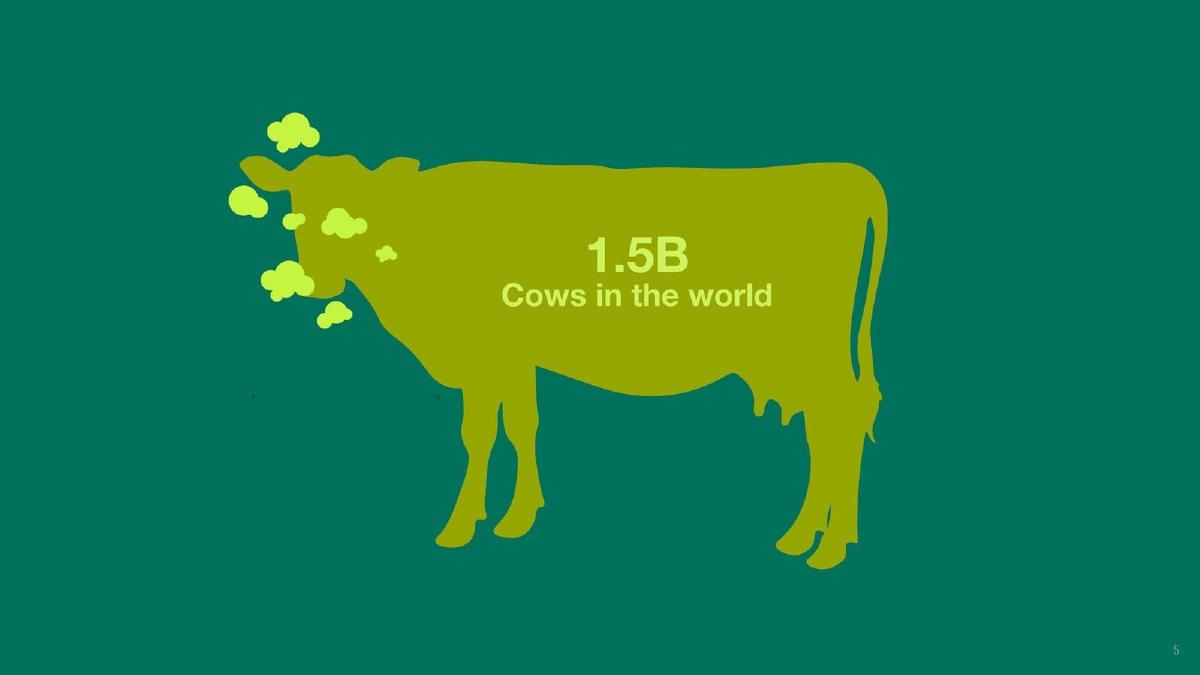
- The market scale is visualized simply with a global count of 1.5 billion cows (Slide 5).
- The core product mechanism is presented as a 0.5% additive to traditional feed that redirects energy from methane production to animal growth (Slide 7).
- The 'Less Methane = Fatter Cows' slogan serves as the deck's primary economic hook for the customer (Slide 7).
- The founding team features deep technical expertise, including two U.C. Berkeley PhD candidates in Physical Chemistry (Slide 9).
- The deck omits specific unit economics, manufacturing scale-up plans, and regulatory milestones.
- Reported by Business Insider, the company successfully raised $4M in a 2024 Seed round following this presentation.
The Power of Economic Alignment in Climate Tech
Alga Biosciences, a North American biotech startup, raised $4M in 2024 to commercialize a modified kelp additive for cattle. In the world of climate tech, the 'green premium'—the extra cost of choosing a sustainable option—is often the death of promising startups. Alga’s deck is a masterclass in avoiding this trap. By slide 7, they have moved past the environmental 'why' and landed firmly on the economic 'how': making cows more efficient biological machines.
Slide 1: The Hook
The cover slide establishes the brand identity immediately with a bold, green-on-green aesthetic. The sub-headline, 'We stop cows from burping methane and save farmers money,' is a perfect two-part value proposition. It identifies the environmental problem and the economic solution in a single sentence. For an investor, this signals that the company understands its customer (the farmer) is not a charity, but a business operator motivated by margins.
Slide 3: The Methane Lever
Slide 3 moves to the macro problem. It states, 'Methane is a uniquely powerful lever, for both heating and cooling.' This is a sophisticated way to frame the climate crisis. By highlighting methane’s potency compared to CO2, Alga justifies why they are focusing on this specific gas. The underlining of 'and cooling' suggests that reducing methane provides a faster path to climate stabilization than carbon sequestration alone, creating a sense of investment urgency.
Slide 5: Quantifying the Opportunity
Market sizing slides are often cluttered with complex CAGR percentages and fragmented segments. Alga takes the opposite approach on Slide 5. A single silhouette of a cow with the text '1.5B Cows in the world' tells the entire story of the Total Addressable Market (TAM). It implies that if the product works, the scale is massive and global. The simplicity of the graphic keeps the focus on the sheer volume of the opportunity.
Slide 7: The Core Value Proposition
This is the most important slide in the deck. It features a side-by-side comparison of a cow on 'Traditional Feed' versus a cow on '+ 0.5% AlgaBio Traditional Feed.' The visual shows energy (arrows) being diverted. In the traditional model, energy is lost to 'Methane' burps. In the AlgaBio model, that energy is redirected toward 'Growth.' The headline 'Less Methane = Fatter Cows' is the ultimate 'so what?' for the agricultural industry. It transforms an environmental regulation hurdle into a profit-maximizing tool.
Slide 9: The Founders
In deep-tech and biotech, the team slide is a credibility check. Slide 9 introduces Alex Brown (CEO), Daria Balatsky, and Caroline McKeon. The academic pedigree is the focal point here: two founders are 'U.C. Berkeley PhD candidate[s] in Physical Chemistry.' This provides the necessary scientific weight to back up the claims made in the previous slides. Alex Brown’s experience as 'Chief of Staff @ LiveRamp' suggests a level of operational and organizational maturity to balance the heavy science.
Slide 11: Contact and Branding
The final slide returns to the logo and provides direct contact information for the CEO. The background imagery—a swirling green and white pattern—evokes both the biological nature of the product (algae/kelp) and the 'green' mission of the company. It is a clean, professional exit that maintains the minimalist tone of the entire presentation.
What Alga Biosciences Does Exceptionally Well
The primary strength of this deck is its narrative discipline . Many biotech founders feel the need to include complex chemical structures, metabolic pathway diagrams, and p-values from their latest studies. Alga Biosciences resists this urge. They understand that a Seed round is about selling the vision and the team's ability to execute on a massive market.
By focusing on the 0.5% inclusion rate (Slide 7), they subtly address a major logistical concern in the feed industry: volume. If a farmer had to replace 20% of their feed with kelp, the supply chain would be impossible. A 0.5% additive is a 'drop-in' solution that fits existing infrastructure, making the path to 1.5 billion cows feel achievable rather than fantastical.
What is Missing from the Deck
While the minimalism is a strength for storytelling, there are significant gaps that a sophisticated investor would likely probe during due diligence, which are not addressed in these 11 slides:
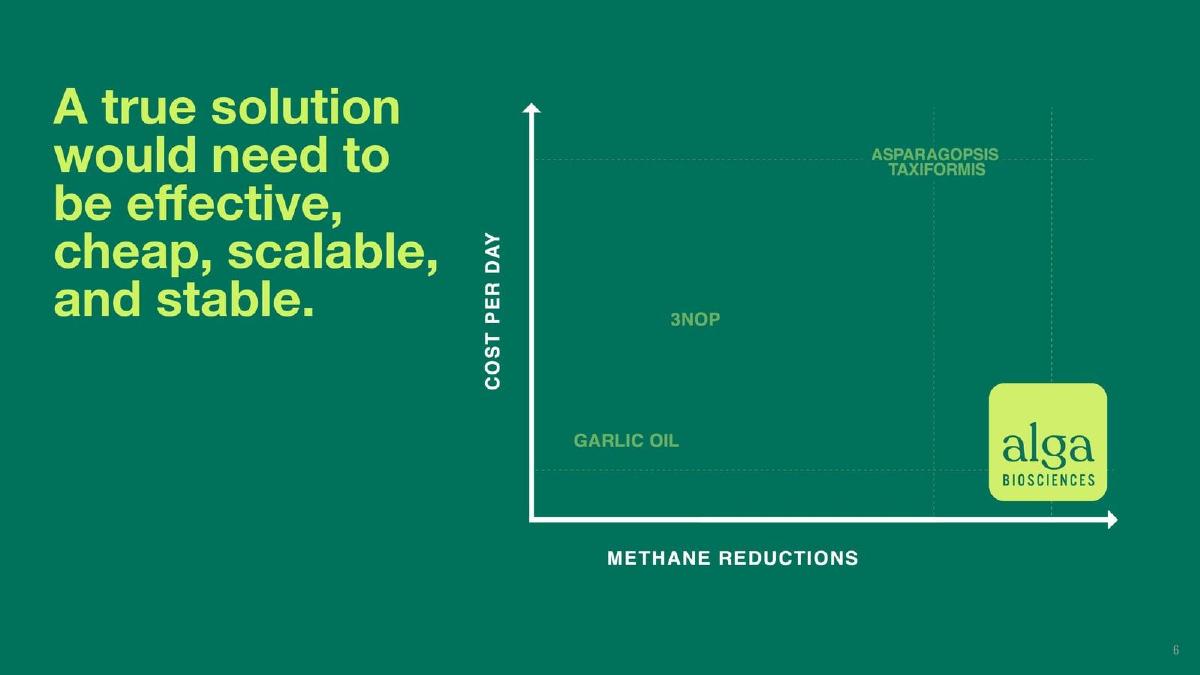
Regulatory Roadmap: Feed additives that claim to change the physiology of an animal (like increasing growth) often fall under strict FDA guidelines. The deck does not mention the status of GRAS (Generally Recognized As Safe) certification or other regulatory hurdles. · Unit Economics: While the deck claims to 'save farmers money,' it does not provide the cost per ton of the additive versus the projected value of the extra weight gain in the cattle. · Scalability of Supply: Harvesting or growing enough modified kelp to service even a fraction of the 1.5 billion cows is a massive industrial challenge. The deck omits how they plan to produce this at scale. · Competitive Landscape: The seaweed-for-cows space is crowded (e.g., companies using Asparagopsis taxiformis). Alga does not explain why their 'biochemically modified' approach is superior to natural seaweed or synthetic inhibitors like Bovaer.
Founder Lessons: Copy This Strategy
1. Solve for the Customer's Wallet, Not Just the Planet: If you are building in climate tech, your 'Slide 7' must show how the user makes more money. Alga’s 'Fatter Cows' hook is the reason they raised $4M. Altruism is a secondary motivator for most industries; profitability is the primary one.
2. Use 'Big Numbers' for Big Impact: Don't hide your market size in a spreadsheet. If your market is '1.5B Cows,' put it in the center of the slide in a large font. It forces the investor to visualize the ceiling of the investment.
3. Lead with Pedigree: If your team has PhDs from top-tier institutions in the exact field you are disrupting, make that the centerpiece of your team slide. In biotech, the 'who' is often as important as the 'what' because the 'what' is still being proven in the lab.
4. Maintain Visual Cohesion: The consistent use of the green palette and the square logo container makes the brand feel established and 'real,' even at the Seed stage. It suggests a level of attention to detail that investors associate with high-quality management.
Frequently asked questions
- What is the specific product Alga Biosciences is developing?
- According to publisher reports, Alga Biosciences develops a biochemically modified kelp feed additive. The deck specifies on Slide 7 that this is intended to be a 0.5% addition to traditional cattle feed to reduce methane emissions and improve growth.
- How does Alga Biosciences justify the cost of their additive to farmers?
- The deck uses Slide 7 to argue that reducing methane leads to 'Fatter Cows.' By preventing energy from being wasted as methane gas (burps), that energy is redirected toward animal growth, potentially increasing the farmer's yield and saving them money.
- What is the technical background of the founding team?
- The team is highly technical, as shown on Slide 9. Daria Balatsky and Caroline McKeon are both U.C. Berkeley PhD candidates/program members in Physical Chemistry. Alex Brown, the CEO, has a background in Cognitive Science and experience as a Chief of Staff at LiveRamp.
- Does the deck include a competitive analysis or market landscape?
- No. The 11-slide deck focuses entirely on the problem, the Alga solution, and the team. It does not list other seaweed-based feed companies or synthetic methane inhibitors, which are common in this sector.
- What information is missing from the Alga Biosciences deck?
- The deck lacks several standard 'late-seed' elements, including a detailed financial ask, a roadmap for regulatory approval (FDA/GRAS), specific trial data results, and a go-to-market strategy for reaching 1.5 billion cows.