Alba Health’s pitch deck is a masterclass in establishing scientific authority to justify a consumer health play. By centering the narrative on co-founder Prof. Willem de Vos and his 800+ publications, the company bypasses the skepticism often directed at 'wellness' startups. The deck highlights a massive $80B market opportunity driven by declining sequencing costs and rising chronic conditions. With 1,500+ tests already completed and a 50% month-over-month growth rate, the startup demonstrates clear early traction. However, the deck is notably light on unit economics and a specific breakdown…
Key takeaways
- The deck leads with high-authority social proof, citing a 4.8/5 Trustpilot rating and $2.8 million in previous funding on Slide 1.
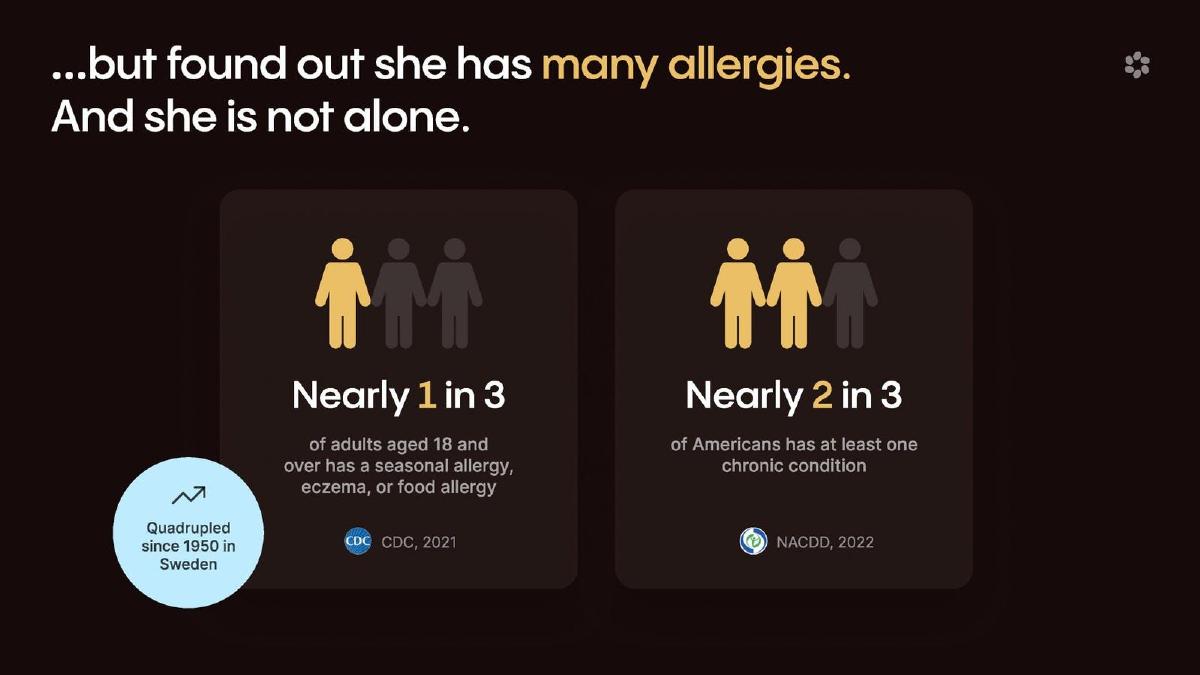
- Market urgency is established by citing that nearly 1 in 3 adults has a seasonal allergy, eczema, or food allergy, a figure that has quadrupled in Sweden since 1950 (Slide 2).
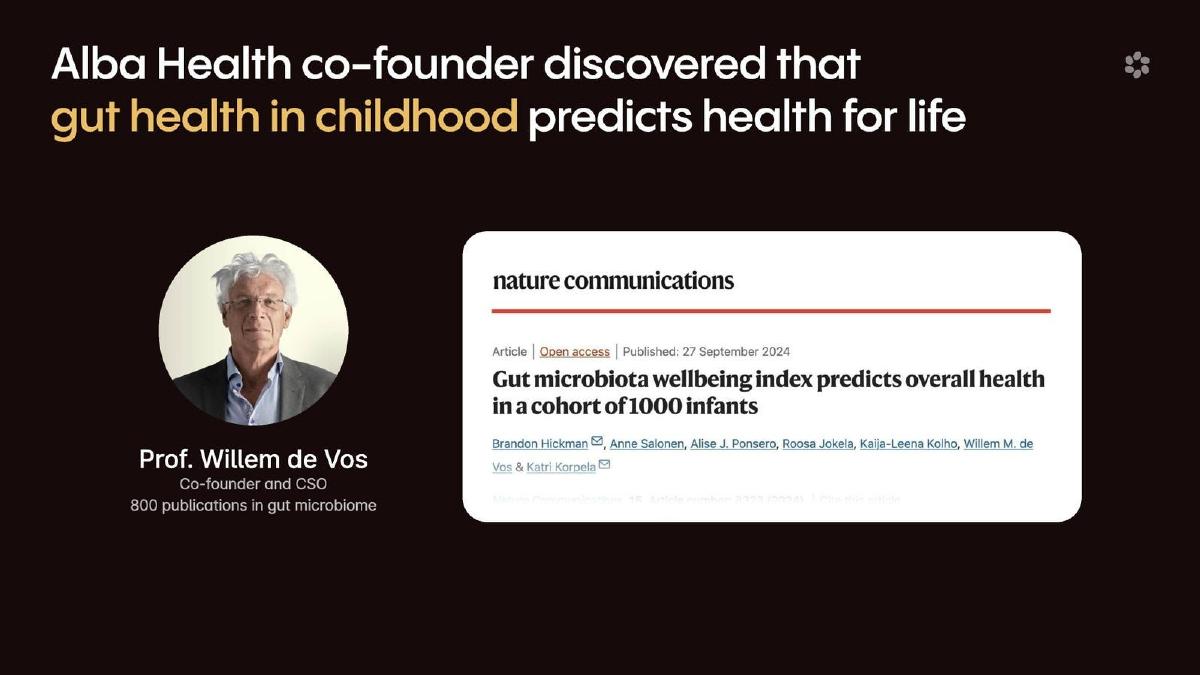
- Scientific validation is the core pillar, featuring a Nature Communications article published in September 2024 regarding a cohort of 1,000 infants (Slide 3).
- The product workflow is simplified into four steps: detect, restore, coach, and track, utilizing metagenomics and AI (Slide 4).
- Data defensibility is highlighted through the HELMi Cohort, consisting of 10,000 microbiome samples and 50,000+ lifestyle datapoints (Slide 5).
- The 'Why Now' slide uses four exponential charts showing rising microbiome publications and plummeting DNA sequencing costs (Slide 6).
- Traction is quantified with 1,500+ tests done and 300,000 proprietary datapoints collected (Slide 7).
- The deck omits a traditional 'Ask' slide, a detailed team slide beyond the CSO, and any mention of specific unit economics or CAC/LTV metrics.
Executive Summary: The Science-First Approach to Pediatric Wellness
Alba Health’s pitch deck for their 2024 Seed round is a concise, 15-slide presentation that leans heavily into the 'Scientific Founder' trope. Based in the Swedish-Danish region, the startup aims to address the rising tide of childhood allergies and chronic conditions through gut microbiome analysis. The deck successfully bridges the gap between complex metagenomics and a consumer-friendly product interface, though it leaves several business-critical questions unanswered regarding its long-term financial viability.
Slide 1: The Hook
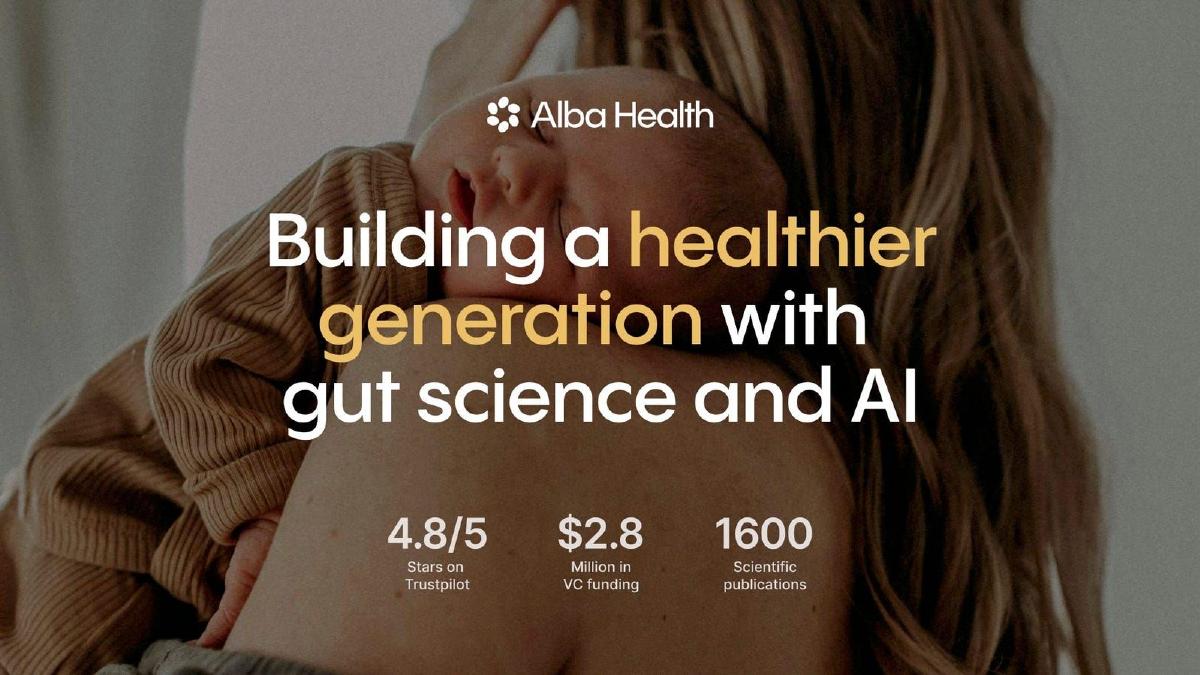
The cover slide does more than just state the company name. It serves as a 'traction teaser.' By including three key metrics—a 4.8/5 Trustpilot rating, $2.8 million in VC funding (reported as $2.5M in the 2024 round), and 1,600 scientific publications—Alba Health immediately establishes credibility. The imagery of a baby on a parent's shoulder targets the emotional core of their primary customer: concerned parents.
Slide 2: The Problem - A Growing Epidemic
Slide 2 frames the problem as a global health crisis. It cites CDC and NACDD data to show that nearly 1 in 3 adults suffers from allergies or eczema, and 2 in 3 Americans have at least one chronic condition. Crucially, it includes a localized data point: allergy rates have quadrupled since 1950 in Sweden. This creates a sense of urgency and validates the 'Why Now' for a solution targeting the next generation.
Slide 3: The Scientific Moat
This is arguably the most important slide in the deck. It introduces Prof. Willem de Vos, Co-founder and CSO. By showcasing a 2024 publication in Nature Communications titled 'Gut microbiota wellbeing index predicts overall health in a cohort of 1000 infants,' Alba Health proves that their product is not just another wellness trend, but is rooted in peer-reviewed research. The mention of his 800 publications in gut microbiome research is a powerful signal of authority.
Slide 4: The Solution - Metagenomics and AI
Slide 4 visualizes the user journey. It breaks the product down into four pillars: Detect (a physical test kit), Restore (diet and lifestyle recommendations), Coach (1:1 support), and Track (longitudinal monitoring). The UI shown is clean and modern, suggesting a high-quality consumer experience that masks the complexity of the underlying metagenomics and AI.
Slide 5: The Data Advantage
To win in AI-driven healthcare, you need data. Slide 5 highlights the HELMi Cohort, which includes 10,000 microbiome samples and 50,000+ lifestyle datapoints from the University of Helsinki. While a small footnote clarifies that Alba Health does not process data directly from this cohort, the association implies a deep pipeline of insights and a competitive advantage in training their predictive models.
Slide 6: The Market Opportunity
The company claims an $80B market opportunity. They justify this through four charts: increasing scientific knowledge, a surge in probiotic products, rising consumer demand (web searches), and the most critical factor—the plummeting cost of DNA sequencing. This 'Cost' chart is the classic enabler for any genomics startup; as costs drop, the TAM (Total Addressable Market) expands because the product becomes accessible to the mass market.
Slide 7: Current Traction
Slide 7 provides the 'hard' numbers to back up the vision. The company reports 1,500+ tests completed and 300,000 proprietary datapoints. The most impressive metric is the +50% month-on-month growth in the last six months. This indicates that the product has found early product-market fit and is ready for the scaling capital provided by a Seed round.
Slide 8: The Closing
The final slide is a simple contact page. It lacks a specific 'Ask' or a roadmap, which is a missed opportunity to define what the $2.5M will specifically achieve. However, in the context of a high-interest Seed round, sometimes the traction and team speak for themselves.
What Works in the Alba Health Deck
1. Scientific Credibility: By featuring a Nature Communications article and a CSO with 800 publications, Alba Health effectively neutralizes the 'snake oil' perception that often plagues the supplement and gut-health industry. Investors are buying into a laboratory-validated methodology, not just a marketing brand.
2. Clear Value Proposition: The deck does not get bogged down in the technical details of DNA sequencing. Instead, it focuses on the outcomes: reducing allergies and improving childhood health. The 'Detect, Restore, Coach, Track' framework is easy for a non-technical investor to grasp.
3. The 'Why Now' Logic: The combination of rising allergy rates and falling sequencing costs provides a logical foundation for why this business is viable today when it wasn't five years ago. This is a standard but essential component of a successful pitch.
What is Missing from the Alba Health Deck
1. The Business Model: There is no mention of the price point for the kits or the cost of the coaching. Without unit economics (CAC, LTV, Gross Margin), it is difficult to assess if this is a high-margin software-like business or a low-margin logistics business.
2. Competitive Landscape: The gut health space is crowded (e.g., Viome, Zoe). Alba Health does not include a competitor matrix or a clear statement on why their pediatric focus is a defensible niche against these larger, well-funded incumbents.
3. The 'Ask' and Use of Funds: The deck ends abruptly. A standard Seed deck should outline how the new capital will be deployed—whether it's for R&D, clinical trials, geographic expansion, or marketing. The absence of a roadmap makes the pitch feel more like a status report than a call to action.
4. Full Team Slide: While the CSO is highlighted, the operational leadership (CEO, CTO, COO) is absent from the provided slides. Investors at the Seed stage invest in the team's ability to execute, not just the science.
Founder Takeaways: How to Copy Alba Health's Success
Lead with Authority: If you have a PhD or a published researcher on your team, make them the star of the deck. Use logos of prestigious journals (like Nature) to provide instant validation. · Quantify the 'Why Now': Don't just say the market is growing. Show the intersection of two trends—one social (rising illness) and one technological (falling costs). · Simplify the Product: Even if your backend is a complex AI metagenomics engine, your product slide should look like a simple consumer app. Investors need to see how a customer interacts with the solution. · Use a Traction Grid: Slide 7's layout is an excellent way to present disparate metrics (funding, publications, views, tests, growth, data) in a single, high-impact view. It creates a 'wall of success' that is hard to argue with.
Frequently asked questions
- How does Alba Health differentiate itself from other gut health startups?
- Alba Health differentiates through its focus on the pediatric market and its deep academic roots. Slide 3 and 5 emphasize their connection to the HELMi Cohort and Prof. Willem de Vos, who has 800 publications. This suggests a level of longitudinal data access (10,000 samples) that generic consumer gut tests often lack.
- What is the primary revenue driver for the company?
- While not explicitly detailed in a business model slide, Slide 4 illustrates a physical test kit and a mobile app offering 1:1 coaching and tracking. This implies a hybrid revenue model consisting of one-time kit sales and potentially recurring subscription fees for health coaching and ongoing monitoring.
- Is the scientific data proprietary to the company?
- Slide 5 includes a critical disclaimer: 'Alba Health does not process data directly from the HELMi cohort.' However, Slide 7 claims the company has '300,000 proprietary datapoints.' This suggests they are building their own database alongside their academic partnerships.
- What market size does Alba Health target?
- Slide 6 identifies an $80B market opportunity. They frame this opportunity through the lens of rising demand (web searches for microbiome tests) and the increasing prevalence of chronic conditions and allergies in children and adults.
- What are the biggest risks identified in this deck?
- The biggest risk is the lack of financial transparency. The deck does not show burn rate, margins, or how the $2.5M Seed round will be spent. It relies on the 'halo effect' of its scientific co-founder to carry the investment thesis.