Probe Fashion is an AI-driven fashion platform designed to solve the disconnect between visual inspiration and digital purchasing. The deck outlines a mobile-first experience where users can 'shop by picture' using in-house computer vision algorithms. Positioned primarily in the United Arab Emirates and Middle East, the company leverages a 10% affiliate commission model while eyeing B2B SaaS opportunities. The deck is notable for its clear product roadmap—distinguishing between existing features like clothing classification and future modules like image similarity search—and its aggressive ge…
Key takeaways
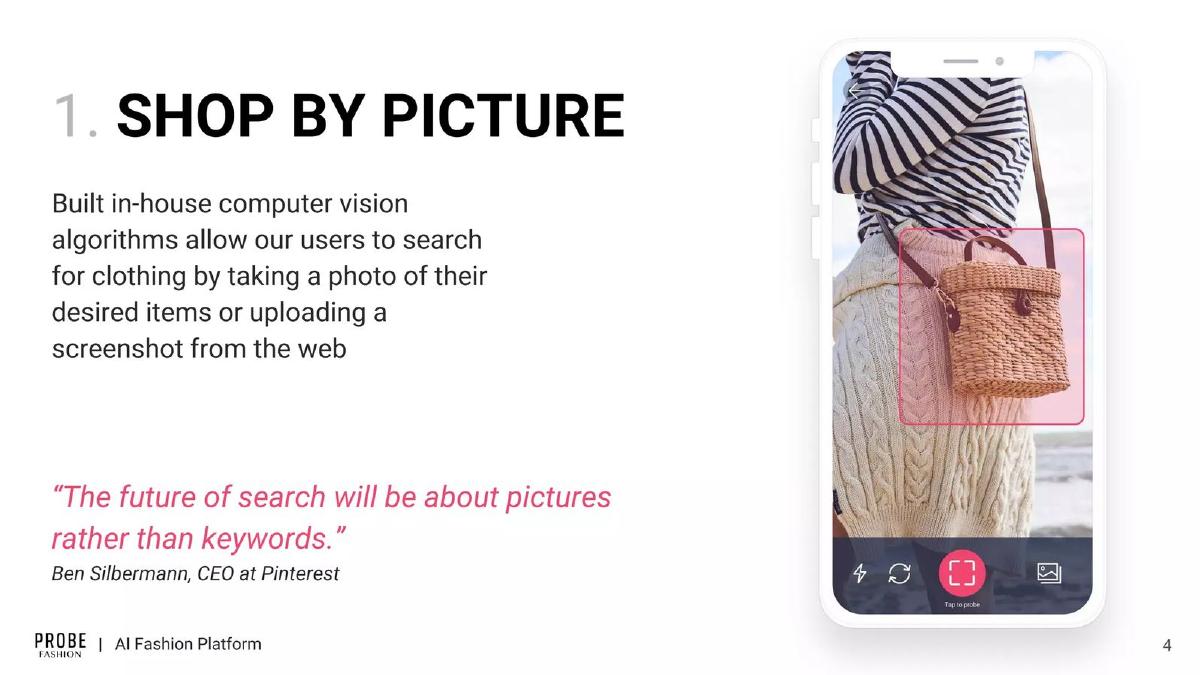
- The platform utilizes in-house computer vision algorithms to allow users to search for clothing via photos or web screenshots (Slide 4).
- Revenue is currently driven by affiliate programs yielding an average of 10% in commissions per in-app purchase (Slide 10).
- The company projects reaching 1.68 million users and $51.24 million in revenue by 2023 (Slide 11).
- Expansion is prioritized in the MENA region, with UAE 'in progress' and plans for Tunisia, Algeria, and South Africa by mid-2020 (Slide 12).
- The technology stack is divided into existing products, items under development, and future SaaS modules (Slide 8).
- Probe Fashion claims a competitive advantage through a dataset of over 1 million labeled fashion-related images (Slide 14).
- The deck lists major retail partners including Farfetch, Amazon, Souq, and Namshi (Slide 15).
- The investment slide seeks a 'seed round' to reach 100,000 active users and $2.5M in revenue within 18 months, but omits the specific funding amount requested (Slide 16).
Introduction and Problem Statement
Slides 1-2: The Vision and the Friction
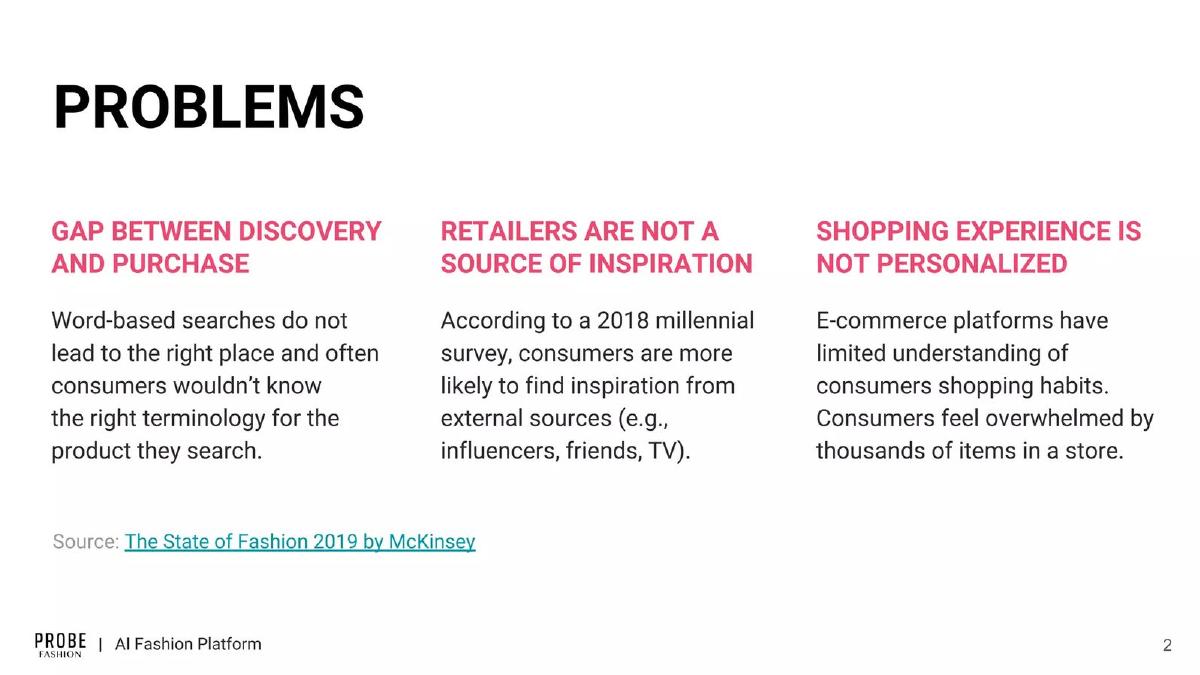
Probe Fashion opens with a standard title slide (Slide 1) identifying itself as an 'AI Fashion Platform.' The deck immediately moves into the 'Problems' (Slide 2), citing a 2019 McKinsey report. The founders identify three core issues: the 'Gap Between Discovery and Purchase,' where word-based searches fail to find specific visual items; the fact that 'Retailers are not a source of inspiration,' forcing users to look to influencers or friends; and a 'Shopping experience [that] is not personalized,' leading to user overwhelm.
The Solution and Product Features
Slides 3-7: The 'One-Stop-Shop' Mobile Experience
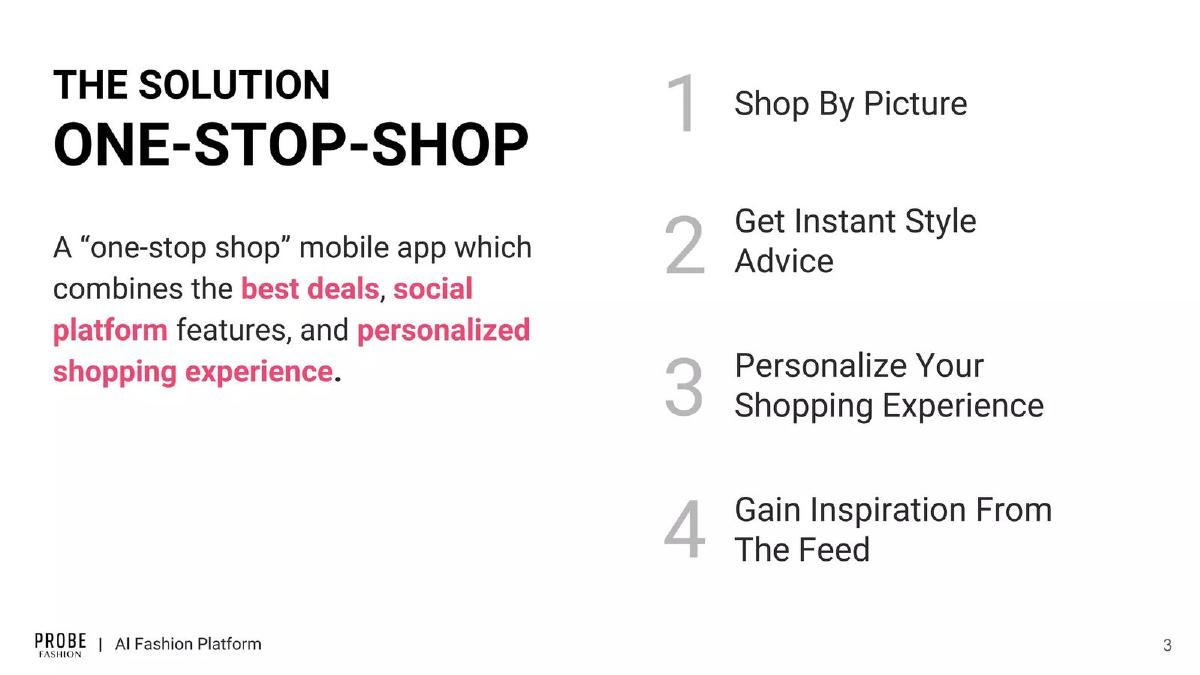
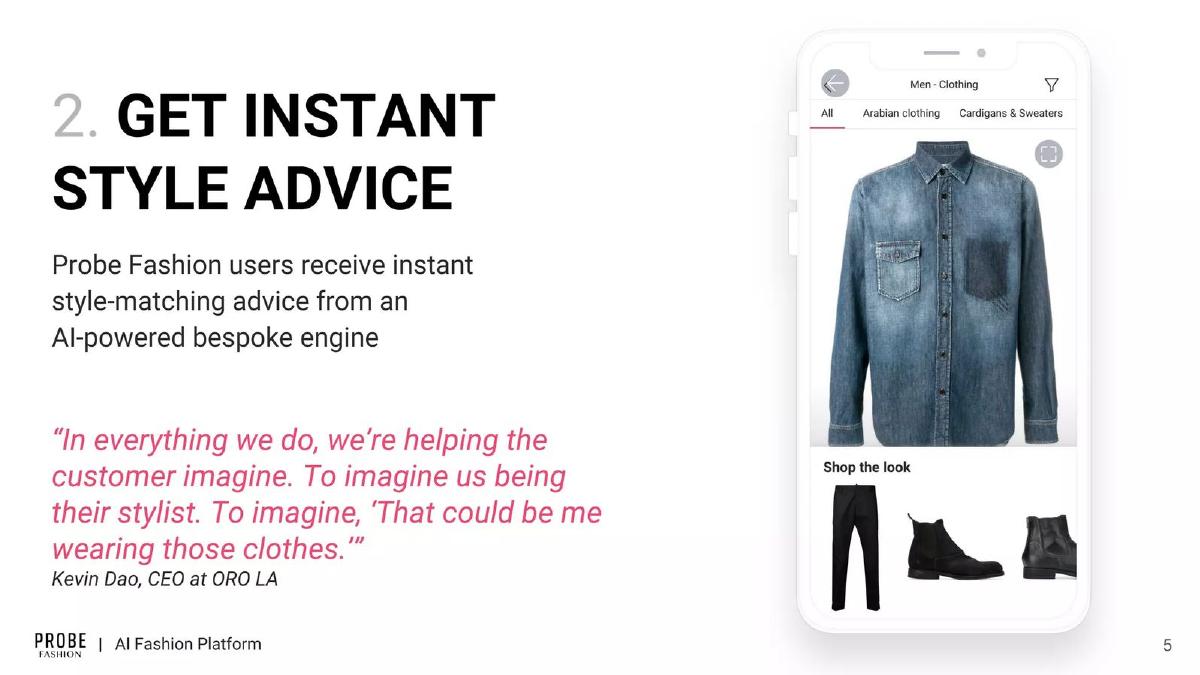
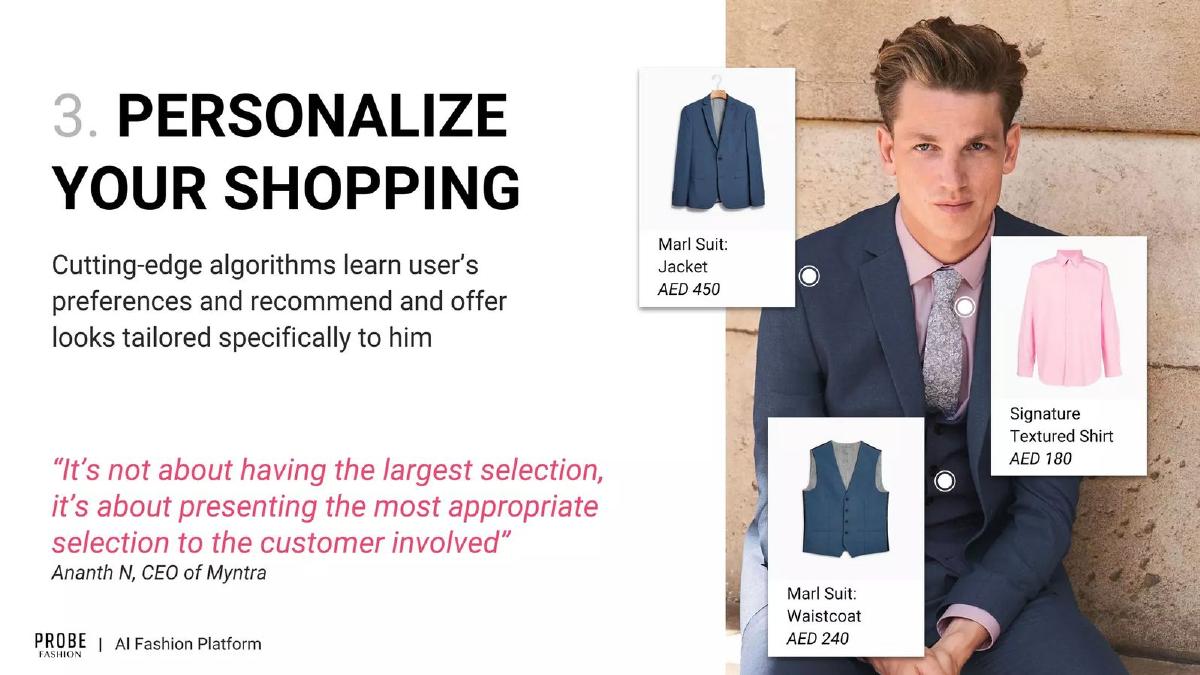
Slide 3 introduces the solution: a mobile app combining deals, social features, and personalization. The product is broken down into four pillars. Shop By Picture (Slide 4) is the lead feature, utilizing in-house computer vision to turn photos into search queries. The slide includes a quote from Pinterest CEO Ben Silbermann to validate the visual search trend. Get Instant Style Advice (Slide 5) introduces an AI-powered bespoke engine for style matching, while Personalize Your Shopping (Slide 6) claims to use algorithms to tailor 'looks' to individual users, showing price points in AED (United Arab Emirates Dirham), such as a 'Marl Suit: Jacket' for AED 450. Finally, Gain Inspiration From The Feed (Slide 7) highlights a social discovery element where AI-editors and friends share items, citing a Shopify report that 43% of purchases are influenced by personalized recommendations.
Technology and Market Opportunity
Slides 8-9: The Technical Roadmap and TAM
Slide 8 provides a transparent look at the 'Technology' stack. It categorizes features into three buckets: 'Existing Product' (Clothing Classifier, Street-to-Shop search), 'Under Development' (Clothing Segmentation, Social Feed), and 'Future Development' (SaaS Platform, Image Similarity Search). This is a strong slide because it differentiates between what is built and what is purely aspirational. Slide 9 addresses the 'Market Opportunity,' showing a bar chart of projected worldwide fashion e-commerce revenue growing from $418B in 2018 to $713B in 2022, based on Shopify data. While these are large numbers, the slide lacks a specific 'Serviceable Obtainable Market' (SOM) calculation for their target MENA region.
Business Model and Growth Projections
Slides 10-12: Revenue and Expansion
The 'Business Model' (Slide 10) is straightforward. The current 'Main Revenue Source' is affiliate programs yielding a 10% commission. Future revenue is expected from B2B SaaS and brand partnerships. Slide 11, 'Growth Projection,' shows an aggressive hockey-stick curve. The company expects to grow from $1.40 million in revenue (2019) to $51.24 million (2023). The user count is projected to grow from 50,000 to 1.68 million in the same period. Slide 12 outlines 'Expansion Plans,' showing a clear focus on the UAE, Middle East, and Asia before attempting to enter the US or EU markets in 2021.
Competitive Landscape and Partnerships
Slides 13-15: Positioning and Validation
Slide 13 uses a standard 2x2 matrix to plot 'Competition.' Probe Fashion positions itself in the top-right quadrant as both 'Personalized' and 'Social,' contrasting itself against 'Catalog-Based' players like Amazon and ASOS, and 'Generic' players like Stitch Fix or Thread. Slide 14 lists 'Competitive Advantages,' including a 'Viral Effect' from the app's network structure and a proprietary dataset of 'Over 1 million labelled fashion-related images.' Slide 15, 'Partners,' displays logos for major retailers like Farfetch, Amazon, Souq, Namshi, and Noon, suggesting the affiliate integrations are already active or in negotiation.
The Ask and Omissions
Slides 16-17: The Investment
Slide 16, 'Investment,' states the company is looking for a 'seed round.' The stated goals are to reach 100,000 active users and $2.5M in revenue within 18 months, and to expand the AI research group. However, the slide does not state how much money is being raised . The final slide (Slide 17) shows the app is 'Available on the App Store' over a background of smiling users. Notably, there is no team slide in the entire 17-slide deck. For a technology-heavy startup claiming 'in-house computer vision algorithms' and a 'strong data science team' (Slide 14), the absence of founder bios or technical credentials is a significant red flag for investors.
What Works and What is Missing
What Works
Clear Product Roadmap: Slide 8 is excellent for technical due diligence, as it clearly separates existing tech from future plans. · Geographic Focus: The expansion plan (Slide 12) shows a logical progression through emerging markets where visual search might have higher utility due to language barriers in traditional search. · Revenue Specificity: Stating a 10% average commission (Slide 10) gives investors a concrete number to use for their own modeling.
What is Missing
The Team: As mentioned, the total absence of a team slide is the deck's biggest weakness. Investors back people, especially at the seed stage. · The Ask Amount: Asking for a 'seed round' without a dollar figure makes the pitch feel incomplete. · Unit Economics: While revenue projections are provided, there is no data on the cost to acquire these users (CAC) or the expected lifetime value (LTV). · Traction to Date: While the UAE is 'in progress,' the deck does not state current active user numbers or actual revenue generated to date, only projections.
Founder Takeaway: What to Copy
Founders should emulate the visual clarity of the product slides (Slides 4-7). By using mockups and clear, numbered value propositions, Probe Fashion makes it very easy to understand how the app works. The Technology roadmap (Slide 8) is also a best-in-class example of how to communicate technical progress without getting bogged down in jargon. However, founders must ensure they include a team slide and a specific funding ask, as these are the two most important components of a seed-stage pitch.
Frequently asked questions
- What is the core technology behind Probe Fashion?
- Probe Fashion relies on in-house computer vision algorithms. According to Slide 4, this enables 'Shop By Picture,' where users upload photos or screenshots to find matching products. Slide 14 further specifies that their competitive advantage is built on a proprietary dataset of over 1 million labeled fashion images, which powers their clothing classifier and image-similarity ranking engines.
- How does the company generate revenue?
- As stated on Slide 10, the current primary revenue source is affiliate commissions, averaging 10% from every in-app purchase. The deck also outlines two projected revenue streams: strategic partnerships with brands for promotion and a B2B SaaS offering where they license their search and recommendation algorithms to other retailers.
- What is the geographic focus of the platform?
- The company is heavily focused on the MENA (Middle East and North Africa) and Asian markets. Slide 12 shows the UAE as the initial market, followed by the Middle East and India in mid-2019, Southeast Asia in late 2019, and East Asia in early 2020. Western markets (US, Canada, EU) are not slated for expansion until late 2020 or early 2021.
- What are the financial projections for Probe Fashion?
- Slide 11 provides a five-year growth projection. It starts at 50,000 users and $1.40 million in revenue for 2019, scaling significantly to 1.68 million users and $51.24 million in revenue by 2023. This represents a highly aggressive growth curve, assuming a consistent revenue-per-user metric as the platform scales.
- What information is missing from the pitch deck?
- The most critical omission is the team slide; there is no mention of the founders, their experience, or the technical staff. Additionally, Slide 16 identifies the need for a 'seed round' but fails to state the specific amount of capital being raised. The deck also lacks detailed unit economics, such as Customer Acquisition Cost (CAC) or Lifetime Value (LTV).