Profound’s Series A deck is a masterclass in narrative-driven fundraising, securing $20M from top-tier investors like Kleiner Perkins and Khosla Ventures. With only 11 slides, the company avoids the clutter of traditional decks to focus on a singular, massive shift: the transition from 'blue links' to 'answer engines.' The deck positions Profound not just as a tool, but as the creator of a new category—AI Optimization (AIO). By highlighting that 10% of U.S. internet users already turn to answer engines first, the deck creates immediate urgency for Fortune 500 brands. While it lacks traditiona…
Key takeaways
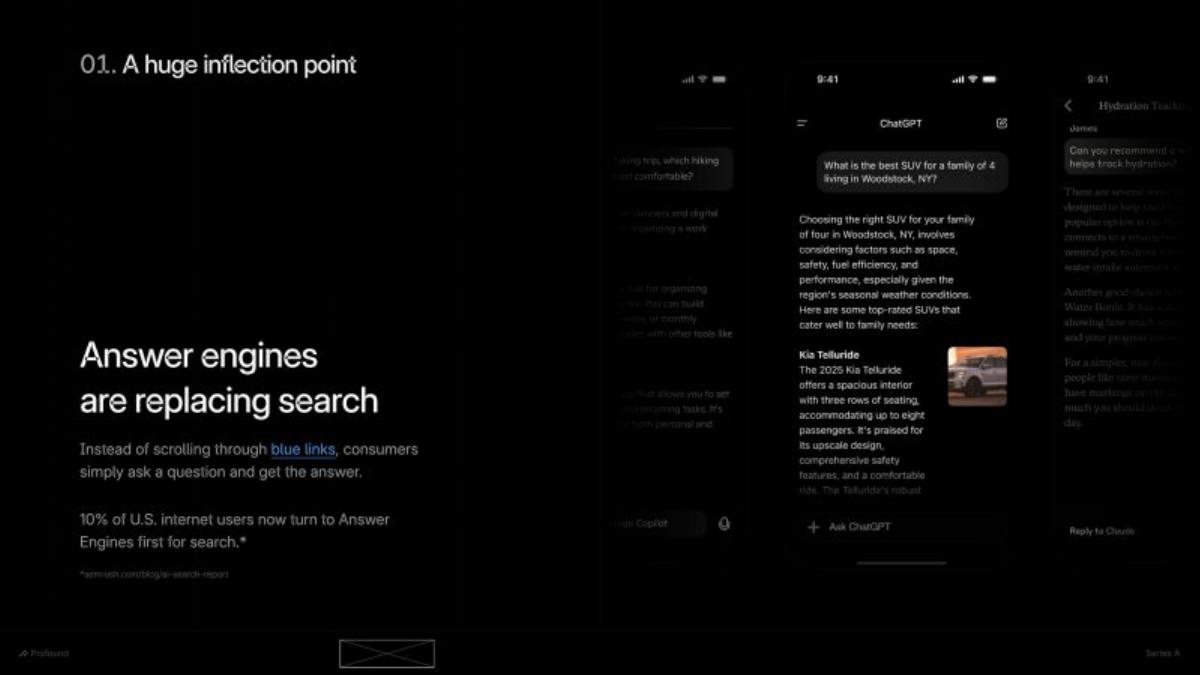
- The deck identifies a major shift where 10% of U.S. internet users now turn to Answer Engines first for search (Slide 2).
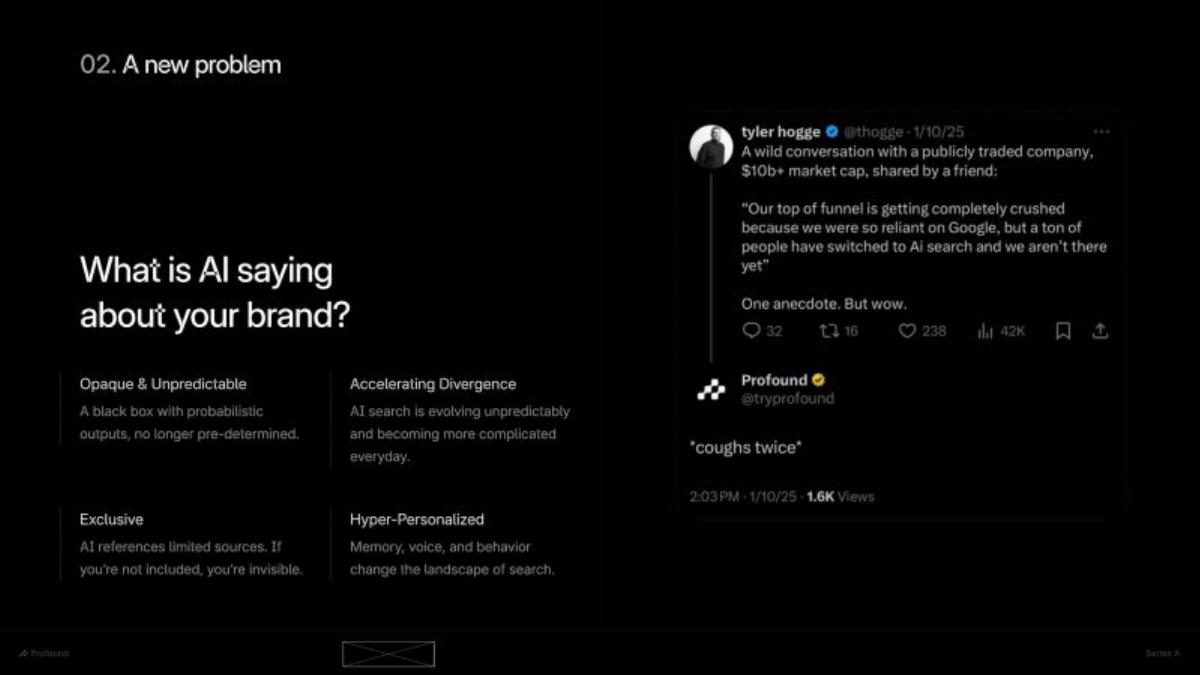
- Profound defines a new problem: AI outputs are 'Opaque & Unpredictable,' making brands 'invisible' if not cited (Slide 3).
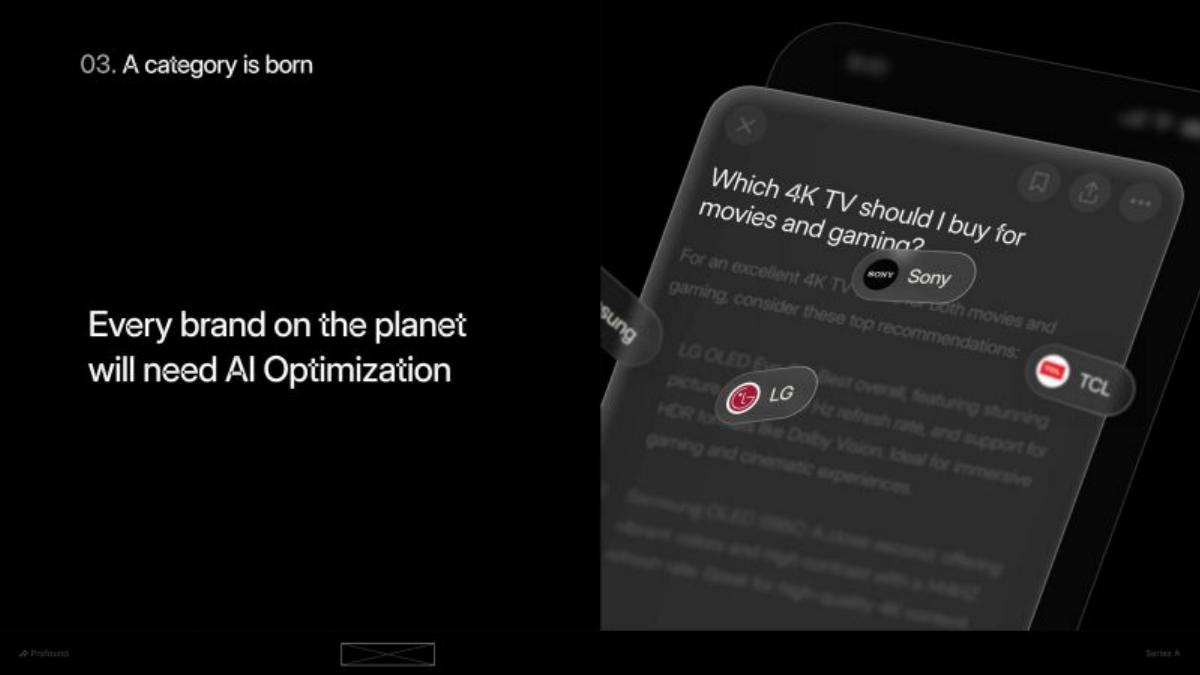
- The company explicitly claims the creation of a new category: AI Optimization (Slide 4).
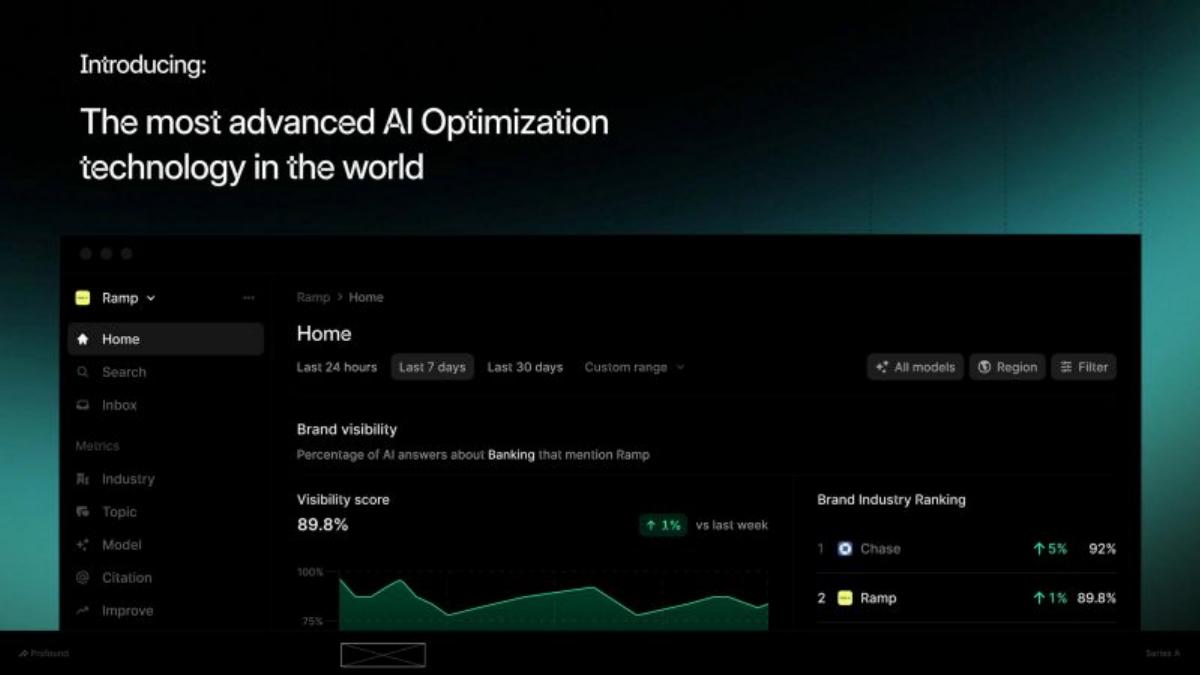
- Product capability is demonstrated through a dashboard showing a 'Visibility score' and 'Brand Industry Ranking' (Slide 5).
- The deck claims that Fortune 500 brands already rely on Profound, though specific logos are obscured in the public version (Slide 6).
- Market opportunity is framed by a projected $215B spend on marketing software by 2027 (Slide 7).
- The founding team has direct pedigree from Uber and the MarTech company Kyra (Slide 8).
- The 'Grand Vision' includes expanding into Generative UI, Agentic browsing, and Voice interfaces (Slide 9).
The Narrative of the Generative Shift
Profound’s Series A deck is a concise 11-slide presentation that prioritizes market narrative over spreadsheet-style data. In the 2025 venture landscape, where AI applications are numerous, Profound differentiates itself by focusing on the infrastructure of brand visibility. The deck is designed to convince investors that a fundamental shift in human behavior—moving from searching to asking—has rendered the multi-billion dollar SEO industry obsolete, creating a vacuum for a new leader in 'AI Optimization.'
Slide 1: Title and Branding
The deck opens with a minimalist black slide featuring the Profound logo and the text Series A . There is no tagline or mission statement on the cover. This suggests a high level of brand confidence and a focus on the stage of the company rather than an immediate explanation of the product.
Slide 2: A Huge Inflection Point
Slide 2 sets the stage by defining the 'Answer Engine' era. It states, "Answer engines are replacing search." The slide contrasts the old behavior of "scrolling through blue links" with the new behavior of simply asking a question. Crucially, it provides a data point to ground this claim: "10% of U.S. internet users now turn to Answer Engines first for search." The visual includes a mockup of a ChatGPT interface recommending a Kia Telluride, illustrating the real-world stakes for brands.
Slide 3: A New Problem
Slide 3 articulates the pain point for enterprises. It asks, "What is AI saying about your brand?" It lists four characteristics of the current AI landscape that make it a problem for marketers:
Opaque & Unpredictable: A black box with probabilistic outputs. · Exclusive: AI references limited sources; if you aren't included, you're invisible. · Accelerating Divergence: AI search is evolving unpredictably. · Hyper-Personalized: Memory and behavior change the landscape.
The slide also features a tweet from Tyler Hogge mentioning a $10B+ market cap company whose top-of-funnel is being "crushed" because of the shift to AI search.
Slide 4: A Category is Born
This slide is the pivot from problem to solution. It boldly claims, "Every brand on the planet will need AI Optimization." By naming the category (AI Optimization or AIO), Profound positions itself as the inevitable leader of a new industry, much like companies in the early 2000s did with SEO. The visual shows brand logos like Sony, LG, and TCL floating over an AI response, reinforcing the idea of brand placement within generative text.
Slide 5: Introducing the Solution
Profound reveals its product interface here, described as "The most advanced AI Optimization technology in the world." The dashboard shows a "Visibility score" of 89.8% for the company Ramp, tracking how often they are mentioned in AI answers about "Banking." It also shows a "Brand Industry Ranking" where Ramp is compared to Chase. This slide proves that the company has moved beyond theory into a functional analytics platform.
Slide 6: Fortune 500 Validation
Slide 6 is a social proof slide. It states, "Fortune 500 brands rely on Profound for AI Optimization." While the specific logos are not visible in this version of the deck, the claim is intended to signal that the product has already achieved enterprise-grade product-market fit. This is a critical slide for a Series A, as it moves the conversation from "this might work" to "this is already working for the world's largest companies."
Slide 7: Market Opportunity
Profound frames its Total Addressable Market (TAM) by looking at the broader MarTech spend. It cites that "$150B+ will be spent on marketing software in 2025" and that this is "Projected to exceed $215B by 2027." The slide argues that every major platform shift (Dot-com, Mobile, Social) has created a "huge MarTech brand," and the "Generative" era (starting in 2022) will be no different, aiming for "Decacorn" status.
Slide 8: The Team
The People slide highlights the founders' pedigrees. James Cadwallader (CEO) previously co-founded Kyra, a MarTech company. Dylan Babbs (CTO) comes from Uber, where he worked on geospatial and data products. The supporting team is shown with logos from AMD, Amazon, 6sense, Attentive, HubSpot, and Microsoft , suggesting a blend of deep engineering talent and enterprise sales experience.
Slide 9: Our Grand Vision
Slide 11 (labeled as 11 in the deck) outlines the roadmap. The goal is to "Empower brands to win the generative internet." The future of information discovery, according to Profound, includes:
Generative UI · Memory and personalization · Voice interface · Generative advertising · Shopability · Custom indexing · Agentic browsing · Consumer hardware developments
This slide tells investors that Profound isn't just a dashboard; it's an ecosystem play for the future of how humans interact with machines.
Slide 10: Closing
The deck concludes with a simple "Thank You" and the URL tryprofound.com . There is no specific call to action or fundraising amount listed on this slide.
What Profound Does Well
The deck excels at category creation . Instead of saying "we are an AI analytics tool," they say "we are the AI Optimization (AIO) platform." This is a powerful psychological trick in fundraising because it suggests that if the category succeeds, the leader of that category (Profound) will naturally become a decacorn. The use of external validation—like the tweet from a known tech executive and the 10% market adoption stat—makes the problem feel urgent and real rather than theoretical.
What is Missing
The most notable omissions are financials and the ask . There is no mention of current Revenue, Monthly Recurring Revenue (MRR), or growth rates. While they mention Fortune 500 customers, they don't disclose the number of customers or the average contract value (ACV). Additionally, the deck does not state how much money they are raising or how they intend to spend it. This suggests the deck was likely used as a visual aid for a conversation where those details were handled separately, or that the company's momentum was so high that the narrative alone was the primary selling point.
What Founders Should Copy
Founders should emulate the "Inflection Point" slide. Every great pitch deck needs to answer the question "Why now?" Profound answers this by pointing to a specific shift in consumer behavior (the 10% stat). If you can prove that the world changed six months ago and that old tools no longer work in this new world, you have a compelling reason for an investor to write a check today. Furthermore, the clean, high-contrast design of the deck reflects a modern, tech-forward brand that appeals to top-tier VCs like Kleiner Perkins.
Frequently asked questions
- What is the core problem Profound is solving?
- Profound addresses the 'invisibility' of brands in the age of generative AI. As consumers move from traditional search engines (blue links) to answer engines like ChatGPT or Perplexity, brands lose visibility if the AI does not mention them. Slide 3 describes AI as a 'black box' where outputs are no longer pre-determined, creating a need for brands to track and optimize their presence within these probabilistic models.
- How does Profound define its market category?
- The company uses the term 'AI Optimization' (AIO). Slide 4 explicitly states that 'Every brand on the planet will need AI Optimization,' positioning it as the successor to Search Engine Optimization (SEO). They argue that just as the dot-com, mobile, and social eras birthed massive MarTech brands, the 'generative internet' will birth a new 'MarTech Decacorn' (Slide 7).
- What metrics does the deck use to show traction?
- The deck is light on hard internal growth metrics but heavy on market validation. It cites that 10% of U.S. internet users are already using answer engines first (Slide 2). On Slide 6, it claims that 'Fortune 500 brands rely on Profound,' and Slide 5 shows a functional dashboard with a 'Visibility score' of 89.8% for a sample client, Ramp.
- Who are the founders and what is their background?
- The team is led by CEO James Cadwallader, who previously co-founded the MarTech company Kyra, and CTO Dylan Babbs, a former Software Engineer and Product Designer at Uber who worked on geospatial and data products. The broader team includes talent from AMD, Amazon, HubSpot, and Microsoft (Slide 8).
- What is missing from this pitch deck?
- This is a high-level narrative deck. It lacks a slide detailing the specific 'Ask' (how much they are raising and on what terms), a breakdown of current Revenue/ARR, unit economics (CAC/LTV), and a detailed competitive landscape. It relies on the 'huge inflection point' and team pedigree to carry the pitch rather than granular financial data.