Project Terraform is an Indian industrial startup that converts waste materials like fly-ash, bagasse-ash, and industrial sludge into eco-friendly bricks and custom concrete products. Operating five plants in Maharashtra, the company has reached its first anniversary and is seeking 3.8 Crores (approximately $450,000 USD) at a 12 Crore valuation to fund land acquisition and equipment modernization. The deck is notable for its heavy focus on technical material composition and rigorous testing standards, such as IS:3495 compliance. However, it lacks a traditional market size analysis (TAM/SAM/SO…
Key takeaways
- The company utilizes four specific waste streams: Fly-Ash, Bagasse-Ash, Quarry Dust, and Industrial Sludge (Slide 1).
- Operations are currently localized to five plants across the state of Maharashtra, India (Slide 1).
- Product transparency is high, with specific material ratios provided for three distinct brick types (Slide 2).
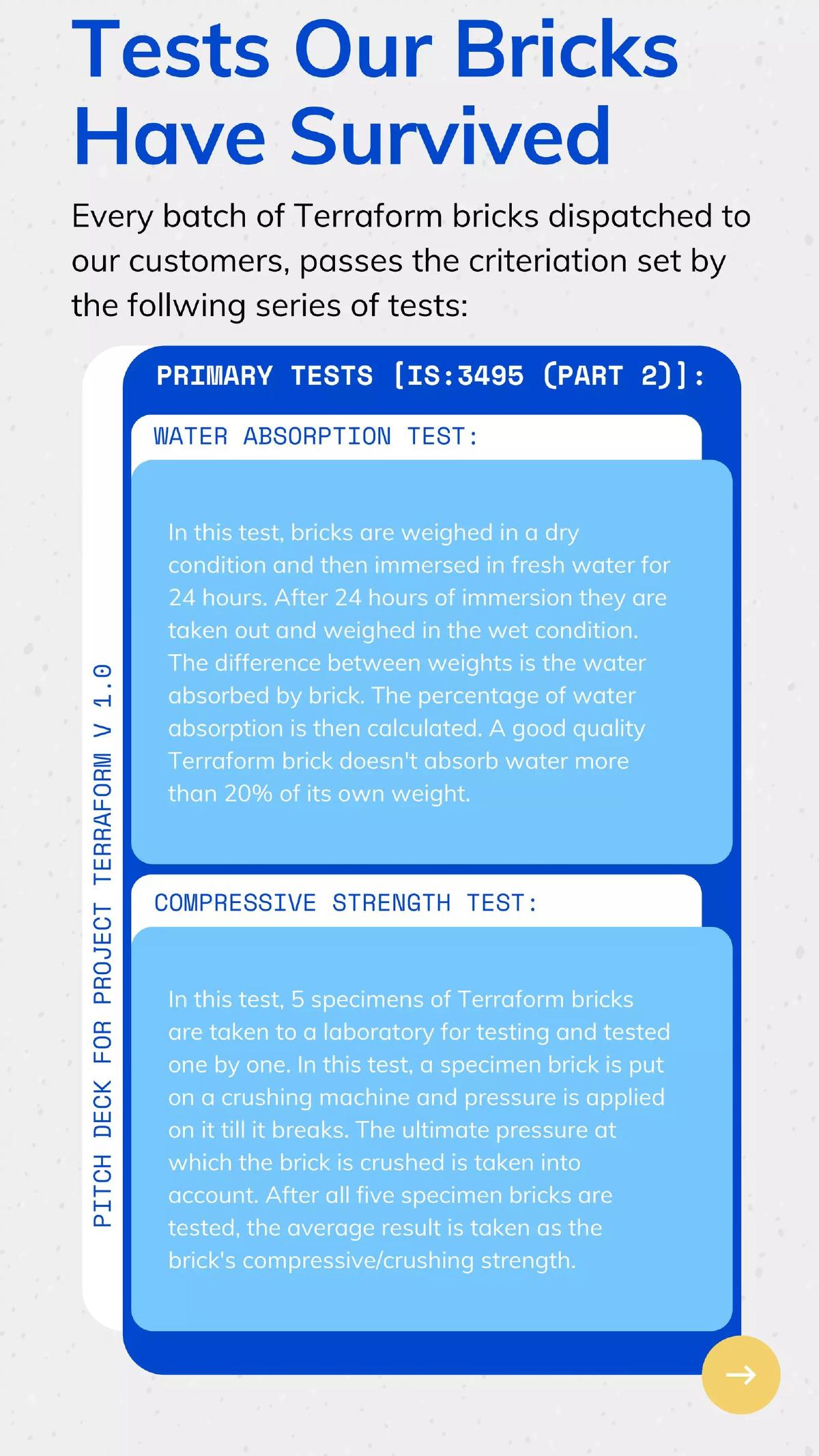
- Technical validation is a core focus, citing IS:3495 (Part 2) standards for water absorption and compressive strength (Slide 3).
- The business model includes a 'Customization Services' arm producing non-brick items like benches, clocks, and lighting (Slide 4).
- The startup has developed an internal 'Employee Performance Tracking App' to manage sales and customer lists (Slide 5).
- Expansion costs are heavily weighted toward land (150 Lacs) and manpower (100.50 Lacs) (Slide 6).
- The investment ask is 3.8 Crores based on a DCF-derived valuation of 12.0 Crores (Slide 7).
Executive Summary and Mission
Slide 1: Company Introduction
The deck opens with a clear mission statement: eliminating industrial wastes such as Fly-Ash, Bagasse-Ash, Quarry Dust, and Industrial Sludge to create eco-friendly bricks. The company, Project Terraform , highlights its immediate traction by noting it is one year old and already operates 5 plants across Maharashtra. This is a strong start for a hardware/industrial pitch, as it proves the concept has moved beyond the laboratory and into multi-site production.
Product Composition and Technical Specs
Slide 2: Material Ratios
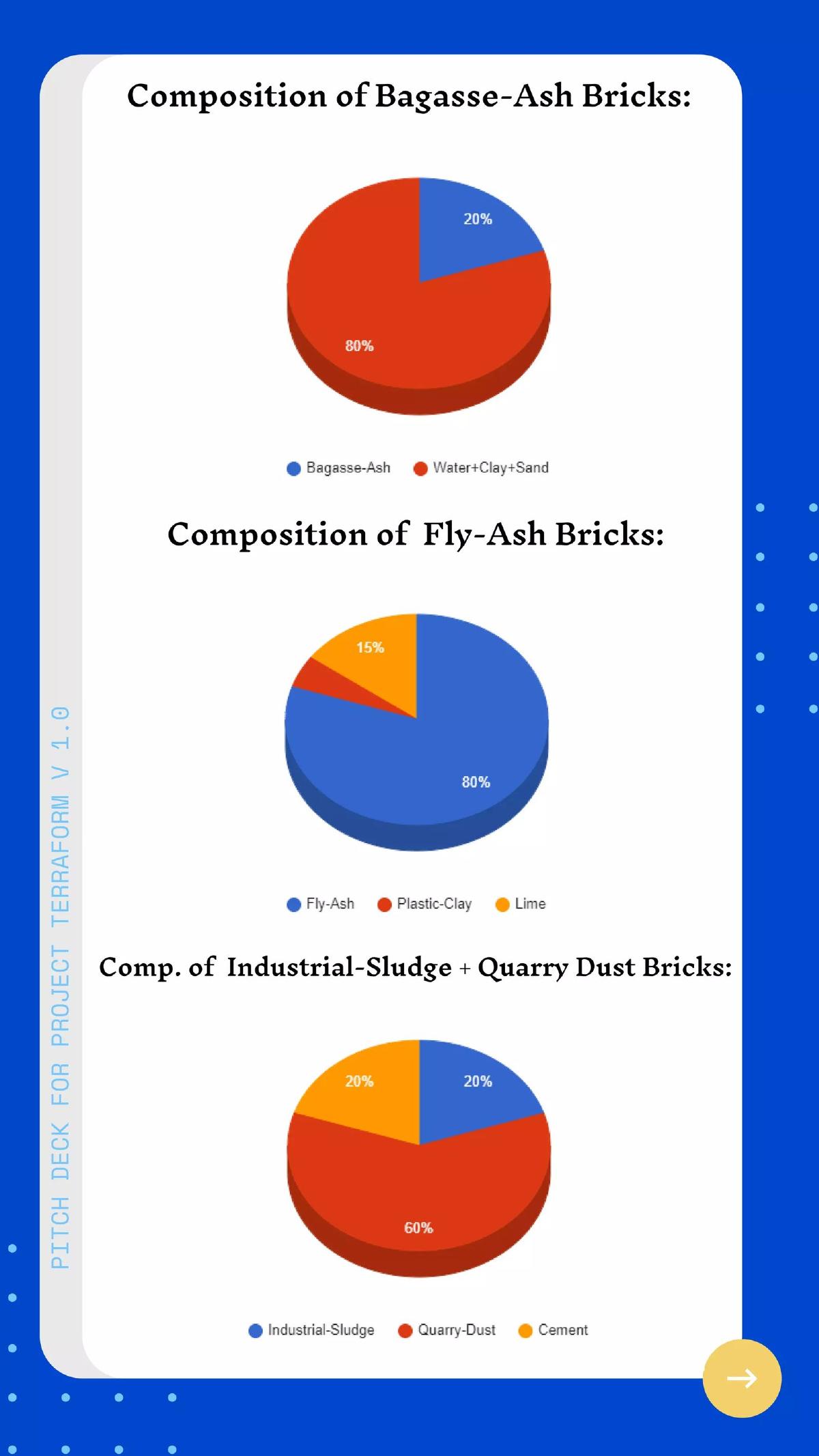
Slide 2 provides transparency into the manufacturing process through three pie charts. The Bagasse-Ash Bricks consist of 20% ash and 80% water/clay/sand. The Fly-Ash Bricks are more waste-heavy, utilizing 80% fly-ash, 15% lime, and 5% plastic-clay. Finally, the Industrial-Sludge + Quarry Dust Bricks use a mix of 20% sludge, 60% quarry dust, and 20% cement. Providing these ratios helps investors understand the raw material dependencies and the potential margins associated with low-cost waste inputs.
Slide 3: Quality Assurance and Testing
For a construction startup, safety and standards are paramount. Slide 3 details the IS:3495 (Part 2) testing protocols the bricks undergo. It specifically outlines the Water Absorption Test (limit of 20% weight gain) and the Compressive Strength Test . By citing specific Indian Standards (IS), the company builds technical credibility, assuring potential partners that these 'waste' bricks meet the structural requirements of the building industry.
Value Proposition and Diversification
Slide 4: USPs and Customization
The company identifies two primary Unique Selling Propositions: a Low Cost Profile and Customization Services . The slide includes a collage of non-brick products, including concrete benches, circular outdoor tables, minimalist clocks, and pendant lighting fixtures. This suggests the company is not just a commodity brick manufacturer but a design-oriented concrete firm capable of higher-margin architectural products.
Slide 5: Operational Technology
Interestingly, the deck includes a slide dedicated to an internal Employee Performance Tracking App . The screenshots show a mobile interface for sales performance, lead optimization, and customer management. The customer list includes prominent names like Lodha Group , Godrej Properties , and Mahindra Lifespaces . While the app itself might not be the core product, its existence suggests a level of operational sophistication and a data-driven approach to managing a distributed workforce across five plants.
Financial Analysis and Investment Ask
Slide 6: Expansion Costs and Break-even
Slide 6 provides a granular breakdown of the 384.00 Lacs (3.84 Crores) needed for expansion. Land is the primary driver at 150 Lacs, followed by Manpower at 100.50 Lacs. The Break-even Analysis shows a 'Sales Realization' target of 337.50 Lacs against total costs, resulting in a Break-Even Point (BEP) of 20.46% of targeted sales. This is a relatively low BEP, which could be attractive to investors, though the deck does not specify the timeframe to reach these targets.
Slide 7: Valuation and Use of Funds
The company sets its valuation at 12.0 Crores based on a Discounted Cash Flow (DCF) method. They are requesting a 3.8 Cr investment. The utility of funding is categorized into three buckets: acquiring land, modernizing equipment, and marketing/labor. This slide is direct, though investors would likely require the underlying DCF model to justify the 12 Crore valuation for a one-year-old company.
Slide 8: Team and Contact
The final slide lists the core team: Siddhanth Nadkarni (CEO), Harshita Khemka , Aman Aditya , Bryan Jose , and Aditya Patil . While the roles are clear, the slide lacks any information regarding their previous experience, education, or industry expertise. The contact section includes a 'beta version' website and a Gmail address, which may signal the early-stage nature of the corporate infrastructure.
What Project Terraform Does Well
The deck excels at technical transparency . By showing the exact composition of their bricks and the specific industrial standards they meet, they preemptively answer concerns about the structural integrity of recycled materials. The inclusion of the 'Customization Services' slide also shows a path toward higher-margin revenue streams beyond bulk construction materials. Furthermore, the mention of five existing plants provides immediate proof of execution that many seed-stage startups lack.
What is Missing from the Deck
Market Opportunity: There is no slide detailing the Total Addressable Market (TAM). Investors need to know the size of the Indian brick market and the volume of industrial waste available to be processed. · Competitive Landscape: The deck does not mention other fly-ash brick manufacturers or traditional clay brick competitors. Explaining why Project Terraform wins against established players is a critical omission. · Founder Pedigree: The team slide is a list of names. In early-stage fundraising, the 'Why You?' is as important as the 'What?'. The lack of bios or LinkedIn links makes it difficult to assess the team's ability to scale a heavy industrial business. · Revenue History: While the break-even analysis is present, there is no mention of actual revenue generated in the first year of operations.
Founder Takeaways
1. Lead with Traction: Project Terraform correctly highlights their 5-plant footprint on the first slide. For physical businesses, showing that you can actually build and operate facilities is the best way to de-risk the investment. 2. Standardize Your Quality: If you are in a regulated industry like construction, citing specific codes (like IS:3495) is non-negotiable. It proves you aren't just 'making things' but are building a compliant enterprise. 3. Show, Don't Just Tell, Your Tech: The inclusion of the internal app screenshots (Slide 5) serves as a 'trust signal.' It shows the founders are thinking about scalability and management systems, even if the app isn't the product they are selling. 4. Be Specific with the Ask: The financial table on Slide 6 is a model for clarity. Instead of asking for a lump sum, they broke it down into land, machinery, and even furniture, which helps investors see exactly where their capital will be deployed.
Frequently asked questions
- What is the primary value proposition of Project Terraform?
- The company focuses on environmental remediation by diverting industrial waste from landfills and converting it into construction materials. By using materials like fly-ash and bagasse-ash, they offer a 'Low Cost Profile' for bricks while providing eco-friendly alternatives to traditional clay bricks, which often deplete topsoil.
- How does the company validate the quality of its recycled bricks?
- According to slide 3, the company adheres to IS:3495 (Part 2) testing standards. This includes a Water Absorption Test, where bricks must not absorb more than 20% of their weight, and a Compressive Strength Test, where five specimens are crushed in a laboratory to determine their average load-bearing capacity.
- What are the specific financial requirements for their expansion?
- The company identifies a total expansion cost of 384.00 Lacs (3.84 Crores). The largest line items are Land at 150 Lacs, Manpower at 100.50 Lacs, and Plant and Machinery at 66 Lacs. They also allocate smaller amounts for marketing, furniture, and working capital margins.
- What is the current scale of the business?
- As stated on slide 1, Project Terraform is one year old and currently operates five manufacturing plants. All existing locations are situated within Maharashtra, India. The deck also lists several major Indian real estate developers, such as Lodha Group and Mahindra Lifespaces, in their customer tracking app.
- What is missing from this pitch deck that an investor might expect?
- The deck lacks a competitive landscape analysis and a clear 'Problem' slide that quantifies the waste crisis. It also omits detailed professional backgrounds for the five-person leadership team. Furthermore, there is no mention of current revenue or historical growth, only 'Sales Realization' targets in the break-even analysis.