98point6 Technologies utilized this 18-slide deck to secure $30.7M in 2023, as reported by Business Insider. The presentation serves as a masterclass in 'pivot storytelling,' detailing the company's transition from a direct-to-consumer virtual clinic to a B2B technology licensor. By highlighting a track record of 500,000 text-based visits and the acquisition of their care delivery arm by Transcarent, the deck argues that their technology is 'battle-tested.' The narrative focuses on solving provider burnout and optimizing physical footprints for regional health systems. While the deck is light…
Key takeaways
- The company successfully completed its 500,000th text-based visit in February 2023, providing a massive data set for product optimization (Slide 5).
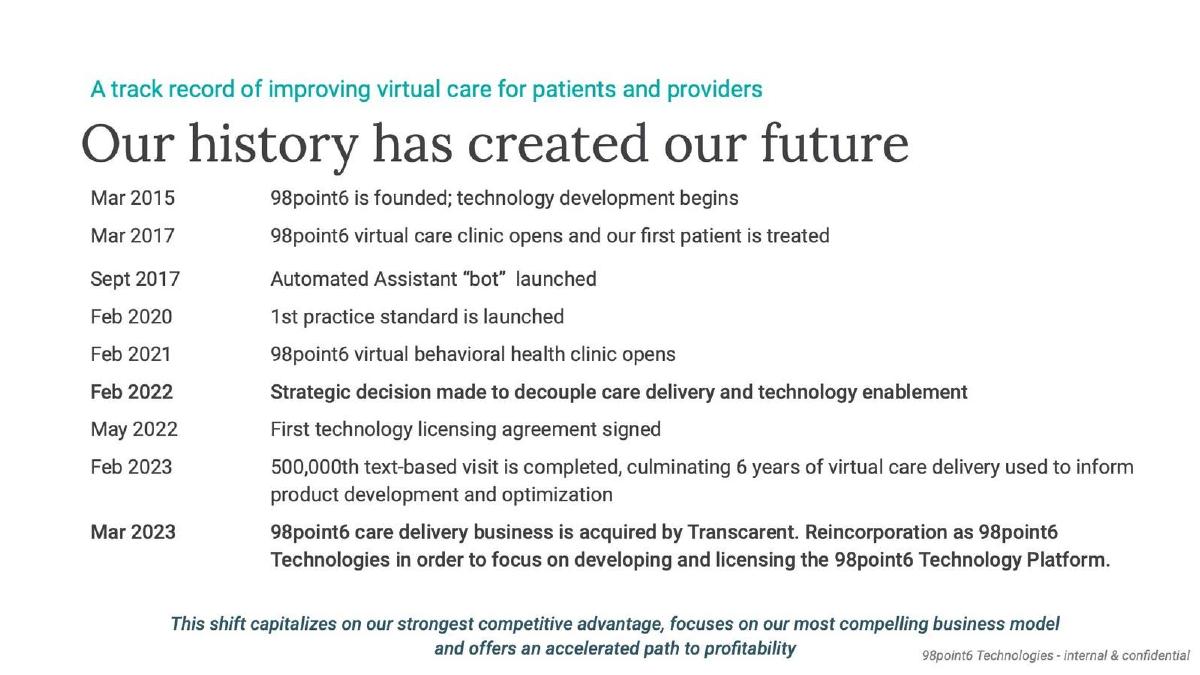
- A major strategic pivot occurred in March 2023 when the care delivery business was acquired by Transcarent, allowing the company to reincorporate as 98point6 Technologies (Slide 5).
- The platform targets a ~20% daily reduction in excess provider capacity by operating a linked network across single locations (Slide 15).
- The core product is delivered via an SDK, allowing health systems to maintain their own branding while using 98point6's virtual care infrastructure (Slide 13).
- The technology stack includes an automated assistant 'bot' launched in September 2017 and ML/AI capabilities for full visit transcript analysis (Slides 5, 17).
- The value proposition for health systems is built on four pillars: Expertise, Access, Integration, and Extension (Slide 11).
- The deck omits a traditional 'Team' slide, 'Competitor' matrix, and specific 'Ask' details, focusing instead on the shift in business model (Slides 1-18).
- The company emphasizes 'asynchronous care' and 'text-first' modalities as the primary drivers for reducing provider cognitive burden (Slide 16).
The Strategic Pivot: From Clinic to Core Infrastructure
98point6 Technologies occupies a unique space in the 2023 digital health landscape. Having spent years building a direct-to-consumer virtual clinic, the company made the bold move to sell off its clinical arm to Transcarent and focus entirely on the software that powered it. This deck is the narrative vehicle for that transition. It aims to convince investors that the company's 'battle-tested' technology is more valuable as a licensed utility for health systems than as a standalone clinic. The $30.7M raised suggests that the market agreed with this 'arms dealer' approach to virtual healthcare.
Slides 1-2: The New Identity
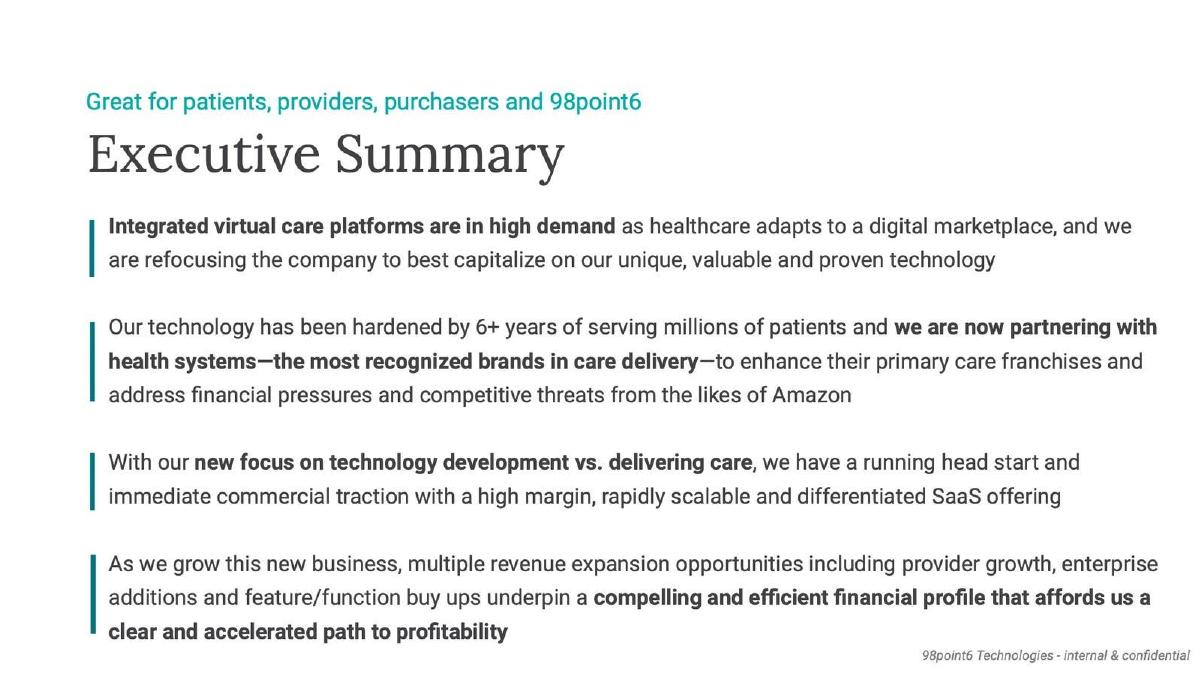
Slide 1 introduces the company as 98point6 Technologies, with the tagline 'Digital healthcare for a competitive edge.' This is a subtle but important shift from their previous consumer-facing branding. Slide 2 provides an executive summary that sets the stage for the pivot, though the text captured focuses on the high-level vision of enabling health systems to master the patient experience.
Slides 3-5: Defining the Market and the History
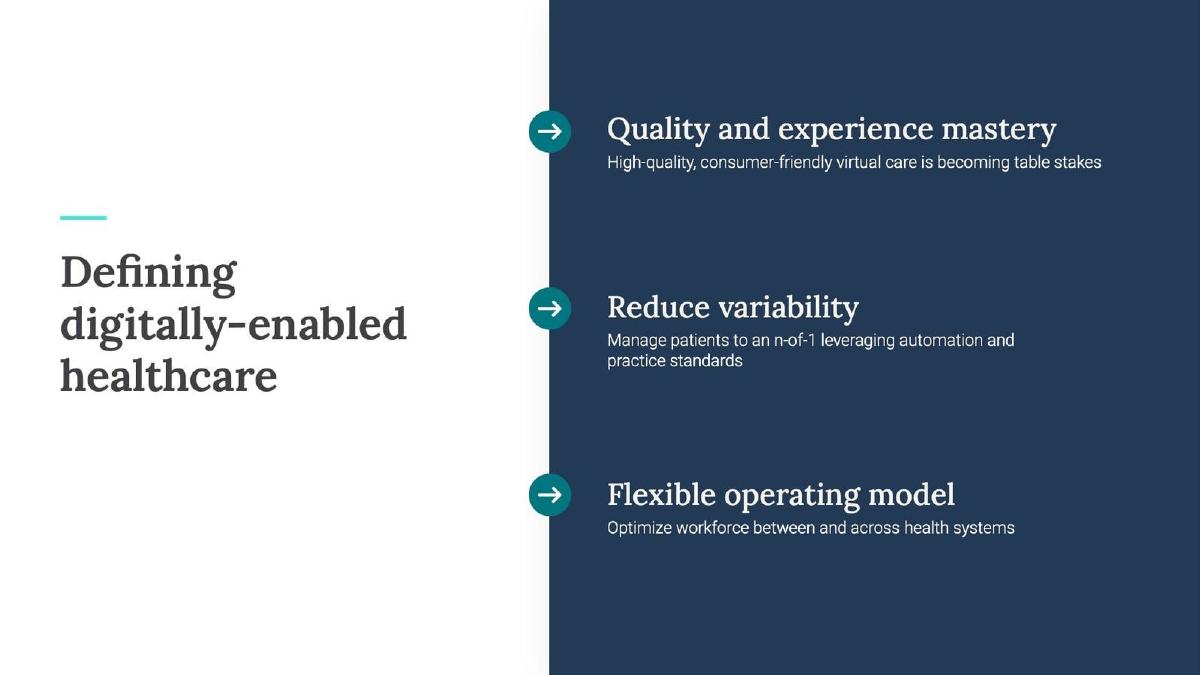
Slide 3 defines 'digitally-enabled healthcare' through three pillars: quality mastery, reduced variability, and flexible operating models. This slide serves to educate the investor on the company's specific philosophy—that virtual care is no longer a luxury but 'table stakes.'
Slide 5 is perhaps the most critical slide in the deck. It provides a timeline of achievements that justifies the pivot. Key milestones include the founding in 2015, the launch of the 'Automated Assistant' bot in 2017, and the completion of the 500,000th text-based visit in February 2023. The timeline concludes with the March 2023 acquisition of the care delivery business by Transcarent. By framing the pivot as a 'strategic decision to decouple care delivery and technology enablement,' the company positions the move as a proactive optimization rather than a retreat from the clinic space. The slide explicitly states this shift offers an 'accelerated path to profitability.'
Slides 6-9: The Market Necessity
Slide 7 addresses the 'Why Now?' question, citing COVID-19, increasing pressure on providers, and a shift toward home diagnostics as catalysts. Slide 8 and 9 detail how the company is shifting its scope. The focus moves from a narrow clinic model to a broad technology support system for health institutions. The narrative here is that health systems are desperate for 'advanced digital capabilities' that they cannot build themselves, and 98point6 is the ready-made solution.
Slides 10-12: The Value Proposition for Health Systems
Slide 10 and 11 introduce the concept of 'Strategic Collaboration.' The value proposition is broken down into Expertise, Access, Integration, and Extension. Slide 12 describes the product as a 'digital wrapper' to power care models. This is a sophisticated way of saying they provide the plumbing and the interface, while the health system provides the doctors and the brand. This reduces the friction for health systems that are wary of losing their patient relationships to third-party virtual providers.
Slides 13-15: Product Delivery and ROI
Slide 13 showcases the SDK (Software Development Kit) in action. It displays a series of mobile screens under the 'Sample Health' brand, demonstrating how the 98point6 technology can be white-labeled. The screens show a text-based interface, provider search results, and a care plan transcript. This visual proof is essential for a B2B pitch.
Slide 15 tackles the financial justification. It claims the platform generates an 'immediate and attractive ROI' by reducing provider burnout and optimizing physical footprints. A specific metric is provided here: the platform can utilize excess provider capacity, which typically sits at '~20% daily' at a single location. By linking a network of locations through the platform, that capacity can be reclaimed.
Slides 16-18: The Technology Edge
The final slides focus on the technical 'moat.' Slide 16 emphasizes the 'text-first' and 'asynchronous' nature of the care. This is presented as a benefit for both patients (convenience) and providers (efficiency). Slide 17 discusses 'Actionable Insights,' noting that because the care is text-based, every interaction is captured in a full transcript. This allows for ML/AI analysis that goes beyond traditional chart notes. Slide 18 concludes by highlighting how automation technology standardizes care delivery, ensuring that every patient receives the same high level of service regardless of the specific provider.
What 98point6 Technologies Does Well
The deck excels at provenance . Many SaaS startups pitch 'what if' scenarios; 98point6 pitches 'what we already did.' By citing 500,000 completed visits (Slide 5), they remove the technical risk from the investor's mind. The technology isn't a prototype; it's a veteran system that has already handled half a million patients.
The white-label strategy is also clearly articulated. Slide 13's visual demonstration of the SDK is the most effective way to show how they solve the 'brand dilution' problem that plagues many health systems when they partner with digital health companies. They aren't competing with the health system; they are empowering it.
What is Missing from the Deck
The most glaring omission is a Team Slide . While the company's history is well-documented, the specific leadership team driving this new 'Technologies' entity is not introduced in these 18 slides. In a $30M venture round, the pedigree of the engineering and sales leadership is usually a top-tier concern for investors.
There is also a lack of Competitive Landscape analysis. The virtual care and health-tech licensing space is crowded with players like Teladoc, Amwell, and various white-label startups. The deck assumes the investor already understands why 98point6 is superior to these incumbents without providing a direct comparison matrix.
Finally, the Unit Economics and Financial Projections are absent. While Slide 15 mentions ROI for the customer , it does not detail the revenue model for 98point6 (e.g., per-member-per-month fees vs. licensing fees) or the projected path to the 'accelerated profitability' mentioned on Slide 5.
Founder Takeaways: The Pivot Playbook
Founders looking to pivot should study Slide 5. It doesn't hide the change in direction; it frames it as the logical evolution of the company's 'strongest competitive advantage.' If you are moving from a service model to a software model, you must prove that the service years were actually a long-term R&D phase for the software.
Additionally, the use of a 'digital wrapper' or SDK concept (Slide 12 and 13) is a powerful way to pitch to enterprise clients. It signals that you understand their biggest fear—losing the customer relationship—and that your product is designed to protect their brand rather than replace it. This 'enabler' positioning is often much easier to fund than a 'disruptor' positioning in highly regulated, institutional markets like healthcare.
Frequently asked questions
- What is the primary product 98point6 Technologies is selling?
- Following their pivot, the company no longer provides direct patient care. Instead, they license their '98point6 Technology Platform' to health systems. This is delivered via an SDK that integrates into a health system's existing patient access points, providing a 'digital wrapper' for virtual care, including automated intake bots and text-based provider interfaces.
- How does the company justify its ROI to health systems?
- According to Slide 15, the ROI is generated by four factors: increasing specialty and in-patient referrals through better engagement, reducing provider burnout, optimizing the physical footprint by shifting walk-in visits to digital, and utilizing excess provider capacity, which they estimate at approximately 20% daily.
- What happened to the original 98point6 clinical business?
- As detailed on Slide 5, the care delivery business was acquired by Transcarent in March 2023. This allowed the remaining entity to reincorporate as 98point6 Technologies and focus exclusively on software licensing, which they claim offers an 'accelerated path to profitability.'
- What role does AI play in their platform?
- The platform uses an 'Automated Assistant' bot for initial patient intake and ML/AI for analyzing full visit transcripts. Slide 17 notes that these transcripts allow for quality control that goes 'beyond analysis of chart notes,' enabling searchable treatment protocols and clinical research opportunities.
- Who is the target customer for this new business model?
- The deck specifically identifies 'regional health systems' as the primary target. The goal is to help these systems provide 'table stakes' virtual care while retaining their own trusted brand through the 98point6 SDK, rather than outsourcing patients to a third-party clinic.