98point6’s 2023 Series E deck is a masterclass in narrative-driven pivoting. After raising and investing over $250M into their own virtual clinic, the company made the strategic decision to sell their care delivery business to Transcarent and reincorporate as 98point6 Technologies. This deck justifies that shift by positioning their 6+ years of clinical data as the 'moat' for a new B2B SaaS model. By licensing their technology to health systems, they aim to solve provider burnout and competitive threats from giants like Amazon. While the deck is light on traditional financial tables, it leans…
Key takeaways
- The company successfully raised $30.7M in 2023 from Activant Capital following a major pivot (Catalogue facts).
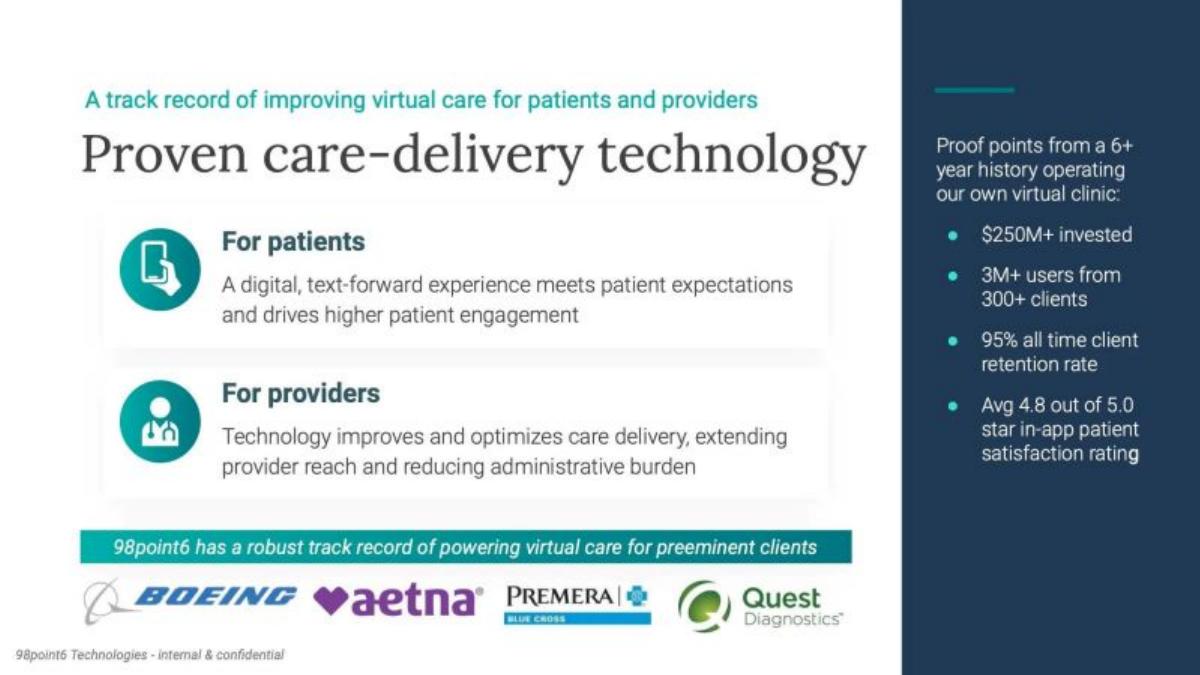
- 98point6 invested over $250M into their technology and served 3M+ users before deciding to license the platform (Slide 6).
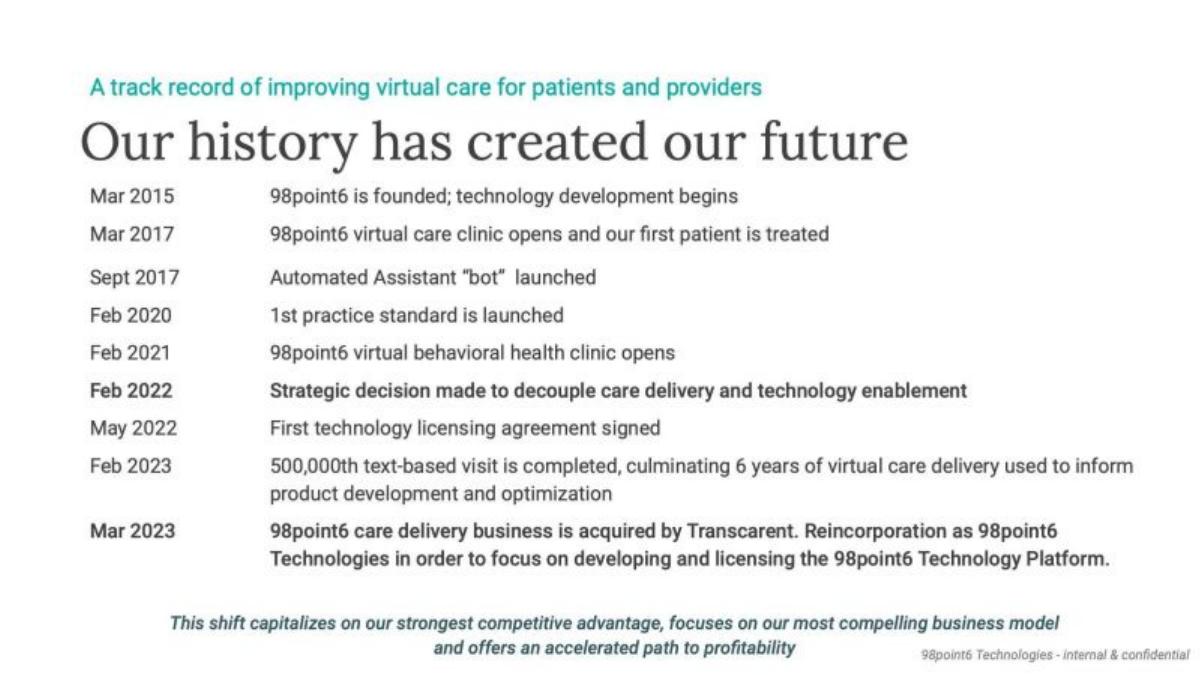
- The 'care delivery business' was acquired by Transcarent in March 2023, allowing the company to focus solely on technology licensing (Slide 5).
- The new business model shifts from low-cost membership fees to high-margin SaaS licensing for health systems (Slide 8).
- Automation technology has reduced the number of questions a doctor must ask during a visit from 100% to less than 20% (Slide 18).
- The platform has maintained a 95% all-time client retention rate with an average 4.8/5.0 patient satisfaction rating (Slide 6).
- The deck identifies Amazon and other PE-backed solutions as primary competitive threats to traditional health systems (Slide 10).
- Evidence-based algorithmic practice standards are currently deployed for 5 conditions, representing approximately 35% of all visits (Slide 18).
The Strategic Pivot: From Clinic to Core Infrastructure
The 98point6 Series E deck is a fascinating example of a company 'selling the shovel' after years of 'digging for gold.' Having built a massive virtual clinic infrastructure, the company realized that their proprietary technology was more valuable as a licensed product for others than as a standalone service. This teardown explores how they communicated this massive shift to investors in 2023.
Slides 1-2: The Executive Reintroduction
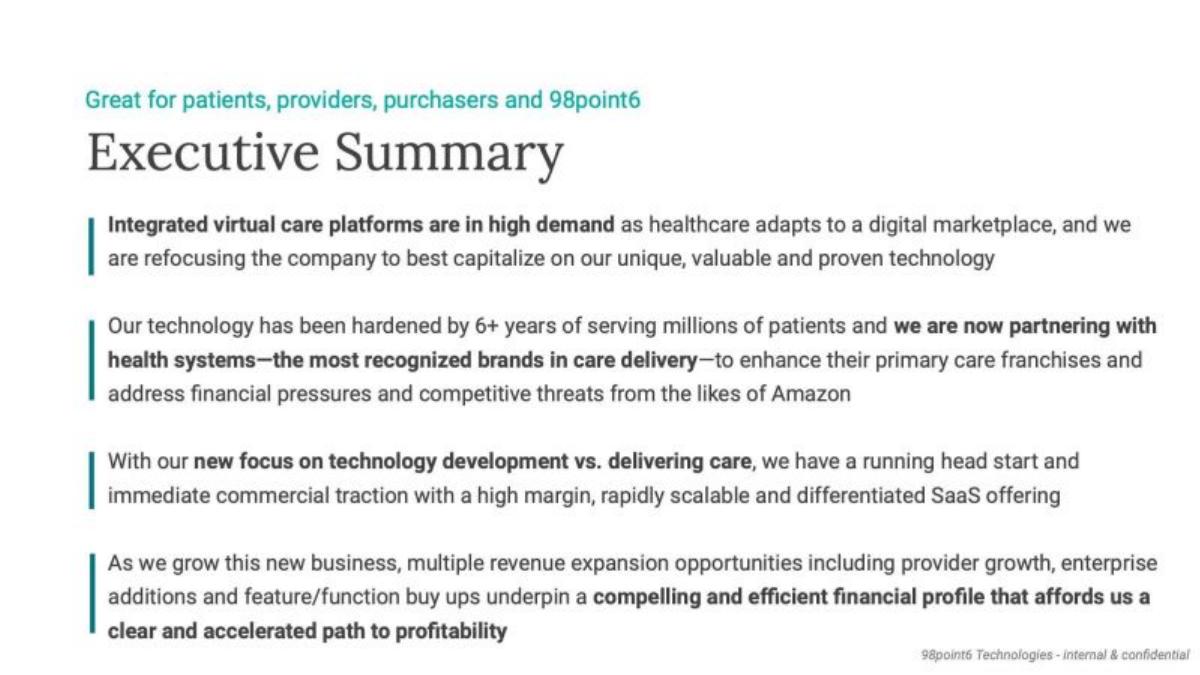
Slide 1 introduces the entity as 98point6 Technologies , a subtle but critical distinction from their previous branding. The tagline, 'Digital healthcare for a competitive edge,' immediately signals that this is now a B2B play. Slide 2 provides a dense Executive Summary . It explicitly states they are 'refocusing the company' to capitalize on 'proven technology.' The key takeaway here is the mention of 6+ years of data and millions of patients, which serves to de-risk the new SaaS model. They aren't a new software company; they are a veteran clinic operator turning their internal tools into a product.
Slides 3-5: Defining the New Reality and History
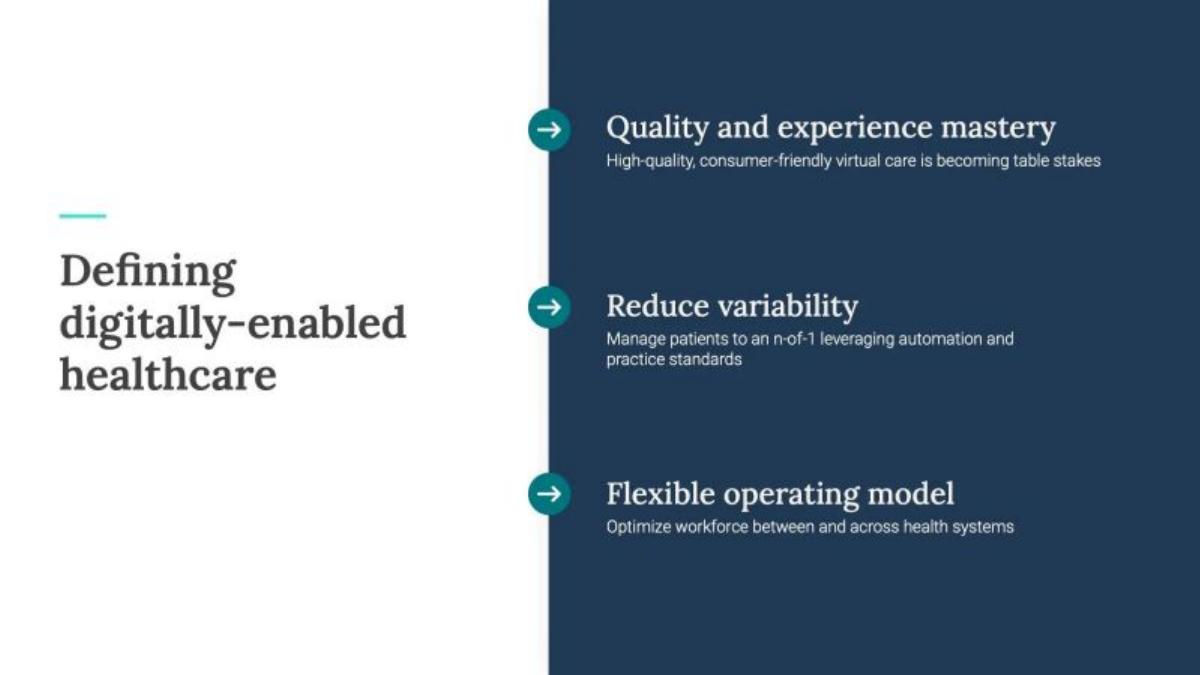
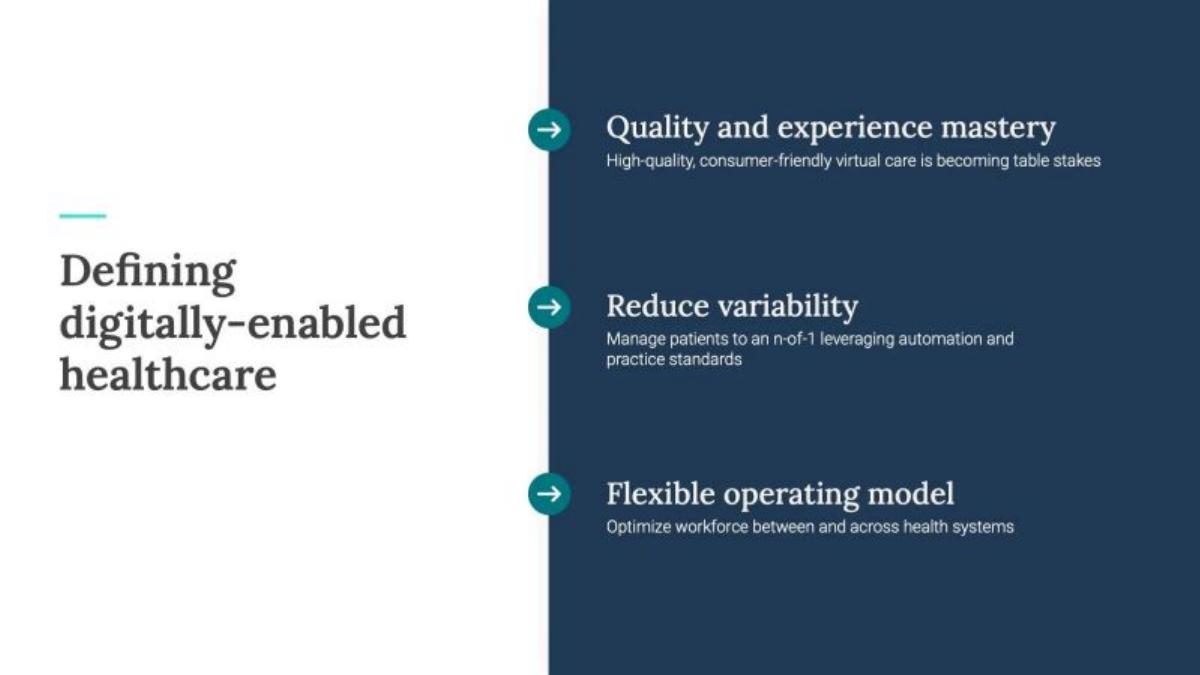
Slides 3 and 4 are identical 'Defining digitally-enabled healthcare' transition slides, focusing on quality mastery, reducing variability, and flexible operating models. Slide 5 is the most important narrative slide in the deck. It provides a timeline from March 2015 to March 2023 . It highlights the launch of their AI 'bot' in 2017 and the 'strategic decision' in February 2022 to decouple care delivery from technology. Crucially, it notes that in March 2023, the care delivery business was acquired by Transcarent . This explains the 'why' behind the fundraise: they are now a lean technology company needing capital to scale a licensing business.
Slide 6: The $250M Proof Point
Slide 6 serves as the 'Traction' slide, but it uses historical data to validate future potential. It claims $250M+ invested in the technology to date. It boasts 3M+ users from 300+ clients and a 95% all-time client retention rate . By showcasing logos like Boeing, Aetna, and Quest Diagnostics, 98point6 establishes that their technology has already passed the procurement hurdles of the world's largest organizations.
Slides 7-8: The Market Shift and Business Model Comparison
Slide 7 addresses the 'COVID-19' effect, noting that virtual care is no longer a luxury but a necessity. Slide 8 is a side-by-side comparison of the '98point6 clinic' vs. '98point6 Technologies.' This is a vital slide for investors to understand the change in unit economics. The Business Model shifts from 'Low cost, membership-based' to 'SaaS licensing.' The Clinic Workforce shifts from 'FTE physicians' (high overhead) to 'Health system providers' (zero overhead for 98point6). This slide effectively argues that the new model is significantly more scalable and higher margin.
Slides 9-11: Strategic Collaboration with Health Systems
Slide 10 identifies the pain points of modern health systems: Rising competition (Amazon), Financial pressure (negative margins), and Deficient assets (physician burnout). It positions 'Strategic collaboration' as the only viable path forward compared to 'Building' (too slow) or 'Buying' (no purpose-built solutions). Slide 11 uses a 'cross' graphic to show how 98point6 provides the 'Access, Expertise, Extension, and Integration' that these systems lack.
Slides 12-13: The Product and SDK
Slide 12 describes the 'Digital wrapper'—a combination of a patient-facing app, a clinician console, and an automated assistant. It emphasizes Secure EMR data exchange , which is the technical 'holy grail' in health-tech. Slide 13 shows the SDK (Software Development Kit) in action, demonstrating how a health system can maintain its own branding ('Sample Health') while using 98point6's underlying tech stack. This 'white-label' approach is a key selling point for established health brands.
Slides 14-15: Unlocking ROI
Slide 15 gets into the 'meat' of the value proposition for regional health systems. It claims the platform can reduce provider burnout by relieving cognitive burden and optimize expensive physical footprints by moving walk-in visits to digital channels. It also mentions utilizing excess provider capacity , noting that operating a linked network can shrink excess capacity at single locations by approximately 20% daily.
Slides 16-18: Patient and Provider Experience
Slide 16 focuses on engagement, noting that >65% of patients access their Care Plan post-visit. Slide 17 discusses 'Actionable insights,' highlighting that full visit transcripts allow for better quality control than traditional chart notes. Slide 18 is the 'money slide' for efficiency. It shows a chart of Active clinician time dropping significantly from 2017 to 2023. It states that their technology has reduced questions asked by the doctor from 100% to and that their algorithmic standards represent ~35% of all visits with >74% physician agreement .
What 98point6 Does Well
Narrative Clarity: The deck does an excellent job of explaining a complex corporate restructuring. It doesn't hide the fact that they sold off half the company; it frames it as a deliberate move toward a better business model. · Validation via History: By citing the $250M already spent, they make the current 'SaaS' version of the product seem like a bargain that has already been 'hardened' by real-world clinical use. · Focus on Efficiency: In a post-2022 venture environment, 'efficiency' is more attractive than 'growth at all costs.' The metrics on slide 18 regarding reduced clinician time are exactly what Series E investors want to see.
What is Missing from the Deck
The Team: There is no team slide. While the brand is well-known, a Series E round usually requires a look at the leadership executing the pivot. · The Ask: The deck does not state how much they are raising or what the specific valuation expectations are. · Financial Projections: There are no slides showing ARR (Annual Recurring Revenue) growth, CAC (Customer Acquisition Cost), or LTV (Lifetime Value) for the new SaaS model. · Competitors: While Amazon is mentioned as a threat to their customers, there is no mention of other health-tech infrastructure competitors like Zus Health or Particle Health.
What Founders Should Copy
The 'We Have Changed' Slide: Slide 8 is a perfect template for any company undergoing a pivot. It clearly defines the 'Old Way' vs. the 'New Way' across six different dimensions (Scope, Model, Data, etc.). · The ROI Slide: Slide 15 speaks the language of the buyer. It doesn't just say 'our tech is cool'; it says 'we save you money on your physical footprint and reduce your staff turnover.' · The Efficiency Chart: The 'Active clinician time' chart on slide 18 is a powerful visual. It shows a clear downward trend over six years, proving that the software is actually getting better at its primary job: saving time.
Frequently asked questions
- What is the primary business model shift described in the deck?
- 98point6 transitioned from being a direct provider of virtual care (the '98point6 clinic') to a technology partner ('98point6 Technologies'). As shown on slide 8, they moved from a low-cost, membership-based model for employers to a SaaS licensing model for health systems. This allowed them to decouple their proprietary technology from the high-overhead burden of employing a full-time clinical workforce.
- How does 98point6 justify its competitive advantage in a crowded telehealth market?
- The company leans on its 'hardened' history. Slide 6 notes they have invested over $250M and managed 3 million users. They argue that their technology is not just a theoretical tool but one refined by 6 years of operating their own clinic. Slide 18 specifically highlights their ability to automate the 'gather findings' phase, which accounts for 50% of a clinician's active time.
- Who are the target customers for the new 98point6 Technologies platform?
- The focus has shifted from employers and health plans to 'health systems and healthcare organizations' (Slide 8). The deck positions the platform as a way for these traditional systems to compete with digital-native threats like Amazon and to address negative margins in primary care settings (Slide 10).
- What specific metrics does the deck use to prove product-market fit?
- Slide 6 lists several key 'proof points': a 95% all-time client retention rate, an average 4.8/5.0 star patient satisfaction rating, and a history of serving 300+ clients including Boeing, Aetna, and Quest Diagnostics. Additionally, slide 16 notes that over 65% of patients access their Care Plan or chat transcript post-visit, indicating high engagement.
- What is missing from this Series E pitch deck?
- Despite being a late-stage round, the deck is surprisingly thin on financial specifics. There is no slide detailing the 'Ask' (amount being raised), no cap table information, no team slide featuring leadership, and no detailed P&L projections. It functions more as a strategic vision document than a traditional data-heavy Series E investor presentation.