How healthcare startups show competition in a pitch deck: name the real alternative (standard of care, in-house builds, incumbents) and compare on evidence.
Healthcare Competition Slide: Who You Really Compete With, and How to Prove You're Better
In healthcare, the competitor is often not another startup. It can be the current standard of care, a face-to-face clinician, a customer's in-house team or a large insurer. This guide compares ten real healthcare competition slides on two questions: did they name the alternative a buyer would actually choose, and did they back the comparison with evidence a clinician or buyer would accept?
TL;DR
Name the alternative your buyer uses today, then compare on the outcome that buyer is judged on, with a source. Ada Health charts condition coverage, accuracy and advice safety against competing symptom apps and GPs and cites the study behind them, though the study found GPs more accurate than the slide's "similar to GPs" suggests. Brain Backups names the imaging agent clinicians use now (DaTscan) and says its product runs on the same GE hardware. BrightInsight and 98point6 name the option most healthcare buyers really weigh: building it themselves. Slides that claim "no competitors" (Call the Doc), list claims with no evidence (BrainySmith), or name consumer wellness apps for a clinical product (VibeBuddy) leave the investor to find the real competition alone.
Healthcare competition slides from real pitch decks
Each example shows the exact stored slide above its analysis and links to the full teardown. The most complete comparisons (named alternative, buyer-relevant outcome, and a checkable basis) come first; a citation alone does not decide the order. Claims are as shown on the slides; checks and comments are ours.
Ada Health competition slide — slide 7
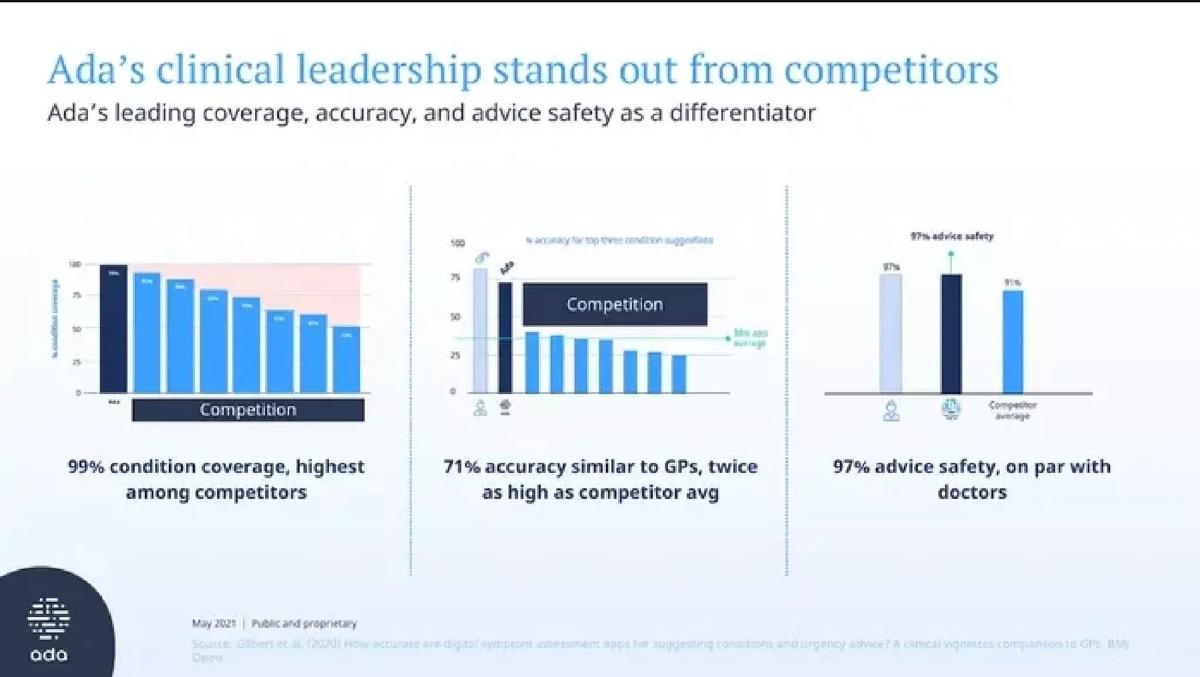
AI symptom assessment app, Series B deck dated May 2021. Three bar charts against competing apps and GPs.
Ada Health deck, slide 7. Exact stored slide matched to this analysis.
Our analysis: A comparison on outcomes a clinician or health buyer would care about, with a citation a reader can check. The citation supports the coverage, rival-accuracy and safety claims, but not the accuracy parity with GPs.
Evidence and limitation: What the study establishes (Gilbert et al., BMJ Open 2020, abstract): 200 primary-care vignettes, not real patients, tested on eight apps and seven GPs. Ada covered 99.0% of conditions, the highest of the apps. Top-3 condition accuracy was 70.5% for Ada, 23.5–43.0% for the other apps (about 33% on average, so "twice as high" holds) and 82.1% on average for GPs, so "similar to GPs" overstates it: GPs were about 12 points higher, and the authors conclude no app outperformed GPs. Safe urgency advice was 97.0% for Ada and for GPs, which supports "on par with doctors"; Symptomate scored 97.8%, so Ada was not the safest app on that measure. The slide's competitor bars are unlabelled.
What a founder can adapt: Chart two or three outcomes against named rivals and the clinician benchmark, and put the study reference on the slide. Word each claim to match what the study measured, including where you trail the benchmark.
Supporting analysis
What the deck claims: "Ada's clinical leadership stands out from competitors." "99% condition coverage, highest among competitors." "71% accuracy similar to GPs, twice as high as competitor avg." "97% advice safety, on par with doctors." Source line: Gilbert et al. (2020), a clinical vignettes comparison with GPs published in BMJ Open.
Presentation choice: It compares on accuracy and safety, not features, and puts the doctor on the same chart, which is the right benchmark, though here the study shows Ada below the GP average on accuracy.
When it does not fit: Competitor bars are unlabeled, so a reader can't tell which app is which. Name them, or say why you can't.
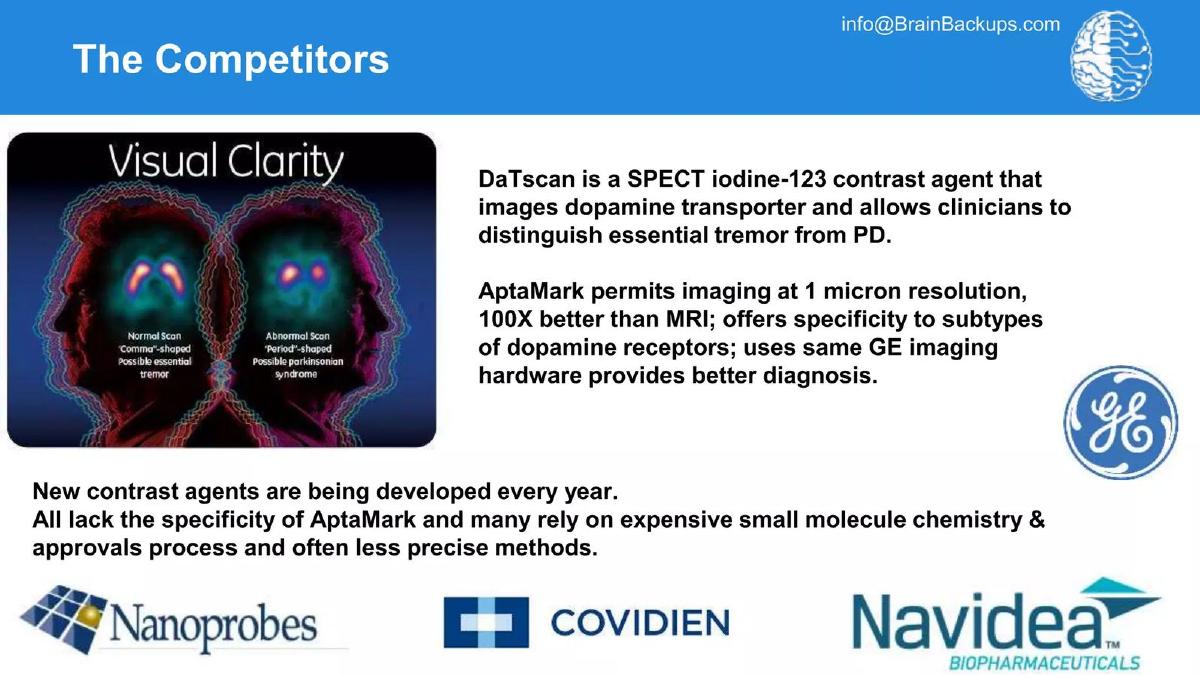
Imaging agent for Parkinson's diagnosis (AptaMark). Series A deck. Names today's agent and three other developers.
Brain Backups deck, slide 7. Exact stored slide matched to this analysis.
Our analysis: It names the standard of care and answers the switching question: clinicians keep their existing GE scanners.
Evidence and limitation: "1 micron" and "100X better than MRI" are stated without a source. The comparison is to MRI, while the named incumbent is DaTscan, which uses SPECT; the slide does not compare AptaMark directly with DaTscan's resolution.
What a founder can adapt: Name the test or treatment clinicians use now and state what would have to change for them to use yours (equipment, training, billing).
Supporting analysis
What the deck claims: "DaTscan is a SPECT iodine-123 contrast agent that images dopamine transporter and allows clinicians to distinguish essential tremor from PD." "AptaMark permits imaging at 1 micron resolution, 100X better than MRI; offers specificity to subtypes of dopamine receptors; uses same GE imaging hardware provides better diagnosis." Logos: Nanoprobes, Covidien, Navidea.
Presentation choice: In diagnostics, fitting existing equipment removes the biggest barrier to adoption. Saying so on the competition slide is more useful than another feature claim.
When it does not fit: Compare against the incumbent you named, on the same measure. Here the "100X" figure is against MRI, not DaTscan.
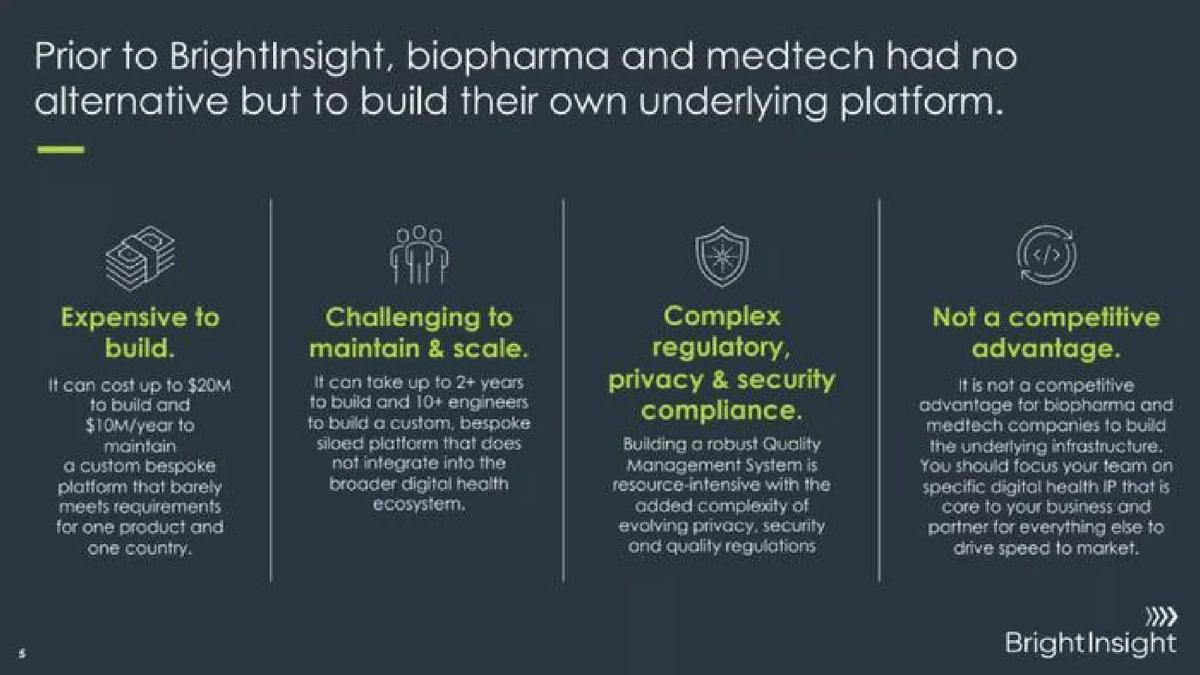
Regulated digital health platform sold to biopharma and medtech companies. Growth-stage deck.
BrightInsight deck, slide 5. Exact stored slide matched to this analysis.
Our analysis: The competitor is the customer's own engineering team, and the slide prices that option in money, time and regulatory work.
Evidence and limitation: Cost and time figures are stated as upper bounds ("up to") with no source.
What a founder can adapt: If buyers could build it, estimate what that costs them in money, months and compliance work, and say where the estimate comes from.
Supporting analysis
What the deck claims: "Prior to BrightInsight, biopharma and medtech had no alternative but to build their own underlying platform." "It can cost up to $20M to build and $10M/year to maintain." "It can take up to 2+ years to build and 10+ engineers." "Complex regulatory, privacy & security compliance." "Not a competitive advantage."
Presentation choice: For enterprise healthcare buyers, "build it ourselves" is usually the real alternative. Putting a cost on it frames the purchase as cheaper and faster than the default.
When it does not fit: "No alternative but to build" leaves out other vendors. Name them, even briefly, or investors will assume you haven't looked.
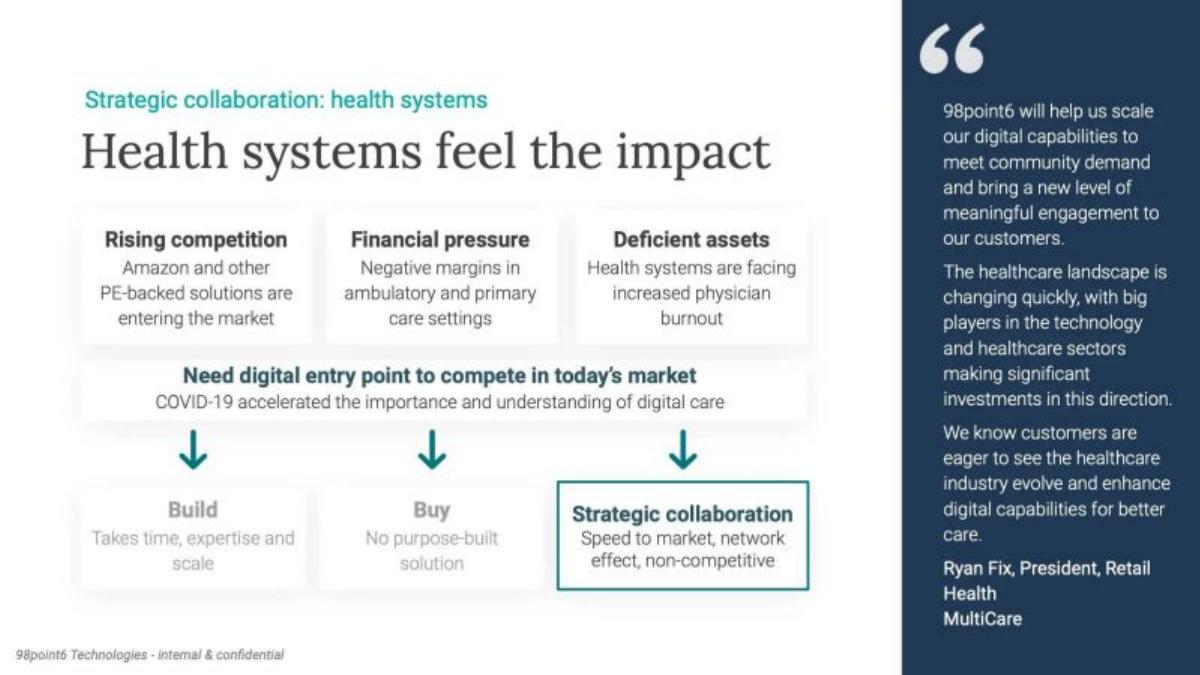
Virtual primary care software licensed to health systems. Series E deck, after its shift to licensing.
98point6 deck, slide 10. Exact stored slide matched to this analysis.
Our analysis: It shows the competition from the customer's side: health systems face Amazon and PE-backed entrants, and 98point6 positions itself as the partner that doesn't compete with them.
Evidence and limitation: A named customer quote supports the framing; no figures on cost or time.
What a founder can adapt: Show your buyer's options (build, buy another product, partner with you) and one reason each falls short.
Supporting analysis
What the deck claims: "Health systems feel the impact": "Rising competition — Amazon and other PE-backed solutions are entering the market", financial pressure, physician burnout. "Need digital entry point to compete in today's market." Build: "Takes time, expertise and scale." Buy: "No purpose-built solution." "Strategic collaboration: Speed to market, network effect, non-competitive." Quote from Ryan Fix, President, Retail Health, MultiCare.
Presentation choice: Build, buy or partner is the decision a health system actually makes. Laying out all three shows the investor where 98point6 wins.
When it does not fit: "No purpose-built solution" under Buy is a strong claim with no competitor named; back it up or soften it.
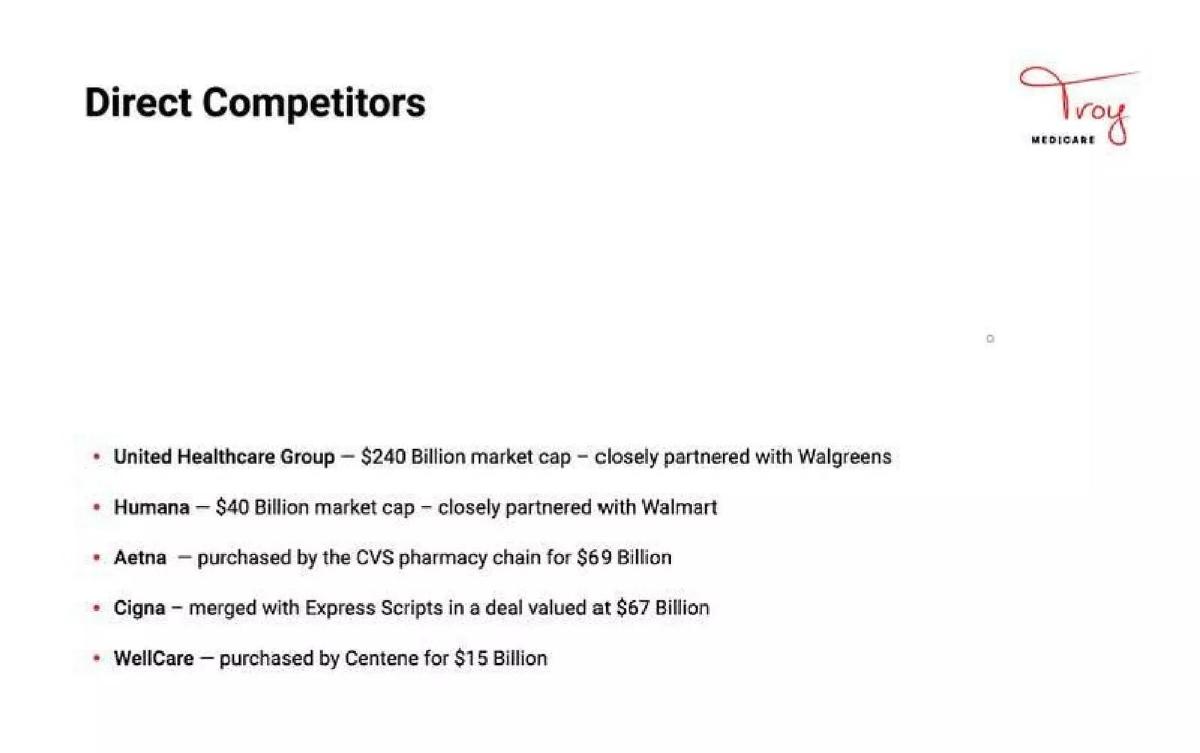
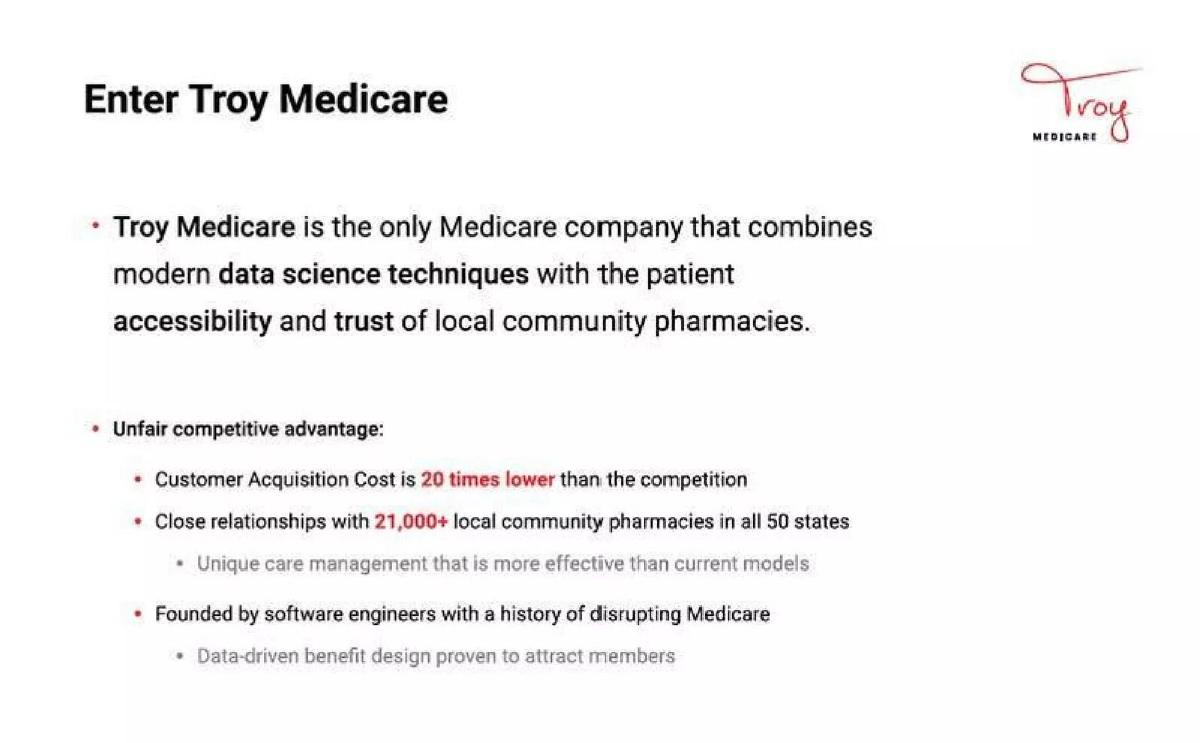
Medicare Advantage plan distributed through community pharmacies. Series B deck. Two slides: incumbents, then its advantage.
Troy Medicare deck, slide 5. Exact stored slide matched to this analysis.Troy Medicare deck, slide 7. Exact stored slide matched to this analysis.
Our analysis: Each incumbent is tied to a large pharmacy chain, which sets up Troy's pitch: the independent pharmacies those giants don't own.
Evidence and limitation: Market caps and deal values as stated, with no date. "20 times lower" CAC has no figures or source.
What a founder can adapt: When incumbents are huge, show the one thing their size ties them to, and the gap that leaves for you.
Supporting analysis
What the deck claims: Slide 5, "Direct Competitors": UnitedHealth Group "$240 Billion market cap — closely partnered with Walgreens"; Humana "$40 Billion market cap — closely partnered with Walmart"; Aetna "purchased by the CVS pharmacy chain for $69 Billion"; Cigna "merged with Express Scripts in a deal valued at $67 Billion"; WellCare "purchased by Centene for $15 Billion". Slide 7: "Customer Acquisition Cost is 20 times lower than the competition"; "Close relationships with 21,000+ local community pharmacies in all 50 states."
Presentation choice: Naming the incumbents with their pharmacy partners turns a list of giants into a reason the independent-pharmacy channel is open.
When it does not fit: Date the market caps, and show the CAC numbers behind "20 times lower". Without them the advantage slide is a claim.
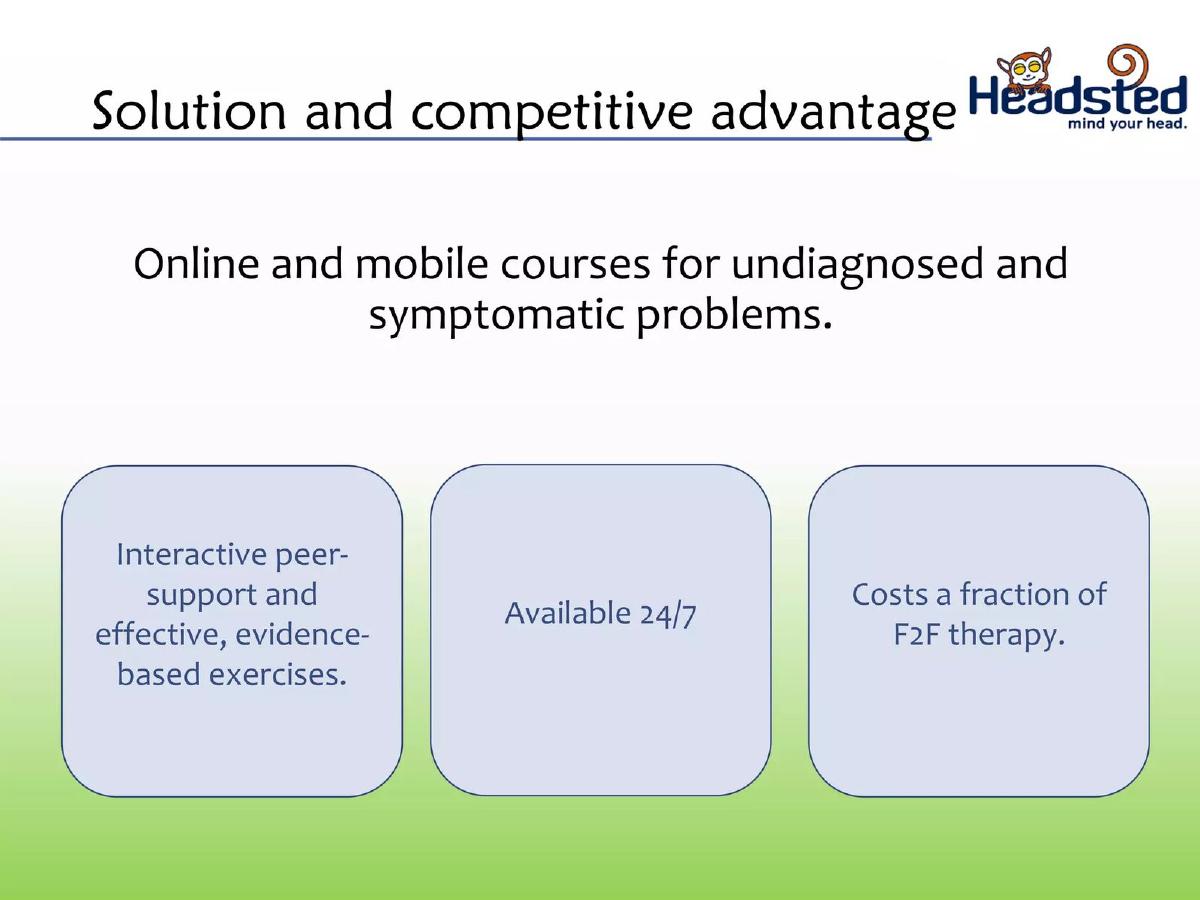
Online mental health courses. Solution and competitive advantage on one slide.
Headsted deck, slide 4. Exact stored slide matched to this analysis.
Our analysis: The competitor is face-to-face therapy, and the slide compares on access and cost, the two things that limit it.
Evidence and limitation: No figures. "A fraction" is not quantified.
What a founder can adapt: Put numbers on the comparison: wait time for a therapist in your market against yours, and cost per session against cost per course.
Supporting analysis
What the deck claims: "Online and mobile courses for undiagnosed and symptomatic problems." "Interactive peer-support and effective, evidence-based exercises." "Available 24/7." "Costs a fraction of F2F therapy."
Presentation choice: It names the real alternative (a therapist) rather than other apps, and picks the right axes.
When it does not fit: "A fraction" and "effective" need numbers and a source to persuade a payer or clinician.
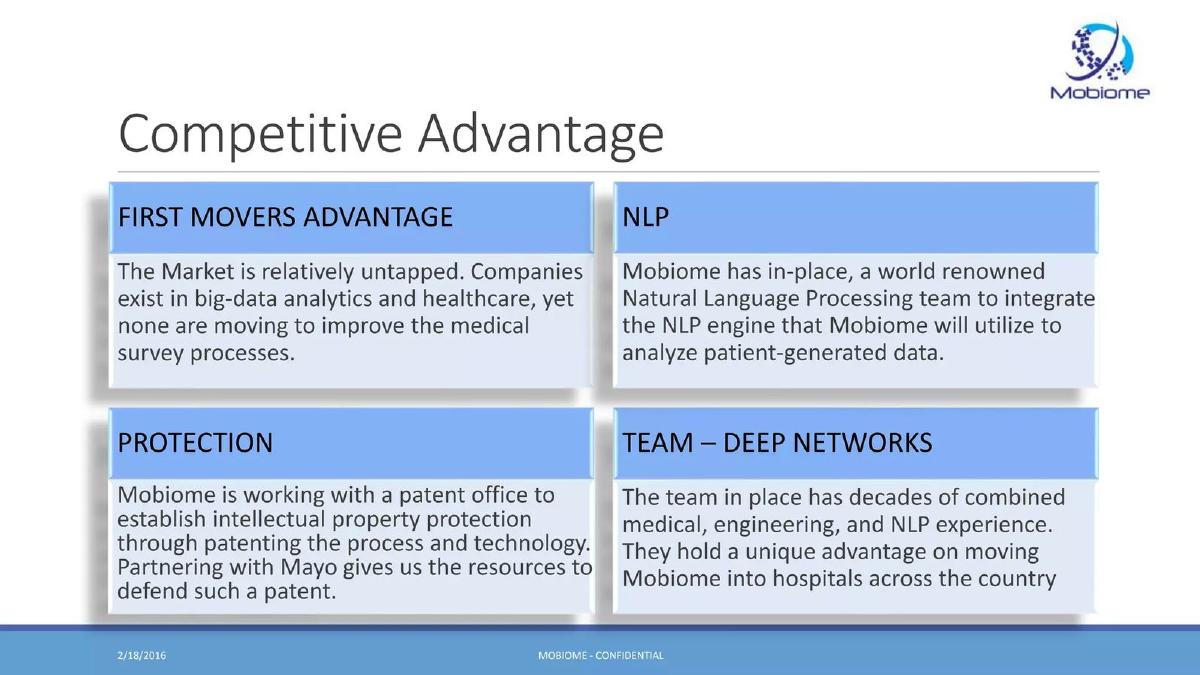
Patient survey analysis using natural language processing. Deck dated 2/18/2016.
Mobiome deck, slide 9. Exact stored slide matched to this analysis.
Our analysis: An advantage slide without a competitor: it says no one is doing this, then lists strengths.
Evidence and limitation: No competitor is named. The patent is described as in progress ("working with a patent office").
What a founder can adapt: Name the survey tools hospitals use today (including paper and staff time), then show where your partner or data makes you hard to copy.
Supporting analysis
What the deck claims: "First movers advantage: The Market is relatively untapped. Companies exist in big-data analytics and healthcare, yet none are moving to improve the medical survey processes." "Protection: … Partnering with Mayo gives us the resources to defend such a patent." NLP team; team with "deep networks".
Presentation choice: Included to show what's missing. The Mayo partnership is the strongest point, but it sits under "Protection" instead of being used as evidence against rivals.
When it does not fit: "None are moving" invites an investor to find one. Name the closest alternatives.
Mental health services. A weaker example, included on purpose: five claims, no competitor named.
BrainySmith deck, slide 5. Exact stored slide matched to this analysis.
Our analysis: It answers "better than whom?" with a list of qualities any provider could claim.
Evidence and limitation: None shown for any claim, including clinical efficacy.
What a founder can adapt: Pick the one alternative your patients use now and the one outcome you beat it on; cite a pilot, trial or published result.
Supporting analysis
What the deck claims: "How are we better than Competition?" Prevention and early treatment; personalization; reduced stigma; data-driven; "Clinical Efficacy: Comparable or superior to existing therapies."
Presentation choice: The efficacy line is the most important claim a mental health company can make, and it is the one with no support.
When it does not fit: Don't claim clinical efficacy without data. A healthcare investor will ask for it first.
AI mood and habit app for students, at concept stage.
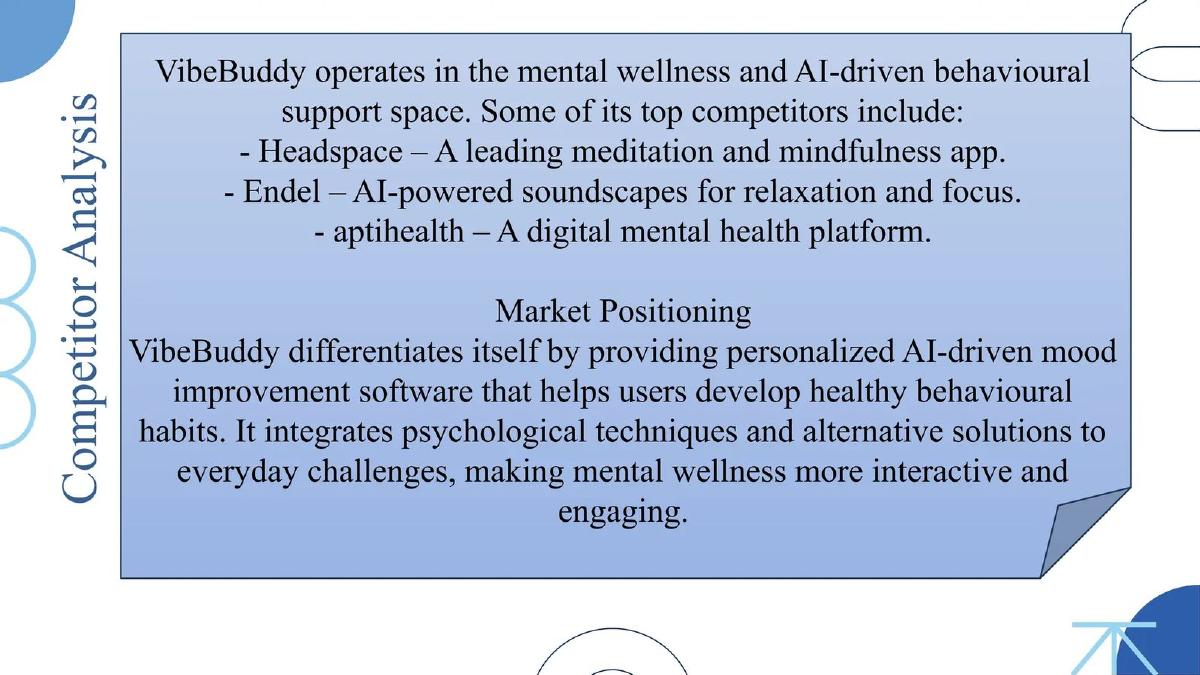
VibeBuddy deck, slide 8. Exact stored slide matched to this analysis.
Our analysis: It names real apps, but mixes wellness apps with a clinical platform, so it's unclear whether VibeBuddy is a wellness product or a health one.
Evidence and limitation: None; positioning statement only.
What a founder can adapt: Decide whether you are wellness or clinical, name rivals from that side, and say what each can't do for your user.
Supporting analysis
What the deck claims: "Some of its top competitors include: Headspace — A leading meditation and mindfulness app. Endel — AI-powered soundscapes for relaxation and focus. aptihealth — A digital mental health platform." "VibeBuddy differentiates itself by providing personalized AI-driven mood improvement software…"
Presentation choice: Which competitors you name tells investors which rules apply to you. A clinical competitor implies clinical evidence and regulation.
When it does not fit: "Personalized AI-driven" describes most of the named rivals too; state a difference a student would notice.
Indian patient-centred health app, seed deck. A weaker example, included on purpose.
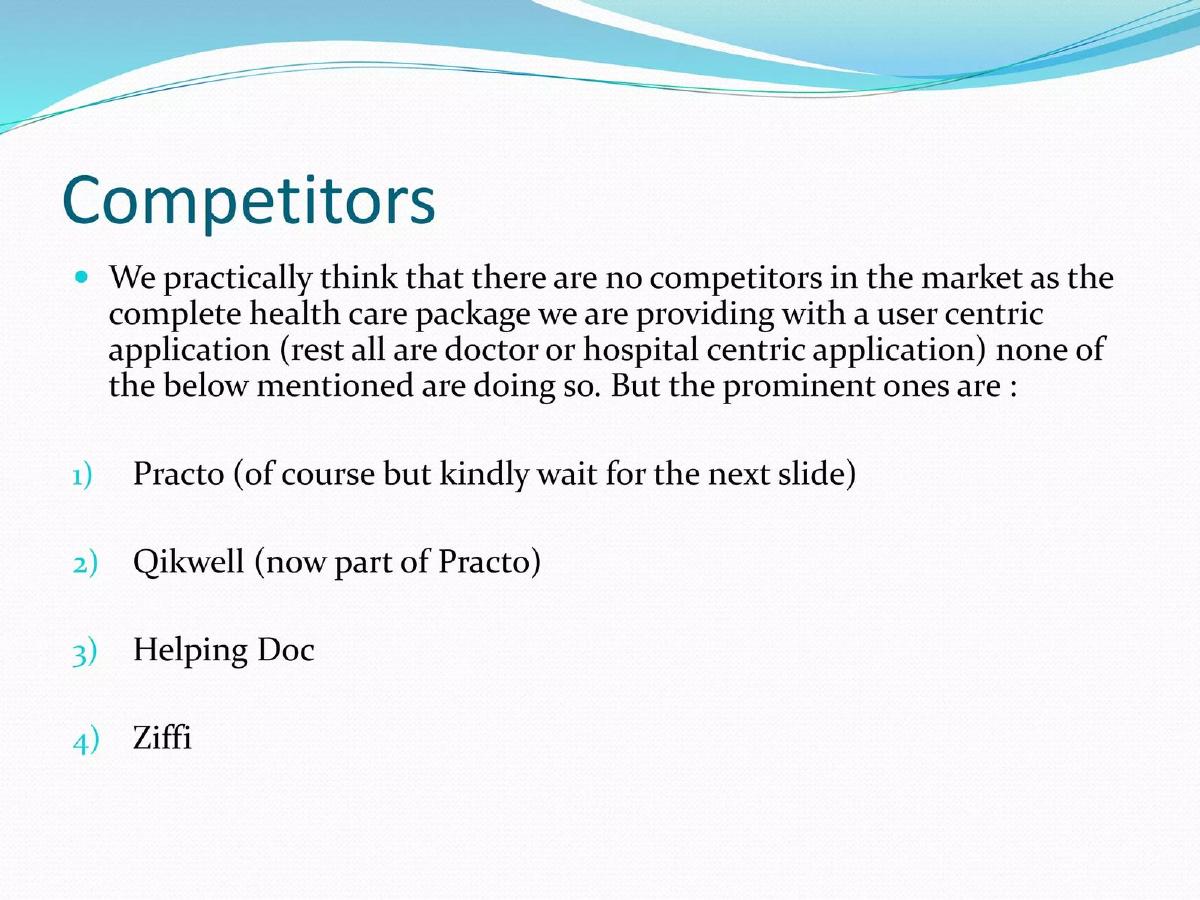
Call the Doc deck, slide 7. Exact stored slide matched to this analysis.
Our analysis: It says there are no competitors and then names four, including the market leader.
Evidence and limitation: None.
What a founder can adapt: Lead with the distinction: "Practo and others are built for doctors and hospitals; we are built for patients," then show one thing that changes for the patient.
Supporting analysis
What the deck claims: "We practically think that there are no competitors in the market as the complete health care package we are providing with a user centric application (rest all are doctor or hospital centric application)…" Then lists Practo "(of course but kindly wait for the next slide)", Qikwell "(now part of Practo)", Helping Doc and Ziffi.
Presentation choice: The patient-centred versus doctor-centred distinction is a real positioning idea, but "no competitors" undercuts it.
When it does not fit: Never write "no competitors" above a list of competitors.
Whether each slide names the alternative a buyer would really choose, compares on an outcome, and gives evidence.
Example
Real alternative named
Outcome-based comparison
Evidence or source
Ada Health
Yes (apps and GPs)
Yes (coverage, accuracy, safety)
Yes (cited study)
Brain Backups
Yes (DaTscan)
Partly (resolution, vs MRI)
No
BrightInsight
Yes (in-house build)
Yes (cost, time)
No ("up to" figures)
98point6
Yes (build / buy)
Partly
Partly (customer quote)
Troy Medicare
Yes (five insurers)
Partly (CAC)
No
Headsted
Yes (F2F therapy)
Yes (access, cost)
No
Mobiome
No
No
Partly (Mayo partnership)
BrainySmith
No
No
No
VibeBuddy
Partly (mixed categories)
No
No
Call the Doc
Partly (after saying none)
No
No
Key Takeaways
Name the real alternative: standard of care, the clinician visit, the customer's own build, or an incumbent payer.
Compare on the outcome the buyer is judged on (accuracy, safety, cost per patient, time to diagnosis).
Cite the source for clinical comparisons; investors in healthcare expect it.
Show how you fit existing equipment, workflows or reimbursement, not just that you are better.
"No competitors" reads as not knowing the market; name who the buyer would pick instead.
Keep "comparable or superior" claims only if you can point to the data.
Build your healthcare competition slide
Start from what your buyer does today.
Buyer. Who decides: clinician, patient, health system, pharma company or insurer?
Today's alternative. What do they use now: the standard test or therapy, a clinician visit, an in-house build, an incumbent, or nothing?
Outcome. Which one or two outcomes are they judged on (accuracy, safety, cost per patient, time)?
Proof. What data or study shows you beat the alternative on that outcome? Who produced it?
Switching. What must change for them to adopt you (equipment, workflow, billing), and how do you reduce it?
Copyable framework: Today [buyer] uses [alternative], which [shortfall on outcome, with number]. [Product] [result, with number] ([source]), and works with [existing equipment/workflow].
Illustrative example 1 — written by us
Before: There are no real competitors. We are more patient-centric, data-driven and effective.
After: Today, clinics refer anxious patients to a therapist, with a typical 6-week wait at $120 a session. Our course starts the same day at $40 a month; in our 200-patient pilot, symptom scores fell by a third in 8 weeks.
What improved: Our illustrative rewrite; figures are invented for the example. It names the real alternative, compares on access and cost, and points to evidence.
What this guide adds
The general competition slide guide covers any business, and the consumer and marketplace guides cover buyers who switch easily. Healthcare is different: buyers are clinicians, health systems, pharma companies or insurers, each judged on outcomes and risk, and switching often means retraining staff or changing equipment. This guide covers who counts as the competitor in that setting and what kind of proof the comparison needs.
The healthcare problem, solution, team and reimbursement guides cover other slides in the same decks. Here we look only at how each deck handles rivals and alternatives.
Four kinds of healthcare competitor
The standard of care: the test, drug or therapy clinicians use today (Brain Backups against DaTscan; Headsted against face-to-face therapy).
The buyer's own build: a health system or pharma company building the software in-house (BrightInsight, 98point6).
Incumbents: large insurers, hospital groups or established apps (Troy Medicare's list of Medicare insurers; Ada's competing symptom apps).
Doing nothing: patients who go untreated or undiagnosed. None of the ten slides names this one directly, though Headsted's "undiagnosed" line comes close.
How we read each slide
We quote the text on the stored slide images and read chart values from the labels shown. We have not checked the underlying studies or company claims. Seven of the ten images were missing from our stored set, so we rendered them from the original deck files already in our library; they are the exact pages quoted.
Common mistakes
"No competitors". In healthcare there is always a current treatment, test or workaround. Name it.
Clinical claims without a source. "Comparable or superior" needs a study, pilot or published result.
Wrong comparison. Compare against the incumbent you named, on the same measure.
Ignoring the build option. Health systems and pharma often weigh building in-house; price that option.
Mixing wellness and clinical rivals. It blurs which evidence and regulation apply to you.
Diagnostic checklist
Names the alternative the buyer uses today.
Compares on one or two outcomes the buyer is judged on.
Cites a source for any clinical or cost comparison.
Says what the buyer must change to adopt you.
Names rivals rather than claiming there are none.
Frequently asked questions
Who is the competitor for a healthcare startup?
Whatever your buyer would choose instead: the current standard of care, a clinician visit, building it in-house, a large incumbent, or doing nothing. Other startups are often not the main one.
Should a healthcare competition slide include clinical data?
Yes, if you compete on outcomes. Ada Health's slide charts accuracy and safety against rivals and GPs and cites the study. A claim like "comparable or superior to existing therapies" with no data is the first thing a healthcare investor will question.
Can I say I have no competitors?
It's better not to. Call the Doc's slide says there are none, then lists four. Name the closest alternatives and explain the difference instead.
How we chose these examples
Corpus: published pitch deck teardowns on StartupFundraising.com. Founder-uploaded private decks are excluded.
Selection (2026-09-26): we searched extracted slide text for competition, competitors, competitive landscape and competitive advantage in decks tagged as healthcare, medical, pharma, care or wellness, and in slides mentioning patients, clinicians or hospitals. About 40 slides matched; most were market-size, disclaimer, history or non-healthcare slides.
We inspected 16 slide images and kept ten. Excluded: DHC p6 and My US Doctor p5 (already used in the general competition guide for the same lesson), Sirona Medical p6 (summary slide), Lifestyler p7 (fitness, not healthcare), Troy Medicare p10 (reimbursement, used elsewhere).
Seven images (Ada Health p7, Brain Backups p7, Call the Doc p7, Troy Medicare p7, Mobiome p9, 98point6 p10, VibeBuddy p8) were not in our stored set; we rendered them from the original deck PDFs in our library and stored them with the existing slide-image workflow.
Review: stored slide text and images were checked on 2026-09-26 and matched to company, deck and slide number (editorial model review). No person has yet completed an editorial review of this page. We make no claim that any slide caused a fundraising outcome.