How health startups show clinical credibility on the team slide: a physician co-founder, a CMO inside the leadership team, a medical director.
Healthcare Team Slides: Real Pitch Deck Examples
Six team slides from health and care startups, shown in full, compare where each company puts its clinical credibility: in a founder, in the leadership team, in a medical director, in outside backers, or only in a sentence.
TL;DR
A healthcare team slide has to answer one question the general team slide does not: who is clinically accountable for the care or the medical claims? Name that person, give their licence or clinical role and one relevant credential, and place them where their authority actually sits. A physician co-founder (Hello Inside) or a CMO in the leadership row (Brightside, Ria Health) answers it directly. Clinical backers (Path) help but do not replace an accountable clinician. A sentence such as "multi-disciplinary experts (technology & medical)" with no names (Navina) does not answer it.
Healthcare team slides from real pitch decks
Each example shows the exact stored slide above its analysis and links to the full teardown. Titles and credentials are as the companies state them and have not been independently verified. Stage and year are given only where the slide states them.
Brightside team slide — slide 2
Online depression and anxiety care. Stage and year are not stated on the slide.
Brightside deck, slide 2. Exact stored slide matched to this analysis.
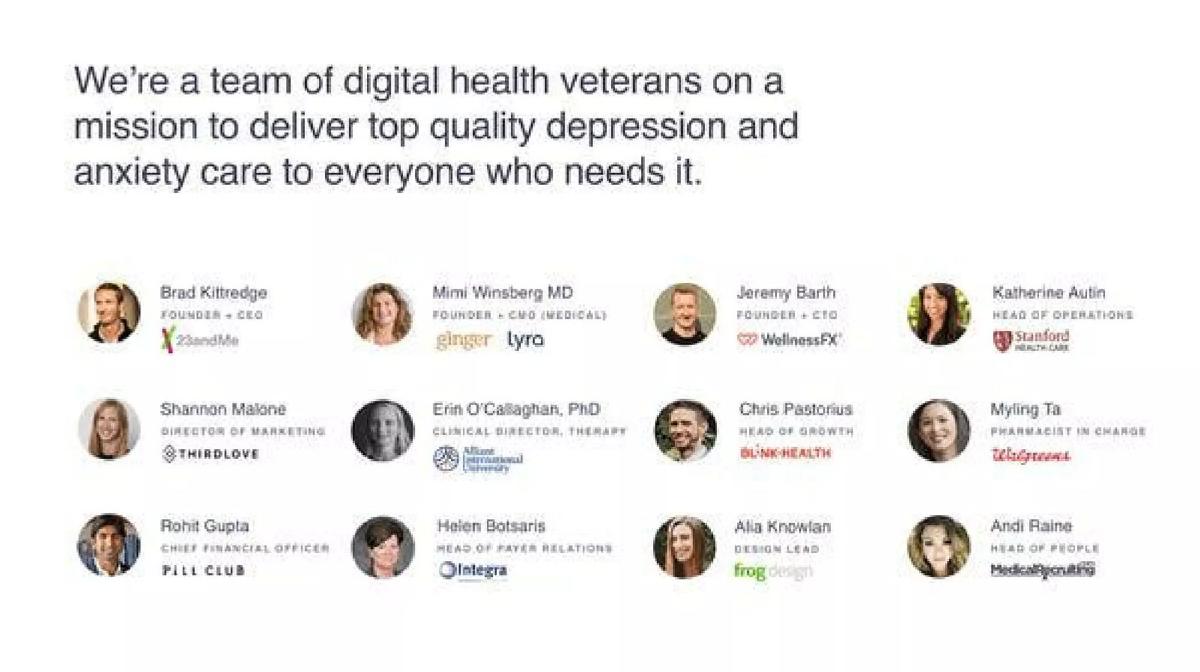
Our analysis: The clinical owner is a co-founder in the top row, and the slide also shows the roles a care-delivery company needs beyond founders: therapy lead, pharmacist, payer relations. It reads as an operating care team, not a software team with a doctor attached.
Evidence and limitation: Logos stand in for experience; no line says what anyone did at those companies. Twelve people at equal size also hides which three matter most. At seed, founders plus the clinical owner is usually enough.
What a founder can adapt: If you deliver care, show the clinical owner as a peer of the CEO and include the one or two operational clinical roles your model depends on (pharmacy, payer contracting, clinical operations).
Supporting analysis
What the deck claims: "We're a team of digital health veterans on a mission to deliver top quality depression and anxiety care to everyone who needs it." Twelve people in a grid with prior-employer logos. The first row is Founder + CEO (23andMe), Founder + CMO (Medical) Mimi Winsberg MD (Ginger, Lyra), Founder + CTO (WellnessFX) and Head of Operations (Stanford Health Care). Later rows include a clinical director of therapy (PhD), a pharmacist in charge (Walgreens) and a head of payer relations (Integra).
Presentation choice: The clinical owner is a co-founder in the top row, and the slide also shows the roles a care-delivery company needs beyond founders: therapy lead, pharmacist, payer relations. It reads as an operating care team, not a software team with a doctor attached.
When it does not fit: Logos stand in for experience; no line says what anyone did at those companies. Twelve people at equal size also hides which three matter most. At seed, founders plus the clinical owner is usually enough.
Addiction treatment delivered remotely. Stage and year are not stated on the slide.
Ria Health deck, slide 2. Exact stored slide matched to this analysis.
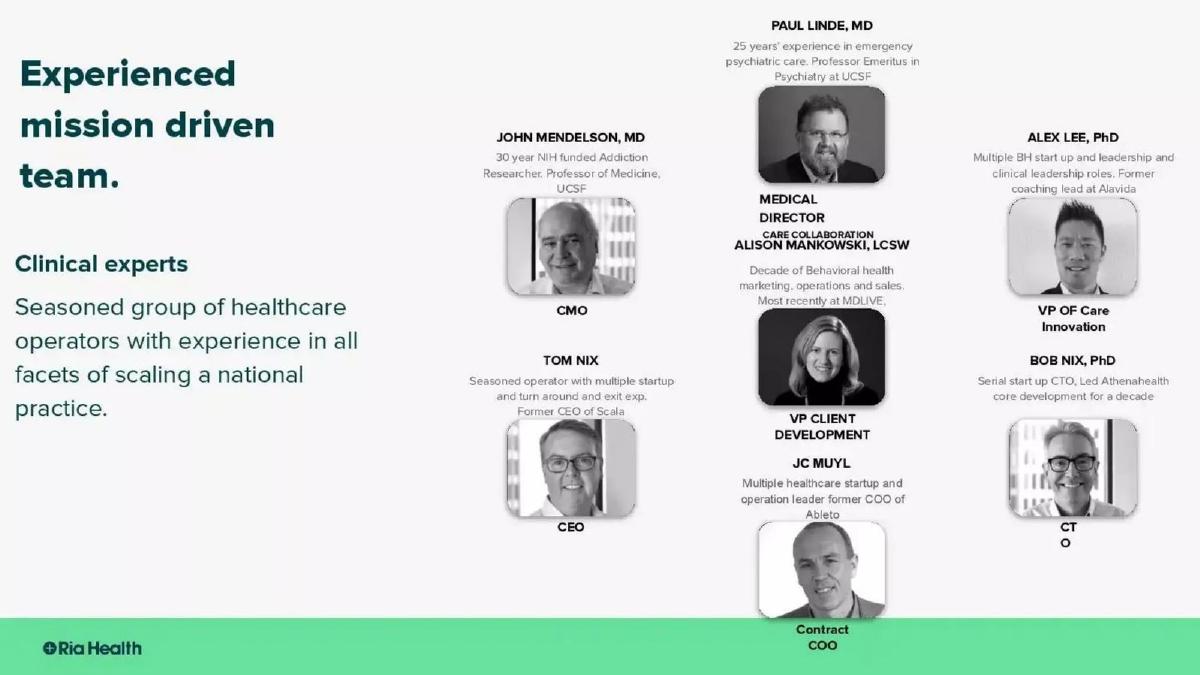
Our analysis: Every clinical credential is specific to the condition treated (addiction, psychiatric emergencies), and there are two clinical leaders with different jobs: research and medical oversight. The one-line bios are the strongest part of the slide.
Evidence and limitation: The layout is hard to scan: titles sit below photos and bios above, and the CTO label wraps as "CT O". The COO is marked "Contract", which invites a question about who runs operations full time.
What a founder can adapt: Write one line per clinical leader that ties their experience to your condition or care setting, and separate the person who owns clinical quality from the person who owns research or protocols.
Supporting analysis
What the deck claims: "Experienced mission driven team" with the subhead "Clinical experts: Seasoned group of healthcare operators with experience in all facets of scaling a national practice." Seven people, each with a one-line credential: a CMO who is a "30 year NIH funded Addiction Researcher" and Professor of Medicine at UCSF; a medical director with "25 years' experience in emergency psychiatric care" and Professor Emeritus in Psychiatry at UCSF; a CEO (former CEO of Scala); a CTO who "led Athenahealth core development for a decade"; plus care-innovation, client-development (LCSW) and contract COO roles.
Presentation choice: Every clinical credential is specific to the condition treated (addiction, psychiatric emergencies), and there are two clinical leaders with different jobs: research and medical oversight. The one-line bios are the strongest part of the slide.
When it does not fit: The layout is hard to scan: titles sit below photos and bios above, and the CTO label wraps as "CT O". The COO is marked "Contract", which invites a question about who runs operations full time.
Consumer self-care app using personal health data ("Scientific self care"). The slide cites a 2021 award; the round is not stated.
Hello Inside deck, slide 3. Exact stored slide matched to this analysis.
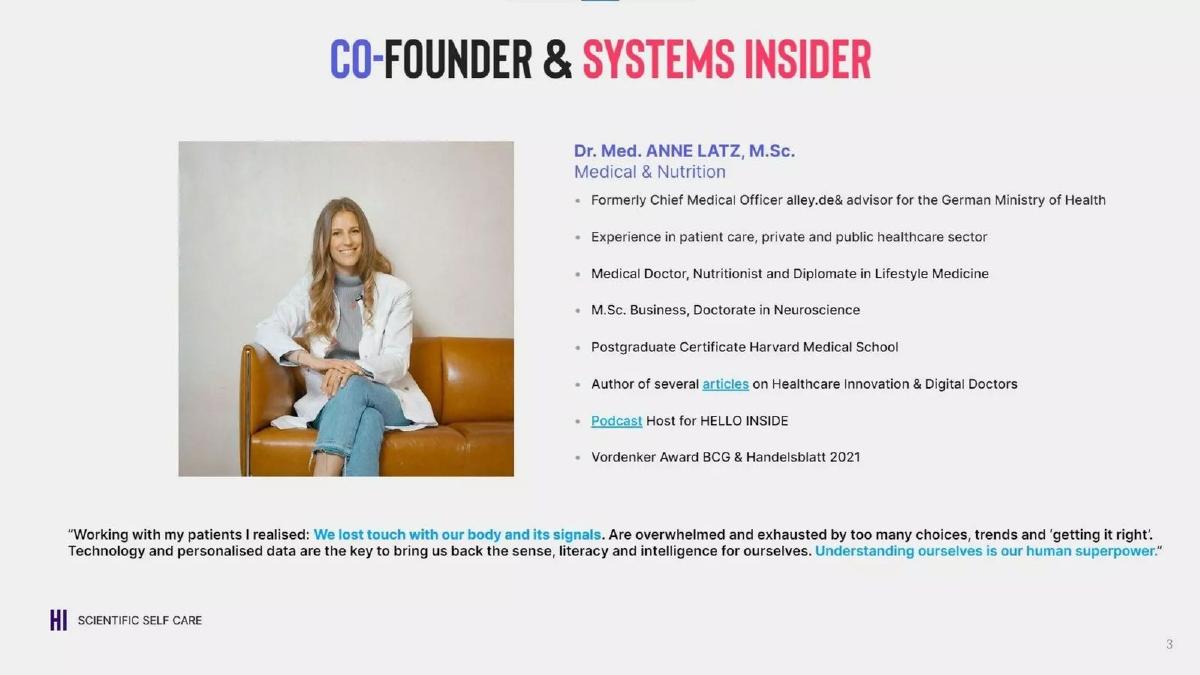
Our analysis: Giving the physician co-founder her own slide makes clinical credibility a headline. "Systems insider" frames the Ministry of Health role as an asset for a product that must work with the health system.
Evidence and limitation: Eight bullets for one person, with the podcast and award weighted like clinical experience. The rest of the team has to appear elsewhere, or the deck looks like a one-person company.
What a founder can adapt: A dedicated slide works when one clinical founder is the main reason to believe. Keep the bullets that show clinical practice and system access; cut media items unless distribution depends on them.
Supporting analysis
What the deck claims: A full slide for one co-founder, titled "Co-founder & systems insider": Dr. Med. Anne Latz, Medical & Nutrition. Bullets: formerly Chief Medical Officer at alley.de and advisor to the German Ministry of Health; experience in patient care in the private and public sectors; medical doctor, nutritionist and diplomate in lifestyle medicine; M.Sc. business and doctorate in neuroscience; Harvard Medical School postgraduate certificate; articles, a podcast and a 2021 BCG and Handelsblatt award. A patient-derived quote explains why she started the company.
Presentation choice: Giving the physician co-founder her own slide makes clinical credibility a headline. "Systems insider" frames the Ministry of Health role as an asset for a product that must work with the health system.
When it does not fit: Eight bullets for one person, with the podcast and award weighted like clinical experience. The rest of the team has to appear elsewhere, or the deck looks like a one-person company.
Addiction treatment offered through employers. Stage and year are not stated on the slide.
Path deck, slide 2. Exact stored slide matched to this analysis.
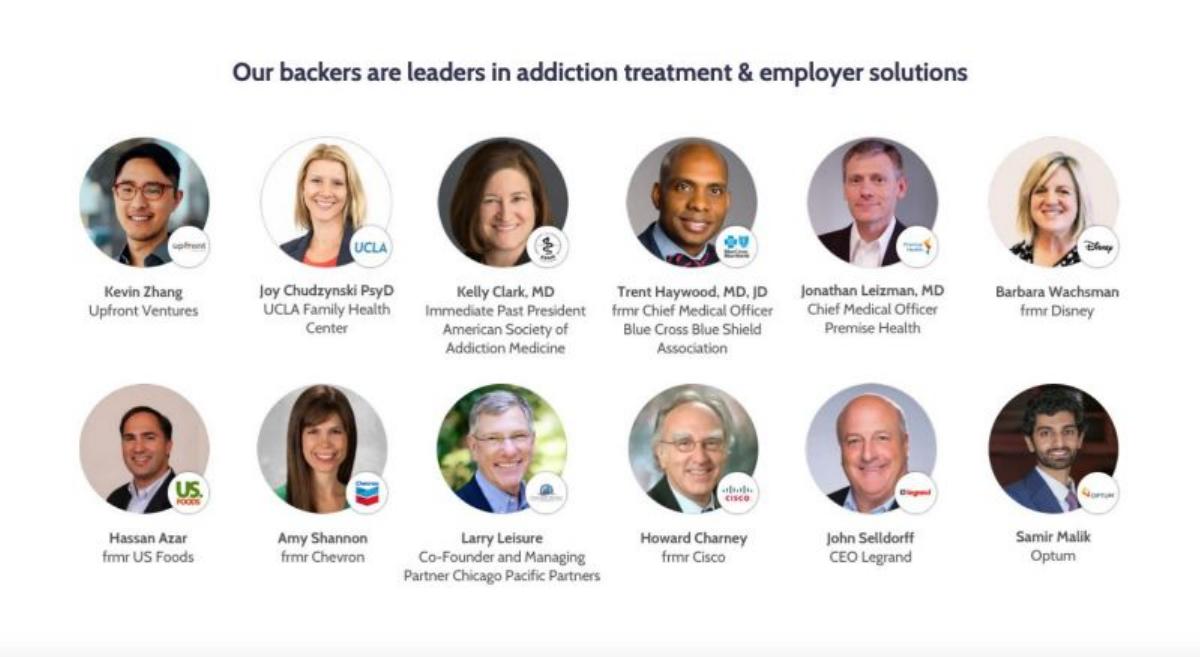
Our analysis: The slide covers both sides of the business: clinical authority in addiction medicine, and employer buyers who would purchase the benefit. Putting it at slide 2 signals that the company has backing from people who understand the buyer.
Evidence and limitation: Backers are not the team. The slide does not say who at Path is clinically responsible or whether these people advise, invest or both. Pair it with a team slide that names the clinical lead.
What a founder can adapt: If your backers include clinicians or buyers, group them by what they vouch for (clinical, payer, employer) and say what each group has committed.
Supporting analysis
What the deck claims: "Our backers are leaders in addiction treatment & employer solutions." Twelve backers with photos and affiliations, including Upfront Ventures, a PsyD from UCLA Family Health Center, the immediate past president of the American Society of Addiction Medicine (MD), a former chief medical officer of the Blue Cross Blue Shield Association (MD, JD), the chief medical officer of Premise Health (MD), and executives formerly at Disney, US Foods, Chevron and Cisco.
Presentation choice: The slide covers both sides of the business: clinical authority in addiction medicine, and employer buyers who would purchase the benefit. Putting it at slide 2 signals that the company has backing from people who understand the buyer.
When it does not fit: Backers are not the team. The slide does not say who at Path is clinically responsible or whether these people advise, invest or both. Pair it with a team slide that names the clinical lead.
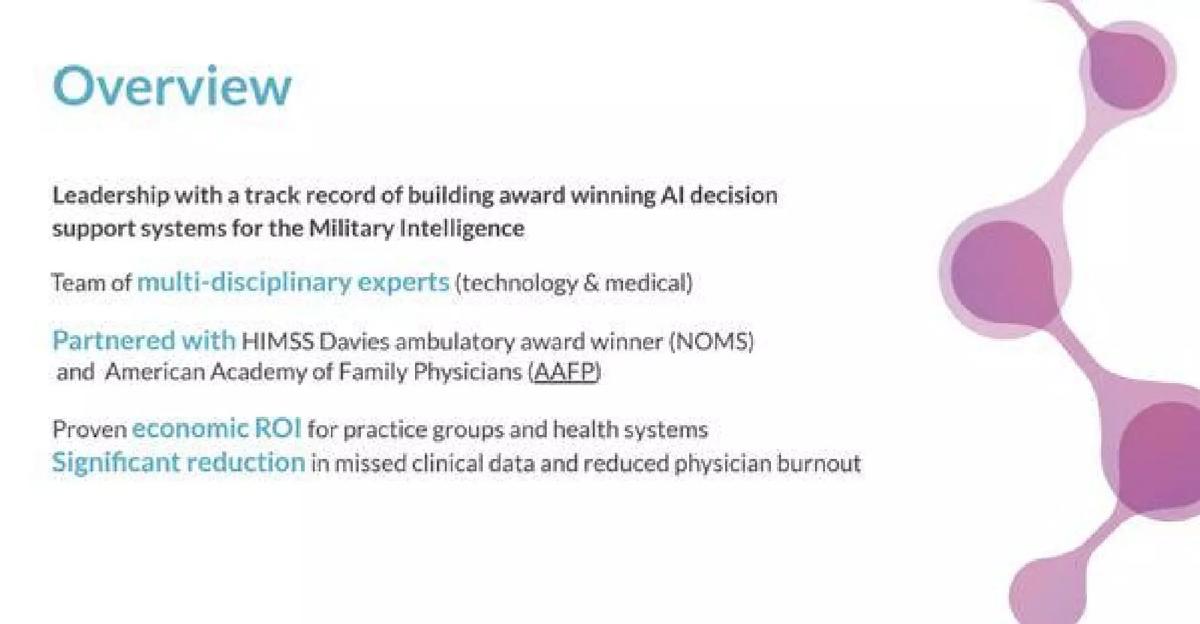
AI software for primary-care physicians. Stage and year are not stated on the slide.
Navina deck, slide 3. Exact stored slide matched to this analysis.
Our analysis: Linking the leaders' military-intelligence background to clinical decision support is a clear story, and naming a physician association as a partner is useful.
Evidence and limitation: Treat this as a slide to improve on: no person is named, "medical" experts are not identified, and ROI and burnout reduction have no numbers. The team section needs its own slide with names.
What a founder can adapt: Keep the one-line thesis about the team's background, then name the leaders and the clinician who owns product safety.
Supporting analysis
What the deck claims: An "Overview" slide that describes the team in two lines: "Leadership with a track record of building award winning AI decision support systems for the Military Intelligence" and "Team of multi-disciplinary experts (technology & medical)." It then lists partnerships (a HIMSS Davies award winner and the American Academy of Family Physicians), "proven economic ROI" and a "significant reduction" in missed clinical data and physician burnout.
Presentation choice: Linking the leaders' military-intelligence background to clinical decision support is a clear story, and naming a physician association as a partner is useful.
When it does not fit: Treat this as a slide to improve on: no person is named, "medical" experts are not identified, and ROI and burnout reduction have no numbers. The team section needs its own slide with names.
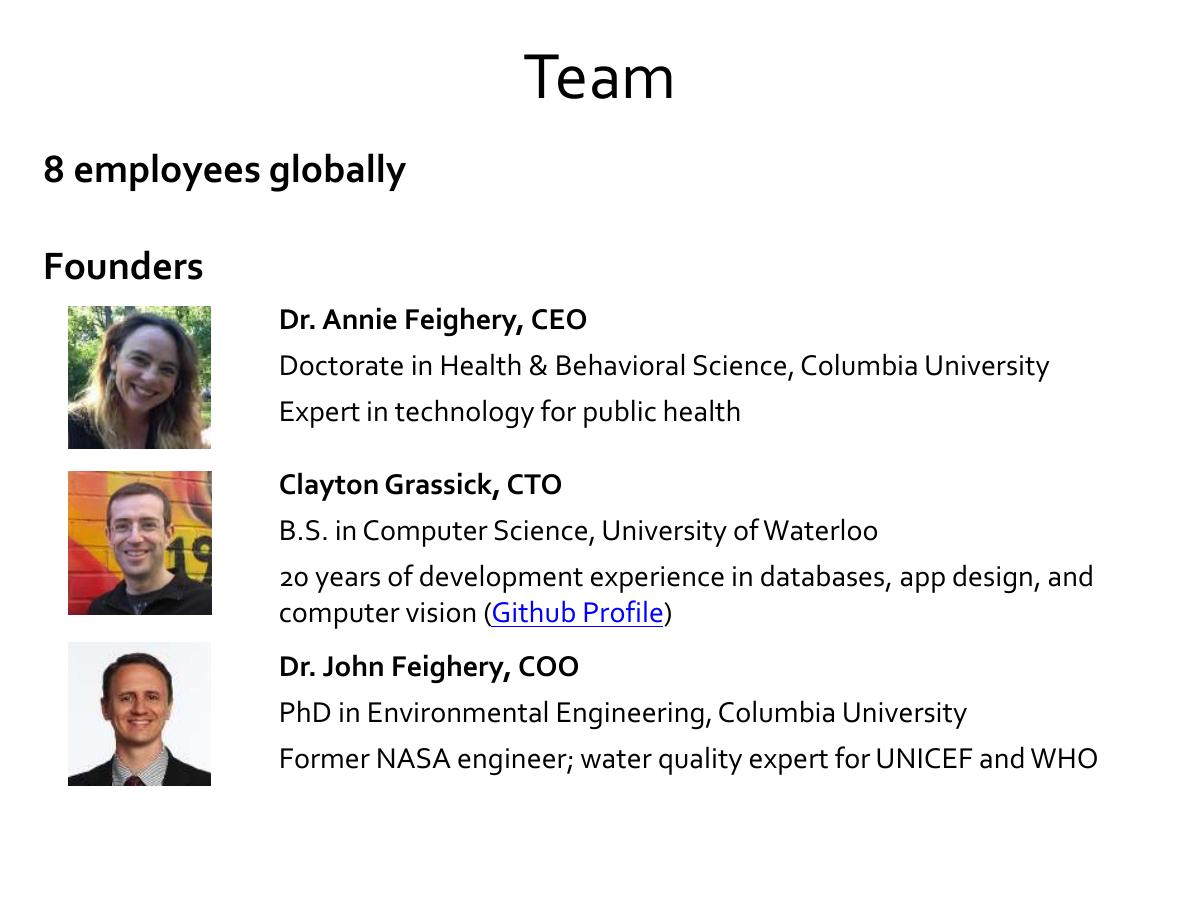
Water and public-health data platform. The slide gives eight employees globally; stage and year are not stated.
mWater deck, slide 6. Exact stored slide matched to this analysis.
Our analysis: Each founder has one field, one institution and one relevant proof point, and the CTO's GitHub link lets an investor check the work. The health expertise matches a public-health data product.
Evidence and limitation: "Dr." here means a research doctorate, not a clinician. That is correct for mWater, but a care-delivery company presenting the same profile would still need a licensed clinical lead.
What a founder can adapt: Use this format (role, degree, one proof point, one link) when your product serves health systems or programmes but does not deliver clinical care.
Supporting analysis
What the deck claims: "Team: 8 employees globally." Three founders with photos: Dr. Annie Feighery, CEO, doctorate in health and behavioral science (Columbia), expert in technology for public health; Clayton Grassick, CTO, B.S. computer science (Waterloo), 20 years of development experience with a GitHub link; Dr. John Feighery, COO, PhD in environmental engineering (Columbia), former NASA engineer and water-quality expert for UNICEF and WHO.
Presentation choice: Each founder has one field, one institution and one relevant proof point, and the CTO's GitHub link lets an investor check the work. The health expertise matches a public-health data product.
When it does not fit: "Dr." here means a research doctorate, not a clinician. That is correct for mWater, but a care-delivery company presenting the same profile would still need a licensed clinical lead.
Choose the placement that matches who actually owns clinical decisions in your company.
Approach
Example
Answers
Fits when
Add
Physician co-founder slide
Hello Inside
Why this founder understands the care problem
One clinician is the core reason to believe
The rest of the team elsewhere
CMO in the leadership row
Brightside
Who owns clinical quality
You deliver or supervise care
One line of relevant experience per person
Clinical leaders with specific bios
Ria Health
Whether expertise matches the condition
A specialty service (addiction, psychiatry)
A cleaner layout; full-time status
Clinical and buyer backers
Path
Who vouches for the model
Credibility with payers or employers matters
A separate team slide naming the clinical lead
Research doctorates, no clinician
mWater
Whether the team knows the domain
Data or programme tools, not clinical care
A clinical advisor if care decisions are involved
Unnamed "medical experts"
Navina
Nothing checkable
Never on its own
Names and roles
Key Takeaways
Put the clinical owner next to the CEO, not in the advisor row. Brightside lists "Mimi Winsberg MD, Founder + CMO (Medical)" in the first row beside the CEO and CTO; Ria Health places its CMO and medical director at the top of the chart.
Give the licence and the relevant clinical experience, not only the degree. Ria Health's medical director line reads "25 years' experience in emergency psychiatric care"; that tells an investor more than "MD" alone.
A doctorate is not a clinical role. mWater's founders hold doctorates in health and behavioral science and environmental engineering; that fits a public-health data product, but it would not satisfy an investor in a clinical-care company.
Backers and advisors support the story; they do not run the care. Path's slide shows two former chief medical officers and an addiction-medicine society president as backers, but not who leads clinical delivery.
Replace team adjectives with names. Navina's "team of multi-disciplinary experts (technology & medical)" gives no person an investor can check.
Check your clinical layer
Answer each prompt, then make sure the answers appear on the slide itself.
Accountability. Who is clinically responsible for what patients receive or what the product recommends? Full-time, part-time or contract?
Licence. What licence or clinical role does that person hold, and in which jurisdiction if it matters?
Relevance. Which single piece of their experience matches your condition, care setting or buyer?
Buyer access. Who on the team has sold to or worked inside the payer, employer or health system you sell to?
Copyable framework: [Name], [MD / RN / PharmD], [role: co-founder / CMO / medical director], [full-time]. [Years] in [your condition or setting]; previously [one relevant outcome].
Illustrative example 1 — written by us
Before: Team of experienced medical and technology experts.
After: [Name], MD, co-founder and CMO (full-time): [n] years in [specialty]; led clinical operations at [organisation]. [Name], CEO: previously [outcome] at [health company].
What improved: Our illustrative rewrite, not any company's text. It names the accountable clinician, states the licence, role and time commitment, and ties experience to the care setting; bracketed values are placeholders.
What a healthcare team slide has to add
In regulated care, the team slide is also a risk slide. Investors ask who signs off clinical protocols, who is licensed to practise or prescribe, and who talks to payers and health systems. A strong generalist founding team can still leave those questions open.
The general team slide guide covers how to present any founding team. This page covers only the clinical layer: which clinical roles to show, where to place them and how much to say about each.
Common mistakes
Clinician only in the advisor row. If a clinician owns care decisions, show them in the leadership team.
Degree without role. "MD" or "PhD" alone does not say who is clinically accountable.
Backers presented as the team. Investors and advisors support credibility; they do not run clinical delivery.
Unnamed experts. "Medical experts" without names cannot be checked.
Logos instead of experience. Add one line on what each person did, not only where.
Diagnostic checklist
The person clinically responsible for care or medical claims is named.
Their licence or clinical role is stated.
Their time commitment is clear (full-time, part-time, advisor).
One line ties their experience to your condition or setting.
Someone on the team has worked with your buyer (payer, employer or health system).
Advisors and backers are labelled as such and kept separate from the team.
Frequently asked questions
How we chose these examples
Corpus: published pitch deck teardowns on StartupFundraising.com. Founder-uploaded private decks are excluded.
Selection (2026-09-24): we searched extracted text of slides 2–6 for team or leadership slides mentioning MD, chief medical officer, medical director, physician, clinician or PhD, where a stored slide image exists. We inspected seven candidates and chose six. Ada Health slide 5 was not selected because it describes clinical quality processes rather than people.
Review: all six stored slide images were inspected on 2026-09-24 and matched to company, deck and slide number (editorial model review). No person has yet completed an editorial review of this page.
Titles, credentials, affiliations and claims such as "proven economic ROI" are shown as the companies state them and have not been independently verified. We make no claim that any slide caused a fundraising outcome.