Pitch Deck Team Slides: Real Examples and What Works
How to write a pitch deck team slide that shows why these founders will win: founder-market fit, relevant proof, gaps and advisors.
Pitch Deck Team Slides: Real Examples and What Works
Compare ten real team slides, see how each deck argues founder-market fit, and turn relevant experience into evidence rather than a row of résumés.
TL;DR
A pitch deck team slide should explain why these people are suited to build this company: current roles, relevant outcomes, and the shared experience or complementary capabilities behind the fit. These examples show how founders use prior results, domain expertise, working history, and explicit role coverage—and where logos or titles leave the argument incomplete.
Team slides from real decks
Each example uses the exact team slide from the public deck when available. Credentials remain company claims rather than verified biographies; two missing exact images are recorded as exceptions and no substitute is used.
Comprehensive team slide — slide 9
Compensation and HR tech, seed.
Verified source excerpt — slide 9
Three people. The CEO is described as founder of Human Interest ($1B valuation) and on a second startup at the intersection of HR tech and consumer finance; the CTO as former CTO of Burger King and Flocabulary (acquired by Nearpod) who built engineering teams from 0 to 250; the VP Customer Success as former head of Option Impact with seven years in compensation management.
The exact team image is not present in the stored slide-image set. No substitute is used.
Our analysis: Every line is an outcome, and every outcome is relevant: a prior company in the same space, scaling engineering, and domain experience in compensation.
Evidence and limitation: Valuation figures of previous companies date quickly; make sure they are still accurate when the deck is sent.
What a founder can adapt: Rewrite each bio as the single outcome most relevant to this company, then add one supporting fact.
Supporting analysis
What the deck claims: Three people. The CEO is described as founder of Human Interest ($1B valuation) and on a second startup at the intersection of HR tech and consumer finance; the CTO as former CTO of Burger King and Flocabulary (acquired by Nearpod) who built engineering teams from 0 to 250; the VP Customer Success as former head of Option Impact with seven years in compensation management.
Presentation choice: Every line is an outcome, and every outcome is relevant: a prior company in the same space, scaling engineering, and domain experience in compensation.
When it does not fit: Valuation figures of previous companies date quickly; make sure they are still accurate when the deck is sent.
Calendar and scheduling software; stage and year not stated on the slide.
Woven deck, slide 2. Exact stored slide matched to this analysis.
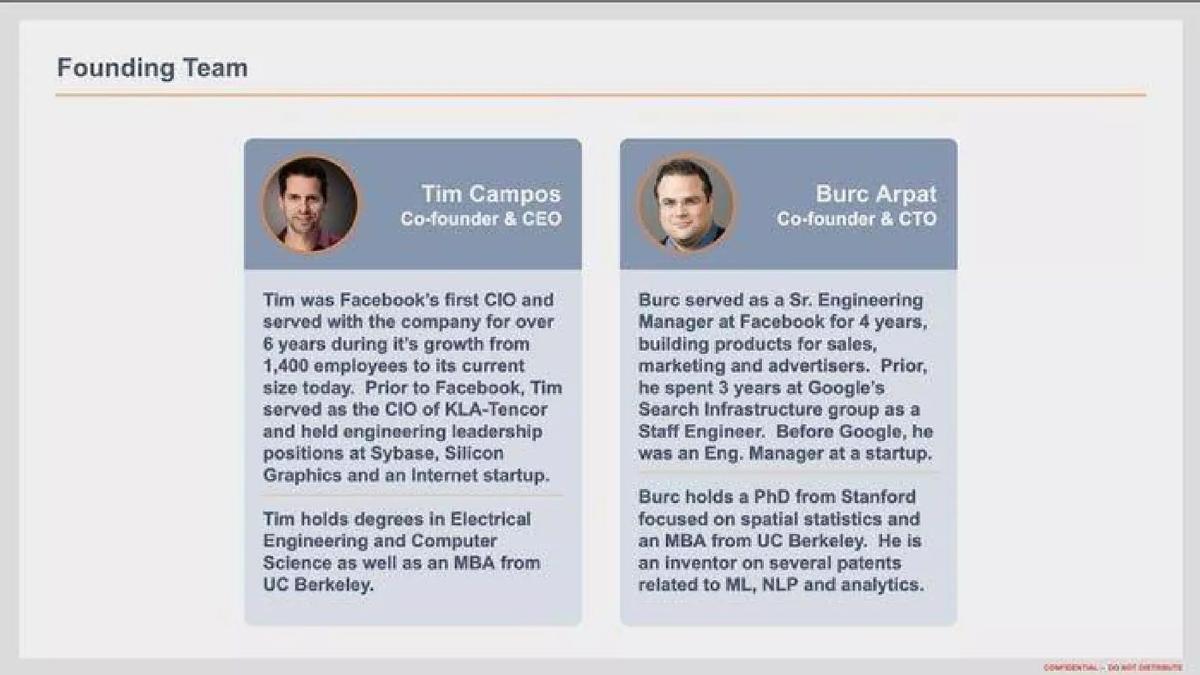
Our analysis: Two people, one card each, and the split is obvious: an executive who has run technology for a hyper-growth company, and an engineer who has built products at scale. The layout answers "who runs the company and who builds it" at a glance.
Evidence and limitation: The bios describe where the founders worked, not why that experience fits scheduling software. Add one line connecting past work to this problem; in our reading, degrees and patents could move to the appendix to make room.
What a founder can adapt: If you have two founders, give each an equal card with role, the one employer that matters most, and the scale they operated at.
Supporting analysis
What the deck claims: Two co-founder cards under the title "Founding Team". The CEO is described as Facebook's first CIO, serving over six years as the company grew from 1,400 employees, and previously CIO of KLA-Tencor; the CTO as a senior engineering manager at Facebook for four years and a staff engineer in Google's search infrastructure group, with a Stanford PhD in spatial statistics and patents in ML, NLP and analytics.
Presentation choice: Two people, one card each, and the split is obvious: an executive who has run technology for a hyper-growth company, and an engineer who has built products at scale. The layout answers "who runs the company and who builds it" at a glance.
When it does not fit: The bios describe where the founders worked, not why that experience fits scheduling software. Add one line connecting past work to this problem; in our reading, degrees and patents could move to the appendix to make room.
CommandBar deck, slide 5. Exact stored slide matched to this analysis.
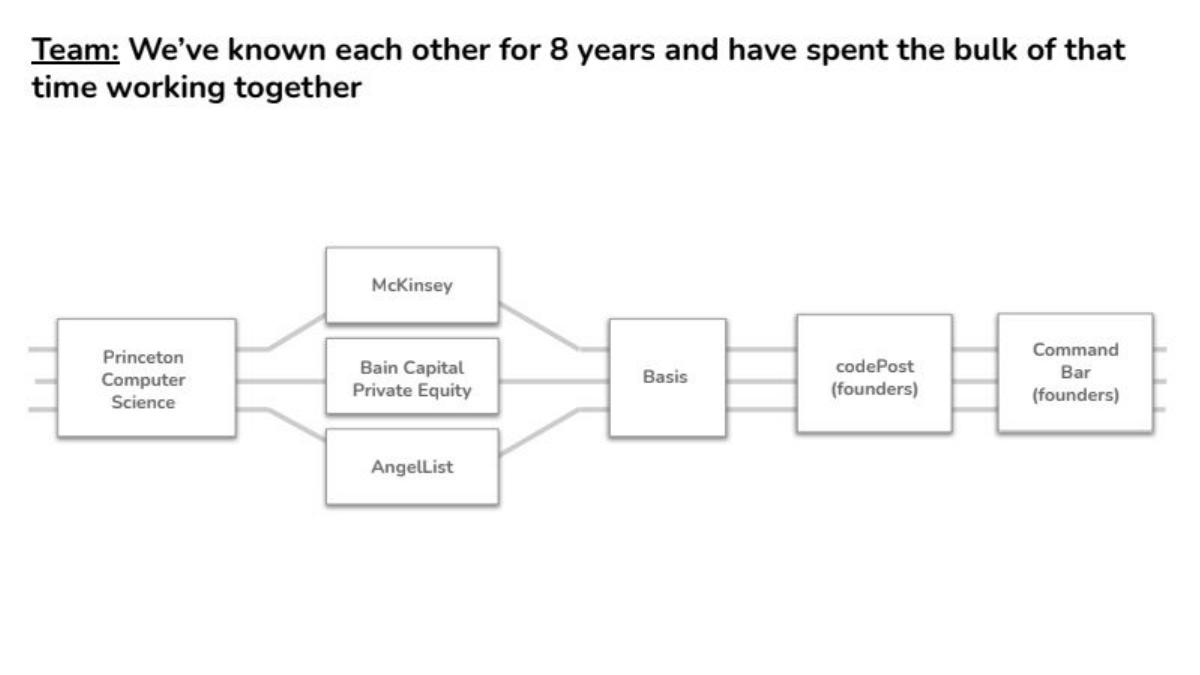
Our analysis: The headline addresses co-founder risk — one of the most common reasons early teams fail — before the investor raises it.
Evidence and limitation: Logos from consulting and private equity say little about building software. Pair them with evidence of shipping product.
What a founder can adapt: If your founders have a long working history, put it in the slide title rather than burying it in bios.
Supporting analysis
What the deck claims: Opens with the line that the founders have known each other for eight years and spent the bulk of that time working together, with prior affiliations including McKinsey, Princeton, Bain Capital private equity and a previous startup.
Presentation choice: The headline addresses co-founder risk — one of the most common reasons early teams fail — before the investor raises it.
When it does not fit: Logos from consulting and private equity say little about building software. Pair them with evidence of shipping product.
Divvy Homes deck, slide 2. Exact stored slide matched to this analysis.
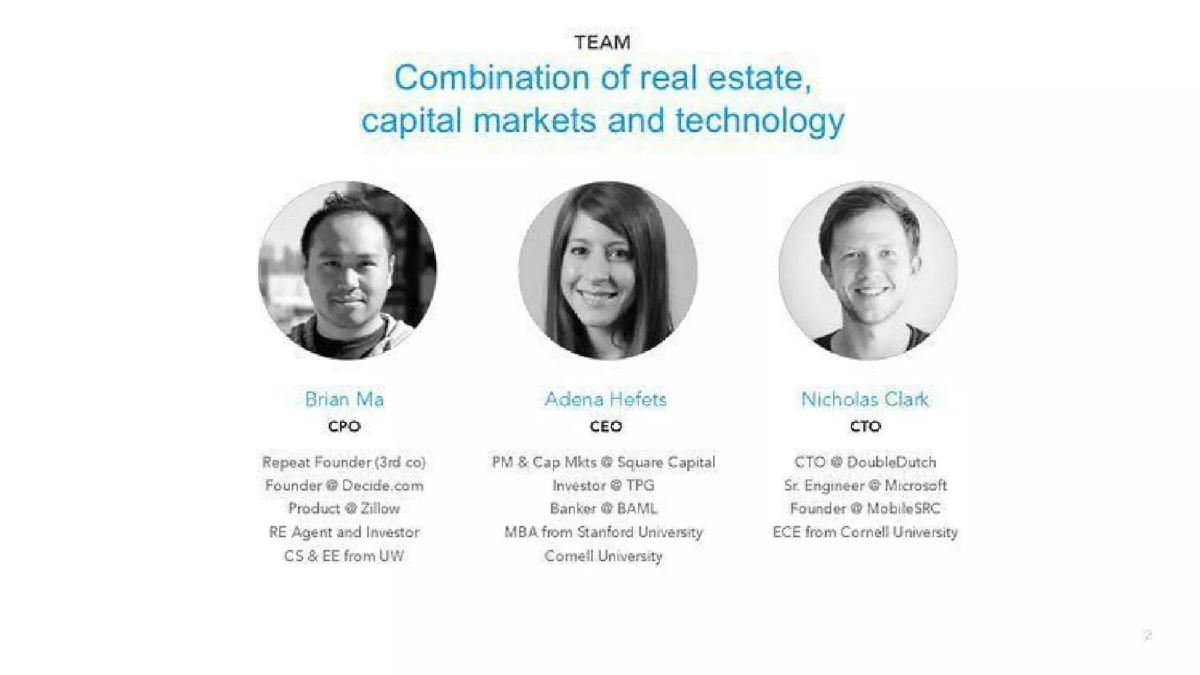
Our analysis: The title names the three disciplines the business needs, and the bios map one to one onto them.
Evidence and limitation: Dense lists of employers make the slide hard to scan. Keep two lines per person in the main deck.
What a founder can adapt: Write a title that lists the capabilities your business model requires, then show who covers each.
Supporting analysis
What the deck claims: Titled "Combination of real estate, capital markets and technology". The CPO is a repeat founder on a third company, with product experience at Zillow, and is a real-estate agent and investor; other founders bring capital markets experience at Square Capital, TPG and BAML, and engineering leadership as a former CTO.
Presentation choice: The title names the three disciplines the business needs, and the bios map one to one onto them.
When it does not fit: Dense lists of employers make the slide hard to scan. Keep two lines per person in the main deck.
Abatable deck, slide 2. Exact stored slide matched to this analysis.
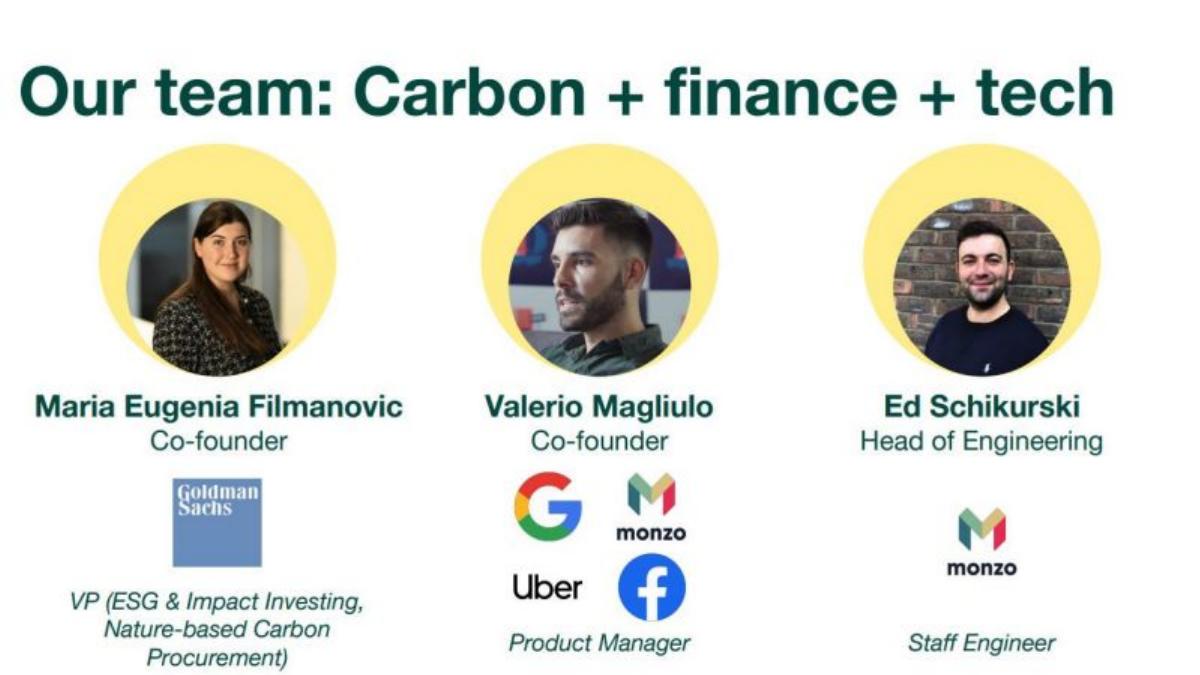
Our analysis: The three-word subtitle is a clear founder-market-fit claim for a product at the intersection of carbon markets and finance.
Evidence and limitation: Make sure each noun in the title is backed by someone on the slide; an unsupported discipline invites questions.
What a founder can adapt: Summarise your team's fit in three nouns that match your market.
Supporting analysis
What the deck claims: Headed "Our team: Carbon + finance + tech", introducing two co-founders and a head of engineering with backgrounds including Goldman Sachs, Monzo and ESG and impact investing, and nature-based carbon product management.
Presentation choice: The three-word subtitle is a clear founder-market-fit claim for a product at the intersection of carbon markets and finance.
When it does not fit: Make sure each noun in the title is backed by someone on the slide; an unsupported discipline invites questions.
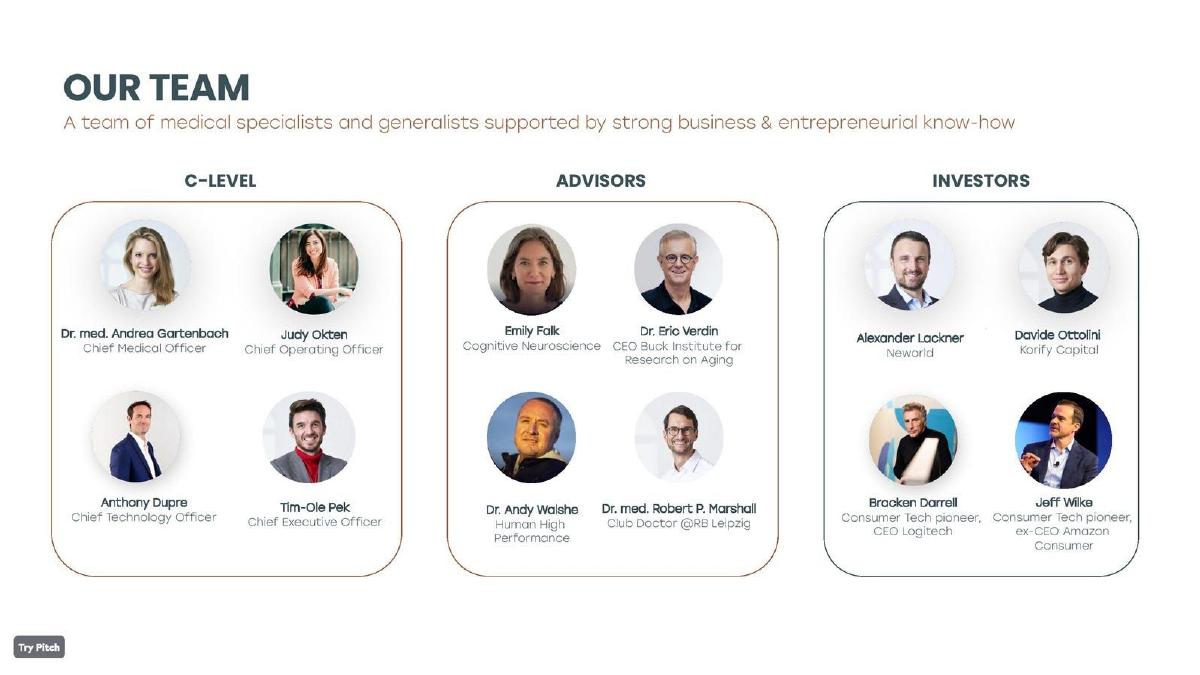
AERA Health deck, slide 3. Exact stored slide matched to this analysis.
Our analysis: In a regulated clinical market, a physician in a leadership role is part of the product's credibility, and the slide shows it immediately.
Evidence and limitation: Four C-level titles at seed can read as title inflation; describe what each person has actually done.
What a founder can adapt: If your market is regulated, lead with the person who carries that expertise, not only the CEO.
Supporting analysis
What the deck claims: Presents a C-level team of medical specialists and generalists: a chief medical officer who is a physician, a CTO, a COO and a CEO, with an advisory group.
Presentation choice: In a regulated clinical market, a physician in a leadership role is part of the product's credibility, and the slide shows it immediately.
When it does not fit: Four C-level titles at seed can read as title inflation; describe what each person has actually done.
A Finnish mental-wellbeing software company with a research-led founding team; the deck is catalogued as a January version.
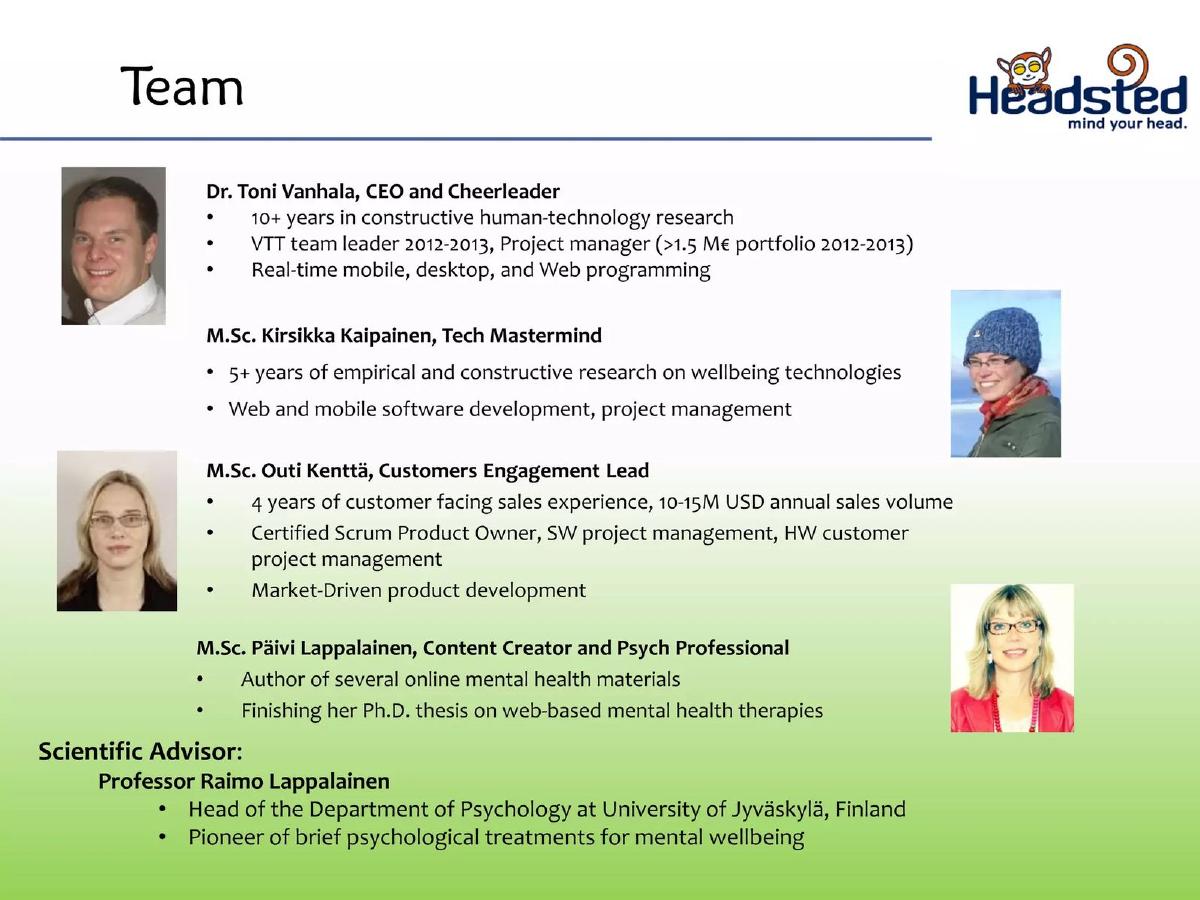
Headsted deck, slide 2. Exact stored slide matched to this analysis.
Our analysis: Research credentials support the product's scientific basis, and the slide also names a person responsible for customers, answering the "who sells it?" question most science-led teams leave open.
Evidence and limitation: Bullet-level bios in small type are hard to read on screen, and years of research say little about outcomes; name one result each person has delivered.
What a founder can adapt: For a science-based company, pair the research credentials with the commercial role, and put the most senior scientific name where investors will see it.
Supporting analysis
What the deck claims: Four team members with their degrees and roles: a CEO with 10+ years in human-technology research and a VTT team-leader role, a technical lead with 5+ years of wellbeing-technology research, a customer engagement lead with four years of customer-facing sales experience, and a psychology professional finishing a PhD on web-based mental-health therapies; plus a scientific advisor who heads a university psychology department.
Presentation choice: Research credentials support the product's scientific basis, and the slide also names a person responsible for customers, answering the "who sells it?" question most science-led teams leave open.
When it does not fit: Bullet-level bios in small type are hard to read on screen, and years of research say little about outcomes; name one result each person has delivered.
Data and analytics for finance professionals, seed.
Apteo deck, slide 10. Exact public-deck slide matched to this analysis.
Our analysis: Each founder covers one element of the product — data, finance, engineering — and the headline says so.
Evidence and limitation: Big-company titles need context: say what the person built or owned there.
What a founder can adapt: When your product sits between two disciplines, show that the founding team spans both.
Supporting analysis
What the deck claims: "We have diverse experience across big data, machine learning, and finance", introducing a CEO who was a data scientist at Twitter, a COO who was a portfolio manager at Point72, and a CTO with machine-learning engineering and technical leadership experience.
Presentation choice: Each founder covers one element of the product — data, finance, engineering — and the headline says so.
When it does not fit: Big-company titles need context: say what the person built or owned there.
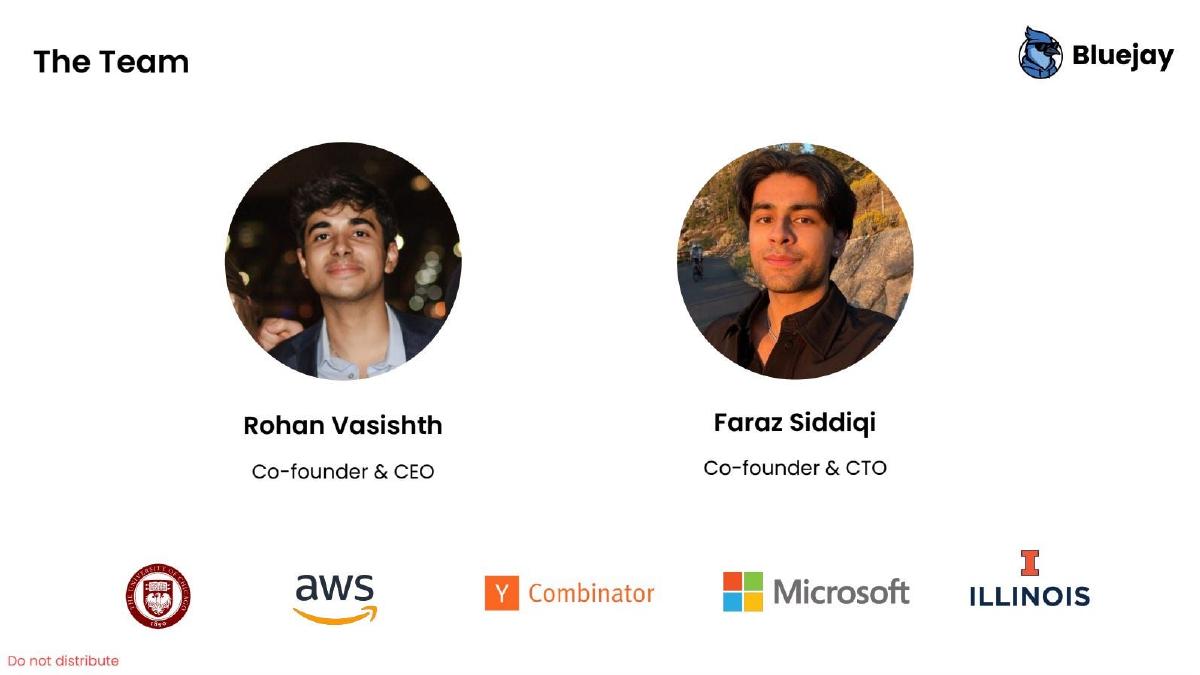
Bluejay deck, slide 2. Exact stored slide matched to this analysis.
Our analysis: In a short deck, a clean two-person slide early on is enough when the affiliations are recognisable and the rest of the deck carries the story.
Evidence and limitation: Logos alone do not explain fit. Add one line per founder on why they are building this company.
What a founder can adapt: If your deck is deliberately short, keep the team slide equally short and put detailed bios in the appendix.
Supporting analysis
What the deck claims: A minimal slide: two co-founders, CEO and CTO, with affiliations including Y Combinator, Microsoft and the University of Illinois.
Presentation choice: In a short deck, a clean two-person slide early on is enough when the affiliations are recognisable and the rest of the deck carries the story.
When it does not fit: Logos alone do not explain fit. Add one line per founder on why they are building this company.
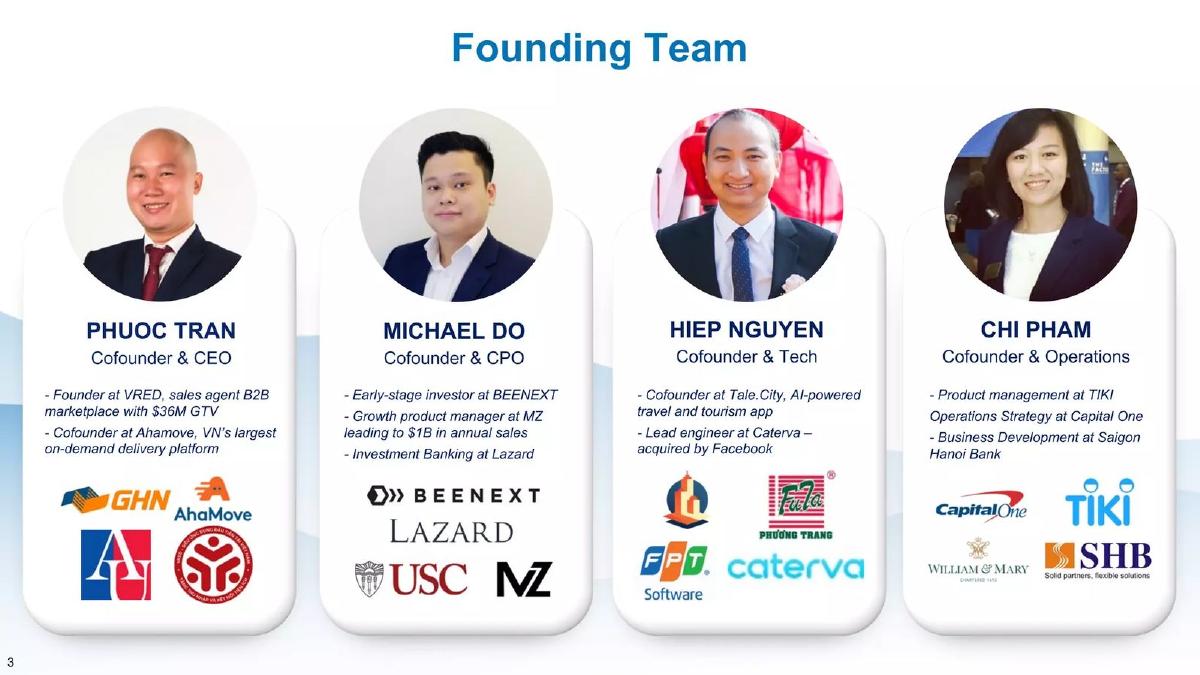
Anfin deck, slide 3. Exact stored slide matched to this analysis.
Our analysis: A complete founding team with clear role splits reassures investors that product, technology and operations are covered from day one.
Evidence and limitation: Four co-founders raises questions about equity split and decision-making; be ready to answer them.
What a founder can adapt: Show the division of responsibility explicitly so the investor sees there is no overlap or gap.
Supporting analysis
What the deck claims: Four co-founders — CEO, CPO, technology and operations — with prior roles including founding a company, B2B sales, early-stage investing at BEENEXT and co-founding another startup.
Presentation choice: A complete founding team with clear role splits reassures investors that product, technology and operations are covered from day one.
When it does not fit: Four co-founders raises questions about equity split and decision-making; be ready to answer them.
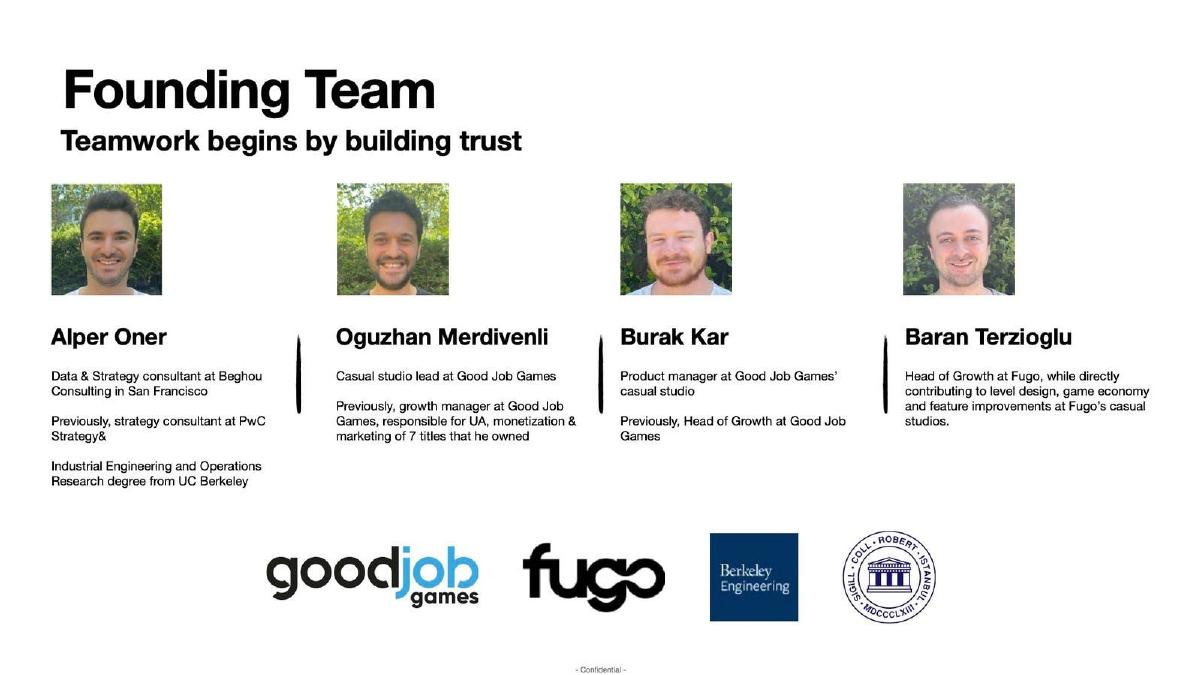
Agave Games deck, slide 2. Exact stored slide matched to this analysis.
Our analysis: Placing the team at slide two signals that the founders see the team as the core of the investment case.
Evidence and limitation: Consulting backgrounds need a bridge to games; show the game-specific experience first.
What a founder can adapt: In a studio business, lead with titles shipped and results achieved, since investors are backing the team's ability to make hits.
Supporting analysis
What the deck claims: "Founding Team — teamwork begins by building trust", with bios starting from strategy consulting and industrial engineering and operations research at UC Berkeley.
Presentation choice: Placing the team at slide two signals that the founders see the team as the core of the investment case.
When it does not fit: Consulting backgrounds need a bridge to games; show the game-specific experience first.
The same person can be described in ways that help or hurt the slide.
Weaker
Stronger
Why
Ex-Google, Stanford MBA
Led the payments team that launched X to Y markets
Outcome and relevance over brand names
10+ years in healthcare
Ran reimbursement for a 40-clinic network
Specific experience the business depends on
Serial entrepreneur
Founded and sold Z to Company W
Checkable, and shows a completed outcome
Passionate about climate
Worked in carbon markets at Firm V for five years
Evidence instead of adjectives
Advisors: six logos
Advisor: former CMO of a target customer, introduced first three pilots
Shows real involvement
Key Takeaways
State the fit before listing credentials. Divvy Homes names real estate, capital markets, and technology; Abatable names carbon, finance, and tech, making every bio easier to interpret.
Lead with outcomes, not affiliations. Comprehensive describes companies built and teams scaled, while Bluejay's recognizable logos still leave the reader to infer relevance.
Use the slide to reduce a specific team risk. CommandBar names eight years of shared history; AERA Health puts clinical leadership into view for a regulated market.
Keep gaps and role boundaries credible. Anfin's role split helps explain coverage, while multiple senior titles or advisor lists need evidence of what each person actually contributes.
Build your team slide
Choose the evidence that connects each person to this market, then make the team's combined advantage explicit.
Required capabilities. Name the two or three disciplines the company must execute unusually well.
Relevant outcomes. For each founder, write one checkable result tied to one of those capabilities.
Team connection. State meaningful working history, lived experience, or the reason this group formed.
Known gap. Name the missing role and how this round will address it rather than padding the slide.
Copyable framework: We combine [capability 1], [capability 2], and [capability 3]. [Name/role] achieved [relevant outcome]; [Name/role] achieved [relevant outcome].
Illustrative example 1 — written by us
Before: Ex-Google · Stanford MBA · 10+ years of experience
After: Led the payments launch across six markets; built the first risk model used for 40,000 transactions
What improved: The rewrite turns brand names and tenure into specific, relevant outcomes.
Why the team slide carries so much weight at seed
At the earliest stages there is often little traction to judge. The product may be a prototype, revenue may be small, and the market story is a forecast. What an investor can assess today is the people. The team slide is where they decide whether the founders are the right people to turn an unproven plan into a company.
Sequoia's business plan outline gives the brief in one line: "Tell the story of your founders and key team members." The word that matters is story. Investors are not asking for a CV; they want to understand how this group of people came to this problem and why their history makes them more likely than others to solve it.
That changes what belongs on the slide. A founder's most impressive credential is not always the most relevant one. A former investment banker building a real-estate product should lead with capital markets experience; the same person building a consumer social app should probably lead with something else. Choose the proof that makes the connection between the person and the problem obvious. (Sequoia Capital)
What to put on the slide
Names, roles and photos. Use real, current photos and the titles people actually hold. Investors will look people up, so the name on the slide should match their public profiles.
One or two lines of relevant proof per person. Prioritise outcomes over positions: a company founded or sold, a product shipped to a known number of users, a team scaled, a revenue line owned, a clinical programme run, a paper published in the relevant field. If a logo appears, it should be because the experience there is relevant, not only because the name is famous.
A line that ties the team together. Commandbar's slide opens with the sentence that the founders have known each other for eight years and spent most of that time working together. That single line answers a question investors worry about — will this founding team stay together under pressure? — before it is asked.
Key hires and advisors only when they change the picture. A chief medical officer on a healthtech deck, or an industry advisor who opens a distribution channel, can be decisive. A long list of advisors who have made no visible commitment adds clutter and sometimes suspicion.
Founder-market fit: making the connection explicit
Investors often use the phrase founder-market fit to mean that the team's background gives them an unusual insight or advantage in this market. The team slide is where you make that case, but it rarely makes itself. A list of employers leaves the investor to guess why the experience matters; a headline sentence tells them.
Several decks in our corpus do this with a subtitle above the photos. Abatable's slide heads its team "Carbon + finance + tech", naming the three disciplines its carbon-credit product needs. Apteo's reads "We have diverse experience across big data, machine learning, and finance" for a product that applies machine learning to financial data. Divvy Homes' says "Combination of real estate, capital markets and technology" for a rent-to-own housing company. In each case the subtitle is a claim about fit, and the bios below are the evidence.
If your fit is personal rather than professional — you lived the problem as a patient, a customer or an operator — say so in one line. It is often the most memorable thing on the slide, and it explains motivation in a way credentials cannot.
How to handle gaps in the team
Most seed teams are incomplete. There may be no technical co-founder yet, no one with sales experience, or no one who has worked in the regulated industry the company is entering. Investors will notice the gap whether or not you mention it.
Address it directly. Name the role you intend to hire with this round, and if you have a candidate or a committed advisor who covers it in the meantime, show them. This turns a weakness into a use-of-funds line and shows the founders see their own team clearly.
Avoid padding. Listing interns, part-time contractors or advisors with no real involvement to make the slide look fuller usually backfires in diligence, when the investor asks to speak to them.
Where the team slide goes
There is no single right position. Many seed decks put the team near the end, after the problem, product, market and traction, so the investor first understands the opportunity and then meets the people who will pursue it. Others put the team at slide two or three, and several examples below do exactly that.
Leading with the team makes sense when the team is the strongest part of the story: repeat founders, a founder with a prior exit, or a group with rare expertise such as clinical or deep technical credentials. Bluejay, Divvy Homes, Connectly and Abatable all place the team at slide two. If traction is the strongest part of your story, lead with that and let the team slide confirm it.
Whichever position you choose, keep it to one slide in the main deck. Detailed bios, the wider team and the full advisory board belong in the appendix or the data room.
Design and length
Team slides tend to collect small text: degrees, years of experience, logo strips and lists of previous roles. Kevin Hale's advice to YC founders is that slides should be legible, simple and obvious. On a team slide that usually means four people at most in the main row, one or two short lines each, and logos only where they save words.
Photos help investors remember people, but they should be consistent in style and size. Mismatched cropped photos and unreadable logos make an experienced team look disorganised.
Test the slide by asking someone unfamiliar with the company to read it for ten seconds and tell you why this team will win. If they repeat your intended answer, the slide works. (Y Combinator)
Common mistakes
Listing employers instead of outcomes. A logo tells the investor where someone worked, not what they achieved or why it matters here.
No link to the problem. If the investor cannot see why this team suits this market, the slide has not done its job.
Padding with advisors. A long advisory board with no visible commitment adds clutter and invites diligence questions.
Hiding gaps. Investors notice a missing technical or commercial lead. Name the gap and the plan to fill it.
Title inflation. Several C-level titles in a three-person company can undermine credibility.
Out-of-date information. Departed team members or old titles in a circulating deck are a warning sign in diligence.
Unreadable small print. Degrees, years and logos in tiny type do not survive a laptop screen.
Diagnostic checklist
Every founder and key hire has a name, role and real photo.
Each person has one or two lines of relevant outcomes, not a CV.
A title or subtitle states why this team fits this market.
How long the founders have worked together is stated if it is a strength.
Gaps are named with a hiring plan.
Advisors appear only if they materially change the picture.
Names match public profiles investors will check.
Detailed bios are in the appendix, not the main deck.
Frequently asked questions
What should a team slide include?
Founders' names, roles and photos, one or two lines of relevant proof per person, and a line explaining why the team fits the problem. Sequoia's outline asks founders to tell the story of the founders and key team members. (Sequoia Capital)
Where should the team slide go in a pitch deck?
Put it early if the team is your strongest asset, such as repeat founders or rare expertise; otherwise near the end, after traction and market. Either works if the slide is strong.
Should I include advisors on the team slide?
Only advisors with real involvement who change the investor's view, such as an industry expert opening distribution. Others belong in the appendix.
How many people should be on the team slide?
Usually two to five: founders and any key hire who is critical to the plan. Show the wider team in the appendix.
What if we do not have a technical co-founder?
Say so and show how you will cover it — a planned hire funded by the round, a contracted team, or a committed technical advisor.
Do investors care about university degrees?
Mainly when they signal relevant expertise, such as a PhD in the field the product depends on. Otherwise outcomes matter more.
How we chose these examples
Corpus: published pitch deck teardowns on StartupFundraising.com, seed to Series A decks from 2014 onward. Founder-uploaded private decks are excluded entirely.
Selection: our slide-type classifier is not reliable enough to pick examples, so we searched extracted slide text for slides that open with team headings (team, founding team, our team, meet the team, management team) within the first eighteen slides. We read 40 matching slides and chose ten that show a clear approach.
Review: examples were selected and described by our editorial model from the extracted slide text and checked against that text. No person has yet reviewed these examples for this page.
Credentials quoted are the companies' own statements on their slides; we have not verified them, and people's roles may have changed since.
We make no claim that any team slide caused a fundraising outcome.