Headsted’s 10-slide deck, presented at Polar Bear Pitching in 2014, focuses on bridging the gap between clinical psychology and accessible digital tools. The company targets the 'undiagnosed and symptomatic' population with evidence-based online courses. The deck leans heavily on the academic credentials of its founders, including a PhD candidate and a Professor of Psychology. While the business model slide provides a clear path to 25M€ in annual revenue based on a 10% conversion rate and a 36€ annual spend, the deck lacks detailed unit economics and a specific capital request. It serves as a…
Key takeaways
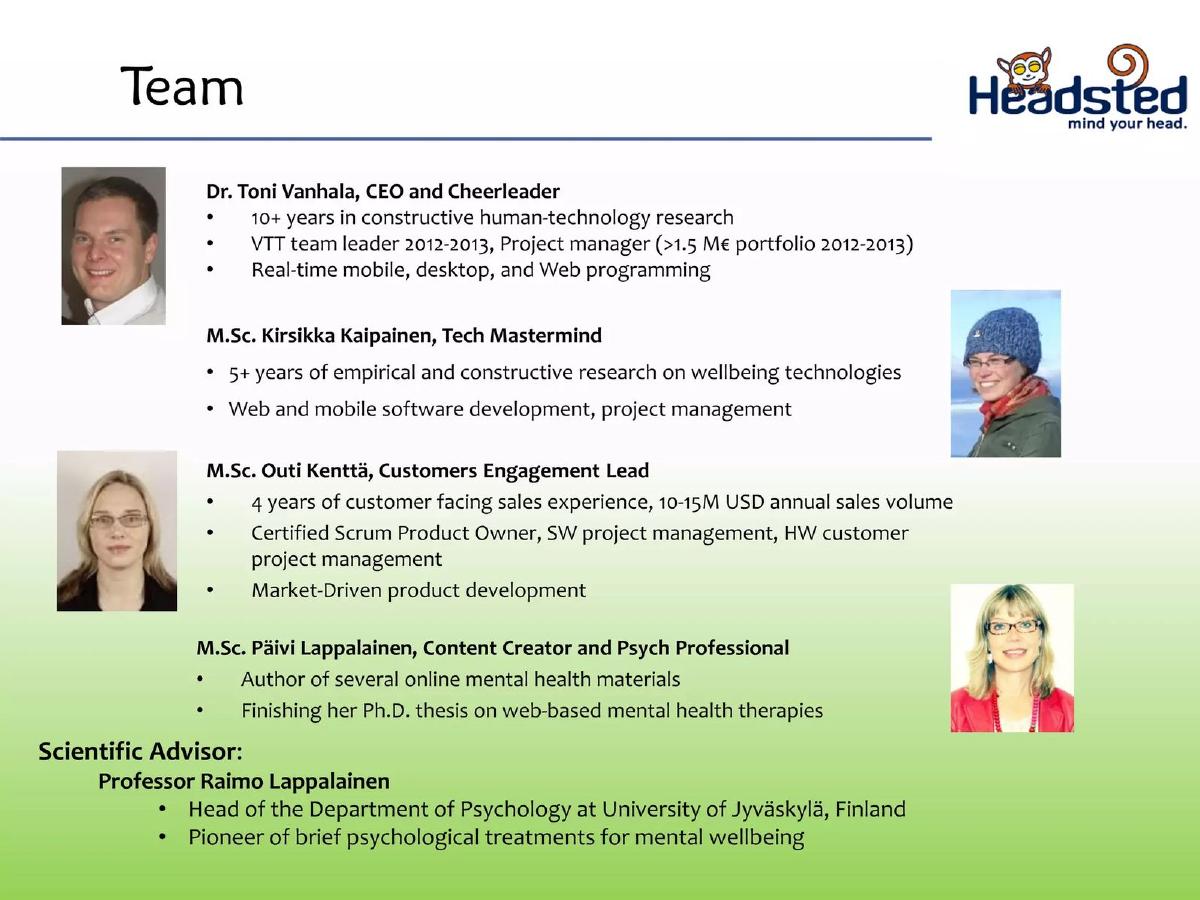
- The team is highly academic, featuring a CEO with 10+ years in human-technology research and a Scientific Advisor who heads a University Psychology department (Slide 2).
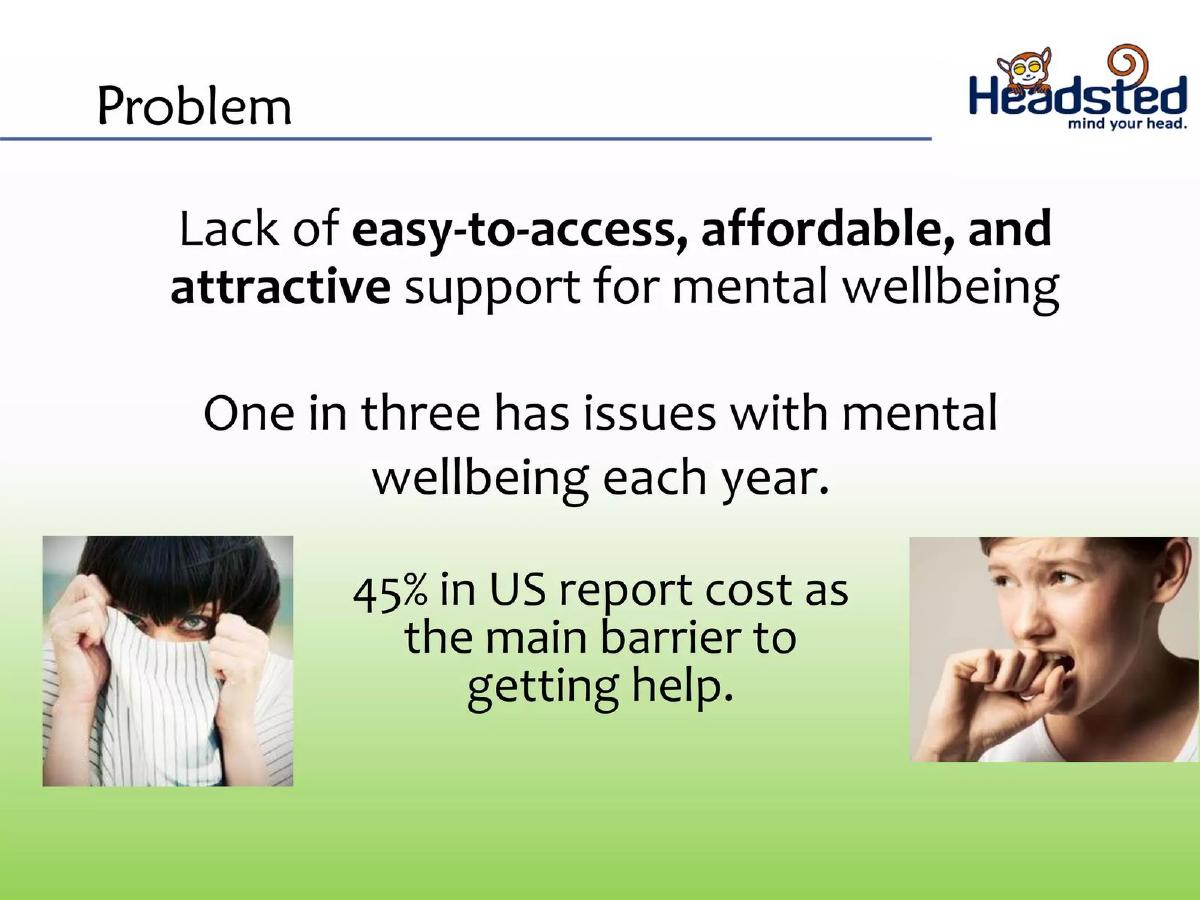
- The problem is defined by a lack of 'easy-to-access, affordable, and attractive' support, noting that 45% of Americans cite cost as a barrier to help (Slide 3).
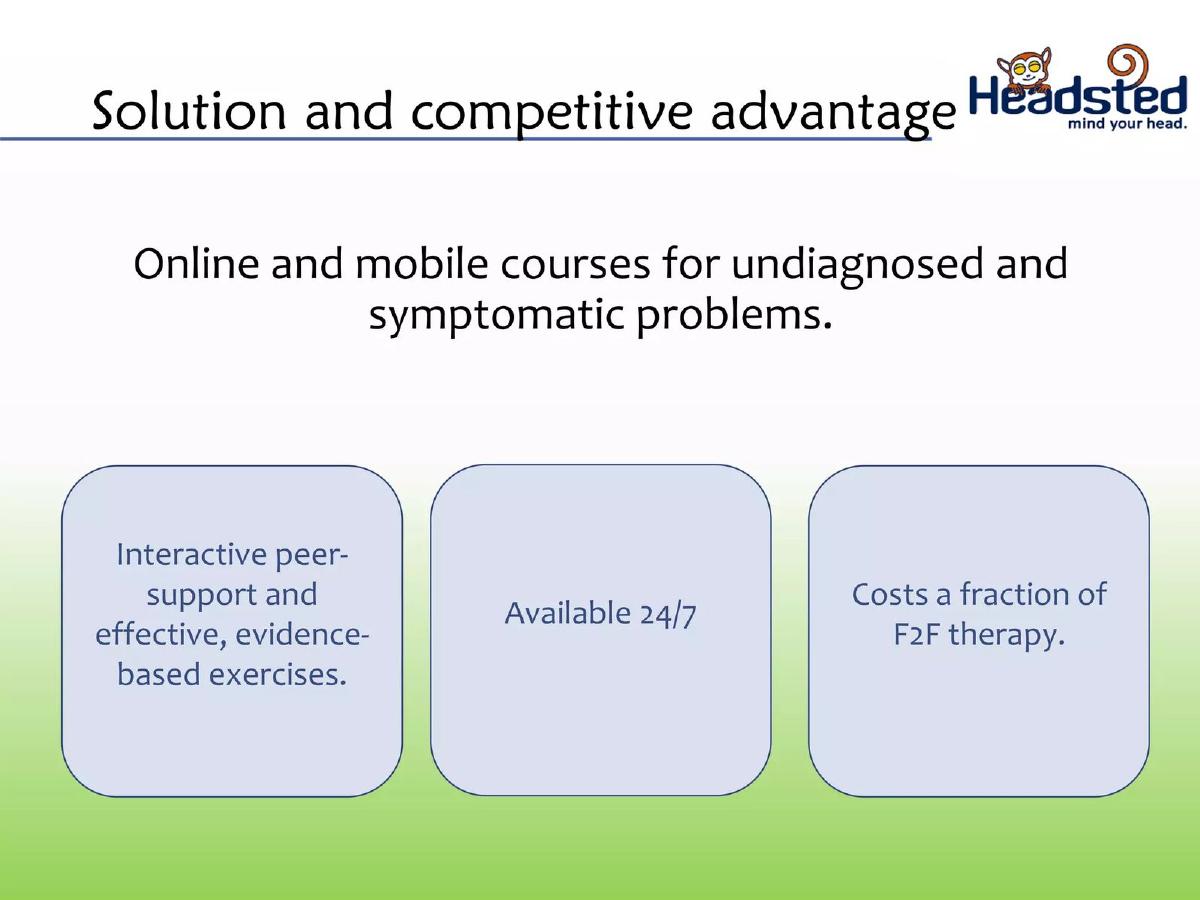
- Headsted positions itself as a low-cost alternative to face-to-face therapy, available 24/7 (Slide 4).
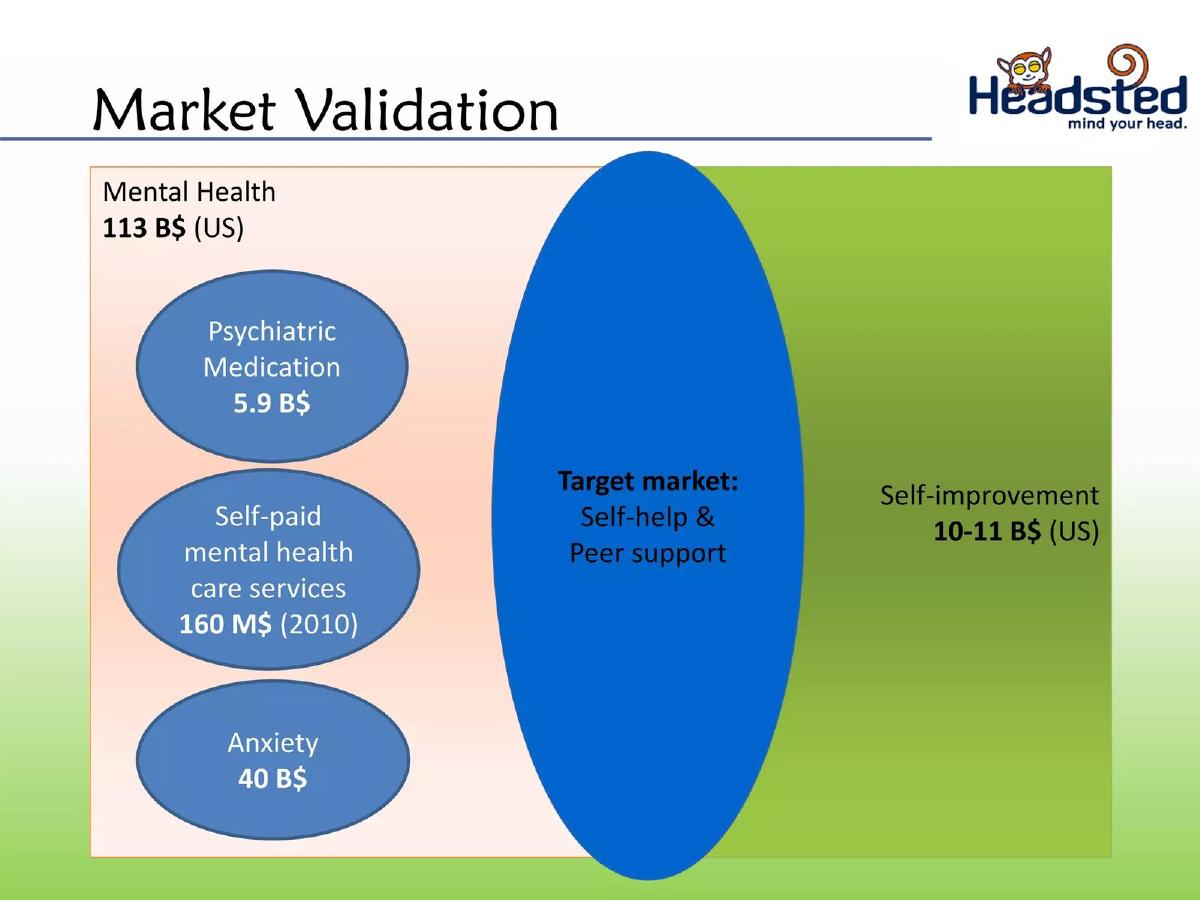
- Market validation identifies a 113B$ US mental health market, specifically targeting the 10-11B$ self-improvement segment (Slide 5).
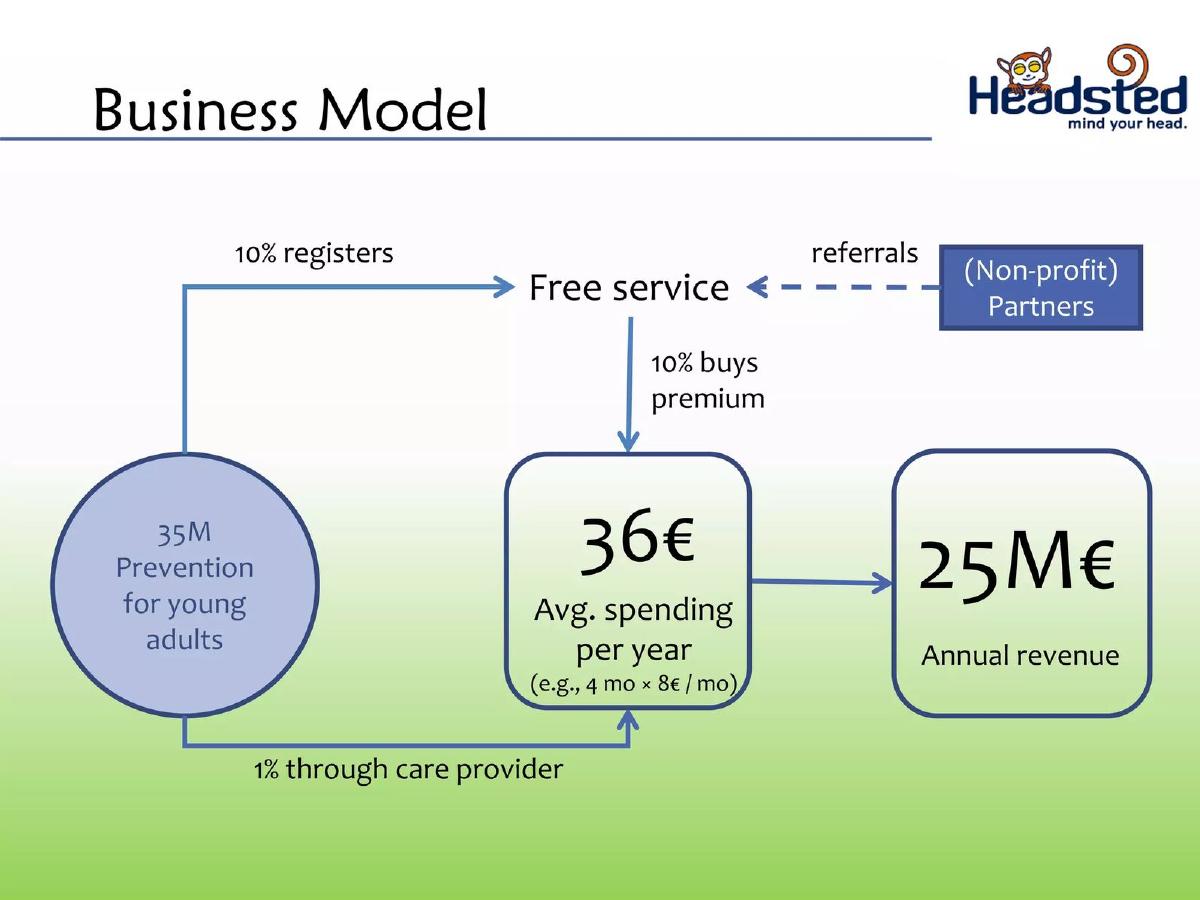
- The business model relies on a freemium funnel: 10% of users register for free, and 10% of those convert to a 36€/year premium plan (Slide 6).
- The Go-to-Market strategy is heavily focused on the Finnish ecosystem, including partnerships with the University of Tampere and YTHS, which serves 135,000 students (Slide 8).
- The product roadmap was immediate, with a first launch in January 2014 and an international version planned for Q2 2014 (Slide 9).
- The 'Ask' is non-specific, requesting that the audience 'Become our Business Angel and/or Advisor' without stating a funding amount or valuation (Slide 10).
Headsted Pitch Deck Analysis
The Headsted pitch deck, presented in February 2014 at the Polar Bear Pitching event in Oulu, Finland, is a concise 10-slide presentation. It focuses on the intersection of academic psychology and digital accessibility. At a time when 'mHealth' (mobile health) was beginning to gain significant venture capital attention, Headsted positioned itself as a research-backed alternative to generic wellness apps.
Slide 1: Title Slide
The title slide introduces the company name, 'Headsted,' with the tagline 'mind your head.' It clearly defines the product as 'Evidence-based online courses for mental well-being.' The date, February 7, 2014, and the event, Polar Bear Pitching, provide context for the deck's brevity and directness. The branding uses a monkey mascot, suggesting a friendly, approachable entry point into the often-intimidating world of mental health.
Slide 2: The Team
Headsted leads with its team, which is a strategic choice for a company selling 'evidence-based' solutions. The slide lists four core members and one scientific advisor. Dr. Toni Vanhala (CEO) is highlighted for having a 1.5M€ portfolio and 10+ years in research. M.Sc. Päivi Lappalainen is noted as finishing her Ph.D. on web-based mental health therapies, providing the academic backbone for the content. The inclusion of Professor Raimo Lappalainen as a Scientific Advisor adds significant institutional credibility, as he is the Head of the Department of Psychology at the University of Jyväskylä. This slide effectively answers the 'Why you?' question by emphasizing deep domain expertise over general business experience.
Slide 3: The Problem
The problem slide identifies three main barriers: accessibility, affordability, and attractiveness. It cites that 'One in three has issues with mental wellbeing each year' and that 45% in the US report cost as the main barrier to getting help. By using these statistics, Headsted frames mental health not just as a medical issue, but as a market inefficiency where the current solution (face-to-face therapy) is too expensive for the general population.
Slide 4: Solution and Competitive Advantage
The solution is described as 'Online and mobile courses for undiagnosed and symptomatic problems.' The slide highlights three key advantages: interactive peer support, 24/7 availability, and a cost that is a 'fraction of F2F [face-to-face] therapy.' This slide is light on product screenshots, focusing instead on the value proposition of convenience and price.
Slide 5: Market Validation
This slide uses a Venn diagram to visualize the market opportunity. It lists the US Mental Health market at 113B$ and the Self-improvement market at 10-11B$ . The target market is defined as the overlap between 'Self-help & Peer support.' It also notes specific sub-sectors like the 40B$ anxiety market and 160M$ in self-paid mental health care services from 2010. This helps investors understand that Headsted isn't just competing for clinical patients, but for the much larger pool of people seeking self-betterment.
Slide 6: Business Model
Headsted presents a clear, albeit optimistic, funnel for revenue. Starting with a pool of 35M young adults , they project that 10% will register for a free service. From that group, 10% are expected to buy a premium version. The math is laid out clearly: 36€ average spending per year (calculated as 4 months at 8€/month) leads to a projected 25M€ in annual revenue . The slide also mentions a 1% conversion through care providers and referrals from non-profit partners, indicating a multi-channel acquisition strategy.
Slide 7: Market Segments
This slide uses a 2x2 matrix to categorize the user base. The axes are 'Subjective wellbeing vs. Experienced mental ill-being' and 'Diagnosed mental illness vs. Objective mental health.' The four quadrants identified are Maintenance, Self-improvement, Health care, and Undiagnosed. This suggests that Headsted sees its product as a versatile tool that can serve both those who are struggling and those who simply want to maintain their current state of mind.
Slide 8: Go to Market
The Go-to-Market strategy is divided into three pillars: Social Media, Partners, and Campaigns. Under Social Media, they target Facebook groups for Anxiety and Depression, each with 100,000+ members . The 'Partners' section is particularly strong, listing major Finnish institutions like YTHS (serving 135,000 students) , the University of Tampere, and the Finnish Association for Mental Health. This localized focus suggests a 'land and expand' strategy, starting in Finland before moving internationally.
Slide 9: Where We Are Now?
This slide provides a timeline and a glimpse of the product. It notes a first product launch at the end of January 2014 , with a comprehensive service due by the end of the year. Crucially, it mentions an international version to be launched in 2Q2014 . The screenshot provided is in Finnish, showing 'Viikko 1: Miksi Jännittää?' (Week 1: Why so anxious?), confirming that the initial rollout was focused on the domestic market.
Slide 10: The Ask
The final slide, 'Help us HELP!', is a soft ask. It encourages the audience to share the service and invites potential 'Business Angels and/or Advisors' to get in touch. It lists email addresses for Toni, Outi, and Kirsikka. The lack of a specific funding amount suggests this deck was used for general networking or a pitch competition where the primary goal was visibility rather than a closed round of financing.
What Headsted Does Well
Academic Credibility: The team slide is the strongest part of the deck. In a field like mental health, having a Professor of Psychology and a Ph.D. candidate on the founding team provides a 'moat' of trust that generic tech startups lack. · Clear Revenue Math: Slide 6 breaks down the path to 25M€ in a way that is easy to follow. Even if the 10% conversion rates are high, the logic of the 36€ annual price point is grounded. · Strategic Partnerships: The Go-to-Market slide shows that the team has already tapped into the Finnish university system, which is a perfect demographic for 'prevention' and 'self-improvement' tools.
What is Missing from the Deck
Unit Economics: While the revenue projections are clear, there is no mention of Customer Acquisition Cost (CAC). Relying on Facebook groups and 'referrals' is a start, but a scalable business model needs a more robust acquisition plan. · Competitive Landscape: The deck mentions 'F2F therapy' as a competitor, but it ignores other digital players. By 2014, apps like Headspace or Calm were already gaining traction. Headsted does not explain how its 'evidence-based' courses differ from these well-funded competitors. · Specific Ask: A professional fundraising deck should state exactly how much money is being raised and what milestones that money will buy (e.g., 'We are raising 500k€ to launch in the UK and US'). · Product Depth: There is only one small screenshot of the product, and it is in Finnish. Investors need to see the user interface and the 'interactive' elements mentioned on Slide 4.
Lessons for Founders
Leverage Your Pedigree: If your team has deep technical or academic roots, put them front and center. It validates the 'Solution' before you even describe it. · Simplify the Funnel: Slide 6 is a masterclass in showing a business model without over-complicating it. By showing the '35M -> 10% -> 10% -> 36€' flow, they make a 25M€ business seem attainable. · Localize First: Headsted’s focus on Finnish universities (Slide 8) shows they understood their immediate environment. Founders should show they can win their home market before promising global domination.
Frequently asked questions
- What is Headsted's core product?
- Headsted offers evidence-based online and mobile courses for mental well-being. According to Slide 4, these courses include interactive peer support and exercises designed for 'undiagnosed and symptomatic problems.' The goal is to provide a tool that costs a fraction of traditional face-to-face therapy while remaining available 24/7.
- How does Headsted plan to make money?
- The company uses a freemium model detailed on Slide 6. They target a segment of 35 million young adults for prevention. They estimate that 10% will register for a free service, and 10% of those registered users will upgrade to a premium version. With an average spending of 36€ per year, they project a potential annual revenue of 25M€.
- Who are the key members of the Headsted team?
- The team is led by Dr. Toni Vanhala (CEO), who has over 10 years of research experience. Other key members include M.Sc. Kirsikka Kaipainen (Tech Mastermind), M.Sc. Outi Kenttä (Customer Engagement), and M.Sc. Päivi Lappalainen (Psych Professional). They are supported by Scientific Advisor Professor Raimo Lappalainen, a pioneer in psychological treatments (Slide 2).
- What is the size of the market Headsted is entering?
- Slide 5 breaks down the US market into several segments: a 113B$ total mental health market, a 40B$ anxiety market, and a 10-11B$ self-improvement market. Headsted specifically targets the intersection of self-help and peer support, aiming to capture users who currently pay for mental health services out-of-pocket (a 160M$ segment in 2010).
- Does the deck include a specific funding request?
- No. Slide 10, titled 'Help us HELP!', is a general call to action. It asks the audience to tell friends about the service or to 'Become our Business Angel and/or Advisor.' It does not list a specific dollar amount, use of funds, or equity offering, which is common for pitch competition decks like those at Polar Bear Pitching.