Knak’s 13-slide deck is a masterclass in narrative simplicity, focusing on the friction between creative marketing teams and rigid automation platforms. By the time of this 2021 Series A, the company had already achieved product-market fit with $0 in external funding, a rare feat that likely served as their strongest leverage point. The deck identifies a specific $25.1B market opportunity created by the 'stodgy' nature of legacy systems like Marketo and Eloqua. While the deck is light on specific financial metrics or a detailed roadmap, it relies heavily on the pedigree of a leadership team f…
Key takeaways
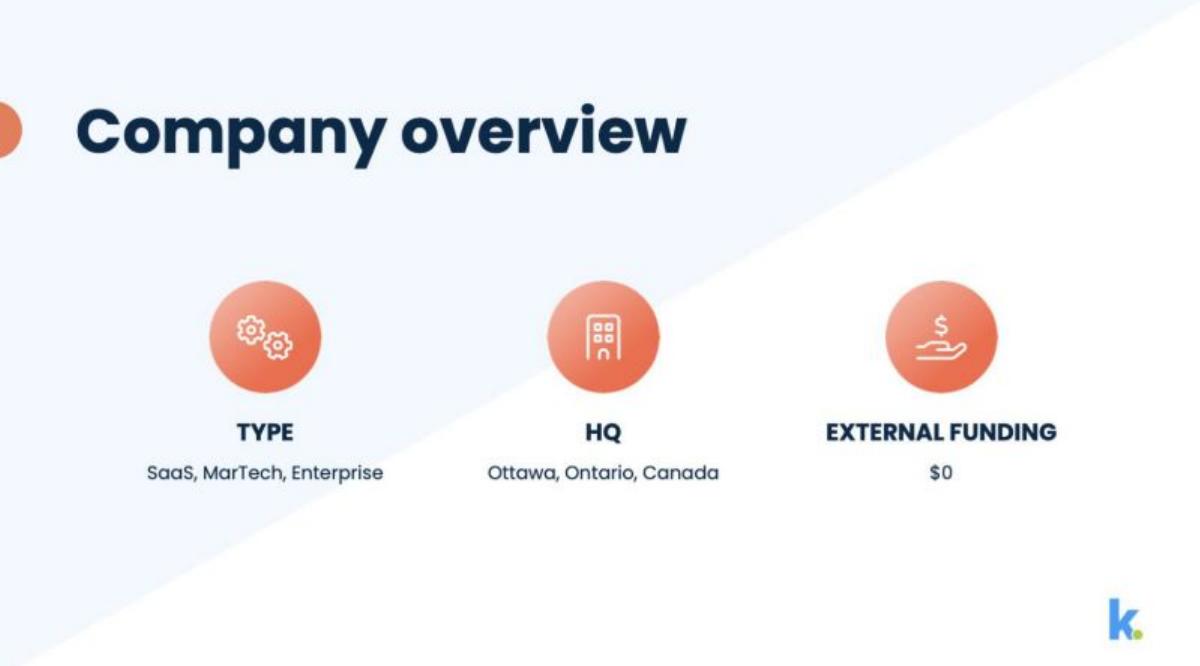
- The company highlighted its capital efficiency by noting $0 in prior external funding on slide 5.
- Knak claims their platform allows marketing teams to get to market up to 95% faster than traditional methods on slide 3.
- The leadership team includes a CEO who is a 'Former 4X Marketo champion,' providing deep domain credibility on slide 7.
- The deck identifies a massive cost inefficiency in manual email creation, citing agency costs between $1k and $75k per email on slide 10.
- The total addressable market for marketing automation is projected to reach $25.1B by 2023, according to slide 10.
- The $25M Series A ask is specifically allocated toward new headcount, marketing, a new office, and a 'war chest' on slide 11.
- The product is positioned as '100% codeless' and 'agnostic,' meaning it integrates with existing enterprise tech stacks on slides 6 and 8.
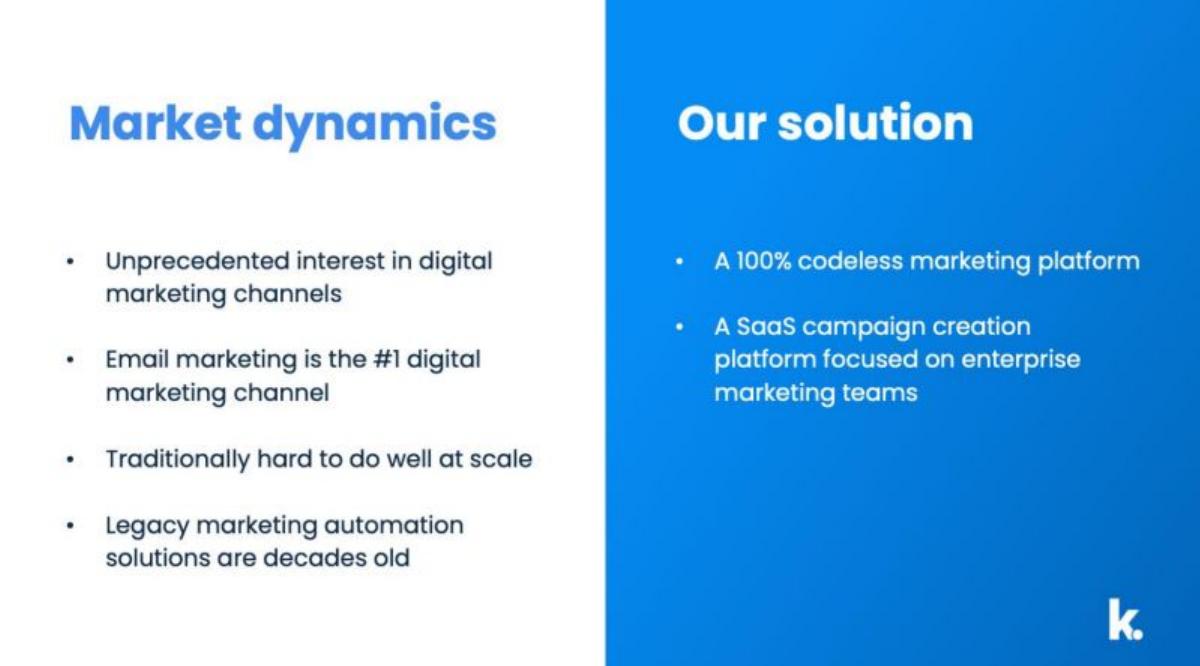
- The deck omits a traditional competition grid, choosing instead to frame 'legacy marketing automation solutions' as the primary antagonist on slide 6.
The Narrative of Creative Liberation
Knak’s Series A deck is a concise 13-slide presentation that focuses on a single, powerful narrative: the liberation of the enterprise marketer. In an era where marketing technology (MarTech) has become synonymous with complex, code-heavy automation, Knak positions itself as the user-friendly layer that sits on top of these 'stodgy' systems. The deck is visually clean, using a consistent blue and white palette that mirrors the professional yet accessible nature of their SaaS product. By raising $25M on this deck, Knak proved that for Series A, a clear problem-solution fit and a credible team can often outweigh the need for a 30-slide data dump.
Slide 1: Title Slide
The deck opens with a minimalist title slide featuring only the Knak logo against a blue gradient background with subtle geometric circles. There is no tagline or date, which forces the viewer to focus entirely on the brand name. It is a confident start for a company that, at this point, had already built a significant reputation in the Ottawa tech scene.
Slide 2: Marketing teams have a problem
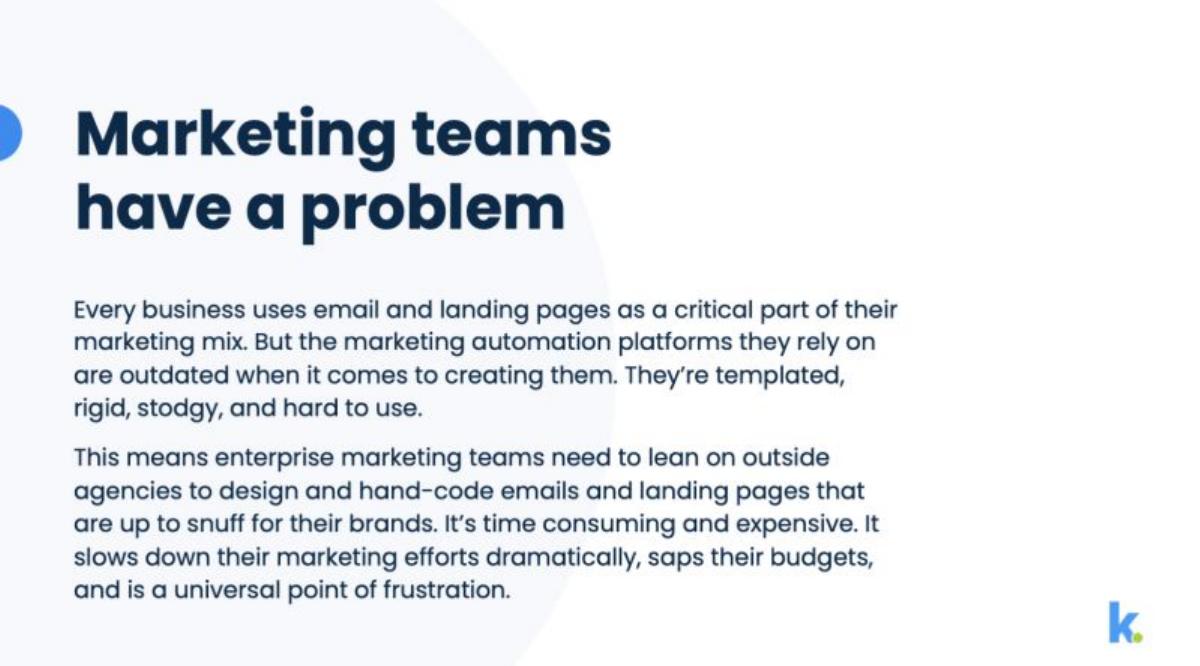
Slide 2 establishes the 'villain' of the story. It identifies that while email and landing pages are critical, the platforms used to create them are 'outdated,' 'templated,' and 'rigid.' The specific pain point mentioned is the reliance on outside agencies to 'hand-code' assets, which is described as a 'universal point of frustration.' This slide does an excellent job of agitating a specific, high-cost pain point that every enterprise CMO understands: the agency bill.
Slide 3: Enter Knak
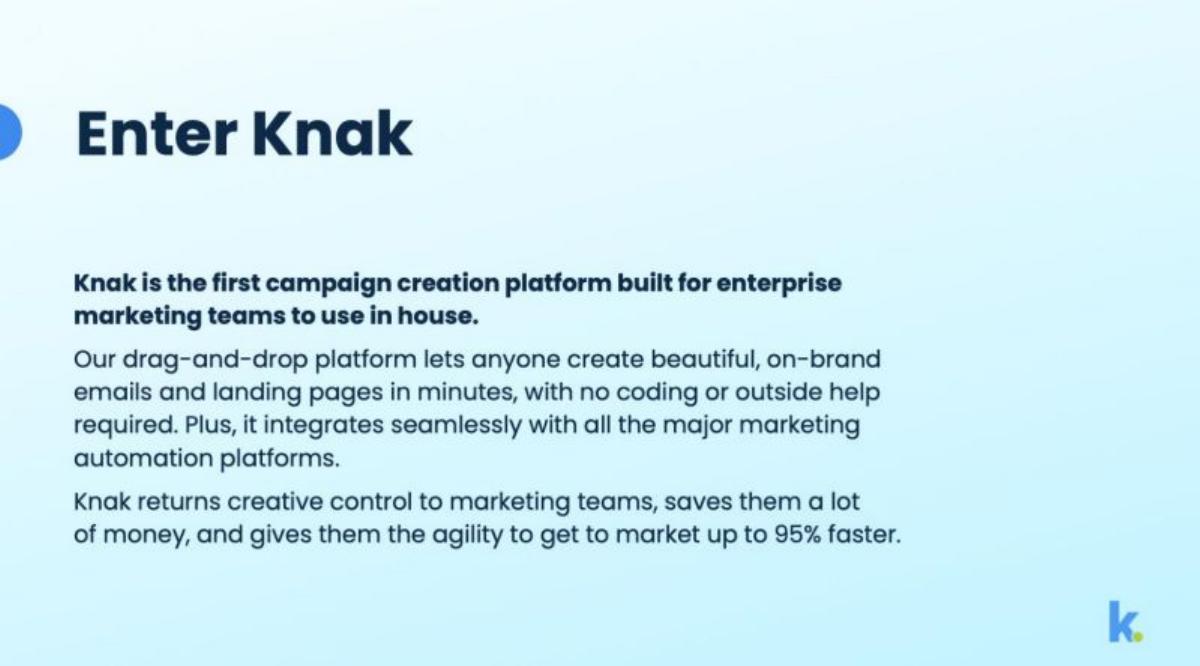
The solution slide introduces Knak as the 'first campaign creation platform built for enterprise marketing teams to use in house.' The value proposition is quantified here: it is a drag-and-drop platform that requires no coding and allows teams to get to market 'up to 95% faster.' This is a bold claim that directly counters the 'slow' and 'expensive' problems outlined in the previous slide.
Slide 4: Where we’re at
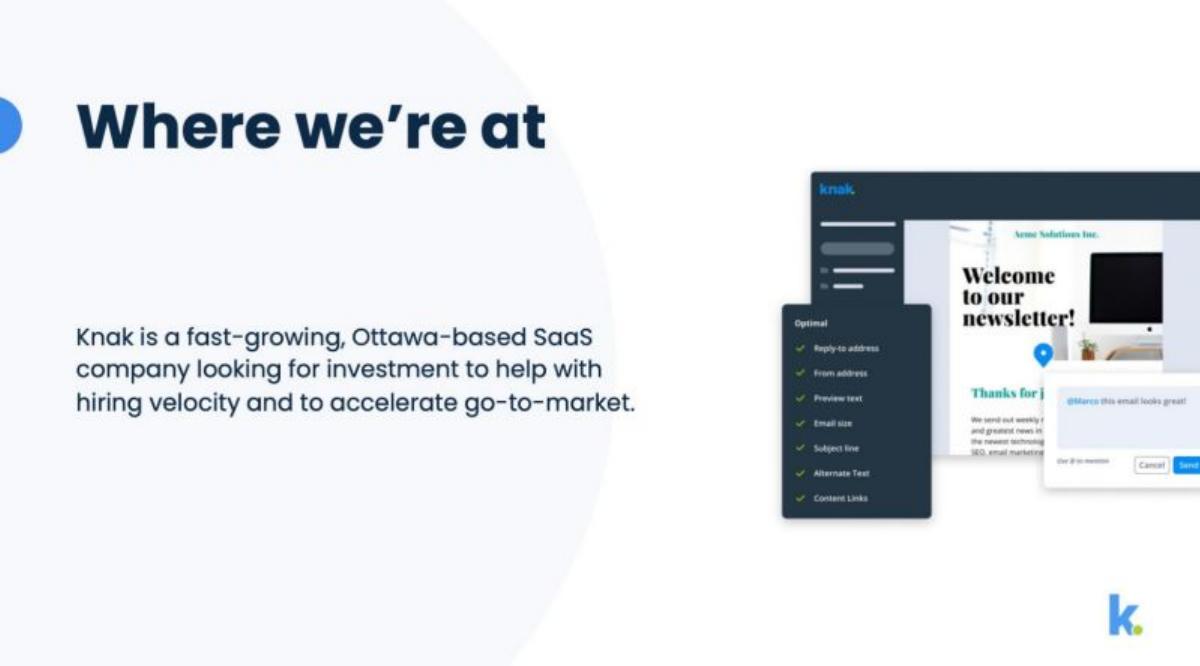
This slide serves as a transition, providing a high-level status update. It identifies Knak as an Ottawa-based SaaS company. The primary goal of the investment is stated clearly: 'hiring velocity' and 'accelerated go-to-market.' A small product mock-up is included on the right, showing a clean UI with a checklist of 'Optimal' email features (Subject line, Alt Text, etc.), hinting at the product's built-in best practices.
Slide 5: Company overview
This is arguably the most important slide for an investor. It lists the company type (SaaS, MarTech, Enterprise) and HQ (Ottawa, Ontario, Canada). However, the standout figure is External Funding: $0 . For a company seeking a $25M Series A, having raised zero dollars previously is a massive signal of capital efficiency and product-market fit. It tells the investor that the founders know how to build a real business, not just a venture-backed experiment.
Slide 6: Market dynamics and Our solution
Slide 6 uses a split-screen approach to contrast the market with Knak’s specific offering. The market dynamics include 'unprecedented interest in digital marketing channels' and the fact that 'legacy marketing automation solutions are decades old.' Knak counters this with a '100% codeless marketing platform.' This slide reinforces the 'Why Now' by highlighting the widening gap between modern marketing needs and legacy software capabilities.
Slide 7: Leadership team
The team slide is heavy on industry-specific 'street cred.' CEO Pierce Ujjainwalla is highlighted as a 'Former 4X Marketo champion' and a consultant for IBM, Microsoft, and NVIDIA. COO Brendan Farnand is credited with leading global MAP (Marketing Automation Platform) implementations. CTO Patrick Proulx is labeled a 'True 10X Developer.' This slide aims to prove that the team has both the technical ability to build the tool and the domain expertise to sell it to the world's largest companies.
Slide 8: The Knak magic
This slide breaks down the product's core pillars: Codeless, Future-proof, Agnostic, Branding Control, and Latest Technology. The use of the word 'agnostic' is key here; it assures investors that Knak isn't competing with giants like Salesforce or Adobe, but rather making those platforms more valuable by improving the user experience of the people who actually use them.
Slide 9: Why now?
The 'Why Now' slide leans into the post-COVID reality. It mentions that 'Covid has made collaborating with remote teams critical' and that 'Marketing needs to be the most agile department.' It also reiterates that the company has achieved product-market fit and has reliable data, suggesting that the risk of the investment is low because the 'spending' will have a predictable impact.
Slide 10: Market size
Knak presents three large numbers to define their opportunity. First, a $25.1B marketing automation market projected by 2023. Second, the 'massive market' of manual email creation by agencies, which they price at $1k-$75k per email . Third, a 100% stat claiming every business in the world sends email. By tying their TAM (Total Addressable Market) to agency spend rather than just software budgets, they significantly expand their perceived value.
Slide 11: Our ask
The 'Ask' slide is direct: Looking to raise $25M USD . The planned investments are listed as New headcount, Marketing, New office, and a 'War chest.' While 'War chest' is a bit vague, the focus on headcount and marketing aligns with the earlier statement about accelerating go-to-market. It is a standard Series A allocation focused on scaling what is already working.
Slide 12 & 13: Closing
The deck ends with a simple 'Thank you' slide and a final slide promoting the source of the deck. There is no contact information or 'Next Steps' slide included in this version, which is common for decks shared publicly after a round closes.
What Knak Got Right
1. The 'Zero Funding' Flex: Mentioning that they had $0 in external funding while asking for $25M is a brilliant move. It immediately sets them apart from the thousands of startups that burn through seed rounds without finding a repeatable sales motion. It suggests that the $25M will be used as fuel for a fire that is already burning brightly.
2. Focusing on the Agency Cost: Most MarTech companies compare themselves to other software. Knak wisely compares itself to the cost of human labor (agencies). By citing $75,000 for a single email, they make their software subscription look like an absolute bargain, regardless of the price point.
3. Domain Authority: The 'Marketo Champion' designation for the CEO is a specific, high-value credential in this niche. It tells investors that the founder isn't just a guy with an idea, but a recognized expert in the very systems he is trying to improve.
What Was Missing
1. Hard Metrics: For a Series A, the lack of a slide showing ARR (Annual Recurring Revenue) growth over time is surprising. While the listing mentions they are 'fast-growing,' investors usually want to see the specific slope of that growth curve. There is also no mention of Net Revenue Retention (NRR) or churn, which are the lifeblood metrics of enterprise SaaS.
2. Customer Logos: The CEO's bio mentions consulting for IBM and Microsoft, but the deck doesn't feature a 'Trusted By' slide with logos of current Knak customers. Seeing a wall of Fortune 500 logos would have significantly bolstered the 'product-market fit' claim on slide 9.
3. Competitive Landscape: The deck treats 'legacy systems' as the only competition. In reality, there are other email builders and content creation tools. A competition matrix showing why Knak is superior to other 'no-code' builders would have helped clarify their moat.
Founder's Playbook: What to Copy
1. Use 'Agitator' Language: Knak doesn't just say legacy tools are old; they call them 'stodgy' and 'rigid.' Use evocative language to describe the pain your customers feel. It makes the solution feel like a relief rather than just another tool.
2. Quantify the 'Before' and 'After': The claim of being '95% faster' (slide 3) is a powerful hook. If your product saves time, give the investor a specific percentage or hourly figure to latch onto.
3. Highlight Capital Efficiency: If you have bootstrapped to a significant milestone, make that a centerpiece of your deck. In a tightening VC market, the ability to do more with less is one of the most attractive traits a founding team can possess.
Conclusion Knak’s deck succeeded because it identified a massive, expensive inefficiency in a huge market and presented a team that was uniquely qualified to solve it. By focusing on the 'creative control' narrative and their history of self-funded success, they turned a 13-slide presentation into a $25M capital injection.
Frequently asked questions
- What is the primary problem Knak solves for enterprise teams?
- According to slide 2, enterprise marketing teams are currently forced to rely on outside agencies to hand-code emails and landing pages because legacy automation platforms are 'templated, rigid, and stodgy.' This process is slow, expensive, and saps marketing budgets. Knak provides a codeless, drag-and-drop alternative that brings this creative control back in-house, significantly reducing the time and cost associated with campaign deployment.
- How does Knak justify its $25M Series A valuation?
- While the deck doesn't list a valuation, it justifies the $25M ask (slide 11) through its impressive 'zero funding' history (slide 5) and the scale of the problem. By citing that agencies charge up to $75,000 for a single email (slide 10), Knak demonstrates a clear path to ROI for enterprise clients. The combination of a $25B market and a proven, bootstrapped product-market fit makes the $25M request a growth-acceleration play rather than a survival one.
- What are the key technical advantages mentioned in the deck?
- Knak emphasizes that its platform is '100% codeless' and 'agnostic' (slide 6 and 8). This is critical for enterprise sales, as it means the software can integrate with any existing tech stack without requiring a total overhaul of the company's marketing infrastructure. Slide 8 also notes that the platform allows for 'branding control at the asset creation level,' ensuring brand consistency across all digital channels without manual oversight.
- Who are the founders and what is their background?
- The leadership team (slide 7) consists of Pierce Ujjainwalla (CEO), a serial entrepreneur and '4X Marketo champion'; Brendan Farnand (COO), a career enterprise marketer from Trend Micro; Patrick Proulx (CTO), described as a '10X Developer'; and Chris Davies (CCO), an agency creative director. This mix of deep technical skill and 'in-the-trenches' marketing experience is presented as a core competitive advantage.
- What is missing from the Knak pitch deck?
- The deck is notably missing a detailed financial slide showing ARR growth, churn rates, or CAC/LTV ratios. It also lacks a specific slide for a competitive landscape, though it mentions 'legacy solutions' generally. Furthermore, there is no detailed product roadmap or specific case studies from their 'hundreds of enterprise clients' mentioned in the CEO's bio. The deck relies more on high-level narrative and team pedigree than granular data.