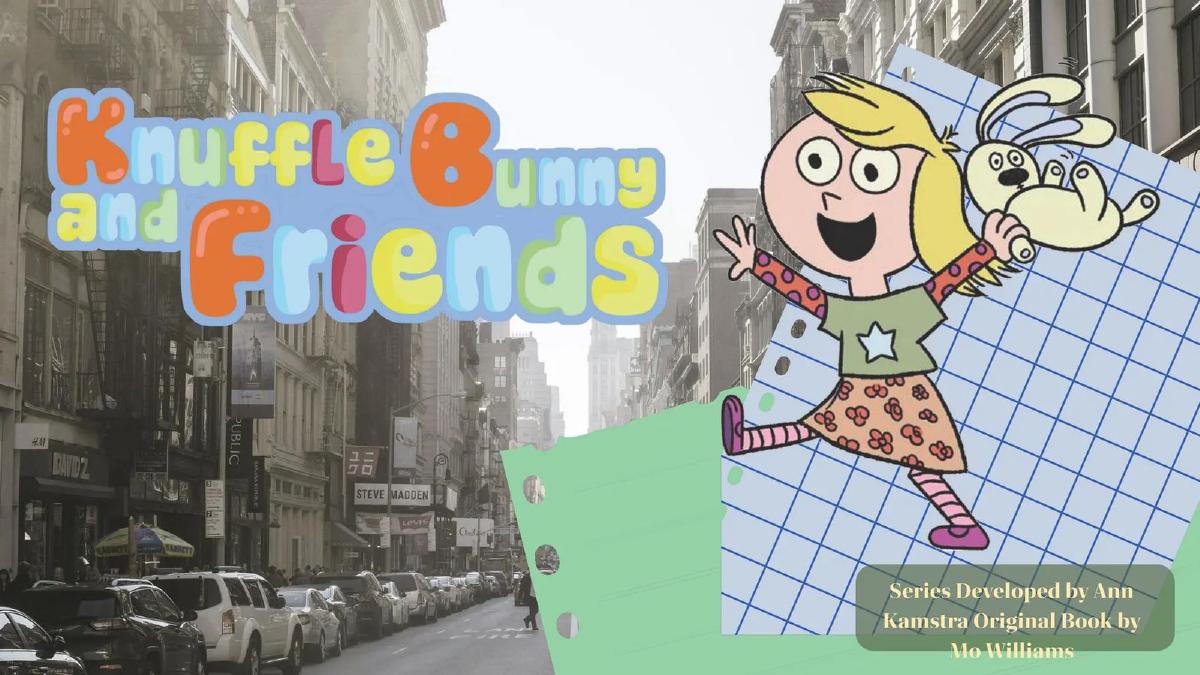
The Knuffle Bunny and Friends pitch deck is a creative proposal developed by Ann Kamstra to adapt Mo Willems' award-winning children's books into an animated television series. Spanning 17 slides, the deck emphasizes the emotional core of the story—the bond between a child and a stuffed animal—while introducing new dynamics, such as toys coming to life exclusively for children. The presentation uses mood boards and character profiles to establish a specific aesthetic and tone, targeting an audience ranging from elementary school to early teens. While the deck successfully identifies high-prof…
Key takeaways
- The series is based on the Caldecott Honor-winning source material by Mo Willems, including Knuffle Bunny, Knuffle Bunny Too, and Knuffle Bunny Free (Slide 2).
- A central narrative conceit is that only children can see and hear their toys come alive, adding a layer of secret fantasy to the grounded setting (Slide 6).
- The deck identifies Adventure Time, Arthur, and Gravity Falls as primary creative comparisons for tone and audience (Slide 7).
- The proposed series structure involves the audience growing alongside the protagonist, Trixie, with each season representing a new school year (Slide 7).
- Character dynamics are built on psychological archetypes, with Trixie's bunny representing her 'childish side' and Sonja's bunny acting as a rational 'angel on the shoulder' (Slides 9, 11).
- The pilot episode plot focuses on a 'mistaken identity' conflict where Trixie and Sonja accidentally swap their identical-looking stuffed animals (Slide 12).
- The deck suggests a high-profile voice cast including Kaitlyn Dias, Kristen Schaal, Michaela Dietz, and Martha Kelly (Slides 13-14).
- Target distribution platforms are narrowed down to Disney+ and PBS Kids, aligning with the educational and family-friendly nature of the IP (Slide 16).
Executive Summary: A Creative Vision for a Beloved IP
The Knuffle Bunny and Friends pitch deck is a 17-slide presentation developed by Ann Kamstra. It seeks to transition the world of Mo Willems’ Knuffle Bunny books into a serialized animated format. Unlike a standard tech startup deck that focuses on market size and revenue models, this deck is a creative treatment designed to sell a narrative vision. It excels at establishing tone and character but leaves the logistical and financial questions of animation production entirely unanswered.
Slide 1: Title Slide
The deck opens with a vibrant, collage-style title slide. It features the protagonist, Trixie, and her stuffed animal, Knuffle Bunny, overlaid on a sepia-toned photograph of a New York City street. The slide clearly attributes the series development to Ann Kamstra and acknowledges Mo Willems as the author of the original book. The visual style immediately establishes the 'urban-meets-whimsical' aesthetic that defined the original books.
Slide 2: The Source Material
Slide 2 establishes the pedigree of the project. It displays the covers of three books: Knuffle Bunny: A Cautionary Tale , Knuffle Bunny Too: A Case of Mistaken Identity , and Knuffle Bunny Free . By showcasing the Caldecott Honor seals on the covers, the deck reminds the viewer that this is a high-value, award-winning property with an existing fan base. It also includes interior illustrations to show the transition from toddlerhood to Pre-K.
Slide 3: Moodboards
This slide is a visual collage intended to communicate the 'feel' of the show. It includes images of crayons, colorful cereal, band-aids, and gritty NYC street corners. The juxtaposition of bright, childhood objects against black-and-white urban photography suggests the show will maintain the book's unique visual style—cartoon characters placed in real-world photographic environments.
Slide 4: Themes and Goals
Slide 4 outlines the educational and emotional pillars of the series. The Themes listed include Growing Up, Peer Pressure, Loss & Grief, Empathy, Setting Boundaries, and Identity. The Goals focus on teaching kids confidence, the balance between independence and asking for help, and navigating interpersonal conflicts. This slide positions the show as 'prestige' children's programming that tackles complex emotions rather than just simple slapstick.
Slide 5: Logline
The logline states: 'Starting as a Kindergardener at West Elm Elementary in New York City, Trixie must learn how to navigate growing up accompanied by her sardonic childhood toy/best friend Knuffle Bunny.' This slide introduces a key shift from the books: the toy is now 'sardonic,' implying a more active, vocal role for the stuffed animal in the animated series.
Slide 6: The World of Knuffle Bunny
This slide introduces the 'magic' of the show. It explicitly states that while adults appear in the story, 'only children can see and hear their toys come alive.' This is a classic trope in children's media (similar to Toy Story or Rugrats ), but it provides the necessary engine for a long-running television series that the original books lacked.
Slide 7: Comps and Audience
Slide 7 identifies the target audience as 'Elementary school–early teen.' It lists three major comparisons: Adventure Time , Arthur , and Gravity Falls . These are high-water marks for animated storytelling. The slide also notes a specific structural choice: 'Each season is a new year of school,' allowing the audience to grow alongside Trixie.
Slides 8-11: Character Profiles
These four slides provide deep dives into the main characters and their toys. Trixie (Slide 8) is described as fun-loving and eccentric. Her toy, KB (Slide 9), is described as her 'childish side' and acts as a 'Devil on the Shoulder.' Sonja (Slide 10) is introduced as a headstrong foil to Trixie, and her toy, Bunny (Slide 11), is a direct foil to KB—nonchalant, indifferent, and acting as a rational 'Angel on the Shoulder.' This setup creates a clear psychological framework for character-driven conflict.
Slide 12: Pilot Episode
The pilot summary focuses on the first day of Kindergarten. The conflict arises when KB (Trixie's bunny) sneaks into Sonja's backpack to see how he can make Trixie 'less uptight.' The episode ends with the 'chaos' of Trixie taking home the wrong bunny. This is a solid 'hook' that establishes the personalities of both the humans and the toys.
Slides 13-14: The Cast
The deck proposes a specific voice cast. Kaitlyn Dias (the voice of Riley in Inside Out ) is suggested for Trixie. Kristen Schaal (Mabel in Gravity Falls , Louise in Bob's Burgers ) is suggested for KB. Michaela Dietz (Amethyst in Steven Universe ) is suggested for Sonja, and Martha Kelly ( Baskets ) for Sonja's bunny. This is an exceptionally strong, albeit likely expensive, 'dream cast' that signals the intended tone of the show.
Slide 15: Writer's Room
This slide features Joe Bennett and Lauren Faust . Faust is a legendary figure in animation, having developed My Little Pony: Friendship is Magic and worked on Foster's Home for Imaginary Friends . Bennett brings a more modern, indie sensibility from Scavengers Reign . Including these names adds significant professional weight to the pitch.
Slides 16-17: Possible Networks and Conclusion
Slide 16 identifies Disney+ and PBS Kids as the ideal homes for the show. This is a logical choice, as the IP fits the educational mandate of PBS and the 'prestige family' brand of Disney+. Slide 17 is a simple 'Thank You' slide with thematic illustrations of ink and a magnifying glass.
What Works in This Deck
Visual Consistency: The deck does an excellent job of mirroring the unique art style of the source material. The use of 'scrapbook' elements like tape and graph paper reinforces the childhood theme. · Character Archetypes: The decision to make the toys 'Angel' and 'Devil' on the shoulders of the children is a clever way to externalize internal monologues, which is essential for a show aimed at younger viewers. · Strong Comps: By citing Adventure Time and Gravity Falls , the deck signals that it intends to be more than just a 'baby show,' aiming for the 'co-viewing' market where parents and older siblings also enjoy the content. · Talent Alignment: The suggested cast and writers are perfectly aligned with the 'sardonic yet sweet' tone described in the logline.
What is Missing from This Deck
IP Rights Status: The most glaring omission is a statement on the legal status of the IP. Does the presenter have an option on the books? Is Mo Willems involved? Without this, the deck is a 'fan pitch' rather than a business proposition. · Production Budget: There is no mention of what it would cost to produce a season of this show. Animation is expensive, especially if it uses the mixed-media (photo + 2D) style of the books. · Distribution Strategy: While 'Possible Networks' are listed, there is no plan for how to reach them or what the licensing model would look like. · The Ask: The deck ends without asking for anything. A fundraising deck needs a clear statement of what is needed (e.g., '$500k for a pilot animatic' or 'Looking for a production partner').
What a Founder Should Copy
The 'Moodboard' Approach: For creative startups, a moodboard (Slide 3) is often more effective at communicating brand identity than a thousand words of copy. · Clear Thematic Pillars: Slide 4 is a great example of how to distill a complex product into simple, relatable goals. · Psychological Framing: The way the toys are framed as extensions of the children's personalities (Slides 9 and 11) is a masterclass in character design that investors can easily understand.
Frequently asked questions
- What is the primary goal of this pitch deck?
- The primary goal is to pitch an animated television series adaptation of the Knuffle Bunny book series. It focuses on establishing the 'vibe,' character arcs, and thematic goals, such as teaching kids about empathy, identity, and navigating interpersonal conflicts. It serves more as a creative pitch to a studio or network than a financial pitch to venture investors.
- Who is the intended audience for the proposed show?
- According to slide 7, the target audience ranges from elementary school students to early teens. The deck proposes a unique aging mechanic where the characters and the audience grow together, with each season of the show corresponding to a new year of school for the protagonist, Trixie.
- Does the deck include information about the production team?
- Yes, slide 15 highlights a 'Writer's Room' featuring Joe Bennett (Scavengers Reign) and Lauren Faust (My Little Pony: Friendship is Magic). This suggests the project aims for a high standard of animation storytelling by leveraging creators with proven track records in both adult-leaning and children's animation.
- What are the major omissions in this deck?
- The deck is entirely missing the business side of a startup or production pitch. There is no mention of the current status of the intellectual property (IP) rights, no estimated production budget, no timeline for development, and no specific 'ask' regarding funding or partnership terms. It is a creative treatment rather than a business plan.
- How does the deck handle competition?
- Instead of traditional market competitors, the deck uses 'Comps' (comparisons) on slide 7. It positions Knuffle Bunny and Friends alongside successful animated hits like Adventure Time and Gravity Falls to signal to executives that the show will have both emotional depth and broad appeal across different age demographics.