AgBiome’s Series D deck is a clinical example of how to present a 'platform-plus-product' story to late-stage investors. By 2021, the company had moved beyond theoretical science to commercial reality, citing significant revenue from its first product, Howler. The deck leverages a high-pedigree team—featuring former CEOs of Bayer and GE—and a proprietary database of over 90,000 sequenced microbes to justify a massive $116M raise. It successfully balances the immediate commercial traction of its current fungicides with a long-term roadmap of 30 product launches by 2030. While it lacks specific…
Key takeaways
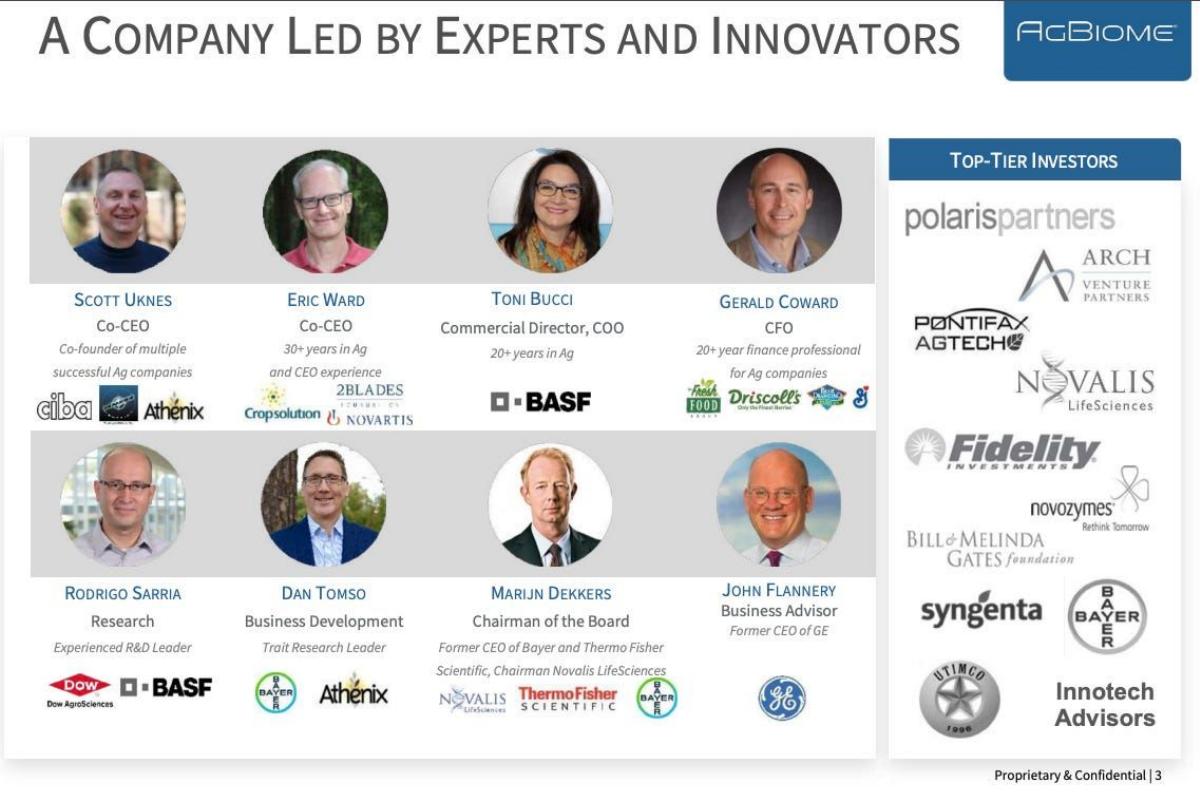
- The team slide (Slide 3) features heavyweights like Marijn Dekkers (former CEO of Bayer) and John Flannery (former CEO of GE), providing immense institutional credibility.
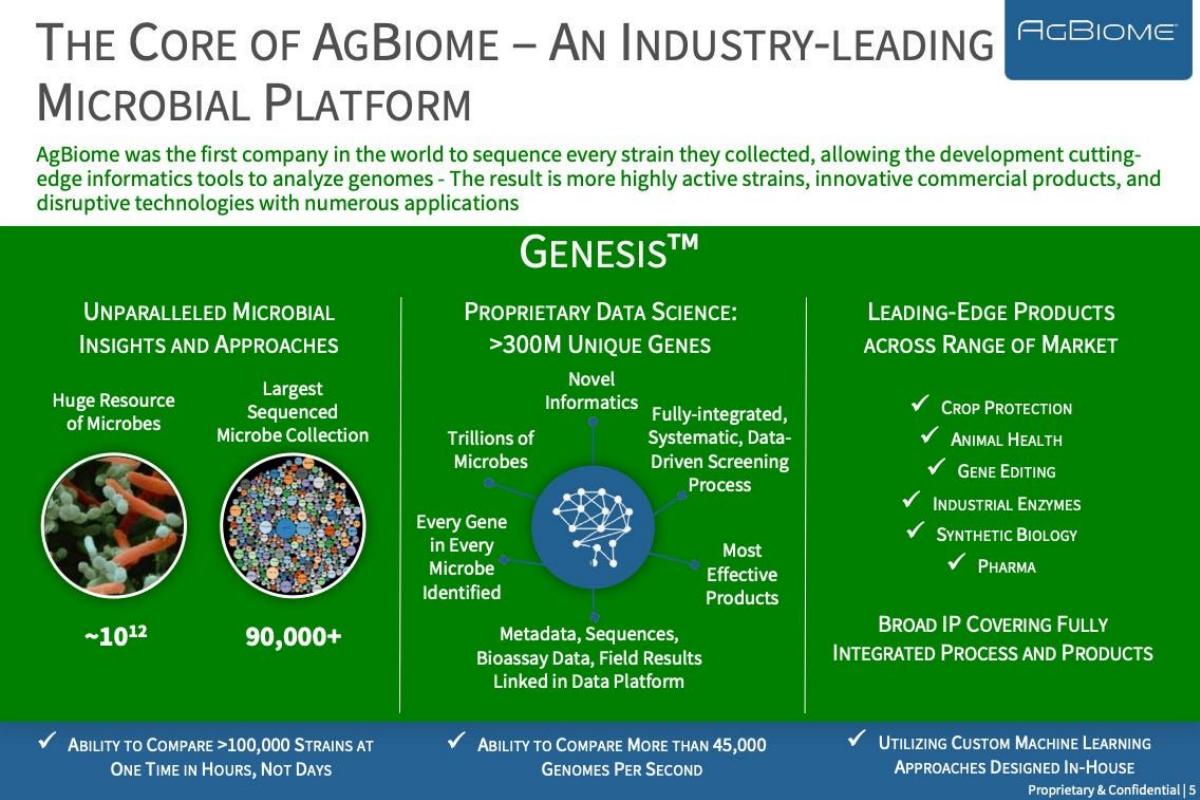
- AgBiome positions its 'Genesis' platform as a data science moat, claiming a collection of 90,000+ sequenced microbes and 300M+ unique genes (Slide 5).
- The market slide (Slide 7) projects the global biologicals market to grow from $1.4B in 2020 to $14.4B by 2030, a 10x increase in one decade.
- A detailed product roadmap (Slide 9) promises a rapid scaling from 1 product launch in 2020 to 30 cumulative launches by 2030.
- The company employs four distinct business models—ranging from wholly-owned to late-stage licensing—to maximize revenue streams across different market segments (Slide 11).
- Traction is validated through ~240 product demos and the claim that their first product, Howler, generated significant revenue in its first full year (Slide 13).
- The deck emphasizes exit potential by listing six major industry acquisitions since 2019, including Syngenta’s acquisition of Valagro (Slide 7).
- Despite the $116M raise, the deck does not include a specific 'Ask' slide or a detailed breakdown of how the Series D capital will be allocated.
The Platform Play: AgBiome’s $116M Series D Narrative
AgBiome’s 2021 pitch deck is a masterclass in late-stage fundraising for deep-tech and life sciences companies. At the Series D stage, investors are no longer looking for just a 'good idea'; they are looking for a validated platform, a massive moat, and a clear path to a multi-billion dollar exit. As reported by Business Insider, this deck helped secure $116M in funding, a testament to its ability to bridge the gap between complex microbial science and commercial scalability.
Slide 1-2: The Vision and Branding
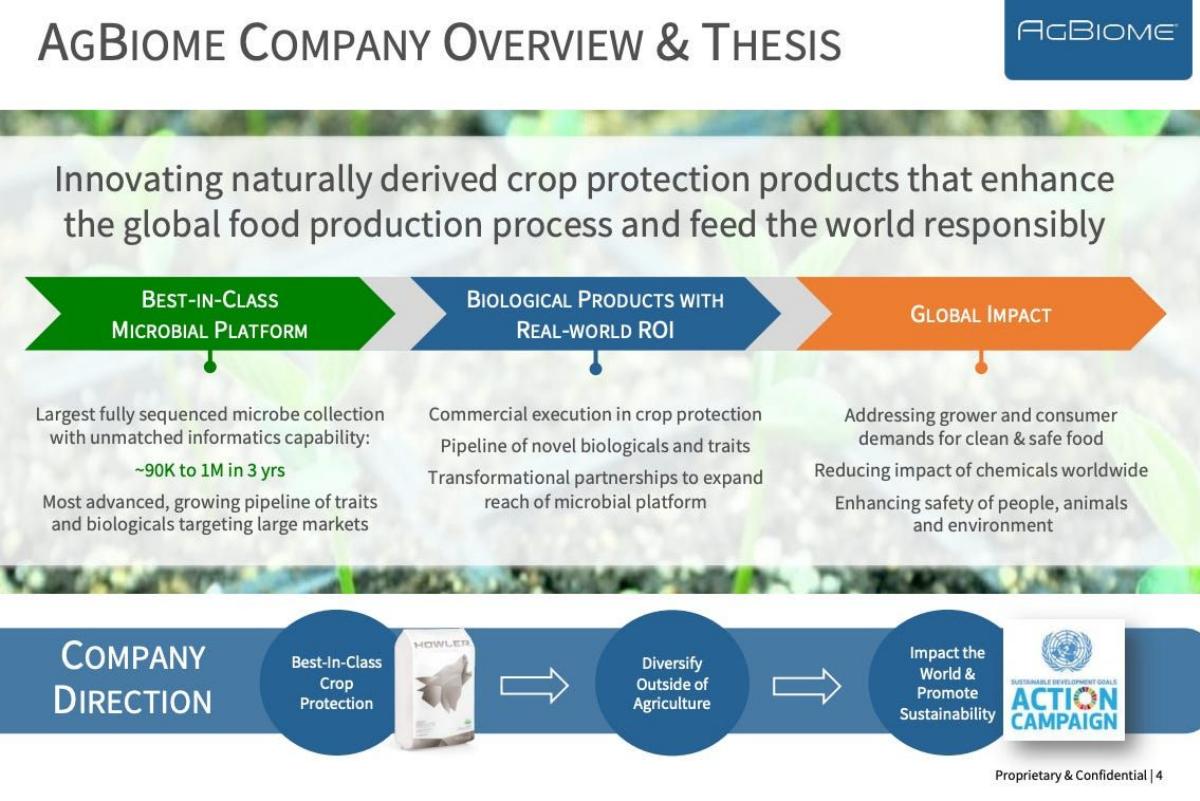
The opening slides establish a clean, professional aesthetic. The tagline 'Changing the World Through Microbial Solutions' immediately positions the company within the ESG (Environmental, Social, and Governance) framework, which was a significant driver of investment in 2021. By focusing on 'Microbial Solutions' rather than just 'pesticides,' AgBiome frames itself as a biotechnology platform rather than a simple chemical manufacturer.
Slide 3: The 'Powerhouse' Team
Slide 3 is arguably the strongest slide in the deck for a Series D round. It doesn't just list founders; it lists industry titans. Having Marijn Dekkers (Former CEO of Bayer) as Chairman and John Flannery (Former CEO of GE) as a Business Advisor provides a level of 'adult supervision' and industry connectivity that de-risks the investment significantly. The inclusion of logos from Ciba, BASF, Novartis, and Dow for the executive team signals that these are not academic researchers, but seasoned veterans who know how to navigate the complex regulatory and commercial landscape of global agriculture. The right-hand column showcasing 'Top-Tier Investors' like Polaris, ARCH, and the Bill & Melinda Gates Foundation further reinforces the 'winner's circle' narrative.
Slide 4-5: The Genesis Platform and Data Moat
Slide 5 introduces 'Genesis,' AgBiome’s proprietary microbial platform. This is the 'moat' slide. The company claims to have the 'Largest Sequenced Microbe Collection' with over 90,000+ strains and 300M+ unique genes . By quantifying their data—stating they can compare 45,000 genomes per second —they move the conversation from biology to data science. This is a crucial distinction for attracting high-valuation tech investors who value software-like scalability. The slide also lists the broad applications of the platform, including Animal Health, Gene Editing, and Pharma, suggesting that while they are starting with crop protection, the upside is far larger.
Slide 6-7: Market Dynamics and Exit Strategy
Slide 7 provides the macro-economic justification for the round. It cites a massive shift in the Global Biologicals Market , projected to grow from $1.4 billion in 2020 to $14.4 billion by 2030 . The most effective part of this slide is the 'Market Moves & Exit Opportunities' section. By listing recent acquisitions by Syngenta, Nutrien, and UPL, AgBiome is telling investors exactly who the potential buyers are. The statement that they are 'one of the few AgTech companies with Public Company Potential' sets the stage for either an IPO or a high-premium acquisition.
Slide 8-9: The Product Roadmap
Slide 9 is a dense, visual representation of their pipeline. It transitions the deck from 'platform' to 'product.' They promise 11 product launches by 2025 and 30 by 2030 . By categorizing these into Fungicides, Biostimulants, Insecticides, and Herbicides, they demonstrate a comprehensive strategy to replace the entire synthetic chemical shelf. The cumulative product launch counter at the bottom of the slide provides a clear metric for future success that investors can track.
Slide 10-11: Multiple Revenue Streams
Slide 11 explains how AgBiome will actually make money. Instead of a single business model, they present four: Wholly-Owned, JV/In-License, Early License, and Late License. This 'portfolio approach' to business models is highly attractive to late-stage investors because it balances high-margin, wholly-owned products (like Howler and Theia) with lower-risk, partner-funded development. The inclusion of partner logos like Elanco and TMG proves that the industry is already 'voting with its feet' by integrating AgBiome’s tech.
Slide 12-13: Key Investment Highlights and Traction
Slide 13 serves as the executive summary. It highlights that Howler generated significant revenue in its first full year and mentions ~240 product demos . This is the 'proof of life' for the commercial side of the business. It reiterates the 'Solving a Global Problem' narrative, ensuring the deck ends on a high-impact, mission-driven note.
Slide 14: Closing
The deck concludes with a simple contact slide, maintaining the professional and understated tone of the rest of the presentation.
What AgBiome Does Exceptionally Well
AgBiome excels at quantifying the unquantifiable . Microbial science can be opaque to non-scientists, but by using metrics like '90,000 strains' and '45,000 genomes per second,' they turn biological discovery into a measurable engineering process. This appeals to the logic of venture capital. Furthermore, their team slide is a masterclass in authority. In a sector as regulated as agriculture, having the former CEO of the world’s largest Ag company (Bayer) on your board is a competitive advantage that few startups can match.
What is Missing from the Deck
For a Series D deck, there are a few notable omissions. First, there is a lack of specific financial data . While they mention 'significant revenue' for Howler, they do not provide a P&L, gross margins, or specific revenue targets. Second, there is no 'The Ask' slide . While we know from reported facts they raised $116M, the deck itself doesn't explicitly state how much they are seeking or how they will spend it (e.g., R&D vs. Sales & Marketing). Finally, the competitive landscape is only addressed indirectly through the market growth slide; a direct comparison against other biological players like Indigo Ag or Pivot Bio is absent.
Lessons for Other Founders
Lead with Credibility: If you have a world-class board or advisors, put them upfront. In deep tech, who you know is often as important as what you know. · Turn Science into Data: If your product is complex, find ways to express its power through numbers (e.g., processing speed, database size, gene count). · Show the Exit: Don't make investors guess who will buy you. List the recent acquisitions in your space to show that the market is active and hungry for your technology. · Diversify Your Business Model: Showing that you can generate revenue through both direct sales and licensing makes your company more resilient and attractive to different types of investors.
Frequently asked questions
- What is AgBiome's core technology?
- AgBiome's core technology is the Genesis platform, described on Slide 5. It is a microbial discovery engine that has sequenced over 90,000 microbe strains and identified over 300 million unique genes. This allows the company to use custom machine learning to compare 45,000 genomes per second, significantly accelerating the discovery of natural, non-chemical pesticides and crop protection solutions.
- How does AgBiome generate revenue?
- As shown on Slide 11, AgBiome uses four business models: Wholly-Owned (direct revenue/profit), JV/In-License (royalties and profit sharing), Early License (upfront cash and royalties), and Late License (milestones and pipeline monetization). This multi-pronged approach allows them to capture value from their platform while partnering with giants like Elanco and TMG for specific market access.
- What is the market opportunity for biological pesticides?
- According to Slide 7, the global biologicals market is expected to grow from $1.4 billion in 2020 to $14.4 billion by 2030. During this same period, the market share of biologicals relative to traditional chemicals is projected to rise from 2% to 14%, driven by regulatory concerns and increasing pest resistance to synthetic chemicals.
- Who are the key people behind AgBiome?
- The leadership team (Slide 3) includes Co-CEOs Scott Uknes and Eric Ward, both with decades of experience in AgTech. The board is particularly notable, featuring Marijn Dekkers, the former CEO of Bayer and Thermo Fisher Scientific, and John Flannery, the former CEO of GE. This level of executive experience is rare for a startup and signals high institutional confidence.
- What products does AgBiome currently have in the market?
- The deck highlights 'Howler' as their flagship biological fungicide, which generated significant revenue in its first year (Slide 13). Slide 9 shows 'Theia' as a subsequent launch in the biological fungicide category, with a broader pipeline of insecticides, herbicides, and biostimulants scheduled for release through 2030.