AgileRL’s 12-slide deck is a masterclass in using community traction to validate a technical infrastructure play. The company addresses the gap between general-purpose LLMs and specialized business agents that require Reinforcement Learning (RL). By showcasing 220,000+ downloads and 800+ GitHub stars, the founders moved past the 'theoretical' stage of AI startups into proven utility. The deck leans heavily on 'RLOps'—the engineering pipeline required to make RL scalable—positioning AgileRL against both legacy HPO libraries like Optuna and modern LLM providers like OpenAI. While the deck lacks…
Key takeaways
- The deck identifies a specific technical gap: general LLMs like OpenAI are 'not good enough' for critical business tasks without RL specialization (Slide 2).
- Open-source traction is the primary validator, citing 220,000+ downloads and 800+ GitHub stars to prove developer demand (Slide 3).
- Performance benchmarks claim 10x faster training compared to state-of-the-art libraries like Optuna (Slide 3).
- The 'Users' slide effectively categorizes traction into academic publications, technology partnerships, and active pilots with firms like Airbus and IBM (Slide 4).
- AgileRL differentiates itself from 'agentic' solutions like Zapier by focusing on autonomous, self-improving agents rather than simple integrations (Slide 5).
- The team slide highlights significant scale experience, noting the CEO managed teams for a £100M ARR SaaS platform (Slide 6).
- Pre-seed backing from Octopus Ventures and Entrepreneur First is used to signal institutional quality to new investors (Slide 6).
- The deck omits a formal 'Ask' slide, financial projections, or a detailed breakdown of how the $7.5M will be allocated.
The Infrastructure of Autonomy: AgileRL Teardown
AgileRL entered the 2024 fundraising market with a clear thesis: the world has enough base models, but not enough tools to make them work for specific business logic. Their $7.5M Seed round, as reported by Business Insider, was built on the back of a 12-slide deck that prioritizes technical validation and open-source momentum over traditional financial forecasting. This teardown examines how they positioned 'RLOps' as the next critical category in the AI stack.
Slide 1: Title and Mission
The cover slide is minimalist, featuring the AgileRL logo and the tagline: "Accelerating reinforcement learning for building superhuman artificial intelligence systems." The use of the word "superhuman" is a bold claim, but it sets the stage for a deck focused on performance and optimization rather than just simple automation. It immediately identifies the company's niche: Reinforcement Learning (RL).
Slide 2: The Specialization Gap
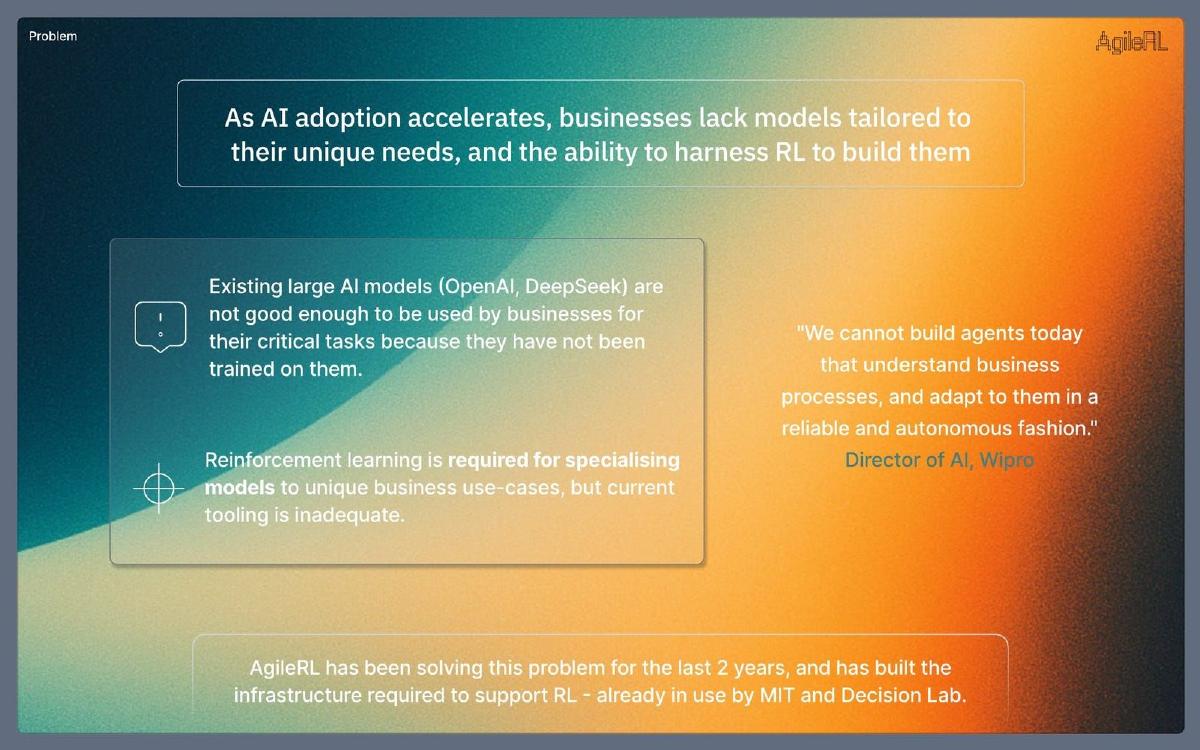
Slide 2 defines the problem. It argues that as AI adoption accelerates, businesses lack models tailored to their unique needs. The slide makes a specific critique of industry giants: "Existing large AI models (OpenAI, DeepSeek) are not good enough to be used by businesses for their critical tasks because they have not been trained on them."
To add weight to this claim, the slide includes a quote from the Director of AI at Wipro: "We cannot build agents today that understand business processes, and adapt to them in a reliable and autonomous fashion." This is a classic 'gap' analysis—identifying that while LLMs are great at talking, they are poor at executing complex, specialized business logic without RL. The slide concludes by noting that AgileRL has been building the infrastructure to solve this for 2 years, citing early use by MIT and Decision Lab.
Slide 3: Open-Source as a GTM Strategy
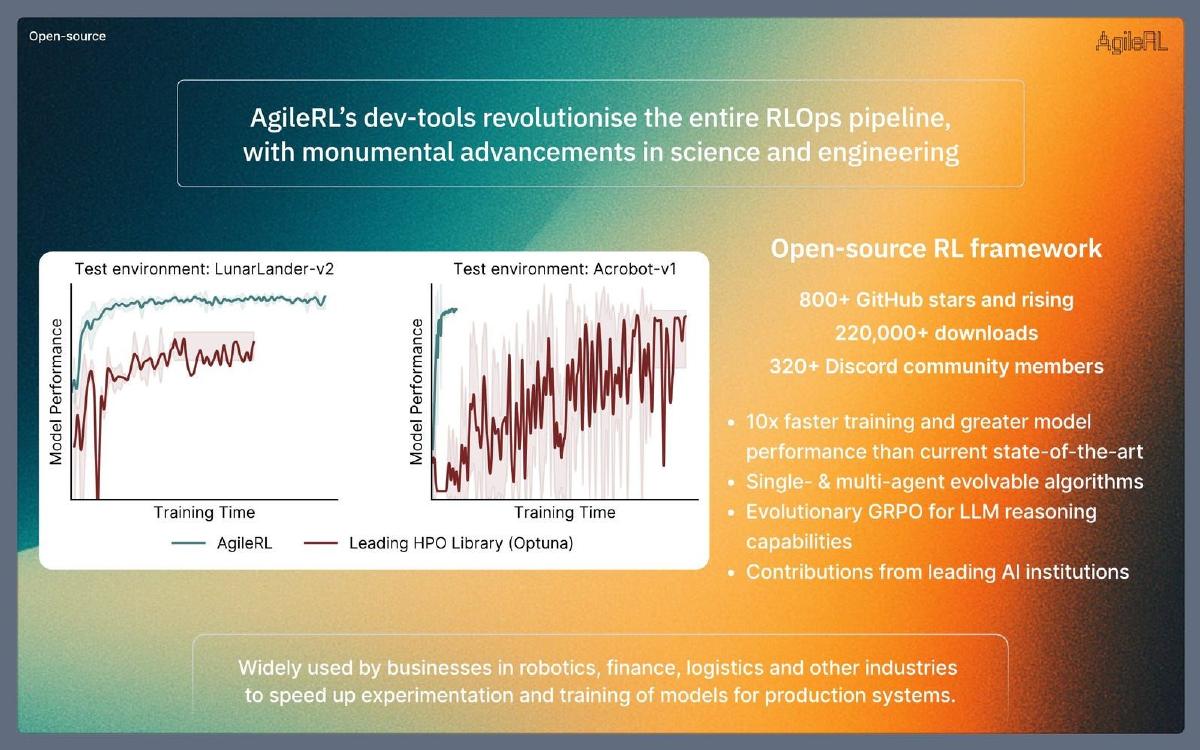
This is arguably the most important slide in the deck. It moves from the 'why' to the 'proof.' AgileRL showcases its open-source RL framework with impressive metrics: 800+ GitHub stars, 220,000+ downloads, and 320+ Discord community members.
The slide also includes technical benchmarks. Two charts show AgileRL's performance in 'LunarLander-v2' and 'Acrobot-v1' environments against Optuna, a leading Hyperparameter Optimization (HPO) library. The key claim here is "10x faster training and greater model performance than current state-of-the-art." By highlighting "Evolutionary GRPO for LLM reasoning capabilities," they bridge the gap between traditional RL and the current LLM hype cycle.
Slide 4: The Traction Ladder
Slide 4, titled "Users," is a masterclass in social proof. Instead of a random jumble of logos, it categorizes traction into a logical progression:
Academic publications: Roblox, Carnegie Mellon, University of Waterloo. · Technology partners: Decision Lab. · Trials: Airbus (onboarding as a supplier). · Open-source contributions: Warburg AI. · Ongoing pilots: IBM, Citi, Intropic, RT Dynamics, eni. · Discussion phase: UBS, SSE, PETRONAS, MIT CSAIL.
This layout shows a healthy pipeline, moving from academic validation to enterprise pilots with multi-billion dollar organizations. The bottom of the slide features three case studies: high-frequency trading, robot learning, and bin-packing efficiency, demonstrating the versatility of their RL infrastructure.
Slide 5: Competitive Landscape
The competition slide uses a matrix to differentiate AgileRL from four distinct groups: specialized RL startups (Luffy.ai), open-source libraries (Optuna), base LLMs (ChatGPT/Gemini), and 'agentic' platforms (Zapier/Agentforce).
AgileRL claims the only 'full house' of checkmarks across four criteria: specialization for business tasks, no need for step-by-step human instructions, autonomous/continually improving agents, and overcoming RL engineering hurdles. The commentary at the bottom is sharp, dismissing most 'agentic' solutions as "just platforms for integrations i.e. Zapier with buzzwords." This positions AgileRL as the deep-tech alternative to superficial automation.
Slide 6: The Team Pedigree
The team slide focuses on two founders with significant scaling experience. CEO Param Kumar is noted as an "AI SaaS product leader" who managed teams building a "£100 million ARR SaaS platform" at Just Eat. This is a critical metric for a Seed round, as it suggests the leadership knows how to handle scale.
CTO Nick Ustaran-Anderegg is presented as the technical engine, with an MEng from Imperial College London and experience creating facial recognition models used to prevent voter fraud 625,000+ times. The slide also lists their pre-seed investors—Octopus Ventures, Counterview Capital, and Entrepreneur First—which signals to new investors that the company has already passed professional due diligence.
What Works in This Deck
The deck excels at category creation. By using the term "RLOps" (Slide 3), they are attempting to own the infrastructure layer for reinforcement learning, much like Databricks owns the data layer or Vercel owns the frontend layer. The use of open-source metrics (220,000 downloads) is a powerful way to bypass the 'chicken-and-egg' problem of enterprise sales; they can prove people want the tool before they prove people will pay for it.
The traction categorization on Slide 4 is also highly effective. It shows a clear path from 'people are talking about us' to 'people are testing us' to 'people are using us.' This reduces the perceived risk for a Seed investor by showing that the technology is already being integrated into complex environments like Airbus and Citi.
What Is Missing
The most glaring omission is the financials and the 'Ask.' In the version of the deck reviewed, there is no slide detailing how much capital is being raised, the valuation target, or the specific milestones the $7.5M will fund. While this information is often handled in a separate document or a follow-up conversation, its absence in the primary deck leaves the 'business' side of the startup under-explained.
Furthermore, there is no Roadmap slide. While they mention being in business for 2 years, they don't show where the product is going next. For a Seed round, investors want to see the transition from an open-source library to a commercial enterprise platform. How do they monetize? Is it a managed cloud service? Per-agent licensing? The deck is silent on the business model.
Founder Takeaways
Founders building in deep tech or infrastructure should copy AgileRL's benchmark-first approach. If you claim your software is better, show a graph comparing it to the industry standard (as they did with Optuna on Slide 3). Don't just say you are faster; prove it with a test environment like LunarLander.
Another key takeaway is the utilization of open-source data. If you have a developer tool, your GitHub and download metrics are your 'revenue' in the early stages. AgileRL leaned into these numbers to justify a $7.5M round in a year where many AI startups struggled to move past the 'wrapper' stage. Finally, the team slide's focus on ARR management experience (the £100M figure) is a great way to show that a technical team also understands the mechanics of a large-scale business.
Frequently asked questions
- What is the core problem AgileRL is solving?
- AgileRL argues that while AI adoption is accelerating, businesses lack models tailored to unique needs. They claim existing large models (OpenAI, DeepSeek) aren't sufficient for critical tasks because they haven't been trained on specific business processes. The 'bottleneck' is the lack of adequate tooling for Reinforcement Learning (RL), which is necessary to specialize these models.
- How does AgileRL prove its technical superiority?
- The deck uses a two-pronged approach: performance data and community adoption. On Slide 3, they show charts comparing AgileRL to Optuna (a leading HPO library), claiming 10x faster training. They also highlight 220,000+ downloads of their open-source framework, suggesting that the market has already 'voted' for their architecture.
- Who are the key people behind AgileRL?
- The team is led by CEO Param Kumar, who previously managed engineering teams for a £100M ARR platform at Just Eat, and CTO Nick Ustaran-Anderegg, a machine learning engineer from Imperial College London who developed RL models for conversational agents and route optimization.
- What kind of market traction does the company have?
- AgileRL shows a sophisticated 'traction ladder' on Slide 4. This includes academic features (Roblox, CMU), technology partnerships (Decision Lab), completed trials (Airbus), and ongoing pilots with major financial and industrial institutions like IBM, Citi, and PETRONAS.
- What is missing from the AgileRL pitch deck?
- The deck is notably missing a slide detailing the specific 'Ask' (how much they are raising and on what terms), a roadmap for the next 18-24 months, and any detailed financial projections or unit economics. It functions more as a technical and strategic 'why now' document.