The Kraft Heinz merger deck is a quintessential example of a 'scale and synergy' play. Rather than focusing on disruptive technology, the presentation centers on the massive consolidation of two iconic brand portfolios to create the #3 food and beverage player in North America. The narrative is driven by two primary levers: $1.5 billion in identified cost efficiencies through zero-based budgeting and the 'repatriation' of Kraft brands into Heinz’s superior international distribution infrastructure. With backing from Berkshire Hathaway and 3G Capital, the deck prioritizes shareholder value thr…
Key takeaways
- The transaction provided Kraft shareholders with 1 share of the new entity plus a $16.50 per share cash payment (Slide 6).
- The merger aimed to create the #3 Food & Beverage player in North America with $22.2 billion in regional sales (Slide 24).
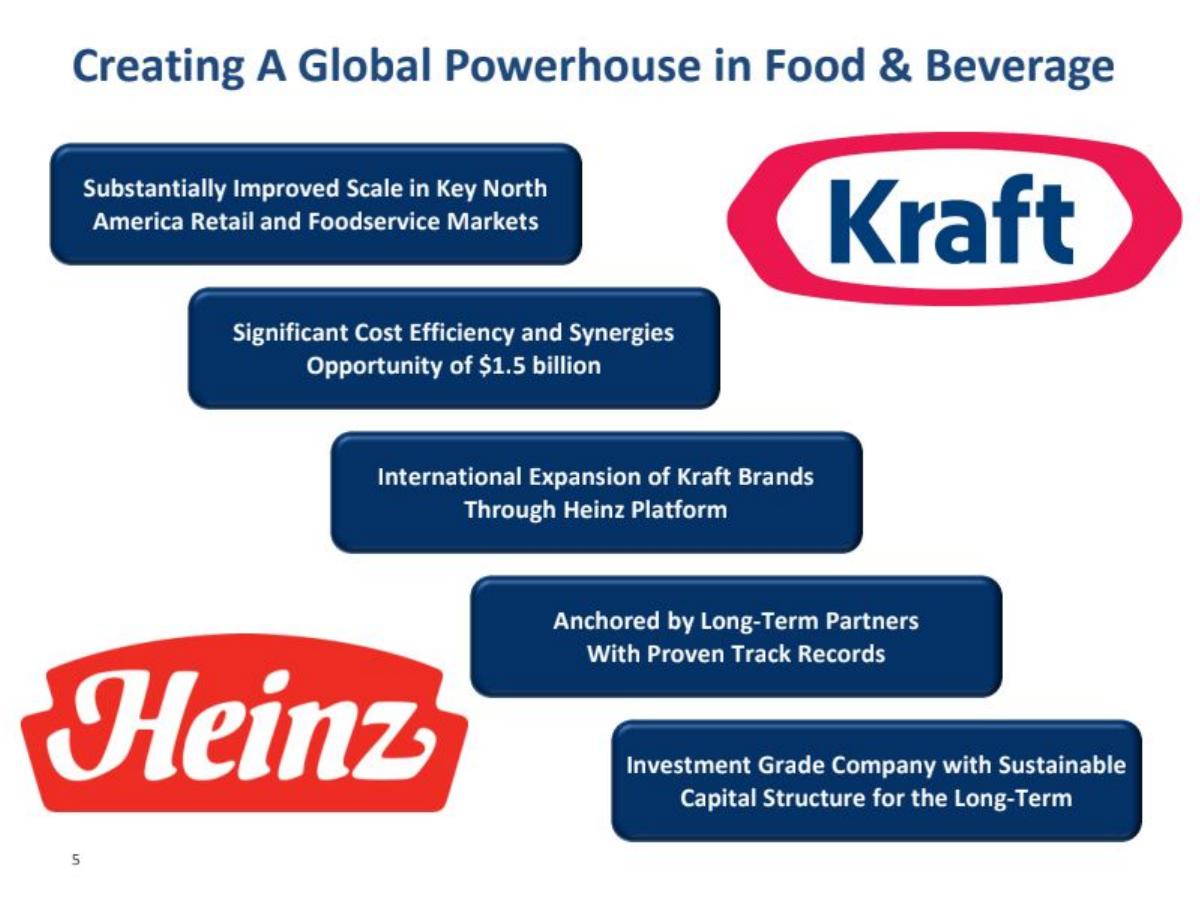
- A core value proposition was the achievement of $1.5 billion in annual cost synergies by 2017 (Slide 26).
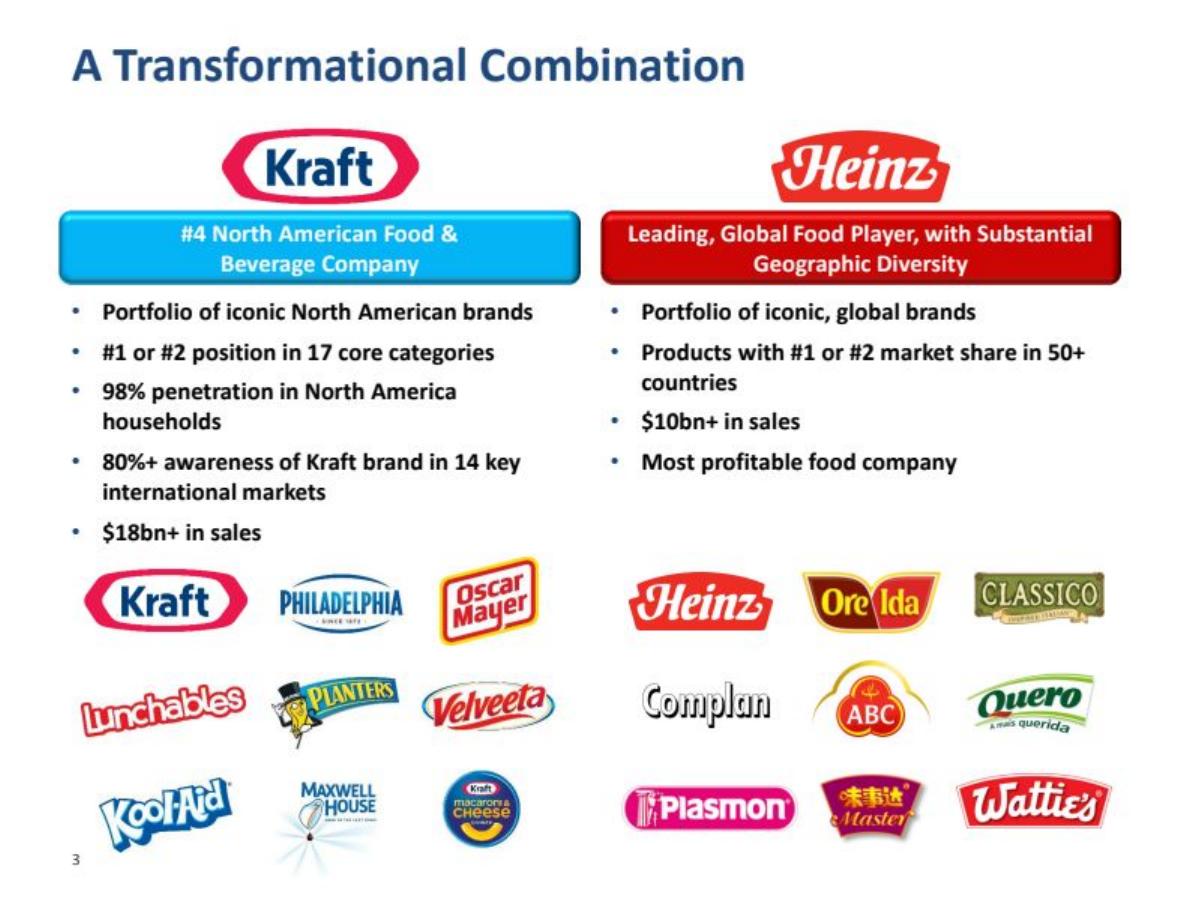
- Kraft boasted 98% household penetration in North America, yet lacked the international reach of Heinz (Slide 12).
- Heinz generated ~60% of its sales outside of North America, providing the 'platform' for Kraft’s global expansion (Slide 16).
- The strategy relied heavily on 3G Capital’s 'Zero-Based Budgeting' to rationalize manufacturing and distribution (Slide 26).
- The new Board of Directors included high-profile figures such as Warren Buffett and Alex Behring (Slide 8).
- The deck identifies specific 'untapped' international opportunities for Kraft brands like Mac & Cheese and Jell-O across Europe, Latin America, and Asia (Slide 30).
The $45 Billion Consolidation: A Strategic Teardown
The merger of Kraft and Heinz in 2015 wasn't just a corporate marriage; it was a fundamental restructuring of the consumer packaged goods (CPG) landscape. This investor presentation, dated March 25, 2015, served as the roadmap for convincing shareholders and the market that two legacy giants were better together. The deck is a masterclass in articulating 'synergy'—a word often used vaguely in startups but defined here with surgical precision.
Slides 1-4: The Vision and the Players
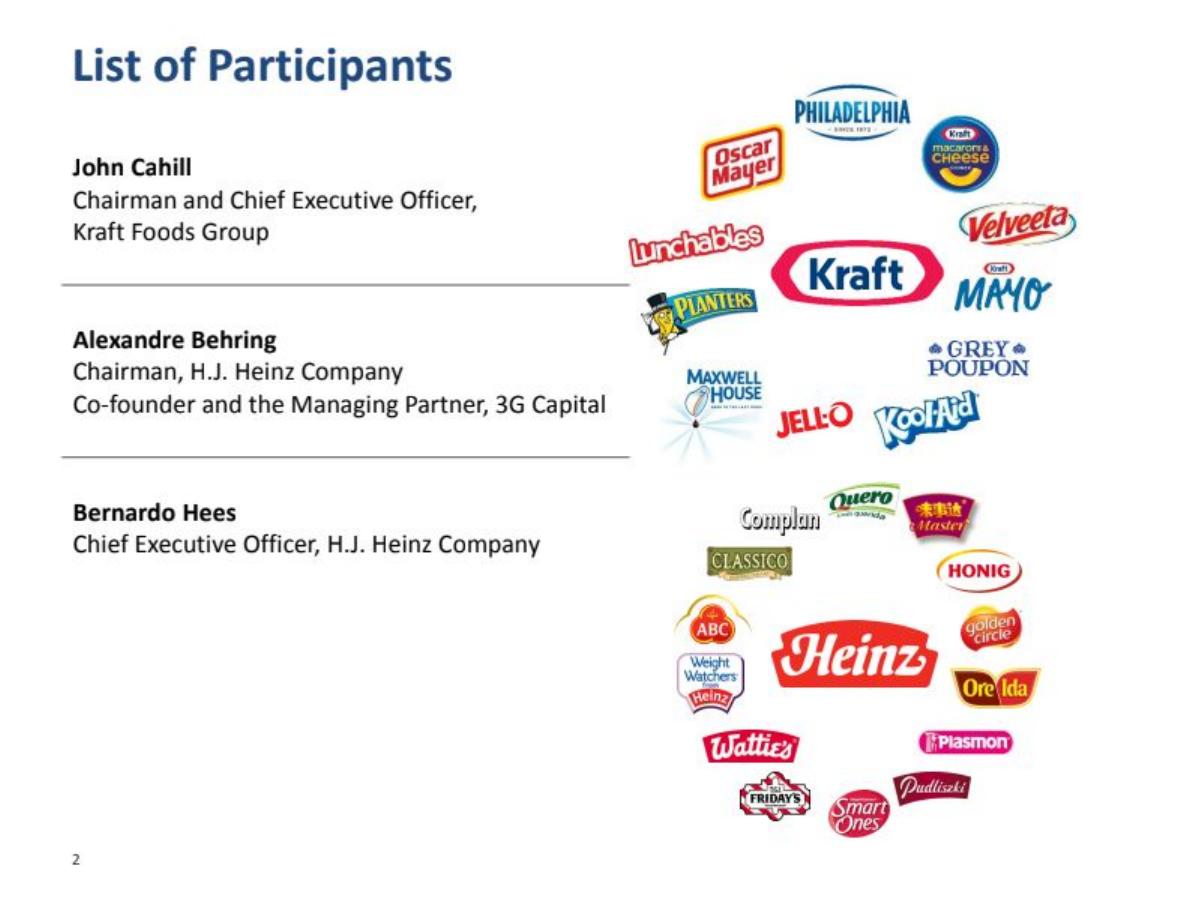
The presentation opens with a simple, authoritative title slide: "Creating a Global Food & Beverage Leader." The branding is immediate, placing the two iconic logos side-by-side. Slide 2, "List of Participants," establishes the heavy-hitting leadership involved. It lists John Cahill (Kraft), Alexandre Behring (Heinz/3G Capital), and Bernardo Hees (Heinz). The right side of the slide is a visual bombardment of brands—Philadelphia, Oscar Mayer, Lunchables, Maxwell House, Ore-Ida, and Wattie's. This visual serves to remind investors of the sheer cultural weight these companies carry. Slide 4 provides a standard agenda, signaling a structured walk-through of the transaction, the individual company overviews, and the combined future.
Slides 6-10: Transaction Mechanics and Governance
Slide 6 is the 'money slide' for Kraft shareholders. It uses a simple flow diagram to show that 1 share of Kraft today equals 1 share of Kraft Heinz plus a $16.50 cash payment. This immediate liquidity, combined with the promise of being "EPS Accretive by 2017," was the primary hook for the deal. Slide 8, "Key Governance Highlights," details the power-sharing agreement. It notes that the Board would consist of five Kraft-appointed members and six Heinz-appointed members. Crucially, it lists Warren Buffett as a board member, providing an unmatched 'seal of approval' for institutional investors. Slide 10 introduces the 'New Partners'—Berkshire Hathaway and 3G Capital. It highlights their track records with brands like Wrigley, GE, Burger King, and Tim Hortons, positioning the merger as being managed by the world's most successful capital allocators.
Slides 12-14: The Kraft Profile - Domestic Dominance
Slide 12 focuses on Kraft’s incredible North American reach. It cites "98% Household Penetration in North America" and the fact that they hold the #1 or #2 position in 17 categories. This slide establishes Kraft as a stable, cash-generating machine with brands that average ">2x the share of the nearest branded competitor." However, the subtext is clear: Kraft has peaked in the U.S. Slide 14 visualizes this, showing Kraft as the #4 player in North American Food & Beverage sales at $17.9 billion. The growth story for Kraft isn't at home; it's abroad.
Slides 16-20: The Heinz Profile - The Global Engine
Slide 16 mirrors the Kraft overview but with a different emphasis. While Kraft is about penetration, Heinz is about "Diversified Geographic Footprint," with ~60% of sales coming from outside North America. It also highlights "Industry-Leading EBITDA Margins," a nod to 3G Capital’s efficiency-first management style. Slide 18 uses a pie chart to show the 61% international sales mix and a bar chart showing that emerging market sales grew from 9% in 2005 to 25% in 2014. Slide 20 outlines the strategy for organic growth: increased marketing, "Big, Bold Bets on Innovation," and SKU rationalization. This sets the stage for what Heinz brings to the table: a global distribution pipe and a high-margin operating model.
Slides 22-24: The Power of the Combination
Slide 22 marks the transition to the 'Transformational Combination' section. Slide 24 is the most important competitive slide in the deck. It shows the combined entity jumping to the #3 spot in North America with $22.2 billion in sales. By visually moving the Kraft and Heinz bars together, the deck illustrates the creation of a new 'Big Three' alongside PepsiCo and Nestlé. This isn't just a merger; it's an ascent to the top tier of global industry.
Slides 26-30: Synergies and International Expansion
Slide 26 gets into the operational weeds, promising "$1.5bn of Cost Efficiencies and Synergies." It explicitly mentions "Zero-Based Budgeting" (ZBB) twice. For the uninitiated, ZBB requires every expense to be justified from scratch every period, rather than just adjusting the previous year's budget. This was the 'secret sauce' 3G Capital promised to bring to the relatively bloated Kraft organization. Slide 28 and 30 focus on revenue synergies. Slide 28 shows how Kraft brands like Planters and Velveeta can be brought to international markets using Heinz’s platform. Slide 30 is a world map detailing exactly which Kraft brands are 'untapped' in which regions—for example, bringing Kraft Cheese and Mac & Cheese to the European Union and Kraft Mayo to South America. This is the 'growth' half of the 'cut-and-grow' strategy.
Slide 32: The Closing Argument
The deck concludes on Slide 32 by reiterating why Berkshire Hathaway and 3G Capital are the "Right Partners." It emphasizes a "Long-term oriented" vision and a "Track record of revitalizing" brands. The final takeaway is "Shareholder Value Creation," a direct appeal to the fiduciary interests of the investors in the room.
What Makes This Deck Work?
1. Extreme Clarity on Value: The deck doesn't hide the ball. Slide 6 tells shareholders exactly what they get in cash and equity. In a merger of this scale, ambiguity is the enemy; this deck is a model of transactional transparency.
2. Complementary Strengths: The narrative is perfectly balanced. Kraft is the 'Product' (98% penetration, iconic brands), and Heinz is the 'Platform' (global distribution, 3G efficiency). The deck successfully argues that Kraft is a great product looking for a better platform, and Heinz is a great platform looking for more products.
3. The 3G Capital 'Brand': By 2015, 3G Capital had a fearsome reputation for cost-cutting. By explicitly naming "Zero-Based Budgeting," the deck signaled to the market exactly how the $1.5 billion in savings would be achieved. It wasn't a hopeful estimate; it was a stated management philosophy.
What Is Missing?
1. Cultural Integration Risks: Mergers of this size often fail due to culture clashes. The deck mentions "streamlining the organization," which is corporate-speak for layoffs. There is no mention of how the distinct cultures of a Chicago-based legacy giant (Kraft) and a 3G-managed global firm (Heinz) would blend.
2. Debt Profile: While the deck mentions cash payments and dividends, it is light on the specific debt load the new entity would carry to fund the $16.50 per share dividend. For a $45 billion deal, the leverage details are surprisingly absent from these specific slides.
3. Consumer Trends: The deck focuses entirely on financial and operational engineering. There is almost no mention of changing consumer preferences toward healthier, less processed foods—a trend that would eventually become a significant headwind for the combined company in the years following the merger.
What Founders Should Copy
1. The 'Platform vs. Product' Logic: If you are pitching an acquisition or a strategic partnership, use the Kraft Heinz model. Show that you have a 'Product' (high engagement, great unit economics) that is currently limited by a lack of 'Platform' (distribution, sales force, geographic reach). This makes the '1+1=3' math undeniable.
2. Quantified Synergies: Don't just say you will "save money." Say how much and through what specific mechanism. Kraft Heinz didn't just say "efficiencies"; they said "$1.5 billion" and "Zero-Based Budgeting." Specificity creates credibility.
3. Visualizing the 'New Reality': Slide 24, which shows the combined company moving up the leaderboard, is a powerful psychological tool. It forces the investor to stop looking at you as a standalone entity and start seeing you as a dominant market force. Always show the 'After' picture as clearly as the 'Before'.
Frequently asked questions
- What was the primary financial incentive for Kraft shareholders?
- According to slide 6, Kraft shareholders received a 'Transaction Consideration' consisting of one share of the newly formed Kraft Heinz Company for every share of Kraft they owned, plus a special cash dividend of $16.50 per share. The deck also promised that the transaction would be EPS accretive by 2017 and that the new company would maintain and eventually increase dividends.
- How did the companies plan to achieve $1.5 billion in savings?
- Slide 26 outlines a two-pronged approach to cost efficiencies. First, 'COGS Savings' through rationalizing manufacturing footprints and optimizing procurement. Second, 'SG&A Savings' by streamlining the organization. Both categories explicitly mention the implementation of 'Zero-Based Budgeting,' a hallmark strategy of 3G Capital designed to eliminate unnecessary overhead and redundant roles.
- What was the 'International Opportunity' mentioned in the deck?
- Kraft was primarily a North American business, while Heinz had a robust global footprint with 61% of sales being international (Slide 18). Slide 30 details a 'repatriation' strategy, where Kraft’s iconic brands—such as Planters, Velveeta, and Lunchables—would be plugged into Heinz’s existing international infrastructure to drive organic growth in markets where Kraft previously had little to no presence.
- Who led the management and governance of the new entity?
- Slide 8 states that Bernardo Hees, the CEO of Heinz, was appointed CEO of the combined company. Alex Behring, Chairman of Heinz and Managing Partner at 3G Capital, became the Chairman. The Board of Directors was a mix of representatives from both companies, including Warren Buffett from Berkshire Hathaway and John Cahill from Kraft, who took the role of Vice Chairman.
- How did the combined company rank against competitors after the merger?
- Slide 24 provides a bar chart of North American Food & Beverage sales. Before the merger, Kraft was #4 ($17.9B) and Heinz was much lower ($4.2B). Combined, they reached $22.2 billion in sales, surpassing Coca-Cola to become the #3 player in North America, trailing only PepsiCo and Nestlé.