Krane’s 9-slide seed deck is a masterclass in brevity and persona-based product marketing. By framing their software as a suite of 'AI-native collaborators'—named agents like Milo, Chase, and Rio—they transform a dry procurement tool into a tangible workforce solution. The deck reports significant early traction, including $15B+ in projects under management and 97% on-time deliveries (Slide 06). While it successfully highlights the pain of 'disconnected systems' and spreadsheets (Slide 04), the deck notably omits a team slide, financial projections, and a specific funding ask. Despite these g…
Key takeaways
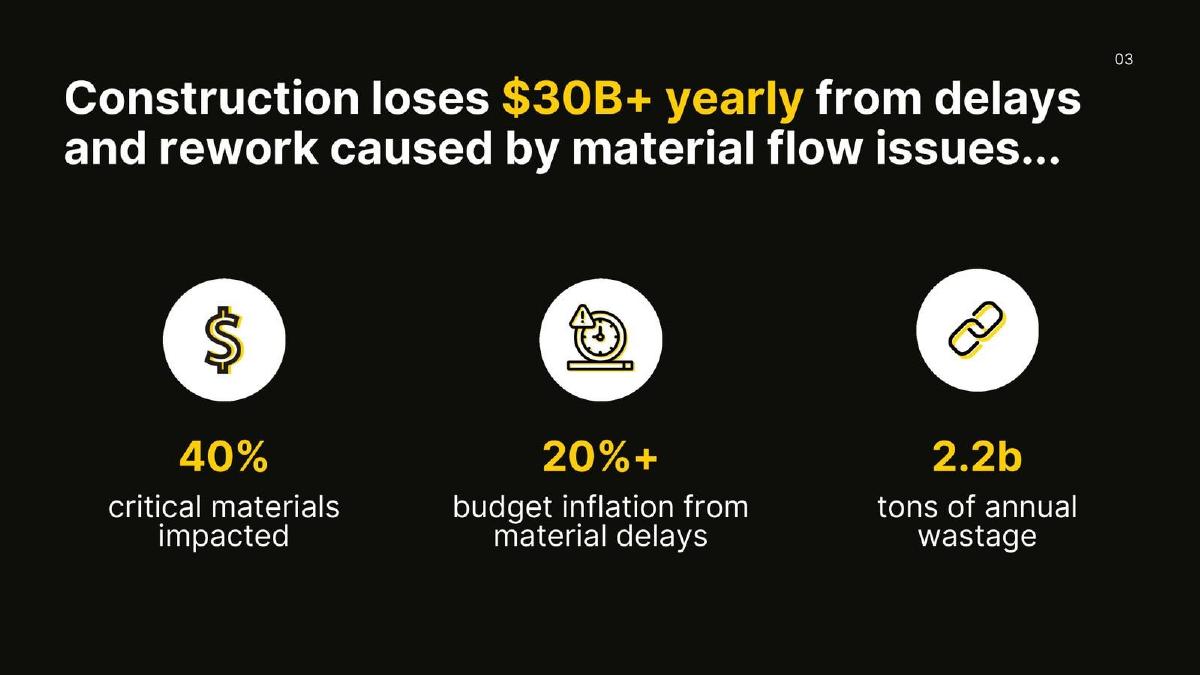
- Construction loses $30B+ yearly due to material flow issues, with 20%+ budget inflation stemming from delays (Slide 03).
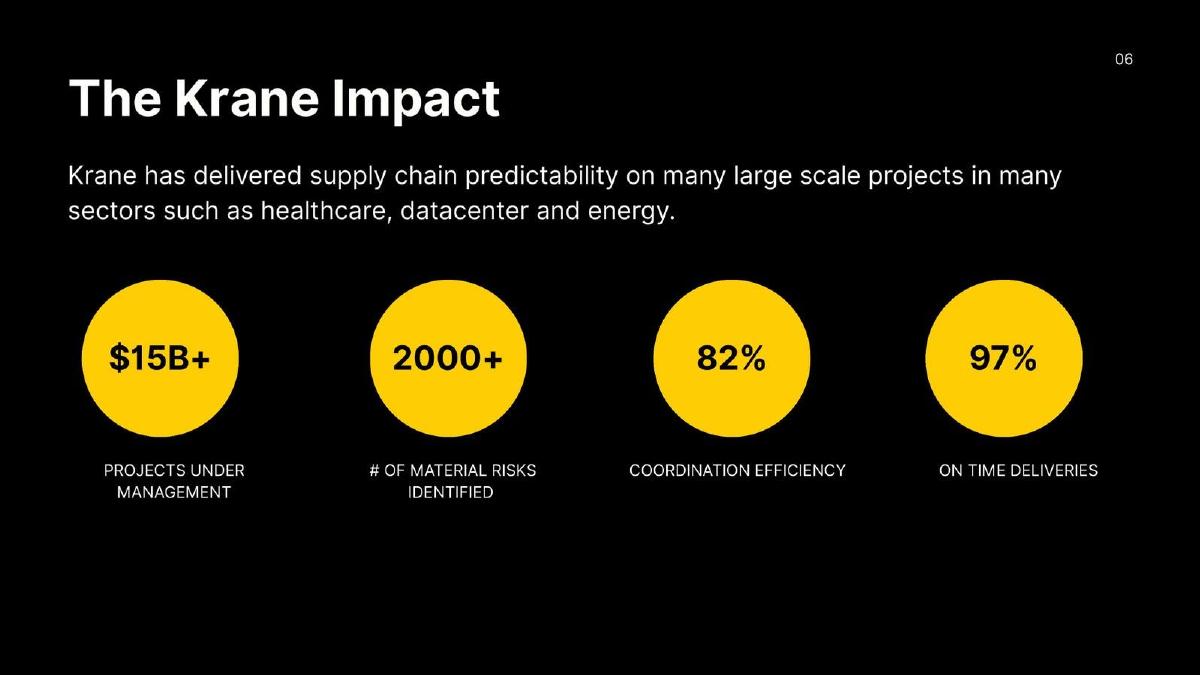
- The platform manages over $15B in projects across healthcare, datacenter, and energy sectors (Slide 06).
- Krane claims a 97% on-time delivery rate and an 82% increase in coordination efficiency for its users (Slide 06).
- The product is marketed through six distinct AI agents, such as 'Milo' for procurement logs and 'Chase' for trade partner follow-ups (Slide 08).
- Krane positions itself as an 'operations layer' that integrates with Procore, Autodesk Construction Cloud, SAP, and Oracle P6 (Slide 09).
- The company reports 100% customer retention across data centers, education, healthcare, and commercial sectors (Slide 10).
- The deck completely omits a team slide, failing to identify the founders or their relevant industry expertise.
- There is no 'Ask' slide detailing how the $9M will be spent or what milestones the Seed round is intended to hit.
The Lean Strategy of a $9M Seed Round
Krane’s pitch deck is a study in high-level positioning. At only 9 slides (numbered up to 10, though one is missing or skipped in the sequence provided), it avoids the technical weeds of AI architecture and instead focuses on the massive financial hemorrhaging of the construction industry. According to publisher reports, this deck helped secure $9M in 2024, a significant sum for a Seed round in a tightened venture market. The deck’s primary strength lies in its ability to quantify the problem and present a solution that feels like an automated workforce rather than just another software subscription.
Slide 01: The Identity
The cover slide establishes Krane as an 'AI-native Procurement and Material Management Platform.' It identifies three distinct user groups: Owners, GCs (General Contractors), and Subcontractors. The tagline 'Right Materials, Right Time' is a direct nod to Just-In-Time (JIT) manufacturing principles, signaling that Krane intended to bring supply chain sophistication to the historically fragmented construction site.
Slide 02: The Mission Statement
Slide 02 is a simple transition slide that sets the scope: 'From Spec to Install, We Make Material Flow Predictable Across the Entire Construction.' This is a bold claim in an industry where 'predictable' is rarely used to describe supply chains. It serves to bridge the gap between the brand identity and the hard data that follows.
Slide 03: Quantifying the $30B Pain Point
This is the 'Why Now' and 'Why Care' slide. Krane cites that construction loses $30B+ yearly due to material flow issues. They break this down into three visceral metrics: 40% of critical materials are impacted, material delays cause 20%+ budget inflation, and there are 2.2 billion tons of annual wastage. By leading with these numbers, Krane justifies the need for a high-cost solution; if they can save even a fraction of that 20% budget inflation, the software pays for itself many times over.
Slide 04: The Status Quo (The Enemy)
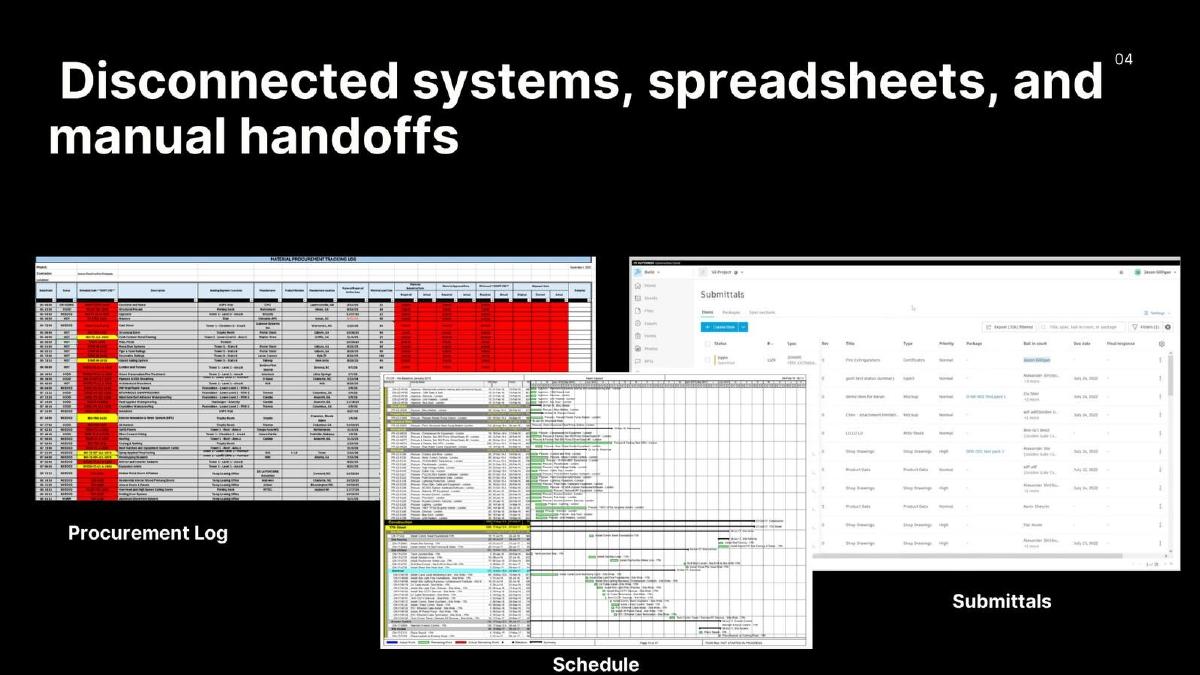
Slide 04 visualizes the 'mess.' It shows screenshots of 'Disconnected systems, spreadsheets, and manual handoffs.' Specifically, it displays a dense Procurement Log, a complex Schedule, and a Submittals dashboard. This slide is designed to make an investor (or a potential customer) feel the cognitive load of the current process. It frames the existing tools not as solutions, but as part of the problem.
Slide 05: The Reveal
A simple 'Introducing Krane' slide. It repeats the 'AI-native' branding. The use of a silhouette of construction workers in the background reinforces that this technology is meant to be used in the field, not just by accountants in a back office.
Slide 06: Traction and Impact
This is arguably the most important slide in the deck. Krane claims to have $15B+ in projects under management. For a Seed stage company, this is a massive figure, likely representing the total construction value of the projects their early pilots are attached to. They also claim to have identified 2000+ material risks and achieved 97% on-time deliveries. The 82% coordination efficiency metric is particularly high, suggesting that their automation significantly reduces the 'chasing' of vendors and updates.
Slide 08: The AI Collaborators (The Product)
Instead of showing a feature list, Krane introduces six 'AI-native collaborators.' This is a clever marketing tactic that personifies the software’s capabilities:
Milo: Automates procurement strategy from specs and drawings. · Chase: Handles the 'grunt work' of calling, emailing, and texting trade partners for lead-time updates. · Rio: Manages delivery scheduling and dock conflicts. · Lana: Handles submittal logs and quality control. · Arlo: Links activities and timing across systems. · Theo: A 'PO Module' that manages the financial side from RFP to payment.
This approach makes the product feel like a team of experts rather than a list of buttons and menus.
Slide 09: The Ecosystem Integration
One of the biggest hurdles for new construction tech is the 'walled garden' of existing platforms. Slide 09 positions Krane as the 'operations layer' that sits on top of and syncs with the industry giants. They show logos for Procore, Autodesk Construction Cloud, Oracle P6, SAP, and CMiC. This tells investors that Krane isn't trying to replace the systems of record, but rather to make them functional through automation.
Slide 10: Validation and Retention
The final slide focuses on social proof. It claims 100% customer retention across Data Centers, Education, Healthcare, and Commercial sectors. The testimonials are high-quality: Jack Craig from HITT Construction emphasizes the need for error-free supply chains in data centers, while Geoffrey Clark from Juneau Construction Company explicitly states that Krane is 'better than Procore and Autodesk' for supply chain management. Ending on a quote that claims superiority over the industry incumbents is a strong closing note for a fundraising pitch.
What Works in the Krane Deck
The Agent Persona Strategy: By naming their AI agents (Milo, Chase, etc.), Krane makes complex automation understandable. It allows the founder to explain the 'how' without getting lost in technical jargon. It also suggests a modular product where customers can see immediate value in specific roles.
High-Stakes Vertical Focus: The deck mentions 'Data Centers' and 'Healthcare' multiple times. These are high-margin, high-complexity construction projects where a delay isn't just an inconvenience—it's a multi-million dollar disaster. Focusing on these verticals suggests a high Willingness to Pay (WTP).
Integration, Not Replacement: By showing the circular flow between Krane and existing ERPs/Project Management tools, the company lowers the perceived 'switching cost' for customers. They aren't asking a GC to rip out Procore; they are asking them to make Procore work better.
What is Missing from the Krane Deck
The Team Slide: It is highly unusual for a $9M Seed deck to omit the team. In construction tech (ConTech), founder background is critical because the industry is notoriously difficult to sell into without deep domain expertise or existing relationships. The absence of this slide in the provided materials is a significant gap.
The Business Model: There is no mention of how Krane makes money. Is it a per-project fee? A percentage of the $15B under management? A SaaS subscription per user? Investors generally want to see the path to $100M in ARR, which requires a clear pricing strategy.
The Competition: While Slide 10 mentions Procore and Autodesk, it doesn't provide a competitive matrix. It ignores other startups in the procurement and logistics space, focusing only on the 'big' legacy players. A more robust deck would address why other 'AI for construction' tools haven't solved this $30B problem yet.
The Ask: The deck ends without a 'The Round' slide. There is no information on how much they are raising (though we know from reports it was $9M), what the valuation is, or what the specific milestones for the next 18 months are. This suggests the deck may have been used as a 'teaser' or a 'leave-behind' rather than the full presentation used in the final partner meeting.
What Founders Should Copy
Quantify the Waste: Slide 03 is a perfect example of how to frame a problem. Don't just say 'construction is inefficient.' Say 'construction loses $30B and causes 2.2 billion tons of waste.' Specificity creates urgency.
Visualizing the 'Mess': Slide 04’s use of actual (albeit blurred) spreadsheets is a great way to build empathy with the user. It reminds the investor that behind every 'digital transformation' pitch is a real person drowning in Excel tabs.
Outcome-Oriented Metrics: Krane doesn't brag about their 'AI algorithms.' They brag about '97% on-time deliveries.' Founders should always lead with the business outcome, not the technology that enables it.
Frequently asked questions
- How does Krane define its market problem?
- Krane focuses on the financial and physical waste in construction. According to Slide 03, the industry loses $30B+ annually due to material flow issues. They specifically highlight that 40% of critical materials are impacted by these issues, leading to 2.2 billion tons of annual wastage and significant budget inflation.
- What is the 'AI-native collaborator' approach?
- Instead of showing a standard dashboard, Krane uses Slide 08 to introduce six AI agents: Milo, Chase, Rio, Lana, Arlo, and Theo. Each agent has a specific job, such as turning drawings into procurement logs or automating delivery scheduling. This humanizes the AI and makes the specific utility of the software easier for non-technical stakeholders to grasp.
- Does the deck show actual product interfaces?
- Only in the context of the 'problem.' Slide 04 shows messy spreadsheets and existing submittal logs to illustrate the current 'disconnected' state of the industry. The deck does not show the actual Krane user interface, opting instead for conceptual agent descriptions and high-level integration diagrams.
- Who are Krane's primary customers?
- Slide 10 identifies their core sectors as Data Centers, Education, Healthcare, and Commercial Mixed Use. Testimonials are provided by executives from HITT Construction and Juneau Construction Company, suggesting they are targeting large General Contractors (GCs) and Owners who manage high-stakes, complex builds.
- What is missing from this deck that most investors expect?
- This is a very lean deck. It lacks a Team slide, which is unusual for a $9M Seed round where founder pedigree is usually a primary selling point. It also lacks a Go-To-Market (GTM) strategy, a detailed Business Model/Pricing slide, and a clear 'Ask' slide explaining the round's objectives.