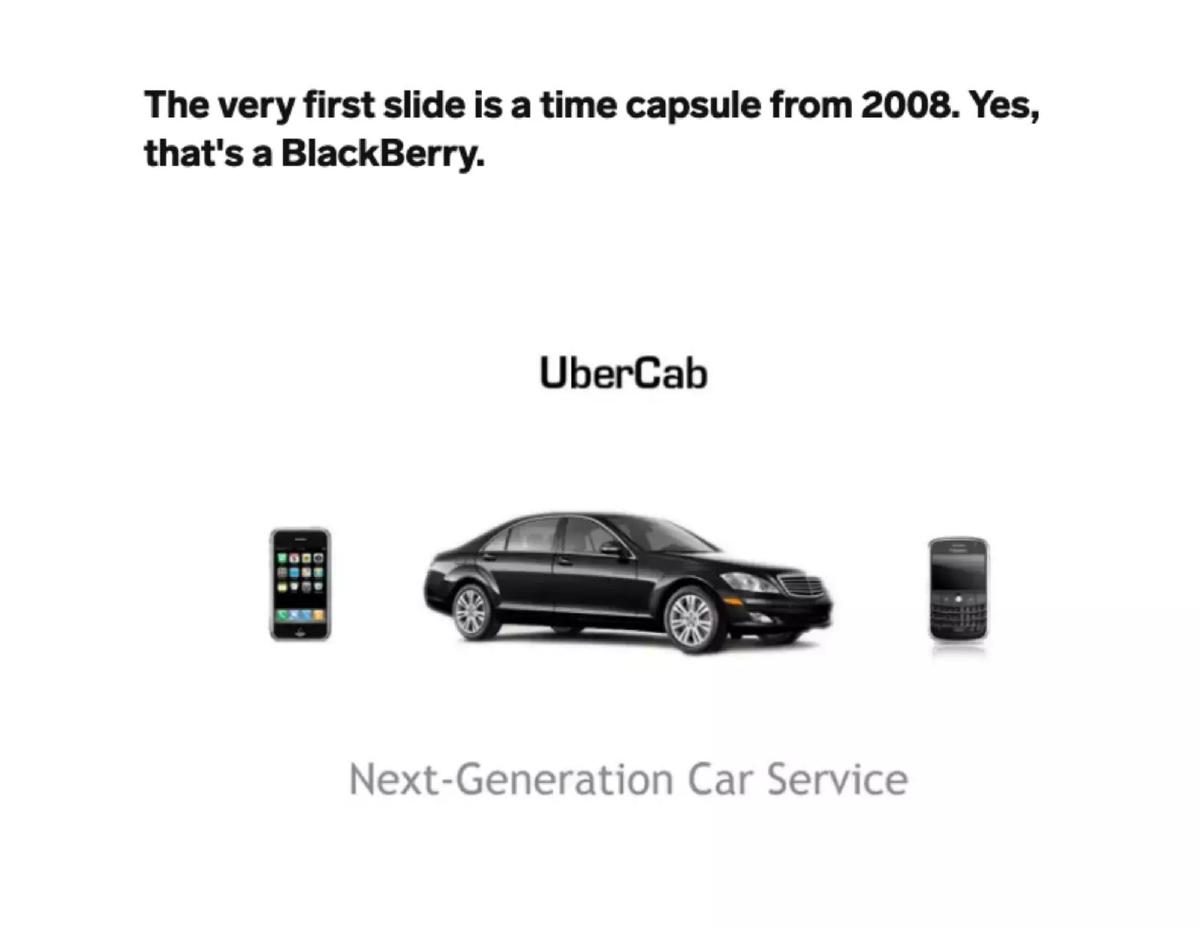
Uber's original 2008 pitch deck (operating then as UberCab) presents a vision for a 'Next-Generation Car Service' designed specifically for professionals in American cities. The deck identifies core inefficiencies in the 2008 taxi market, such as radio dispatch, lack of GPS coordination, and significant 'dead-time' for drivers. Interestingly, the initial strategy was not a mass-market play but a luxury-focused, members-only service utilizing high-end vehicles like Mercedes S-class sedans. The deck relies heavily on the proliferation of GPS-enabled smartphones (iPhone, BlackBerry, and Symbian)…
Key takeaways
- The service was originally positioned as a members-only luxury car service to avoid medallion license requirements (Slide 5).
- The core value proposition was reducing 'dead-time,' noting that NYC cabs spent 35% of their time looking for fares (Slide 12).
- Uber identified the smartphone market shift early, citing August 2008 data showing RIM (BlackBerry) at 32% and iPhone at 19% share (Slide 21).
- Initial fleet plans focused on fuel efficiency as a differentiator, proposing hybrid Mercedes and Lexus models to double taxi fuel economy (Slide 13).
- The market was defined as a $4.2B annual industry where the top four players held only 22% of revenue (Slide 17).
- The 'Worst-Case Scenario' projected the company remaining a 10-car, 100-client service in San Francisco (Slide 20).
- Progress to date included a provisional patent filed and 15 clients recruited by late 2008 (Slide 24).
- The deck omits a dedicated team slide, specific bios, and a detailed breakdown of the 'few million' dollar ask (Slide 24).
The Foundation of a Disruptor: UberCab's 2008 Vision
The original UberCab pitch deck is one of the most famous documents in venture capital history. It serves as a time capsule from late 2008, a period when the iPhone was only a year old and the BlackBerry was still the dominant professional smartphone. The deck is remarkably focused on efficiency, logistics, and market fragmentation rather than the 'sharing economy' tropes that would define later years.
Slides 1-3: The Problem with Taxis
The deck opens with a clear title slide: UberCab: Next-Generation Car Service . Slide 2, titled 'Cabs in 2008,' immediately establishes the villain of the story. It lists the inefficiencies of the status quo: radio dispatch with no two-way communication, the 14mpg Ford Crown Victoria as the standard vehicle, and the lack of GPS coordination between client and driver. By highlighting 'significant fareseeking or dead-time,' the founders identify the primary economic leak they intended to plug.
Slides 4-7: The UberCab Concept and Differentiators
Slide 4 introduces the solution as a 'fast & efficient on-demand car service' for professionals. A key phrase here is 'The NetJets of car services,' which signals a high-end, reliable, and membership-based model. Slide 5 reinforces the 'Members Only' aspect, noting that because it is not hailed from the street, 'no medallion licenses are required.' This was a critical legal hypothesis for the early business. Slide 6 lists key differentiators, including 1-click hailing, luxury Mercedes sedans, and a 'Rate your trip' feature to ensure driver quality. Slide 7 outlines operating principles, emphasizing that the service would be 'Profitable by design' and 'Cashless.'
Slides 8-10: The User Experience
Slide 8 shows the multi-platform approach, featuring images of an iPhone, a BlackBerry, and a Nokia device. The deck promises 1-click requests from geo-aware devices and SMS hailing for older phones. Slide 9 discusses the web interface, UberCab.com, where users could pre-specify locations with labels like 'home' or 'bob-work' to simplify texting for a ride. Slide 10 lists use-cases, ranging from restaurant trips to 'Working while commuting' (noting wifi in cars) and even 'Elderly transport.'
Slides 11-13: Benefits and Fleet Strategy
Slide 11 contrasts the service with traditional options, stating that car services usually require 1-3 hours notice and cost over $60. UberCab promised to be 'faster & cheaper than a limo, but nicer & safer than a taxicab.' Slide 12 focuses on environmental benefits through better utilization. It claims that in NYC, 35% of a cab's time is spent looking for fares. Slide 13 details the fleet: Mercedes S550 for 'SF Beta clients' and Lexus GS450h hybrids to achieve 30mpg, compared to the 14-16mpg of existing fleets.
Slides 14-16: The Technology Stack
Slide 14 identifies Central San Francisco as the initial service area, with Manhattan to follow. Slide 15 dives into the 'Technology,' citing 'Operations research for route optimization' and a 'Patent-pending system design.' Slide 16, 'Demand Forecasting,' is particularly forward-thinking for 2008. It describes cars 'hovering' in statistically optimized positions to minimize pickup time based on the hour of the week, weather, and traffic conditions.
Slides 17-19: Market Analysis
Slide 17 defines the 'Overall Market' as $4.2B annually and growing. It notes that the market is highly fragmented, with the top four players holding only 22% of revenue. Slide 18 breaks down the composition of the market, showing that 'Retail - non-airport trips' make up 64% of the share. Slide 19 targets specific cities, claiming that expanding to LA, Chicago, Houston, PA, and Dallas would cover 50% of the entire US market.
Slides 20-22: Outcomes and Trends
Slide 20 presents 'Potential Outcomes.' The best-case scenario was $1B+ in yearly revenue, while the realistic success was $20-30M+ in annual profit. Slide 21, 'SmartPhones, Aug 2008,' justifies the timing of the venture by showing the rapid growth of GPS-enabled devices. Slide 22 looks at 'Future Optimizations,' including buying used cars to lower costs and implementing surge pricing (described as 'pay premium for on-demand service').
Slides 23-24: Marketing and Progress
Slide 23 offers marketing ideas like 'Invite Only' and slogans such as 'The One-click cab' or 'Cabs 2.0.' The final slide, Progress to Date , lists milestones: the domain reserved, California LLC filed, and 15 clients recruited. The 'Next' steps were to buy 3 cars and 'Raise a few million' for a small office and a General Manager in SF.
What Works in This Deck
The 'Why Now' is undeniable: By tying the business model directly to the August 2008 smartphone data (Slide 21), the founders made a compelling case that the technology finally existed to solve a decades-old logistics problem. · Clear Economic Inefficiency: Identifying that 35% of taxi time is wasted 'dead-time' (Slide 12) provides a clear mathematical path to how a more efficient system could offer better cars at competitive prices. · Specific Geographic Focus: Instead of claiming global dominance on day one, the deck focuses on a 'SF Beta' (Slide 13) and a clear expansion path to five specific cities to capture 50% of the market (Slide 19).
What Is Missing
The Team Slide: This is the most glaring omission. In seed-stage investing, the team is often more important than the idea. The deck does not mention Travis Kalanick, Garrett Camp, or their previous exits. · Unit Economics: While the deck claims the service is 'Profitable by design,' it does not provide a breakdown of the take rate, driver payments, or the cost of insurance and maintenance. · Competitive Landscape: The deck mentions 'YellowCab' as a brand but does not analyze other car services or the potential for other tech startups to enter the space.
Founder Lessons
Founders should emulate Uber's problem-first approach . The first three slides are entirely dedicated to the pain points of the current system. By the time the solution is introduced, the investor already agrees that the taxi industry is broken. Additionally, the use of analogies ('NetJets for car services') quickly communicates a complex business model and target demographic without needing paragraphs of text. Finally, the Outcome Scenarios (Slide 20) are a great way to show investors that you have considered the floor as well as the ceiling, demonstrating a pragmatic business mindset.
Frequently asked questions
- What was Uber's original name and target audience?
- The company was originally called UberCab. As shown on Slide 4, the target market was specifically 'Professionals in American cities.' The concept was described as the 'NetJets of car services,' emphasizing a premium, reliable experience for business users rather than the mass-market utility service it is today.
- How did Uber plan to bypass taxi regulations initially?
- Slide 5 explicitly states that by operating as a members-only service that was 'not hailed from the street,' the founders believed no medallion licenses would be required. This 'digital-hail' model was their primary strategy for navigating the high barriers to entry in the traditional taxi market.
- What technology did the founders consider essential in 2008?
- The deck highlights 'Geo-aware devices' as the primary enabler. Slide 8 and Slide 15 show that Uber intended to build for iPhone, BlackBerry, and Symbian OS. They also emphasized 'Operations research for route optimization' and 'Demand Forecasting' to ensure cars were positioned in statistically optimized locations.
- What were the projected financial outcomes in the deck?
- Slide 20 outlines three scenarios. The 'Best-Case' was becoming a market leader with $1B+ in yearly revenue. The 'Realistic Success' scenario involved capturing 5% of the top 5 US cities to generate $20-30M+ in annual profit. The 'Worst-Case' saw them remaining a niche SF-based executive service.
- What is missing from the original Uber pitch deck?
- The deck is notably missing a Team slide, which is unusual for a seed-stage startup. It also lacks a detailed breakdown of unit economics (CAC, LTV, or per-ride margins) and a specific use-of-funds table, simply asking to 'Raise a few million' on the final slide.