Advantage Lithium (TSX-V: AAL) presents a 30-slide investor deck from February 2018 that prioritizes technical validation and management pedigree over typical startup growth metrics. Operating in the lithium brine sector in Argentina, the company uses its Cauchari Joint Venture as the centerpiece of its value proposition. The deck is notable for its 'Management Prior Success' timeline, which visualizes over $2 billion in aggregate exits and capital raises, effectively de-risking the leadership team for institutional investors. While it lacks traditional SaaS-style unit economics, it provides…
Key takeaways
- The deck emphasizes a management team with a proven track record, specifically citing David Sidoo's $630M+ sale of American Oil & Gas to Hess (Slide 7).
- A comprehensive success timeline visualizes major industry milestones from 2000 to 2017, including a $700M buyout of Thompson Creek (Slide 10).
- Technical validation is provided through a geological cross-section of the Cauchari JV, showing drill depths reaching 682 meters (Slide 16).
- The company highlights a $20 million capital raise achieved shortly after March 2017 to signal momentum and liquidity (Slide 13).
- Strategic positioning is established by showing the project's proximity to major players like Lithium Americas and SQM (Slide 16).
- A clear development roadmap sets a specific target for project permitting in the first half of 2019 (Slide 22).
- Market valuation benchmarking places Advantage Lithium at approximately $250M USD, positioning it as a mid-tier player compared to Lithium Americas at $700M+ (Slide 25).
- The inclusion of site visit photography with named technical leads like Andy Robb and Frits Reidel adds a layer of 'boots on the ground' authenticity (Slide 28).
Executive Summary: The Industrial Validation Playbook
Advantage Lithium Corp’s February 2018 investor deck is a high-signal document designed for the TSX Venture Exchange environment. Unlike early-stage tech decks that often struggle to define a market, Advantage Lithium operates in a commodity market with infinite demand but finite, difficult-to-extract supply. Consequently, the deck ignores 'market size' tropes and focuses entirely on Execution Credibility and Resource Validation . The narrative arc moves from the 'Who' (proven winners) to the 'What' (geological data) to the 'When' (development timeline).
Slide 1: Title and Market Identity
The cover slide establishes immediate professional legitimacy. It lists the company name, the core value proposition ('Creating The Next Lithium Producer'), and the date (February 2018). Crucially, it includes the ticker symbol TSX-V: AAL . For a public company, the ticker is the most important piece of information on the cover, as it allows investors to instantly pull up real-time pricing and historical filings. The background image of a drill rig reinforces the industrial nature of the business.
Slide 4: The Strategic Framework
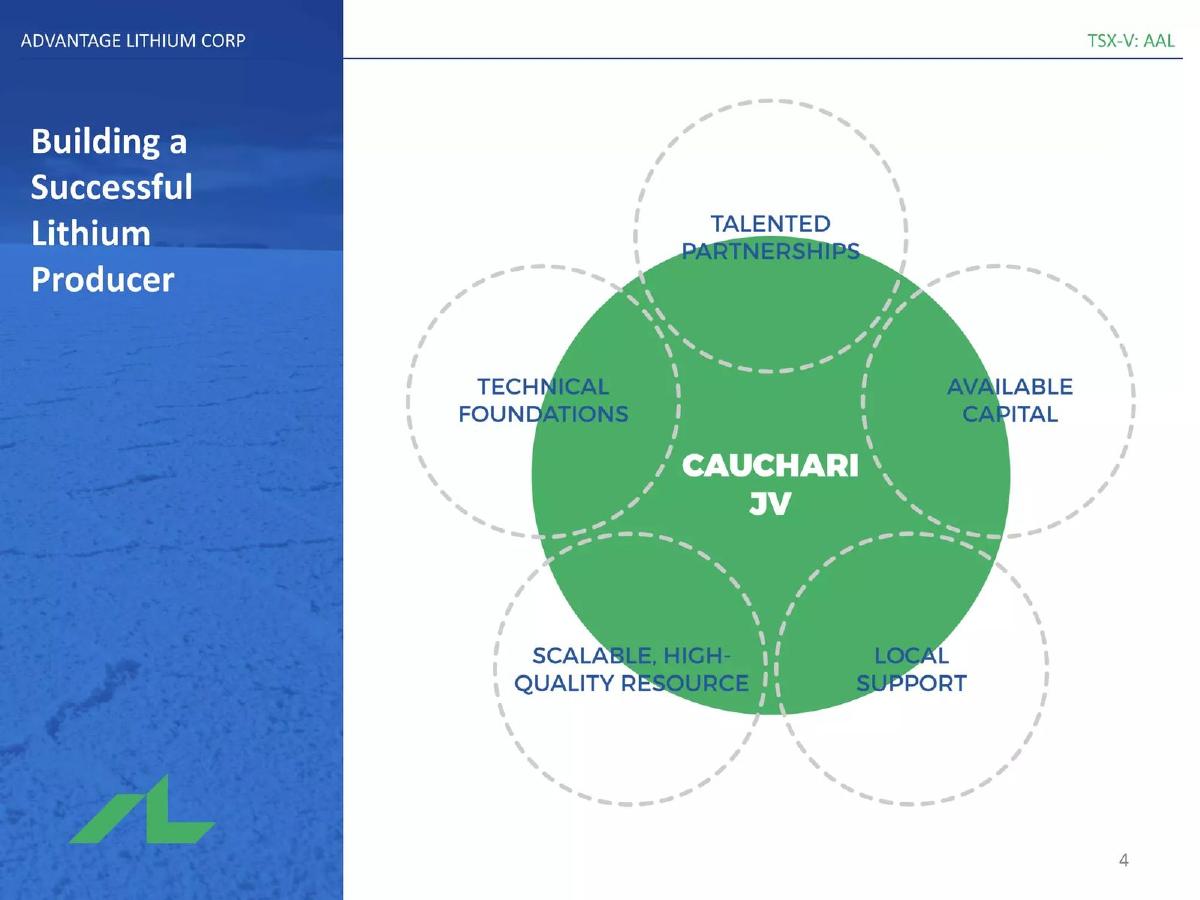
Slide 4 uses a Venn-style diagram to center the Cauchari JV . The company identifies five pillars of success: Talented Partnerships, Available Capital, Local Support, Scalable High-Quality Resource, and Technical Foundations. This slide serves as a table of contents for the investor's due diligence process. It tells the viewer exactly which boxes the company intends to check during the presentation. By including 'Local Support' as a pillar, the company acknowledges the geopolitical and community risks inherent in Argentinian mining operations.
Slide 7: Management Team Highlights
In mining, the team is the collateral. Slide 7 profiles David Sidoo (CEO) and Nick DeMare (CFO). The bullet points are not about skills, but about outcomes . Sidoo is credited as the founder and largest shareholder of American Oil & Gas, which was sold to Hess for $630M+ . DeMare is positioned as a regulatory and compliance expert with a tenure dating back to 1991. This slide is designed to answer one question: 'Have these people made money for shareholders before?' The answer provided is a definitive yes.
Slide 10: The Track Record Timeline
Slide 10 is perhaps the most effective slide in the deck for building investor confidence. It visualizes a timeline from 2000 to 2017, mapping out a series of massive financial events: a $700M buyout of Thompson Creek, a $35M raise for East West Petroleum, and a $750M total debt and equity raise for Orocobre. By placing the Advantage Lithium logo at the end of this arrow of success, the deck suggests that the current venture is the logical next step in a multi-decade winning streak. This is a 'pedigree' play that justifies a premium valuation.
Slide 13: Recent Momentum
Titled 'Events Since March 2017,' this slide focuses on velocity. It lists eight key achievements, including raising $20 million and acquiring a 'Defined Resource.' The phrase 'Moving Forward Fast' is used to counter the common investor perception that mining projects are slow and bureaucratic. The inclusion of a map showing the project's location in the 'Lithium Triangle' (Chile, Bolivia, Argentina) provides necessary geographic context, placing the Cauchari JV near major hubs like Salta and Jujuy.
Slide 16: Deep Technical Validation
Slide 16 is the 'Product' slide. It shows a geological cross-section of the Cauchari Joint Venture. This is high-density information. It identifies specific drill holes (CAU07, CAU09, CAU10) and their depths (up to 682 meters ). It also shows the proximity to Lithium Americas/SQM's resource of 11.8 mt LCE. By showing that their drilling is 'directly south of Orocobre Olaroz with the same aquifer units,' the company uses geological proximity to imply a lower risk of 'dry' holes. The mention of an average value of 585 mg/l Lithium provides the specific grade data that institutional analysts require.
Slide 19: Evidence of Activity
Slide 19 features a photograph of the South East Sector drilling site. In an industry plagued by 'lifestyle companies' that never actually dig, photos of active rigs (labeled AAL Drill CAU09 and CAU10) serve as proof of work. The caption notes the photo was taken looking Northeast, providing a sense of scale and orientation. This slide transitions the deck from theoretical data to physical reality.
Slide 22: The Path to Production
Slide 22 outlines the 'Accelerated Development Potential.' It sets a clear, linear path: Drill program in Q2 2017, Resource estimate in Q1 2018, Scoping Study/PFS/FS in 2018, and a Permitted Project by H1 2019 . The use of blue triangles increasing in size visually represents the growing 'Economic Reserve' and value of the asset as it moves toward the final 'LITHIUM' goal. This slide is the 'contract' with the investor, setting the milestones by which the management team should be judged.
Slide 25: Relative Valuation
Slide 25 addresses the 'Is it cheap?' question. It compares the market value of Advantage Lithium (approx. $250M ) against other junior lithium brine explorers. It shows AAL is valued similarly to LSC Lithium and Neo Lithium, but significantly below Millennial Lithium (approx. $400M) and Lithium Americas (approx. $750M). The visual argument is clear: Advantage Lithium has room to double or triple in value just to catch up to the leaders in its specific niche.
Slide 28: The Human Element
The final slide in this selection is a group photo from an Argentina site visit in November 2017. It names the key technical and executive personnel, including Murray Brooker, Miguel Peral, and Callum Grant. This reinforces the 'Talented Partnerships' pillar from Slide 4. It shows a large, unified team on-site, which suggests that the $20M raised is being spent on a significant human infrastructure to move the project forward.
What Advantage Lithium Does Well
The deck excels at de-risking . In mining, risk comes from three places: the ground (is the metal there?), the money (can we fund the mine?), and the people (will they steal the money or mismanage the project?). Advantage Lithium uses Slide 16 to address the ground, Slide 13 to address the money, and Slides 7 and 10 to address the people. The use of specific, verifiable numbers ($630M takeover, 585 mg/l lithium, 682m depth) leaves little room for ambiguity. The deck is also visually consistent, using a professional blue and green palette that aligns with the 'Advantage' branding.
What is Missing from the Deck
While the deck is strong on technicals, it omits several key financial and operational details that a sophisticated investor would eventually require:
Unit Economics: There is no mention of the projected cost per tonne of Lithium Carbonate Equivalent (LCE) production. While this is often reserved for a Preliminary Economic Assessment (PEA), a 'target' cost would help benchmark against low-cost producers. · Ownership Structure: While it mentions a 'Joint Venture,' the exact percentage of ownership between Advantage Lithium and its partners (like Orocobre) is not explicitly detailed in these slides. · Environmental and Social Governance (ESG): Beyond a brief mention of 'Local Support' on Slide 4, there is no detail on water usage rights or community agreements, which are the primary reasons lithium projects in Argentina face delays. · The 'Ask': As a public company deck, it lacks a specific 'we are raising X amount' slide, which can leave a private investor wondering what the immediate entry point is.
Founder's Lesson: The Power of the 'Exit Slide'
Founders in any sector should study Slide 10. Most 'Team' slides are a collection of logos (Google, Stanford, Goldman Sachs) that imply intelligence but not necessarily shareholder returns . Advantage Lithium’s timeline slide is superior because it focuses entirely on liquidity events . It tells the investor: 'We know how to get you out of this investment with a profit.' If you are a second or third-time founder, do not just list your previous companies; list the valuation at which they were sold or the total capital you successfully stewarded . This shifts the investor's mindset from 'Is this a good idea?' to 'I want to be on the winning team.'
Frequently asked questions
- How does Advantage Lithium handle the 'Team' slide differently than tech startups?
- Unlike tech decks that focus on 'vision,' AAL focuses on 'exits.' Slide 7 and 10 are dedicated to proving that the management team has successfully navigated the entire lifecycle of a natural resource company, from founding to multi-hundred-million-dollar buyouts. This is critical in mining, where the primary risk is not product-market fit, but the team's ability to raise massive capital and manage complex regulatory environments.
- What is the significance of the Cauchari Joint Venture in this deck?
- The Cauchari JV is the company's primary asset. Slide 4 positions it at the center of a five-pillar strategy (Technical Foundations, Talented Partnerships, Available Capital, Local Support, and Scalable Resource). By showing its location relative to established producers like Orocobre and SQM on Slide 16, the deck uses 'neighborhood validation' to suggest that the lithium brine quality is likely consistent with proven, high-value deposits nearby.
- Why include a geological cross-section in a fundraising deck?
- In the junior mining sector, the 'product' is the resource in the ground. Slide 16 provides the 'specs' of that product. By showing specific lithium concentrations (585 mg/l) and drill hole depths (up to 682m), the company provides the raw data necessary for an analyst to build a resource model. This moves the conversation from 'we think there is lithium' to 'here is the volume and grade of the lithium we found.'
- What does the 'Market Value' chart on Slide 25 tell investors?
- Slide 25 is a classic 'comparable companies' analysis. It shows that while Advantage Lithium is valued higher than Wealth Minerals, it trades at a significant discount to Millennial Lithium and Lithium Americas. The implicit argument is that as AAL hits its H1 2019 permitting milestones (Slide 22), its valuation should naturally gravitate toward the $400M-$700M range occupied by its more advanced peers.
- Is there a specific 'Ask' or use of funds in the provided slides?
- The provided slides do not contain a specific 'Ask' slide detailing a new round of funding or a specific dollar amount requested. However, Slide 13 notes that $20 million was raised recently. In the context of a public company (TSX-V: AAL), this deck functions more as a 'shelf' presentation for institutional investors to support ongoing liquidity and potential future secondary offerings rather than a one-time seed round pitch.